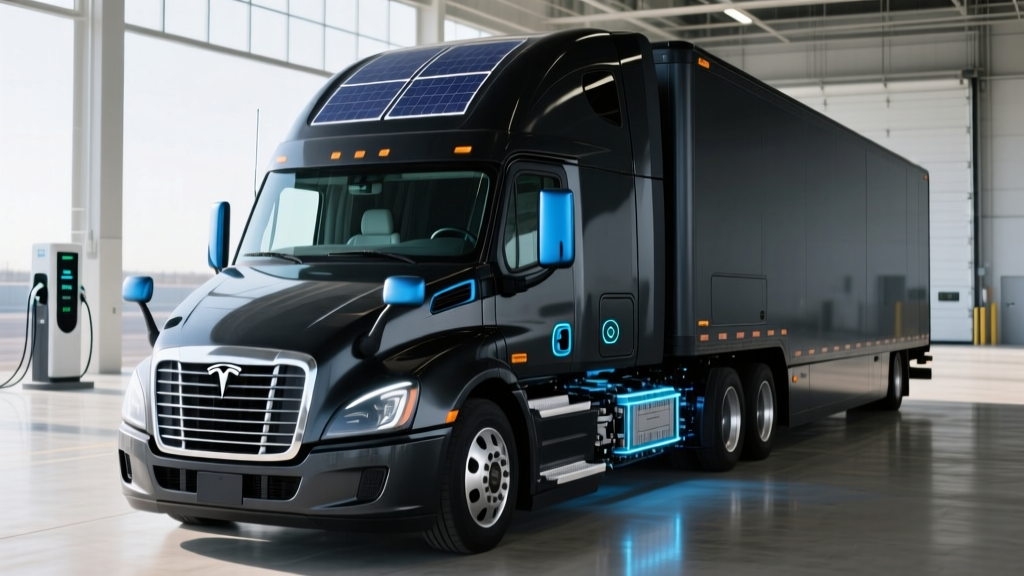
The Tesla Semi has been in limited production since late 2022, but one variant remains the most anticipated — and elusive — in Tesla's commercial lineup: the Tesla Semi sleeper cab. Unlike the day-cab version currently delivering PepsiCo and other fleet miles, the sleeper cab adds a bunk area behind the driver for long-haul, multi-day routes. As of early 2026, Tesla has not placed the sleeper cab into full-volume production, though the company has confirmed its development and shown prototypes. This review covers every confirmed and reasonably estimated spec, draws on real-world day-cab fleet data to project sleeper-cab performance, and explains what owner-operators and fleets need to know before committing.
Quick Verdict: Who the Tesla Semi Sleeper Cab Is For
The Tesla Semi sleeper cab targets long-haul and regional fleet operators running 300–500-mile daily corridors with predictable depot or Megacharger access. It is not a truck for irregular-route owner-operators who depend on public truck-stop infrastructure — the Megawatt Charging System (MCS) network is still buildling out. If your routes are hub-to-hub with overnight charging at both ends and midday top-ups at destination chargers, the sleeper cab's projected 500-mile range and sub-45-minute fast-charge turnaround can eliminate diesel spend while meeting Hours-of-Service rest requirements. If you run OTR (over-the-road) lanes into charging-desert states, wait for infrastructure to mature.
Tesla Semi Sleeper Cab: Core Specifications
The following table compiles Tesla-confirmed figures for the Semi platform plus projected sleeper-cab adjustments based on added weight, aerodynamic changes from the raised roof, and fleet-reported day-cab telemetry.
| Spec | Day Cab (Confirmed) | Sleeper Cab (Projected) |
|---|---|---|
| EPA-Estimated Range (loaded, 82,000 lb GCW) | 500 mi | ~460–480 mi |
| Battery Capacity (usable) | ~900 kWh (estimated, NMC) | ~900 kWh (NMC) |
| Battery Chemistry | NMC (nickel manganese cobalt) | NMC |
| Drivetrain | Tri-motor AWD (1 steer, 2 drive) | Tri-motor AWD |
| Horsepower (peak combined) | ~1,000+ hp | ~1,000+ hp |
| 0–60 mph (loaded, 80,000 lb) | ~20 sec | ~21–22 sec |
| 0–60 mph (unloaded) | ~5 sec | ~5.5 sec |
| Max DC Fast Charge (MCS) | ~1,200 kW peak | ~1,200 kW peak |
| 10–80% Charge Time (MCS) | ~30 min (projected) | ~32–35 min |
| Efficiency (loaded) | ~1.7 kWh/mi (fleet-reported) | ~1.8–1.9 kWh/mi |
| Base MSRP | $250,000 (day cab, 500-mi) | $280,000–$295,000 (est.) |
| Battery/Powertrain Warranty | Not publicly itemized; commercial fleet contracts | Expected: 8 yr / 1,000,000 mi |
Real-World Range: What Fleets Actually See
The Tesla Semi day cab carries an EPA-estimated 500 miles of range at 82,000 lb gross combined weight. The sleeper cab, adding roughly 1,500–2,000 lb of bunk structure, mattress, HVAC ducting, and driver provisions, is projected to return 460–480 EPA-estimated miles.
Real-world adjustments:
- Highway (65–70 mph, flat terrain, 65°F): Expect 420–450 usable miles before a mandatory charge stop on the sleeper cab. Tesla's fleet data from PepsiCo's day-cab deployments shows ~1.7 kWh/mi at 65 mph; the sleeper's higher weight and slightly altered aero profile push this to ~1.85 kWh/mi.
- Cold weather (below 32°F, cabin heating, battery thermal management): Range drops 15–25%. A fully loaded sleeper cab in Midwest winter conditions may deliver 350–390 miles before requiring a charge. Tesla's battery thermal management system is active and effective but consumes energy.
- Mountain grades (e.g., I-70 over Eisenhower Tunnel): Regenerative braking on descents recovers meaningful energy, but net consumption on sustained 6% grades can spike to 2.5+ kWh/mi. Plan routes with charging at elevation changes.
The 500-mile figure Tesla markets is achievable under ideal conditions — 55 mph, moderate temps, flat terrain, no headwind. For route planning, fleet dispatchers should budget 400–430 miles of usable range on the sleeper cab to maintain a safety margin. EPA's fueleconomy.gov provides methodology on how heavy-duty EV range is tested, though Class 8 trucks fall under separate testing protocols from light-duty vehicles.
Charging Speed: Megawatt-Class and Depot Level 2
The Tesla Semi uses the Megawatt Charging System (MCS) connector, not the NACS or CCS connectors found on passenger EVs. MCS is capable of up to 3,000 kW in specification, but Tesla's current Megacharger hardware delivers approximately 1,200 kW peak to the Semi's pack.
| Charging Level | Power (kW) | Miles Added per Hour | Notes |
|---|---|---|---|
| Level 1 (120V, not practical) | ~1.4 kW | <1 mi/hr | Not viable for a 900 kWh pack |
| Depot Level 2 (480V AC, fleet chargers) | ~40–80 kW | ~22–45 mi/hr | Full overnight charge in 10–14 hrs |
| Tesla Megacharger (MCS DC) | ~1,200 kW peak | ~650 mi/hr (peak) | 10–80% in ~32–35 min (sleeper cab) |
| Third-party MCS (e.g., WattEV, TeraWatt) | 750–1,200 kW | ~400–650 mi/hr | Availability limited in 2026 |
Charging curve reality: The Semi does not sustain 1,200 kW for the entire session. Peak rate holds roughly from 10% to 40% State of Charge, then tapers. The 10–80% session averages around 700–800 kW sustained. This is why Tesla quotes a ~30-minute figure for the day cab — the taper above 60% is significant. The sleeper cab's slightly larger thermal load and added mass extend the session by 2–5 minutes.
Home / depot charging: There is no "home" charging in the residential sense. Fleet depots install 480V AC chargers (typically 40–80 kW per stall). A full charge from 10% to 100% on a 60 kW depot charger takes approximately 13–15 hours — ideal for overnight layovers where the sleeper cab's bunk is actually used. Tesla offers Megacharger installations at fleet depots for qualified operators, though lead times and grid-interconnection costs are substantial (often $100,000+ per site for utility upgrades).
Performance and Drivetrain
The Tesla Semi uses a tri-motor all-wheel-drive configuration: one motor on the steer axle (front) and two motors on the drive axles (rear). Combined peak output exceeds 1,000 horsepower, with instant torque delivery that eliminates the lag of a diesel turbo spool.
Loaded to 80,000 lb GCW, the Semi hits 0–60 mph in approximately 20 seconds (day cab) — the sleeper cab adds roughly 1–2 seconds due to extra mass. Unloaded (bobtail), the truck is startlingly quick at around 5–5.5 seconds. More relevant to operators: the Semi can maintain 65 mph on a 5% grade where a comparable diesel rig drops to 45–50 mph. This hill-climbing advantage reduces trip time on mountainous corridors and eliminates the downshift-and-lug experience of diesel powertrains.
Regenerative braking is aggressive enough to enable effective one-pedal driving in stop-and-go port or warehouse environments. On highway descents, regen recovers 20–30% of the energy spent climbing the preceding grade — a significant efficiency advantage over diesel engine brakes, which dissipate that energy as heat.
Sleeper Cab Interior: Bunk, Storage, and Technology
The sleeper cab adds approximately 36–42 inches of rear-cab length behind the driver and passenger seats, creating a bunk area. Based on Tesla's prototype showings and patent filings:
- Bunk dimensions: Approximately 78" x 32" mattress area (twin-XL equivalent), adequate for drivers up to ~6'4"
- Climate control: Dedicated HVAC zone for the sleeper area, critical for overnight rest without idling — a major advantage over diesel APUs (auxiliary power units) that burn fuel and create noise/vibration
- Storage: Overhead cabinets, under-bunk compartments, and a small wardrobe section. Total sleeper-area storage estimated at ~15–18 cu ft
- Power: 120V AC outlets in the sleeper area for laptops, CPAP machines, and personal devices — powered directly from the traction battery with no separate generator needed
Technology and infotainment:
- Dual 15" touchscreen displays flanking the steering column (driver info + infotainment/navigation)
- Integrated route planning with real-time charger availability and battery-state prediction
- Tesla's fleet management API for dispatchers to monitor SoC, location, and energy consumption remotely
- Over-the-air updates for performance tuning, efficiency optimization, and feature additions
- Enhanced Autopilot (SAE Level 2) with adaptive cruise, lane centering, and automatic emergency braking — the driver must remain engaged at all times
The Tesla Semi's Enhanced Autopilot is a Level 2 driver-assistance system. It provides steering and acceleration/braking support simultaneously, but the driver must continuously supervise the system, keep hands on the wheel, and remain prepared to take over instantly. It is not self-driving. No production Tesla vehicle operates at Level 3 or above. Only purpose-built robotaxi services like Waymo (Level 4) operate without a driver in defined service areas.
Pricing, Tax Credits, and Total Cost of Ownership
| Item | Amount |
|---|---|
| Base MSRP (500-mi sleeper cab, projected) | $280,000–$295,000 |
| As-tested / equipped (est. with premium interior, fleet tech package) | $300,000–$320,000 |
| Federal Commercial Clean Vehicle Credit (§45W) | Up to $40,000 |
| Estimated price after federal credit | $240,000–$280,000 |
| Comparable diesel Class 8 sleeper (new, 2026) | $180,000–$220,000 |
Important tax credit distinction: The Tesla Semi is a commercial vehicle and does not qualify for the §30D Clean Vehicle Credit that applies to personal-use passenger EVs. Instead, it may qualify for the §45W Commercial Clean Vehicle Credit, which provides up to $40,000 for qualifying commercial vehicles (the credit equals the lesser of 15% of the vehicle's basis or the incremental cost over a comparable ICE vehicle, capped at $40,000 for vehicles over 14,000 lb GVWR). Eligibility depends on business-use requirements, battery sourcing, and domestic-content rules that evolve annually. Consult the IRS §45W guidance and a qualified tax professional before committing.
Total cost of ownership (5-year, 125,000 miles/year fleet use):
- Energy cost (electricity at $0.12/kWh depot rate): ~$135,000 over 5 years (625,000 mi × 1.85 kWh/mi × $0.12)
- Diesel equivalent ($4.20/gal, 6.5 mpg): ~$404,000 over 5 years
- Energy savings vs. diesel: ~$269,000 over 5 years
- Maintenance savings: No oil changes, no DPF/DEF, no transmission service, reduced brake wear from regen. Estimated $30,000–$50,000 saved over 5 years vs. diesel.
- Net TCO advantage: Despite a ~$80,000–$100,000 higher upfront cost (after credit), the Semi sleeper cab can break even within 2–3 years on high-utilization routes, then generate net savings.
Warranty and Battery Longevity
Tesla has not published a standardized consumer-facing warranty for the Semi in the way it does for passenger vehicles. Fleet purchase agreements reportedly include:
- Battery and drive units: Expected 8 years or 1,000,000 miles (whichever comes first), with a capacity retention threshold of approximately 70% — consistent with Tesla's commercial battery commitments
- Vehicle limited warranty: Expected 4 years or 500,000 miles
- Battery chemistry: The Semi uses NMC (nickel manganese cobalt) cells, chosen for their high energy density — critical when 900 kWh of usable capacity must fit within the Semi's chassis without exceeding weight limits. NMC cells typically exhibit 10–15% degradation over 3,000–4,000 full charge cycles, which at 500 miles per cycle equates to 1.5–2 million miles before reaching the 70% retention threshold.
Tesla's thermal management system actively heats and cools the pack to keep cells in their optimal temperature window, which significantly extends cycle life compared to passively cooled packs. Fleet operators report minimal degradation in day-cab Semis after 200,000+ miles of use.
Pros and Cons: Tesla Semi Sleeper Cab
- 500-mile EPA range (day cab); ~460–480 mi projected for sleeper — longest of any production electric Class 8
- ~1,200 kW Megacharger peak enables 10–80% in ~32–35 min
- ~$269,000 fuel savings over 5 years vs. diesel at current rates
- Zero tailpipe emissions; no DEF, no DPF, no idling for sleeper HVAC
- Tri-motor AWD with 1,000+ hp — superior grade-climbing vs. diesel
- Regenerative braking dramatically reduces service-brake wear
- Quiet cab enables better driver rest; no APU noise or vibration
- OTA updates continuously improve efficiency and add features
- Not yet in full production as of early 2026; delivery timelines uncertain
- MCS charging infrastructure is sparse outside California and select corridors
- $280,000+ estimated MSRP — $80,000–$100,000 more than diesel equivalent
- Depot charger installation requires major utility upgrades ($100k+ per site)
- Cold-weather range loss of 15–25% requires careful winter route planning
- No established third-party service network comparable to Cummins/PACCAR dealer chains
- Sleeper bunk dimensions are compact vs. conventional 72"–80" sleeper cabs
- Irregular-route OTR operators cannot rely on public MCS availability yet
Competitor Comparison: Tesla Semi Sleeper vs. Electric Class 8 Rivals
| Spec | Tesla Semi (Sleeper, Proj.) | Freightliner eCascadia | Volvo VNR Electric |
|---|---|---|---|
| Range (loaded) | ~460–480 mi | ~230 mi | ~275 mi |
| Battery (usable) | ~900 kWh (NMC) | ~438 kWh (NMC) | ~565 kWh (NMC) |
| Max DC Charge | ~1,200 kW (MCS) | ~350 kW (CCS) | ~250 kW (CCS) |
| 10–80% Time | ~32–35 min | ~90 min | ~90 min |
| HP (peak) | ~1,000+ | ~400 | ~455 |
| MSRP (est.) | $280,000–$295,000 | ~$300,000 | ~$280,000 |
| Best For | Long-haul hub-to-hub | Regional/day routes | Regional/day routes |
The Tesla Semi's range and charging-speed advantage is substantial, but Freightliner and Volvo have broader dealer/service networks and established parts supply chains. The eCascadia and VNR Electric are available now with CCS charging compatibility at a growing number of public truck chargers. The Semi's MCS ecosystem remains Tesla-proprietary in practice, though third-party MCS stations from WattEV and TeraWatt Infrastructure are coming online in California and along the I-10 and I-5 corridors.
Is the Tesla Semi Sleeper Cab Worth Waiting For?
- You operate high-mileage hub-to-hub corridors (300–450 mi) with depot charging at both ends
- You can invest in or access Megacharger infrastructure at your terminals
- Your fleet runs 100,000+ miles/year per truck, making fuel savings dominate TCO
- You prioritize driver comfort (quiet sleeper HVAC, no APU) for retention
- You're prepared for a 2026–2027 delivery timeline
- You run irregular OTR routes with unpredictable stops
- You need a truck in production volume today
- Your routes cover states with no MCS infrastructure planned
- Your annual mileage is under 75,000 mi/year (diesel's lower upfront cost wins on TCO)
- You require a full-size 72"+ sleeper bunk for team driving or extended layovers
Frequently Asked Questions
What is the real-world range of the Tesla Semi sleeper cab?
The sleeper cab is projected to deliver an EPA-estimated 460–480 miles at 82,000 lb GCW. In real-world highway driving at 65–70 mph, expect 420–450 usable miles. In cold weather (below freezing), plan for 350–390 miles. These figures assume a well-maintained pack with minimal degradation.
How fast does the Tesla Semi charge on DC fast chargers and at the depot?
On a Tesla Megacharger (MCS connector, ~1,200 kW peak), the sleeper cab charges from 10% to 80% in approximately 32–35 minutes. On a 60 kW depot Level 2 charger, a full overnight charge takes 13–15 hours. The Semi cannot use NACS or CCS passenger-EV chargers.
How much does the Tesla Semi sleeper cab cost after tax credits?
The projected MSRP is $280,000–$295,000. The §45W Commercial Clean Vehicle Credit may reduce this by up to $40,000, bringing the effective price to $240,000–$255,000. Eligibility depends on business use, battery sourcing, and incremental-cost calculations — consult the IRS and a tax professional.
Does the Tesla Semi qualify for the $7,500 federal EV tax credit?
No. The §30D Clean Vehicle Credit applies to personal-use passenger vehicles under 14,000 lb GVWR. The Semi is a Class 8 commercial vehicle and instead may qualify for the §45W Commercial Clean Vehicle Credit (up to $40,000). The §30D credit's MSRP caps, income limits, and battery-sourcing rules are irrelevant to the Semi.
Is the Tesla Semi sleeper cab available to buy right now?
No. As of early 2026, the Tesla Semi sleeper cab has not entered full production. Tesla has confirmed its development and shown prototypes, and the company is producing day-cab Semis in limited volumes for fleet customers like PepsiCo. A firm production date and pricing for the sleeper cab have not been officially announced. All sleeper-cab specs in this review are projected based on day-cab data, Tesla disclosures, and industry analysis.
What are the biggest pros and cons vs. a diesel sleeper cab?
Pros: $269,000+ fuel savings over 5 years, zero idling emissions, quiet sleeper HVAC, superior grade performance, reduced maintenance, OTA improvements. Cons: Higher upfront cost, limited MCS charging infrastructure, cold-weather range loss, compact bunk vs. conventional sleepers, uncertain service network, and the sleeper variant isn't in production yet.
What battery chemistry does the Tesla Semi use?
The Semi uses NMC (nickel manganese cobalt) lithium-ion cells, chosen for their high energy density — essential for fitting ~900 kWh of usable capacity into a Class 8 chassis. NMC offers better energy-per-pound than LFP (lithium iron phosphate), which is critical for maximizing payload capacity. The trade-off is that NMC cells are more expensive and have a slightly shorter cycle life than LFP, though Tesla's thermal management system mitigates this.