The Tesla Semi RV Question: What Buyers Actually Want to Know
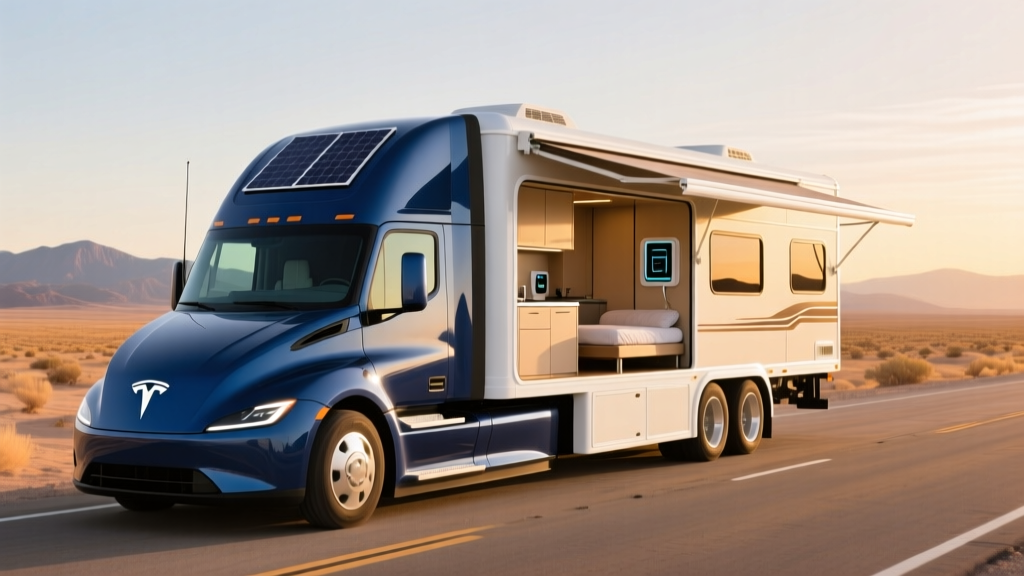
Search forums, Reddit threads, and RV Facebook groups and you will find a persistent fantasy: converting the Tesla Semi into a luxury electric motorhome. The appeal is obvious. A massive battery pack, torque-rich tri-motor drivetrain, and a cab designed for long-haul comfort seem tailor-made for the RV lifestyle. But the Tesla Semi RV remains a concept born entirely from enthusiast imagination — Tesla has never announced, previewed, or hinted at a factory-built recreational vehicle based on the Semi platform.
This article breaks down what the Tesla Semi actually offers as of its 2026 production status, what an RV conversion would realistically involve, and whether the math works for anyone considering this path. We will cover the hard specs — range, charging, battery chemistry, pricing — and then layer on the RV-specific realities that separate internet daydreams from drivable reality.
Tesla Semi Specs: The Platform Underneath the Dream
Before evaluating RV conversion feasibility, we need the actual Tesla Semi specifications as published by Tesla and observed in fleet operations. These numbers define what any motorhome builder would start with.
| Specification | Tesla Semi (300-mi variant) | Tesla Semi (500-mi variant) |
|---|---|---|
| EPA Estimated Range | ~300 miles (loaded, 80,000 lb GCW) | ~500 miles (loaded, 80,000 lb GCW) |
| Battery Capacity (est.) | ~500 kWh usable (NMC) | ~800-900 kWh usable (NMC) |
| Drivetrain | Tri-motor AWD (1 steer, 2 drive) | Tri-motor AWD (1 steer, 2 drive) |
| Horsepower | ~1,000+ hp (combined peak) | ~1,000+ hp (combined peak) |
| 0-60 mph (loaded) | ~20 seconds (80,000 lb GCW) | ~20 seconds (80,000 lb GCW) |
| 0-60 mph (unloaded) | ~5 seconds (bobtail) | ~5 seconds (bobtail) |
| Max DC Fast Charge | ~1,000 kW (Megacharger) | ~1,200 kW (Megacharger) |
| Charge Time (est.) | ~30 min for 70% (~210 mi) | ~30 min for 70% (~350 mi) |
| Efficiency | ~1.7 kWh/mile (loaded) | ~1.7 kWh/mile (loaded) |
| Base MSRP (announced) | $250,000 | $290,000 |
| Battery Warranty | Not publicly disclosed (fleet contracts) | Not publicly disclosed (fleet contracts) |
Tesla has not published formal EPA range stickers or detailed battery chemistry disclosures for the Semi as it has for consumer vehicles. The figures above are derived from Tesla's announced specifications, Tesla's Semi product page, and fleet operator reports. The battery chemistry is believed to be nickel-manganese-cobalt (NMC) given the energy-density requirements of a long-range Class 8 truck — LFP would be too heavy for this application.
Charging the Tesla Semi: Megachargers vs. Public Infrastructure
This is where the Tesla Semi RV concept hits its biggest practical wall. The Semi was designed around Tesla's proprietary Megacharger network — high-power DC fast chargers capable of delivering up to 1,200 kW. These are not the same as Superchargers (which peak at 250-350 kW for consumer vehicles).
| Charging Method | Power (kW) | Miles Added per Hour | Practical Availability |
|---|---|---|---|
| Tesla Megacharger (DC) | ~1,000-1,200 kW | ~600-700 mi/hr | Extremely limited; fleet depots only |
| CCS1 DC Fast Charger | ~350 kW (max public) | ~200 mi/hr | Growing but requires adapter; most stations 50-150 kW |
| Level 2 (240V/80A) | ~19.2 kW | ~11 mi/hr | Home/commercial; full charge takes 40+ hours |
| Level 1 (120V/15A) | ~1.8 kW | ~1 mi/hr | Effectively useless for a 900 kWh battery |
The charging math is sobering for RV use. A 900 kWh battery charged at a typical public 150 kW DC fast charger would take roughly 5-6 hours to go from 10-80%. At a 350 kW CCS station (the fastest widely available public chargers from networks like Electrify America), you are still looking at 2-3 hours. Tesla's Megachargers solve this, but as of 2026, they exist almost exclusively at fleet customer depots — not at campgrounds, RV parks, or highway rest stops.
Home Level 2 charging is technically possible but practically challenging. A 19.2 kW Level 2 charger (the fastest residential units available) would add roughly 11 miles of range per hour, meaning a full charge from empty would take over 40 hours. Most RV owners who boondock or stay at parks without 480V three-phase power would find daily charging logistics a serious constraint.
The RV Conversion Reality: Coachbuilders, Weight, and Living Space
Traditional diesel pusher motorhomes are built on bare chassis from manufacturers like Freightliner, Spartan, or Volvo. A coachbuilder (Newmar, Tiffin, Airstream, Winnebago) then constructs the living quarters on top. The Tesla Semi could theoretically follow this model — but several engineering challenges make it far from straightforward.
Weight and Payload Constraints
A Class 8 truck has a gross vehicle weight rating (GVWR) that must accommodate the tractor, the coach body, water (fresh, gray, black tanks can total 200+ gallons at 8.34 lb/gallon), propane, furnishings, and personal cargo. The Tesla Semi's battery pack alone is estimated to weigh 8,000-10,000 lb for the 500-mile variant. That massive battery mass eats directly into the payload budget that a motorhome coach requires.
For comparison, a typical 40-foot diesel pusher motorhome has a coach body weight of 15,000-20,000 lb and carries 2,000-3,000 lb of cargo. The Semi's electric drivetrain saves weight versus a diesel engine and transmission, but the battery more than offsets those savings.
Interior Space and Cab Design
The Tesla Semi's cab is designed for a single driver (with a jump seat) and features a centered driving position with dual touchscreen displays. The cab is notably spacious for a semi-truck — Tesla emphasizes stand-up height and a flat floor — but it is not designed as a living space. Any RV conversion would need to:
- Extend or replace the cab with a full motorhome coach body behind the driver
- Integrate climate control for a 300-400 sq ft living area (the Semi's HVAC is designed for cab-only heating/cooling)
- Add plumbing systems, a generator or inverter system for 120V AC appliances, and shore-power connectivity
- Ensure the battery thermal management system operates correctly with a modified body
No third-party coachbuilder has announced a Tesla Semi-based motorhome as of 2026. Companies like Thor Industries (which owns Airstream) and Winnebago have invested in electric RV platforms, but these are based on lighter commercial chassis like the Ford E-Transit or Mercedes eSprinter — not Class 8 trucks.
Pricing and Tax Credit Eligibility
Let's talk numbers — and why the Tesla Semi RV is more fantasy than financial reality for individual buyers.
| Cost Component | Estimated Price |
|---|---|
| Tesla Semi 500-mile (chassis) | $290,000 (announced MSRP) |
| RV coach conversion (custom, 40-ft) | $300,000 - $600,000+ |
| Total estimated build cost | $590,000 - $890,000+ |
| Federal §30D tax credit | Not eligible (see below) |
| Commercial Clean Vehicle Credit (§45W) | Up to $40,000 for qualifying commercial vehicles |
Federal Tax Credit: Why §30D Does Not Apply
The IRS §30D Clean Vehicle Credit is designed for light-duty consumer vehicles. It has strict requirements that disqualify the Tesla Semi entirely:
- GVWR cap: §30D applies to vehicles under 14,000 lb GVWR. The Tesla Semi has a GVWR well over 33,000 lb (Class 8).
- MSRP cap: Vans/SUVs/trucks are capped at $80,000 MSRP. The Semi starts at $250,000-$290,000.
- Buyer income cap: Modified adjusted gross income limits ($150K single / $300K joint) are irrelevant here since the vehicle fails the weight and price tests.
- Personal use requirement: §30D requires the vehicle be for personal use, not commercial — and the Semi is sold only to fleet/commercial buyers.
The §45W Commercial Clean Vehicle Credit could apply if the Semi were purchased for a qualifying business use, offering up to $40,000 for vehicles over 14,000 lb GVWR. But this credit requires the vehicle be used in a trade or business — not as a personal RV. Consult a tax professional for your specific situation.
Tesla Semi RV vs. Real Electric RV Alternatives
For buyers genuinely interested in electric RV living, several platforms are actually available or in advanced development as of 2026:
Best Available: Winnebago e-RV (eTransit chassis)
- Range: ~108 miles (EPA, Ford E-Transit platform)
- Battery: 68 kWh (NMC)
- Length: 22 feet
- Price: ~$125,000
- Best for: Weekend trips, campground-hopping with shore power
Best Concept: Lightship L1 (electric travel trailer)
- Range impact: Near-zero (aerodynamic design, solar roof)
- Battery: 80 kWh (propulsion assist)
- Length: 25 feet
- Price: ~$125,000 (announced)
- Best for: EV owners who want to tow without range destruction
Neither of these matches the Tesla Semi RV fantasy of 500-mile range and luxury living, but they are real products you can buy or reserve. The Winnebago e-RV's 108-mile range is limiting, but it can charge at any CCS public station and plugs into standard RV park shore power. The Lightship L1 is a trailer, so it works with any EV you already own.
Who Would Actually Want a Tesla Semi RV?
Even setting aside the massive cost and the fact that no conversion currently exists, the use case for a Tesla Semi RV is narrow:
Choose the Tesla Semi RV concept if:
- You operate a commercial fleet and want a mobile office/showpiece
- You have $600K+ to spend on a custom one-off build
- You primarily travel routes with confirmed Megacharger access
- You need Class 8 towing capacity alongside living quarters
Choose an existing electric RV or PHEV motorhome if:
- You want to actually buy and drive something this year
- Your budget is under $200,000
- You need campground compatibility (30A/50A shore power)
- You travel routes without confirmed high-power DC charging
- You want manufacturer warranty support and service infrastructure
The Biggest Pros and Cons of a Tesla Semi RV
Pros (in theory)
- Massive 800-900 kWh battery could power a motorhome for days off-grid (V2H/V2L capability)
- 500-mile range dwarfs any existing electric RV
- 1,000+ hp means confident mountain-pass climbing even fully loaded
- Regenerative braking reduces brake wear on long descents
- Tesla's over-the-air updates and Autopilot (SAE Level 2) for highway cruising
- Near-zero operating emissions at the tailpipe
- Quiet operation — no diesel vibration or noise at camp
Cons (in reality)
- Not available for individual purchase — fleet sales only as of 2026
- No factory RV variant exists; no coachbuilder has announced one
- $590K-$890K+ estimated total build cost
- Megacharger network is not publicly accessible for RV travelers
- Level 2 home charging takes 40+ hours for a full charge
- No §30D tax credit eligibility (weight, price, and commercial-use exclusions)
- Battery replacement cost could exceed $100,000-$150,000 out of warranty
- Insurance for a custom one-off conversion would be extremely expensive
- Campground infrastructure (shore power, site size) not designed for Class 8 vehicles
- Cold-weather range loss of 30-40% on a 900 kWh battery means 100+ lost miles
Frequently Asked Questions
Can I buy a Tesla Semi as an individual in 2026?
No. Tesla is currently selling the Semi exclusively to commercial fleet customers like PepsiCo, Frito-Lay, and Sysco. There is no individual consumer ordering pathway, and Tesla has not announced plans to change this. Even fleet customers have faced multi-year waitlists and limited production volumes.
What is the real-world range of the Tesla Semi in an RV configuration?
Tesla claims 500 miles at 80,000 lb gross combination weight. An RV conversion with a coach body, water, furnishings, and cargo would likely reduce that to 350-450 miles in ideal conditions and 250-350 miles in cold weather or mountainous terrain. The boxy aerodynamic profile of a motorhome body is significantly worse than a streamlined tractor-trailer, further reducing efficiency.
How fast does the Tesla Semi charge?
On a Tesla Megacharger (~1,000-1,200 kW), the Semi can reportedly recover 70% of range in about 30 minutes. However, Megachargers are only available at select fleet depots. On a public 350 kW CCS charger (the fastest widely available), expect 2-3 hours for a 10-80% charge on the 500-mile variant. On a home Level 2 charger at 19.2 kW, a full charge takes over 40 hours.
Does the Tesla Semi qualify for the federal EV tax credit?
Not the §30D consumer credit. The Semi exceeds the 14,000 lb GVWR limit, the $80,000 MSRP cap, and is not sold for personal use. The §45W Commercial Clean Vehicle Credit may provide up to $40,000 for qualifying business purchases. Always verify current-year rules with the IRS and a qualified tax professional.
Has any company built a Tesla Semi RV or motorhome conversion?
No. As of early 2026, no coachbuilder or third-party converter has announced or completed a Tesla Semi motorhome conversion. The Semi's limited production volume, proprietary charging connector, and commercial-only sales model make it an impractical platform for the RV aftermarket.
What is the best electric RV I can actually buy today?
The Winnebago e-RV (built on the Ford E-Transit chassis) is the most widely available electric motorhome, with ~108 miles of range and a price around $125,000. For longer trips, the Lightship L1 electric travel trailer (announced, entering production) offers near-zero range impact when towed by an EV. For extended off-grid travel, a diesel or PHEV motorhome remains more practical given current charging infrastructure.
Could Tesla ever make a factory Semi RV?
It is extremely unlikely. Tesla's strategy with the Semi is squarely focused on commercial freight — displacing diesel Class 8 trucks in fleet duty cycles. The RV market is low-volume, highly customized, and requires a dealer/service network that Tesla does not operate for motorhomes. If Tesla ever enters the recreational space, a smaller platform (perhaps based on the Cybertruck or a future van) would be far more likely than a Semi-based motorhome.
The Verdict: A Great Idea That Is Not Real
The Tesla Semi RV is a compelling thought experiment. A 900 kWh battery, 500-mile range, and 1,000+ horsepower would make it the most capable electric motorhome ever conceived. But as of 2026, it remains exactly that — a concept that exists only in forum threads and render artists' portfolios.
The barriers are not just technical. Tesla will not sell you a Semi. No coachbuilder will convert one. The Megacharger network is not open to RV travelers. The cost would approach $1 million for a finished build. And the §30D tax credit that makes consumer EVs affordable does not apply.
If electric RV travel is your goal, the Winnebago e-RV, the upcoming Lightship L1, or a PHEV motorhome (like those based on the Ford E-450 chassis with range-extender capability) are real options you can research, buy, and drive today. They lack the Tesla Semi's headline-grabbing specs, but they offer something more valuable: the ability to actually go camping this summer.