What Is the Tesla Semi in 2026?
The Tesla Semi is a Class 8 battery-electric semi-truck designed for regional and long-haul freight. First unveiled in 2017, it entered limited production in late 2022 at a dedicated facility near the Gigafactory in Sparks, Nevada. As of 2026, the Semi remains a low-volume, fleet-focused product — not a truck you can walk into a dealership and buy as an individual. Tesla has prioritized reservations from large fleet operators like PepsiCo, DHL, and Schneider National, with volume production timelines repeatedly pushed back.
This review examines the Semi's real-world specs as they stand today, separating Tesla's initial claims from what fleet operators have actually experienced on the road.
Specs at a Glance: Tesla Semi (2026 Production Model)
| Specification | 300-Mile Variant | 500-Mile Variant |
|---|---|---|
| EPA Estimated Range | ~300 mi (loaded) | ~500 mi (loaded) |
| Battery Capacity (estimated) | ~500 kWh (NMC/NCA) | ~900 kWh (NMC/NCA) |
| Drivetrain | Tri-motor AWD (1 steer, 2 drive) | Tri-motor AWD (1 steer, 2 drive) |
| Horsepower | ~1,000+ hp (combined) | ~1,000+ hp (combined) |
| 0-60 mph (loaded, 80,000 lbs GCW) | ~20 sec | ~20 sec |
| 0-60 mph (unloaded) | ~5 sec | ~5 sec |
| Max DC Charge Rate | ~1.2 MW (Megacharger) | ~1.2 MW (Megacharger) |
| Energy Efficiency | ~1.7 kWh/mi (loaded) | ~1.7 kWh/mi (loaded) |
| Base MSRP | $150,000 | $180,000 |
| Founders Series Price | $250,000 (limited run) | $250,000 (limited run) |
| Battery/Drivetrain Warranty | TBD (est. 1 million mi) | TBD (est. 1 million mi) |
Note: Tesla has not published a full EPA certification for the Semi. Range and battery figures above are derived from Tesla's claims, fleet operator reports, and independent teardown analyses. Battery chemistry is nickel-based (NMC or NCA), not LFP, due to the energy-density requirements of a Class 8 truck.
Range: What Fleet Operators Actually Report
The 300-mile variant, which carries a smaller battery pack, has proven closer to its sticker claim in real-world use, with operators reporting 250–290 miles under loaded conditions. This variant suits depot-to-depot regional routes where predictable mileage allows precise charging scheduling.
Efficiency is the Semi's standout metric. At approximately 1.7 kWh per mile (loaded), it consumes less than half the energy cost-per-mile of a diesel Class 8 truck. For a fleet running 100,000 miles annually, that translates to roughly 170,000 kWh per year — at an average commercial electricity rate of $0.12/kWh, that's about $20,400 in energy costs versus $45,000+ in diesel fuel at current prices.
Charging: Megacharger Infrastructure and Real-World Speeds
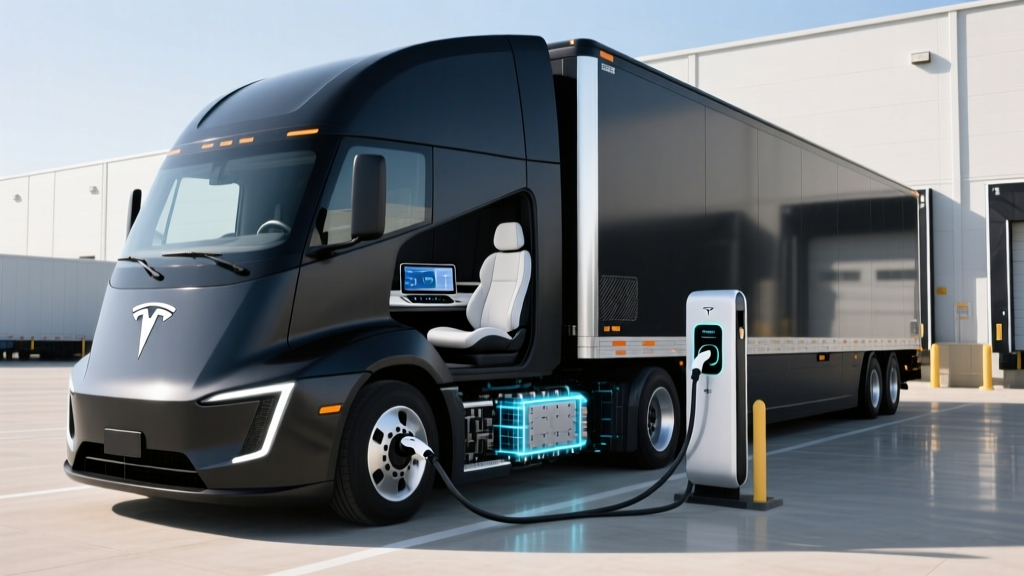
The Tesla Semi requires Tesla's proprietary Megacharger network, which delivers up to 1.2 MW (1,200 kW) of DC fast-charging power. This is roughly 3–4 times the power of the fastest passenger-vehicle Superchargers (which peak around 350 kW for V4 stalls).
| Charging Method | Power (kW) | Estimated Time / Rate |
|---|---|---|
| Tesla Megacharger (DC) | Up to 1,200 kW | ~600 mi range in 30 min (claimed); real-world 10–80% in ~40–50 min |
| CCS2 / MCS Adapter (where available) | Up to 600 kW | 10–80% in ~80–100 min (varies by station) |
| Depot Level 2 (AC, per operator setup) | 40–80 kW (fleet depot) | Full charge overnight (10–14 hours) |
Charging-curve reality: The 1.2 MW peak is not sustained across the full session. Like all lithium-ion packs, the Semi's charge rate tapers significantly above 80% State of Charge (SoC). Fleet operators scheduling tight turnaround windows should plan for 10–80% charges (the practical fast-charge window) rather than full 100% fills. A typical depot strategy involves overnight AC charging to 100% and midday Megacharger top-ups from 20–80% during driver breaks.
The Megacharger network remains extremely limited as of 2026 — concentrated near Tesla's Nevada production facility, select PepsiCo and DHL hubs, and a handful of California freight corridors. This is the Semi's single biggest infrastructure constraint: without depot-installed Megachargers (costing $200,000–$500,000+ per site including grid upgrades), the truck cannot operate at its designed turnaround speed.
Performance, Drivetrain, and the Cab Experience
The Semi uses a tri-motor configuration: one motor on the steer axle and two on the drive axle. Combined output exceeds 1,000 horsepower, giving it a 0–60 mph time of approximately 20 seconds at full 80,000-lb gross combination weight — remarkable for a loaded Class 8. Unloaded, the Semi reportedly hits 60 mph in around 5 seconds.
Regenerative braking is aggressive and well-calibrated for heavy loads, allowing significant one-pedal driving in stop-and-go port or warehouse environments. The low center of gravity (battery pack mounted along the frame rails) reduces rollover risk compared to diesel counterparts.
Inside the cab: The Semi features a centered driver seat position (unconventional for North American trucks) flanked by two large touchscreen displays — one for navigation/telematics and one for vehicle controls/camera feeds. The cab is a day-cab configuration; there is no sleeper berth, which limits the Semi to regional hauls or team-driving relay routes rather than traditional over-the-road (OTR) long-haul operations. Cargo space is irrelevant in the traditional sense (the Semi pulls standard 53-foot trailers), but the cab offers storage compartments and a relatively flat floor thanks to the absence of a transmission tunnel.
Driver Assistance: Autopilot for Trucks
Tesla's camera-only vision approach (no LiDAR) has drawn scrutiny in the trucking sector, where longer stopping distances and larger blind spots make sensor redundancy especially valuable. Fleet safety managers should treat Autopilot as a fatigue-reduction aid, not a driver replacement.
Pricing, Tax Credits, and Fleet Economics
| Cost Factor | 300-Mile Variant | 500-Mile Variant |
|---|---|---|
| Base MSRP | $150,000 | $180,000 |
| Federal Commercial Clean Vehicle Credit (§45W) | Up to $40,000 | Up to $40,000 |
| Estimated Post-Credit Price | ~$110,000 | ~$140,000 |
| Estimated Annual Fuel Savings vs. Diesel | ~$25,000–$30,000/yr | ~$25,000–$30,000/yr |
| Estimated Maintenance Savings vs. Diesel | ~$8,000–$12,000/yr | ~$8,000–$12,000/yr |
Tax credit clarification: The Tesla Semi does not qualify for the consumer §30D clean vehicle credit (that credit applies to light-duty passenger vehicles with MSRP and buyer income caps). Instead, commercial fleets may be eligible for the §45W Commercial Clean Vehicle Credit, which provides up to $40,000 for qualifying heavy-duty electric trucks. Eligibility depends on battery sourcing requirements, manufacturer certification, and the fleet's tax situation. Consult a tax professional and review current IRS guidance on §45W before purchasing.
Additional incentives may be available through state programs — California's Hybrid and Zero-Emission Truck and Bus Voucher Incentive Project (HVIP), for example, has offered vouchers of $75,000–$120,000+ per Class 8 BEV. These vary by jurisdiction and funding availability; check official state sources.
Competitive Landscape: Semi vs. Class 8 Alternatives
| Truck | Range (loaded) | Max Charge Rate | MSRP (approx.) | Availability |
|---|---|---|---|---|
| Tesla Semi (500 mi) | ~350–420 mi real-world | 1.2 MW (Megacharger) | $180,000 | Limited fleet allocation |
| Freightliner eCascadia | ~230 mi | ~250 kW (CCS) | ~$300,000+ | Widely available |
| Volvo VNR Electric | ~275 mi (6-battery) | ~250 kW (CCS) | ~$280,000+ | Widely available |
| Peterbilt 579EV | ~150 mi | ~150 kW (CCS) | ~$250,000+ | Available (regional) |
The Semi's range and energy efficiency are best-in-class among production electric semi-trucks. However, the Freightliner eCascadia and Volvo VNR Electric are available in significantly higher volumes, use the standardized CCS connector (meaning broader public charging compatibility), and come backed by established dealer/service networks with decades of heavy-duty truck support.
Tesla's Megacharger dependency is both an advantage and a risk: the 1.2 MW charge speed is unmatched, but the proprietary connector and near-zero public Megacharger availability mean fleets must invest heavily in depot infrastructure. A fleet that can install Megachargers and run predictable routes will extract maximum value; one relying on public infrastructure will find the Semi impractical today.
Pros, Cons, and Who Should Consider the Semi
- Best-in-class energy efficiency (~1.7 kWh/mi)
- Unmatched DC charge speed (1.2 MW Megacharger)
- Lowest per-mile operating cost in Class 8 EVs
- Strong regenerative braking for port/warehouse duty cycles
- Over-the-air updates and Tesla telematics integration
- Extremely limited production — long reservation wait
- Megacharger infrastructure nearly non-existent publicly
- No sleeper cab — regional use only
- Limited service network vs. legacy truck OEMs
- Battery replacement cost unknown (est. $100,000–$200,000+)
- Real-world range 15–25% below Tesla's 500-mi claim
Who the Tesla Semi suits best: Large fleet operators running predictable regional routes (150–350 miles round-trip), with depot-based charging infrastructure and the capital to install Megachargers. Think beverage distribution, port drayage, and regional parcel delivery. It is not suited for over-the-road long-haul, owner-operators, or fleets without dedicated charging depots.
Frequently Asked Questions
What is the real-world range of the Tesla Semi?
The 500-mile variant delivers approximately 350–420 miles under typical loaded regional driving. The 300-mile variant achieves roughly 250–290 miles. Cold weather reduces these figures by 15–25%.
How fast does the Tesla Semi charge?
On a Tesla Megacharger (up to 1.2 MW DC), the Semi can recover significant range in 30–40 minutes (10–80% SoC). Overnight depot AC charging at 40–80 kW takes 10–14 hours for a full charge. The 1.2 MW peak rate tapers above 80% SoC.
Does the Tesla Semi qualify for a federal tax credit?
Not the consumer §30D credit. Fleets may qualify for the §45W Commercial Clean Vehicle Credit (up to $40,000 per vehicle), subject to battery sourcing, manufacturer, and tax-liability requirements. State incentives (e.g., California HVIP) can add $75,000–$120,000+.
Is the Tesla Semi worth buying vs. the Freightliner eCascadia or Volvo VNR Electric?
If your fleet operates predictable regional routes and can invest in depot Megachargers, the Semi offers the lowest per-mile energy cost and longest range in its class. If you need broad dealer support, CCS public-charging compatibility, or immediate availability, the eCascadia or VNR Electric are more practical today.
Can I buy a Tesla Semi as an individual owner-operator?
Not realistically. As of 2026, Tesla allocates Semi production to fleet reservation holders. Individual purchase is not currently supported through standard channels.
What is the battery warranty on the Tesla Semi?
Tesla has not published official warranty terms for the Semi's battery pack. Elon Musk previously stated the drivetrain is designed for a "million-mile" life, but formal warranty documentation (years/miles, capacity-retention threshold) has not been publicly released as of this writing.