The Case for Three Rows in a Tesla: Model Y vs. Model X
Search "Tesla seating for 7" and you will find two very different answers. Tesla currently offers third-row seats in both the Model Y (a compact crossover) and the Model X (a midsize luxury SUV). But equating the two based solely on seat count is a mistake. The Model Y's third row is a child-sized occasional perch; the Model X's third row accommodates adults on longer trips. For families weighing a 2026 purchase, the distinction matters enormously — not just for passenger comfort, but for range, charging speed, cargo capacity, and a price gap that exceeds $40,000.
This review breaks down both vehicles across every metric that matters to a three-row EV buyer: real-world range, charging curves, interior dimensions, performance, and the current federal tax credit landscape under IRS §30D rules.
Spec Snapshot: 2026 Model Y vs. Model X (7-Seat Configurations)
| Spec | 2026 Model Y Long Range AWD (7-seat) | 2026 Model X Long Range AWD (6-seat / optional 7) |
|---|---|---|
| Base MSRP | $52,490 | $94,990 |
| 7-Seat Option Cost | +$2,500 | Included (7-seat std; 6-seat no-cost) |
| EPA Range | 310 miles (est. w/ 7-seat) | 335 miles |
| Battery (usable) | ~75 kWh, NMC | ~100 kWh, NMC |
| Max DC Fast Charge | 250 kW (peak) | 250 kW (peak) |
| 10–80% DCFC Time | ~27 min | ~30 min |
| Level 2 Rate | 11.5 kW (~44 mi/hr) | 11.5 kW (~36 mi/hr) |
| 0–60 mph | 4.8 sec | 3.8 sec |
| Horsepower | 384 hp (dual motor) | 670 hp (dual motor) |
| MPGe (combined) | 117 MPGe | 102 MPGe |
| Cargo (behind 3rd row) | 12.8 cu ft | ~15 cu ft (est.) |
| Cargo (all rows folded) | 72.1 cu ft | 83.1 cu ft |
| Battery Warranty | 8 yr / 120,000 mi | 8 yr / 150,000 mi |
Sources: fueleconomy.gov, Tesla Model X specs, Tesla Model Y specs. Range and pricing reflect current 2026 model-year data at time of publication.
Real-World Range: What the EPA Sticker Doesn't Tell You
Model Y Long Range AWD (7-seat): EPA 310 miles. Expect ~265–280 miles on sustained highway driving at 70–75 mph. In freezing temperatures (below 32°F), plan for 220–240 miles usable range.
Model X Long Range AWD: EPA 335 miles. Expect ~280–300 miles highway. Cold-weather reduction brings this to roughly 240–260 miles.
The Model X carries a ~100 kWh NMC (nickel manganese cobalt) pack — roughly 25% more energy than the Model Y's ~75 kWh NMC battery. Both use NMC chemistry rather than LFP (lithium iron phosphate), which Tesla reserves for its Standard Range RWD models. NMC offers higher energy density, critical for maintaining range in a heavy, three-row vehicle, but requires more careful charging habits: Tesla recommends daily charging to 80% for NMC packs, reserving 100% for trips.
The Model Y's smaller battery and lighter curb weight (~4,400 lbs vs. ~5,100 lbs for the X) translate to better efficiency — 117 MPGe combined vs. 102 MPGe. If your daily commute is under 60 miles and you charge at home nightly, both vehicles offer more than enough buffer. But for road-trip-heavy families, the Model X's larger battery means fewer charging stops on 400+ mile drives.
Charging Speed and Infrastructure Access
| Charging Method | Model Y Long Range | Model X Long Range |
|---|---|---|
| Level 1 (120V, 12A) | ~1 kW / 4 mi/hr | ~1 kW / 3 mi/hr |
| Level 2 (240V, 48A) | 11.5 kW / ~44 mi/hr | 11.5 kW / ~36 mi/hr |
| DC Fast Charge (peak) | 250 kW | 250 kW |
| 10–80% DCFC | ~27 minutes | ~30 minutes |
| Connector (2026) | NACS (native) | NACS (native) |
| Supercharger Access | Full network | Full network |
Both vehicles peak at 250 kW on V3 Superchargers, but the charge curve tells the real story. The Model Y sustains its peak rate from roughly 10% to 45% SoC before tapering. The Model X, with its larger battery, sustains high charge rates longer (to roughly 50–55% SoC) because 250 kW represents a lower C-rate against 100 kWh. In practice, both add roughly 170–200 miles in a 15-minute stop — enough for a bathroom break and coffee.
For home charging, a 48-amp Level 2 wall connector on a 60-amp circuit is ideal for both. The Model Y replenishes its smaller battery in roughly 7 hours from 10% to 80%; the Model X needs about 9 hours. If your electrical panel is maxed out at 100 amps, a 32-amp Level 2 (7.7 kW) still delivers ~30 miles of range per hour for the Y — sufficient for most overnight top-ups. Always consult a licensed electrician for final installation specs; panel upgrades can add $1,500–$3,000 to your installation budget.
Interior Space: The Third-Row Reality Check
Here is where the "Tesla seating for 7" question gets nuanced. The Model Y's third row offers 26.5 inches of legroom — adequate for children up to roughly age 10 on short trips. Adults will find knees pressed into the second-row seatbacks and headroom compromised by the sloping roofline. Behind the third row, you get just 12.8 cubic feet of cargo space — enough for two carry-on bags or a week of groceries, but not both simultaneously.
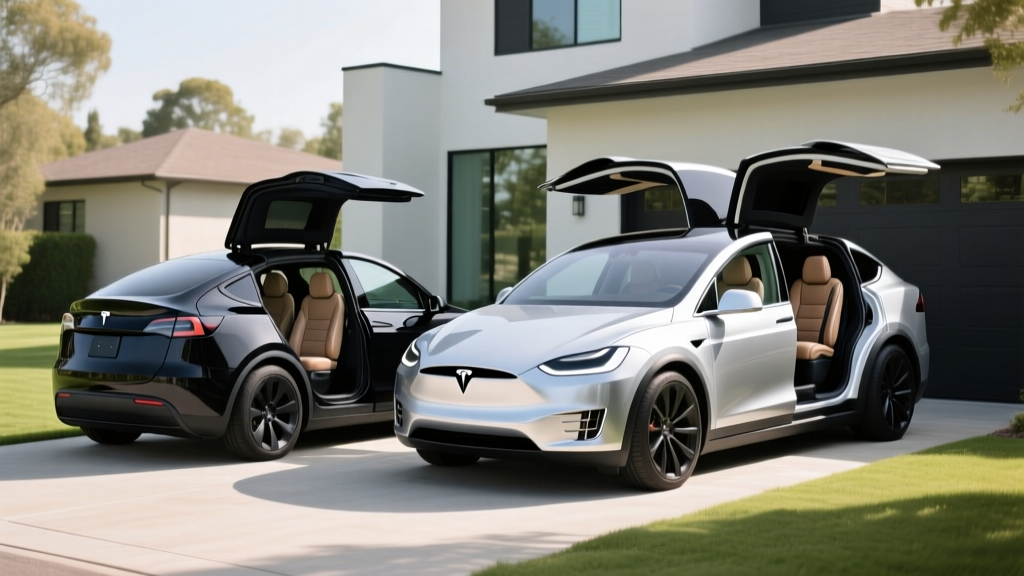
The Model X is a fundamentally different proposition. Its third row provides approximately 32 inches of legroom, making it viable for teenagers and adults on multi-hour drives. The falcon-wing rear doors (now in their third generation with improved seals and sensors) create a dramatically wide opening that makes loading children into car seats far easier than any conventional SUV door. Behind the third row, cargo volume increases to roughly 15 cubic feet, and with all rows folded flat, the Model X swallows 83.1 cubic feet — rivaling full-size SUVs.
Second-row configuration matters: The Model X offers either a 6-seat layout (two captain's chairs with a center walk-through to the third row) or a 7-seat bench configuration. The 6-seat layout sacrifices one seat but dramatically improves third-row access and second-row comfort. For most families with older children, 6 seats plus the walk-through is the more practical choice.
Performance, Ride Quality, and Towing
Neither three-row Tesla is slow, but the performance gap is substantial. The Model X Long Range's dual-motor AWD powertrain produces 670 horsepower and rockets to 60 mph in 3.8 seconds — absurd for a 5,100-pound family hauler. The Model Y Long Range makes 384 hp and hits 60 in 4.8 seconds, which is still quicker than most gas-powered crossovers in its class.
Ride quality diverges more noticeably. The Model X features adaptive air suspension that adjusts ride height between 5.3 and 8.1 inches of ground clearance — useful for snow, rough driveways, or highway efficiency (it lowers automatically at speed). The Model Y uses a conventional coil-spring setup. Tesla revised the Model Y's suspension tuning for 2025–2026 (the "Juniper" refresh), significantly improving ride compliance over earlier models, but it still transmits more road imperfections than the air-suspended X.
Towing capacity: The Model X is rated for 5,000 lbs; the Model Y for 3,500 lbs. If you are pulling a small boat or camper trailer, the X is the clear choice. Note that towing at highway speeds can reduce range by 30–45% in either vehicle.
Pricing, Tax Credits, and Total Cost
| Cost Factor | Model Y LR AWD (7-seat) | Model X LR AWD |
|---|---|---|
| Base MSRP | $52,490 | $94,990 |
| 7-Seat Option | +$2,500 | Included |
| Destination Fee | +$1,390 | +$1,390 |
| Total Before Credit | $56,380 | $96,380 |
| Federal §30D Credit | Up to $7,500 (eligibility varies) | $0 (exceeds MSRP cap) |
| Effective Price (if eligible) | ~$48,880 | $96,380 |
The federal EV tax credit under IRS §30D has strict eligibility rules that dramatically affect these two vehicles differently:
- MSRP Cap: SUVs must have an MSRP at or below $80,000 to qualify. The Model Y clears this easily; the Model X, at $94,990+, does not qualify at all.
- Buyer Income Cap: Modified AGI must not exceed $150,000 (single), $225,000 (head of household), or $300,000 (joint). Above these thresholds, no credit regardless of vehicle.
- Battery Sourcing: Critical minerals and battery components must meet phased-in domestic-content and free-trade-agreement thresholds. Tesla's supply chain has shifted significantly toward compliant sourcing, but the exact credit amount ($3,750 or $7,500) depends on the specific build date and battery pack origin. Check Tesla's website or IRS guidance at purchase time.
- Point-of-Sale Transfer: As of 2024, eligible buyers can transfer the credit to the dealer at purchase, reducing the upfront price rather than waiting for a tax refund.
Tax credit rules are subject to legislative change. Consult a tax professional and verify current IRS guidance before purchasing.
Autopilot, FSD, and Tech: What You Actually Get
SAE Level 2 — Driver Supervision Required. Tesla's Autopilot and Full Self-Driving (Supervised) are Level 2 driver-assistance systems. They do not make the vehicle self-driving. You must keep your hands on the wheel (or demonstrate attention via the cabin camera) and remain prepared to take over at any moment. Only Level 4 systems (like Waymo's robotaxi) operate without a human driver.
Both vehicles ship with basic Autopilot (traffic-aware cruise control and lane centering). Tesla's FSD (Supervised) package — currently $8,000 to purchase or $99/month — adds automatic lane changes, Navigate on Autopilot, traffic light and stop sign recognition, and enhanced parking features. In our experience, FSD performs well on well-marked highways and in moderate city traffic, but still requires active supervision in construction zones, during heavy rain, and at complex unprotected left turns.
Infotainment is identical across both: a 15.4-inch center touchscreen running Tesla's proprietary OS, with no Apple CarPlay or Android Auto. Streaming media, navigation, and vehicle controls are all handled through the screen. The Model X adds a second-row 8-inch touchscreen for rear-seat climate and entertainment controls — a meaningful upgrade for families with children.
Model Y (7-Seat) Pros
- Under $57K before credits — eligible for up to $7,500 federal credit
- Best-in-class efficiency (117 MPGe combined)
- Full Supercharger network access with NACS native plug
- Juniper-refreshed suspension noticeably improves ride quality
- Lower insurance premiums than Model X
Model Y (7-Seat) Cons
- Third row fits only small children — unusable for adults
- 12.8 cu ft behind third row is extremely limited
- No air suspension option
- NMC battery requires 80% daily charge limit for longevity
- No rear-seat entertainment screen
Model X (7-Seat) Pros
- Third row fits adults comfortably on long trips
- 5,000-lb towing capacity
- Air suspension with adjustable ride height
- 83.1 cu ft max cargo with rows folded
- Rear-seat touchscreen for passengers
- Falcon-wing doors ease child-seat loading
Model X (7-Seat) Cons
- $96K+ price tag — no federal tax credit (exceeds MSRP cap)
- Lower efficiency (102 MPGe) means higher charging costs
- Falcon-wing doors can be slow in tight parking garages
- Higher insurance and maintenance costs
- Larger footprint makes urban parking more difficult
Who Should Buy Which?
Choose the Model Y (7-seat) if: Your "seventh seat" is a child under 10, your daily commute is under 60 miles, you want to maximize the federal tax credit, and your budget tops out around $55K–$60K. It is the value play — a highly efficient, well-charging compact crossover that handles the occasional carpool or grandparent visit.
Choose the Model X if: You regularly carry six or seven passengers including teenagers or adults, you need 5,000-lb towing, you want air suspension for variable terrain, and the $96K+ price tag (with no federal credit) fits your budget. It is a genuine three-row luxury EV with few direct electric competitors at this size.
For buyers cross-shopping beyond Tesla, the Kia EV9 (starting ~$56K, 3-row, up to 300 miles EPA, eligible for the tax credit if built in Georgia) and the Rivian R1S (~$79K, 3-row, up to 410 miles with Max Pack, qualifies for credit) are the closest electric alternatives. Neither matches Tesla's Supercharger network convenience, but both offer more usable third rows than the Model Y at prices below the Model X.
Frequently Asked Questions
What is the real-world range of the 7-seat Model Y?
The EPA rates the Model Y Long Range AWD at approximately 310 miles (the 7-seat option reduces this slightly from the 5-seat's 320 miles due to added weight). In real-world highway driving at 70 mph, expect 265–280 miles. In freezing weather, range drops to 220–240 miles. Preconditioning the battery while plugged in helps mitigate cold-weather losses.
How fast do both Teslas charge at home and on the road?
On a 240V Level 2 home charger (48 amps), both vehicles charge at 11.5 kW. The Model Y adds roughly 44 miles of range per hour; the heavier Model X adds about 36 miles per hour. On DC fast chargers, both peak at 250 kW, with 10–80% charging in roughly 27 minutes (Model Y) or 30 minutes (Model X). The Model X's larger battery means it sustains peak charge rates slightly longer.
Does the Model X qualify for the $7,500 federal EV tax credit?
No. Under current IRS §30D rules, SUVs must have an MSRP at or below $80,000 to qualify. The Model X starts at $94,990, well above the cap. The Model Y (base MSRP $52,490, or $54,990 with the 7-seat option) does qualify, provided the buyer meets income limits and the vehicle's battery meets critical-mineral and component sourcing requirements. Always verify eligibility at irs.gov and consult a tax professional.
Can adults fit in the Model Y's third row?
Only on very short trips, and uncomfortably. With 26.5 inches of legroom, the Model Y's third row is designed for children up to roughly age 10. Adults will find their knees pressed into the second-row seatback and headroom tight due to the roofline. If adult third-row seating is a priority, the Model X (32 inches of legroom) or a competitor like the Kia EV9 is a far better choice.
Is the Tesla Model X worth $96K vs. competitors?
The Model X remains one of the few electric SUVs offering genuine adult-capable third-row seating, 5,000-lb towing, and access to the Supercharger network. Its closest electric rival, the Rivian R1S, starts lower (~$79K), qualifies for the tax credit, and offers comparable range — but lacks Tesla's charging infrastructure advantage. The Model X's value proposition hinges on whether you prioritize Supercharger convenience, falcon-wing door utility, and Tesla's software ecosystem over the $17K+ price premium.
What is the battery warranty on these vehicles?
The Model Y Long Range carries an 8-year / 120,000-mile battery and drive unit warranty, with a minimum 70% capacity retention threshold. The Model X extends this to 8 years / 150,000 miles at the same 70% threshold. In practice, Tesla's NMC packs have shown degradation of roughly 10–12% over the first 100,000 miles based on fleet data, well within the warranty floor.