Is There Actually a Tesla RV?
Search "Tesla RV" and you'll find concept renders, camper-conversion forums, and thousands of hopeful buyers. Here's the reality as of 2026: Tesla does not manufacture a dedicated recreational vehicle. There is no Tesla motorhome, no Tesla Class B van, and no Tesla travel trailer currently in production or officially announced.
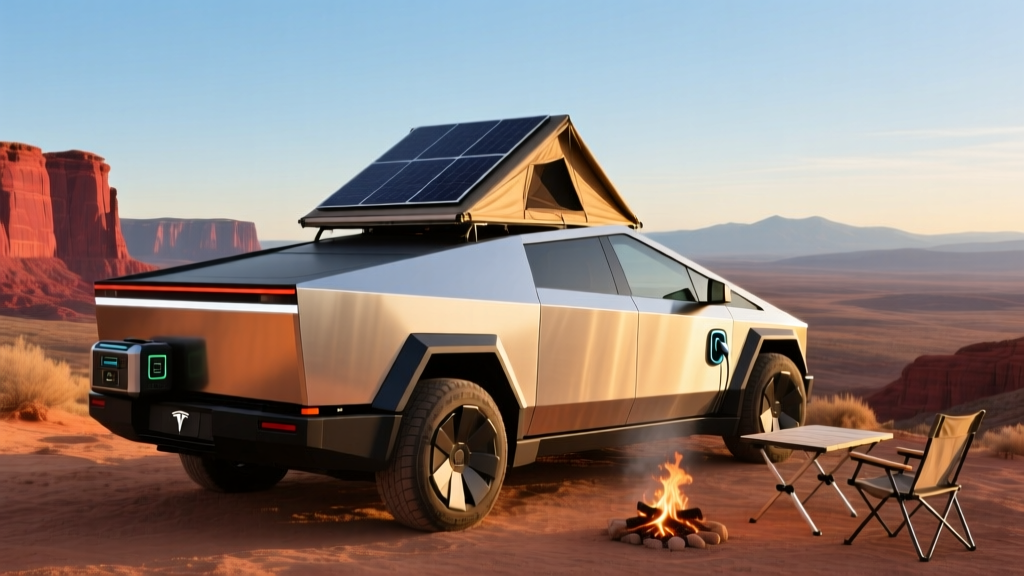
What does exist is the Tesla Cybertruck — the closest vehicle in Tesla's lineup to an RV platform, thanks to its 6-foot bed, available tonneau cover, 11,000-pound towing capacity, and robust vehicle-to-load (V2L) power capabilities. A growing aftermarket of camper shells, rooftop tents, and slide-in truck campers has turned the Cybertruck into a legitimate overlanding and camping platform.
This review evaluates the 2026 Cybertruck through an RV and camping lens: Can it replace a traditional RV? What does range look like when you're loaded down with gear? And how does the charging infrastructure handle remote campgrounds?
2026 Cybertruck Specs at a Glance
| Spec | AWD | Cyberbeast |
|---|---|---|
| Base MSRP | $79,990 | $99,990 |
| Battery (usable) | ~123 kWh (NMC) | ~123 kWh (NMC) |
| EPA Range | 340 mi | 320 mi |
| MPGe (combined) | 79 MPGe | 76 MPGe |
| Efficiency | 48 kWh/100 mi | 50 kWh/100 mi |
| 0-60 mph | 4.1 sec | 2.6 sec |
| Horsepower | 600 hp | 845 hp |
| Drivetrain | Dual-Motor AWD | Tri-Motor AWD |
| Towing Capacity | 11,000 lbs | 11,000 lbs |
| Payload | 2,500 lbs | 2,500 lbs |
| Bed Length | 6 ft (vault) | 6 ft (vault) |
| Battery/Powertrain Warranty | 8 yr / 120,000 mi | |
Range Reality: What to Expect on the Campground Trail
Real-World Highway (loaded): ~240-270 miles with 1,500+ lbs of camper gear
Cold-Weather (below 32°F): ~200-230 miles highway with gear
With Max Tow (11,000 lbs trailer): ~140-170 miles
The Cybertruck's EPA range is competitive among full-size electric trucks. But RV buyers need to think in terms of loaded range. Tesla's stainless-steel exoskeleton is heavy — the truck weighs roughly 6,800 lbs curb — and adding a slide-in camper (typically 1,500-2,500 lbs), rooftop tent, or overlanding gear cuts range by 20-30%.
Towing is where range drops most dramatically. At the full 11,000-pound tow rating, expect range to roughly halve. This is consistent with every EV truck on the market and reflects the physics of moving 18,000+ pounds of combined vehicle and trailer at highway speed. If you plan to tow a mid-size travel trailer (5,000-7,000 lbs), budget for 180-220 miles of real-world range and plan charging stops accordingly.
The Cybertruck's heat pump helps preserve range in cold weather compared to resistive heating, but lithium-ion chemistry inherently loses efficiency below freezing. Expect a 25-35% range reduction in sustained sub-freezing temperatures, especially at highway speeds.
Charging Speed: Getting Back on the Trail Fast
| Charging Level | Power | Speed |
|---|---|---|
| Level 1 (120V household) | ~1.4 kW | ~3-4 mi/hr |
| Level 2 (240V home, 48A) | 11.5 kW | ~29-33 mi/hr |
| DC Fast Charge (peak) | 250 kW (CCS via NACS adapter or native) | 10-80% in ~28 min |
| DC Fast Charge (sustained avg.) | ~150-180 kW | ~200 mi added in 30 min |
The Cybertruck charges at up to 250 kW on DC fast chargers, which is solid but not class-leading — the Ford F-150 Lightning peaks at similar rates, while the Rivian R1T and newer platforms push toward 300+ kW. The critical detail is the charge curve: the Cybertruck sustains peak rate briefly, then tapers. Expect an average of 150-180 kW over a 10-80% session, which takes roughly 28 minutes at a V3 or V4 Supercharger.
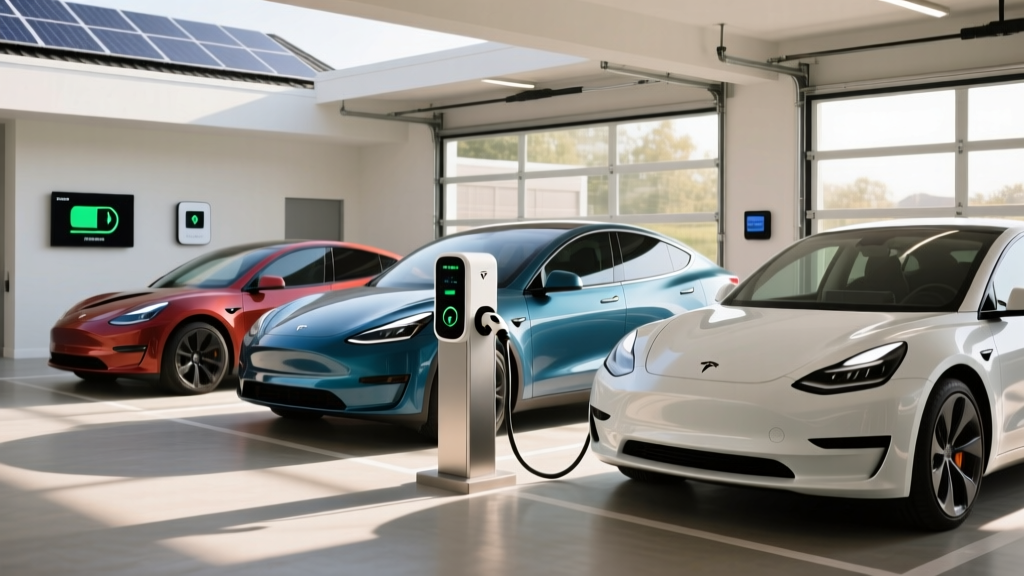
For RV use, this matters at remote campgrounds. Most campgrounds offer 30A or 50A NEMA 14-50 outlets, which deliver Level 2 speeds — about 30 miles of range per hour. An overnight charge (10 hours) adds roughly 290 miles, which is enough to fully replenish the battery. Tesla's Mobile Connector comes included and handles both 120V and 240V outlets.
Home charging on a dedicated 60A circuit (Tesla Wall Connector) adds about 33 miles per hour, meaning a full charge from near-empty takes roughly 10 hours. Most RV-minded owners charge overnight and start each trip fully topped up.
One critical note: Tesla uses the NACS (North American Charging Standard) connector natively. This gives Cybertruck owners direct access to the entire Tesla Supercharger network — over 25,000 stalls in North America as of 2026 — without any adapter. This remains a significant RV-travel advantage, as Superchargers are increasingly located near highways and travel corridors.
Camping & RV Conversion: What the Aftermarket Offers
The Cybertruck's 6-foot vault bed (with power-retractable tonneau) is shorter than a traditional full-size truck bed, which limits slide-in camper options. However, several manufacturers have developed Cybertruck-specific solutions:
- Rooftop tents: Several brands (including Tuff Stuff and Alu-Cab style options) mount directly to the Cybertruck's bed rails or roof rack system. These add 100-150 lbs and preserve bed storage.
- Slide-in truck campers: Companies like Scout Campers and AT Overlander have released or announced compact units designed for mid-size beds, fitting the Cybertruck's 6-foot vault. Expect 1,200-2,000 lbs dry weight.
- Overlanding builds: Drawer systems, kitchen galleys, and auxiliary battery setups integrate with the Cybertruck's V2L (vehicle-to-load) capability, which can output up to 9.6 kW of 120V/240V power — enough to run camp appliances, lighting, and even a small A/C unit.
- Tow-behind campers: At 11,000 lbs of tow capacity, the Cybertruck can pull most mid-size travel trailers (Airstream, Oliver, Escape) and all teardrop campers.
The standout RV feature is V2L power. The Cybertruck's 123 kWh battery is essentially a massive portable power station. You can run induction cooktops, CPAP machines, laptops, LED lighting, and even a residential refrigerator for days without depleting the battery below a comfortable reserve. This eliminates the need for a separate generator at most campsites.
Interior, Cargo, and Livability
The Cybertruck seats five (or six with the optional front bench). Rear legroom measures approximately 38.4 inches — adequate for adults on longer drives. The minimalist interior (18.5-inch front touchscreen, 9.4-inch rear screen) means few physical buttons, which some buyers love and others find frustrating when trying to adjust climate settings with dirty hands at a campsite.
Cargo capacity breaks down as follows:
- Bed (vault): ~67 cu ft (with tonneau closed)
- Front trunk (frunk): ~7.1 cu ft — useful for charging cables, tools, or a small cooler
- Below-bed storage: The Cybertruck has no traditional under-bed storage due to its structural battery pack
- Interior rear (seats folded): Limited flat-load area compared to an SUV; the truck bed is the primary cargo zone
For RV use, the bed vault is the star. It locks securely, is weather-sealed, and with the tonneau deployed, provides a dry, secure storage area for gear. The trade-off is the 6-foot length: standard 8-foot sheets of plywood won't fit flat, and larger slide-in campers designed for full-size trucks are incompatible.
ADAS and Road-Trip Tech: Autopilot on Long Hauls
Tesla Autopilot and Full Self-Driving (Supervised) require continuous driver engagement. The driver must keep hands on the wheel and eyes on the road at all times. This is NOT self-driving.
For long highway drives to remote campgrounds, Tesla's Autopilot (standard) and available Full Self-Driving Supervised ($8,000 option or $99/month) reduce fatigue significantly. The system handles lane centering, adaptive cruise, and highway on/off-ramp navigation competently.
However, FSD Supervised still requires you to monitor the road and intervene. On rural two-lane roads — the kind that lead to most campgrounds — the system is less confident. Construction zones, faded lane markings, and wildlife crossings all demand full human attention.
Other tech relevant to RV use:
- 360-degree cameras: Helpful for tight campground maneuvering and trailer hitching
- Tow mode with trailer-light check: Streamlines hookup
- Route planning with charging: Tesla's navigation automatically routes through Superchargers on long trips and preconditions the battery for faster charging upon arrival
Pricing, Tax Credits, and Total Cost
| Trim | MSRP | §30D Credit Eligible? | Effective Price* |
|---|---|---|---|
| AWD | $79,990 | Yes (MSRP under $80K truck cap) | ~$72,490 |
| Cyberbeast | $99,990 | No (exceeds $80K MSRP cap for trucks) | $99,990 |
*Effective price assumes full $7,500 federal tax credit under IRS §30D. Eligibility depends on buyer income (AGI ≤ $150K single / $300K joint), battery critical-mineral and component sourcing requirements, and MSRP caps ($80,000 for vans/SUVs/pickups). The credit can be transferred to the dealer as a point-of-sale discount. Always verify current-year rules with a tax professional.
The AWD trim at $79,990 scrapes just under the $80,000 MSRP cap for pickup trucks, making it eligible for the full $7,500 federal credit if you meet income and sourcing requirements. The Cyberbeast at $99,990 exceeds the cap and does not qualify.
For RV buyers, the AWD trim is the practical choice: you get dual-motor AWD, 340 miles of EPA range, 11,000 lbs of towing, and the tax credit — all for an effective price around $72,490. That undercuts comparably equipped competitors when you factor in the credit.
How the Cybertruck Stacks Up Against Electric Truck Alternatives
| Spec | Tesla Cybertruck AWD | Ford F-150 Lightning Lariat | Rivian R1T Dual-Motor |
|---|---|---|---|
| EPA Range | 340 mi | 320 mi | 352 mi |
| Battery | 123 kWh NMC | 131 kWh NMC | 128 kWh NMC |
| Peak DC Charge | 250 kW | 250 kW | 220 kW |
| 10-80% Time | ~28 min | ~31 min | ~30 min |
| Towing | 11,000 lbs | 10,000 lbs | 11,000 lbs |
| Bed Length | 6 ft | 5.5 ft | 4.5 ft |
| V2L Power | 9.6 kW | 9.6 kW (Pro Power) | ~3.5 kW |
| Base MSRP | $79,990 | ~$69,990 | ~$75,900 |
| Supercharger Access | Native | Via adapter | Via adapter (2025+) |
The F-150 Lightning is cheaper and has a more traditional truck layout, but its shorter bed (5.5 ft) limits camper options, and Ford's public charging experience remains less seamless than Tesla's Supercharger network.
The Rivian R1T offers the best range and a clever gear tunnel for storage, but its 4.5-foot bed is the shortest of the three, and its lower V2L output limits campsite power options. Rivian's software and build quality are excellent, and it now accesses Superchargers via adapter.
For pure RV and overlanding use, the Cybertruck's combination of a 6-foot bed, 9.6 kW V2L, native Supercharger access, and 340-mile range makes it the most capable platform — if you can accept the polarizing design and minimalist interior.
Pros and Cons for RV & Camping Buyers
Pros
- 9.6 kW V2L eliminates need for a campsite generator
- Native Supercharger access — best road-trip charging network
- 340-mile EPA range (best-in-class for trucks at this price)
- 11,000-lb towing handles most mid-size travel trailers
- Stainless-steel body resists scratches from brush and branches
- Lockable, weather-sealed bed vault secures gear
- Heat pump preserves cold-weather range better than resistive heating
Cons
- 6-foot bed is shorter than full-size trucks — limits camper compatibility
- Heavy curb weight (~6,800 lbs) reduces efficiency under load
- Towing cuts range by 40-50% — requires careful trip planning
- No rear under-bed storage (battery occupies the space)
- Minimalist interior frustrates some users; no physical climate knobs
- $79,990+ price is steep for a camping platform
- Cyberbeast trim doesn't qualify for the $7,500 federal credit
- Polarizing design draws attention — not ideal for low-key campers
Who Should Consider the Cybertruck as an RV Platform?
Choose the Cybertruck if:
- You want a do-everything truck that doubles as a camper without buying a dedicated RV
- You value V2L power for off-grid camping (running appliances, tools, or devices)
- You take road trips that align with the Supercharger network
- You want a lockable, weatherproof bed for gear storage
- You're comfortable with a 6-foot bed and compact camper builds
Look elsewhere if:
- You need a full-size 8-foot bed for traditional slide-in campers
- You tow heavy trailers over 7,000 lbs on long routes (range becomes impractical)
- You want a dedicated motorhome with a bathroom, kitchen, and sleeping area built in
- You need to seat more than 5-6 people
- Budget is a primary concern — consider an F-150 Lightning or a used EV truck instead
Frequently Asked Questions
Does Tesla make an RV or camper van?
No. As of 2026, Tesla does not produce a dedicated RV, camper van, or travel trailer. The Cybertruck is the closest Tesla vehicle to an RV platform, and a growing aftermarket supports camper conversions including rooftop tents, slide-in campers, and overlanding builds.
What is the real-world range of the Cybertruck when loaded for camping?
With 1,500-2,500 lbs of camping gear, expect roughly 240-270 miles of real-world highway range from the AWD trim's 340-mile EPA rating. In cold weather (below 32°F), that drops to approximately 200-230 miles. Towing a trailer cuts range more drastically — plan for 140-220 miles depending on trailer weight.
How fast does the Cybertruck charge at home and on the road?
At home on a 240V Level 2 charger (48A), the Cybertruck adds about 29-33 miles of range per hour, fully charging overnight in ~10 hours. On DC fast chargers, it peaks at 250 kW and charges from 10-80% in approximately 28 minutes, though the average sustained rate is closer to 150-180 kW.
Does the Cybertruck qualify for the $7,500 federal EV tax credit?
The AWD trim ($79,990 MSRP) qualifies for the full §30D federal tax credit of $7,500, provided you meet income limits (AGI ≤ $150K single / $300K joint) and the vehicle meets battery critical-mineral and component sourcing rules. The Cyberbeast ($99,990) exceeds the $80,000 MSRP cap for trucks and does not qualify. The credit can be applied as a point-of-sale discount through a participating dealer. Consult a tax professional to confirm your eligibility.
Can I tow a travel trailer with the Cybertruck?
Yes. The Cybertruck is rated to tow 11,000 lbs, which covers most teardrop campers, pop-up trailers, and mid-size travel trailers (Airstream Bambi, Oliver Legacy, Escape 5.0). However, towing significantly reduces range — expect roughly 140-220 real-world miles depending on trailer weight and conditions. Plan charging stops carefully on longer trips.
Is the Cybertruck better for camping than the F-150 Lightning or Rivian R1T?
It depends on your priorities. The Cybertruck offers the longest bed (6 ft vs. 5.5 ft for Ford, 4.5 ft for Rivian), native Supercharger access, and the highest V2L output (9.6 kW). The F-150 Lightning is cheaper and more conventional. The R1T offers the longest range (352 mi) and a clever gear tunnel. For serious overlanding and off-grid power, the Cybertruck has the edge. For budget-conscious buyers or those needing a traditional truck layout, the Lightning is compelling.
What camper conversions are available for the Cybertruck?
The aftermarket includes rooftop tents (various brands), compact slide-in truck campers (Scout, AT Overlander), overlanding drawer systems with integrated kitchens, and bed-rack systems for gear. The 6-foot vault bed requires purpose-built or mid-size-compatible campers — standard full-size truck campers will not fit.
Sources: fueleconomy.gov (EPA range and efficiency data), IRS §30D Clean Vehicle Credit, Tesla.com official specifications. All pricing and specs reflect 2026 model-year information available at time of publication. Tax credit rules are subject to change — verify current eligibility with the IRS or a qualified tax advisor.