Tesla's Optimus humanoid robot has captured attention far beyond the EV world, and one component draws more scrutiny than any other: the Tesla robotic hand. With 22 degrees of freedom, tendon-driven actuation, and tactile sensing across every finger, the Optimus hand represents a leap in electromechanical dexterity. But for Tesla buyers and EV owners, the real question isn't how impressive the hand is in a demo — it's whether this technology will actually change how Tesla vehicles are built, serviced, and priced.
This article examines the Tesla robotic hand from an EV owner's perspective: what it can do today, where it's deployed, what the limitations are, and how it connects to the vehicles Tesla actually sells. We'll also look at the broader context of robotics in EV manufacturing, because Optimus doesn't exist in a vacuum — BMW, Hyundai, and Figure AI are all racing toward similar factory-floor integration.
What the Tesla Robotic Hand Actually Is
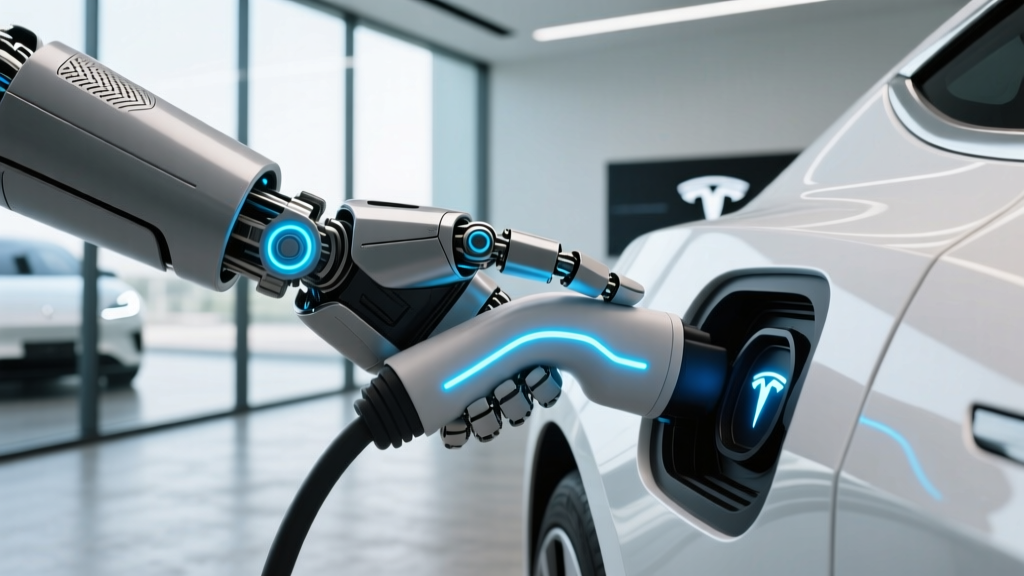
The Optimus Gen 2 hand, introduced in late 2023 and refined through 2024–2025 production iterations, is a five-fingered end effector with 22 degrees of freedom — approaching the ~27 degrees of freedom in a human hand. Each finger is driven by tendon-based actuation, with motors located in the forearm rather than the fingers themselves. This keeps the hand's mass low and allows faster, more fluid motion than gear-driven alternatives.
The palm and finger pads integrate tactile sensor arrays capable of detecting contact pressure across multiple zones. Tesla has demonstrated the hand handling delicate objects — eggs, fabric, small tools — without crushing or dropping them. The sensor feedback loop runs at high frequency, enabling grip-force adjustment in real time.
Key specifications of the Optimus Gen 2 robotic hand:
| Attribute | Specification |
|---|---|
| Degrees of freedom | 22 |
| Actuation method | Tendon-driven (forearm-mounted motors) |
| Tactile sensing | Multi-zone pressure sensor arrays on fingers and palm |
| Grip types demonstrated | Pinch, power grip, lateral grip, precision manipulation |
| Object handling demos | Eggs, fabric, tools, sorting small parts |
| Controller integration | Full-body neural network (end-to-end vision-to-action) |
The hand is not sold separately. It is an integrated subsystem of the Optimus platform, which Tesla positions as a general-purpose humanoid robot for manufacturing and logistics environments.
Where Tesla Is Deploying Optimus (and Its Hands) in EV Factories
Tesla has confirmed that early-production Optimus units are performing tasks inside its own factories — specifically Gigafactory Texas and the Fremont plant — as of late 2024 and into 2025–2026. The tasks are deliberately simple and repetitive:
- Parts sorting and bin-picking: Identifying components on a conveyor or in a bin and placing them into organized trays. The robotic hand's tactile feedback allows it to adjust grip when picking irregularly shaped stamped metal parts or wiring harness connectors.
- Material transport: Carrying trays, boxes, or sub-assemblies between stations. This leverages the full arm-and-hand system rather than just the hand alone.
- Battery cell handling: Tesla has shown Optimus units manipulating cylindrical battery cells (the 4680 format used in Model Y and Cybertruck). This is significant because 4680 cells require careful handling — denting or puncturing the casing can compromise cell integrity.
These are structured, semi-repetitive tasks in controlled factory environments. Optimus is not yet performing complex assembly work like wiring a dashboard or installing a windshield. The robotic hand's dexterity exceeds what those tasks require in current deployment, but Tesla's stated trajectory is toward progressively more complex manipulation over successive software and hardware updates.
How the Robotic Hand Compares to Competitor Systems
Tesla's Optimus hand is not the only advanced robotic end effector targeting EV manufacturing. Several competitors field systems with different engineering trade-offs:
| Platform | Degrees of Freedom | Actuation | EV Factory Deployment | Sensing |
|---|---|---|---|---|
| Tesla Optimus Gen 2 | 22 | Tendon-driven | Internal Tesla plants (2024–2026) | Tactile arrays |
| Figure 02 (Figure AI / BMW) | ~16–20 (estimated) | Electric motor + tendon hybrid | BMW Spartanburg plant (pilot, 2024–2025) | Force/torque + vision |
| Hyundai Boston Dynamics Atlas (electric) | Multi-DOF gripper | Electric actuator | Hyundai R&D pilot programs | Proprioceptive + vision |
| Traditional industrial arms (Fanuc, KUKA) | 2–4 (custom grippers) | Pneumatic / electric | Widespread across all OEMs | Force-limited or none |
The key distinction: traditional industrial robot arms with custom grippers already handle the vast majority of EV assembly tasks — welding, painting, battery module placement, glass installation. These systems are faster, more precise, and cheaper per task than any humanoid. The value proposition of a humanoid with a dexterous robotic hand is flexibility: one platform that can walk to different stations, handle varied objects, and be re-tasked via software rather than re-tooled mechanically.
Whether that flexibility justifies the cost and complexity remains unproven at scale. BMW's pilot with Figure AI at its Spartanburg, South Carolina plant (which builds X-series SUVs, including the iX electric) is the closest external benchmark to Tesla's internal deployment.
What This Means for Tesla Vehicle Buyers
If you're shopping for a Tesla in 2026 — whether a Model Y, Model 3, Cybertruck, or the refreshed Model S/X — the Optimus robotic hand affects you indirectly, through production economics rather than direct vehicle features.
Potential Cost Impact
Tesla's long-term thesis is that Optimus reduces per-unit labor cost. If a humanoid robot can perform material handling, parts sorting, and simple sub-assembly tasks for a fraction of the hourly cost of a human worker, Tesla can either lower vehicle prices or improve margins. Musk has floated the idea that Optimus could eventually make Tesla vehicles significantly cheaper, but this is speculative and multi-year.
For 2026 model-year pricing, Optimus deployment has no measurable direct effect on MSRP. Tesla's current pricing is driven by battery cell costs (particularly 4680 cell ramp at Austin), demand dynamics, competitive pressure from Chinese OEMs, and federal tax credit eligibility.
Quality and Consistency
A more near-term argument for the robotic hand in EV manufacturing is consistency. Human workers vary in grip force, placement accuracy, and fatigue over a shift. A tendon-driven hand with tactile feedback can, in theory, apply the same torque to a fastener or the same insertion force to a connector every cycle. This matters for EV-specific assembly steps:
- High-voltage connector mating: Improperly seated HV connectors can cause intermittent faults or thermal events. Consistent robotic insertion force reduces this risk.
- Battery module handling: 4680 cells and structural battery packs require careful manipulation to avoid cosmetic or structural damage.
- Wire harness routing: Flexible, irregularly shaped harnesses are notoriously difficult for traditional automation. A dexterous hand with tactile feedback could eventually handle these tasks.
Limitations and Honest Assessment
- Complex multi-step assembly requiring tool changes, adhesive application, or sealant dispensing — these remain the domain of dedicated industrial robots and human technicians.
- Unstructured environment operation — Optimus performs well in controlled factory settings with predictable lighting, organized parts, and flat floors. It is not deployed in outdoor or unpredictable environments.
- Force-intensive tasks — pressing bearings, bending sheet metal, or torquing large fasteners exceed the hand's force output. Industrial arms and hydraulic presses handle these.
- Autonomous decision-making at scale — while Tesla uses neural-network-based control, every Optimus deployment is supervised. The system is not operating unsupervised on a production line without human oversight.
It's also important to separate the robotic hand from Tesla's driver-assistance systems. Optimus and its hand are factory robotics — they share no hardware or software with Autopilot or FSD (Supervised) in Tesla vehicles. Those remain SAE Level 2 driver-assistance systems requiring full driver engagement. Optimus operates in a fundamentally different environment with different safety constraints.
Tesla Optimus Timeline and Availability
As of early 2026, Optimus is not available for purchase by consumers or third-party manufacturers. Tesla has stated it expects limited external sales to begin possibly in 2026–2027, initially to industrial partners, with a long-term goal of broader commercial availability. Pricing has been speculated at $20,000–$30,000 per unit at scale, but Tesla has not published a firm price.
For Tesla vehicle buyers, this means Optimus and its robotic hand are a manufacturing story, not a product you can buy. The relevant question is whether Optimus deployment improves the vehicle you receive — through lower cost, higher build consistency, or faster production ramp — not whether you can put one in your garage.
| Period | Status | Location |
|---|---|---|
| 2022 | Prototype reveal (Bumblebee / Optimus concept) | AI Day demo |
| 2023 | Optimus Gen 2 reveal, improved hand dexterity | Internal testing |
| 2024 | Early factory deployment, simple tasks | Gigafactory Texas, Fremont |
| 2025 | Expanded pilot, battery cell handling demos | Tesla plants |
| 2026 (current) | Limited internal deployment, external sales not yet open | Tesla plants |
| 2026–2027 (projected) | Possible limited external partner sales | TBD |
Frequently Asked Questions
Can I buy the Tesla robotic hand separately?
No. The Optimus robotic hand is an integrated component of the Optimus humanoid platform and is not sold as a standalone product. As of 2026, even the full Optimus robot is not available for consumer purchase — it is deployed internally at Tesla factories only.
Does the Tesla robotic hand affect the quality of the Model Y or Model 3 I buy?
Indirectly, potentially yes — over time. If Optimus units with dexterous hands improve consistency in battery cell handling, high-voltage connector seating, or parts sorting, that could reduce manufacturing defects. However, as of 2026, Optimus deployment is limited and handles simple tasks. The vast majority of Tesla vehicle assembly is still performed by traditional industrial robots (KUKA, Fanuc) and human workers.
Is the Tesla robotic hand the same technology as Tesla Autopilot or FSD?
No. Optimus uses a separate neural-network-based control system designed for physical manipulation in factory environments. Tesla Autopilot and FSD (Supervised) are SAE Level 2 driver-assistance systems for on-road vehicle operation. They share some underlying AI philosophy (end-to-end neural networks, vision-based perception) but run on entirely different hardware and are trained on entirely different data.
How does Tesla's robotic hand compare to prosthetic or medical robotic hands?
Different use case entirely. Medical prosthetic hands (like those from Touch Bionics or Bebionic) prioritize lightweight construction, cosmetic appearance, and user intent decoding via myoelectric signals. The Optimus hand prioritizes grip force, tactile sensing for object manipulation, and integration with a full-body robotic platform. There is no cross-application between the two domains currently.
Will Optimus replace human workers at Tesla factories?
Tesla has stated that Optimus is intended to handle repetitive, dangerous, or boring tasks — not to eliminate human workers entirely. In practice, EV manufacturing still requires significant human labor for quality inspection, complex assembly, problem-solving, and tasks requiring judgment. Optimus deployment through 2026 has been limited to simple material handling and sorting, not full-line replacement.
What battery does Optimus use, and does it relate to Tesla EV batteries?
Optimus uses a 2.3 kWh battery pack located in the torso, according to Tesla's published specifications. This is far smaller than any Tesla vehicle battery (the Model 3 RWD uses approximately 57.5 kWh usable). Optimus uses a 52-volt system. The cell format and chemistry have not been publicly detailed, but the pack is custom-designed for the robot's form factor — it is not a repurposed vehicle module.