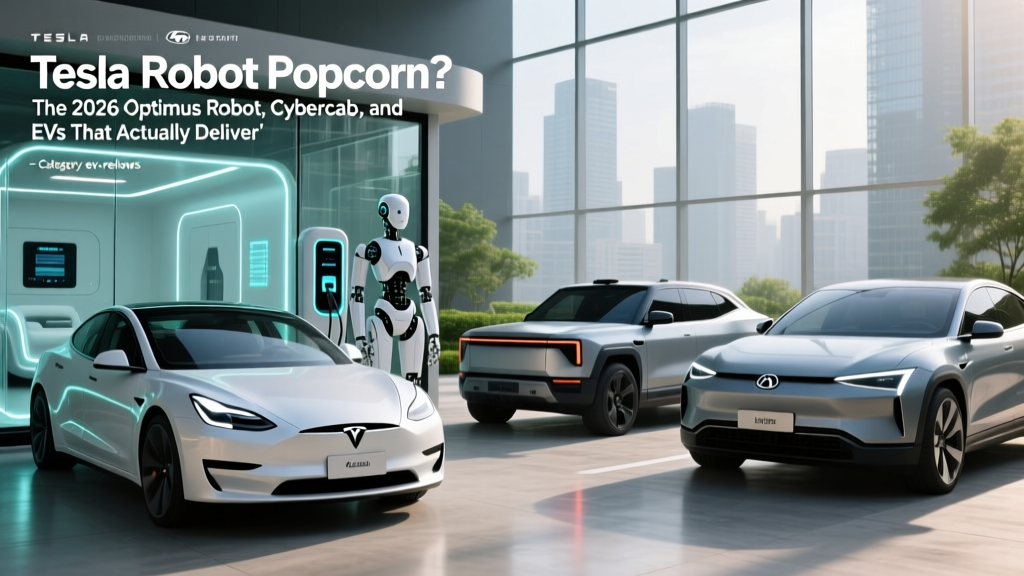
If you've seen a clip circulating online tagged Tesla robot popcorn, you're not alone. The phrase has bounced around social feeds in 2026, blending footage of Tesla's Optimus humanoid robot, the company's robotaxi ambitions, and the occasional meme of a machine "popping corn" on a factory floor. The reality is less cinematic and more interesting: Tesla is simultaneously shipping real EVs, testing a robotaxi service, and developing a humanoid robot that is nowhere near consumer-ready. This guide untangles what's actually buyable, what's in pilot, and what's still a lab project.
The 'Tesla Robot Popcorn' Search: What People Are Actually Looking For
The query clusters around three distinct Tesla programs that get conflated online:
- Optimus (Tesla Bot): A humanoid robot in pilot deployment inside Tesla factories. Not for sale to consumers in 2026.
- Cybercab (Robotaxi): A steering-wheel-free, Level 4 autonomous vehicle announced for limited 2026 production, with ride-hail pilots expected in select cities.
- Tesla's current EV lineup: Model 3, Model Y, Cybertruck, Model S, and Model X — the vehicles buyers can actually order today.
The "popcorn" element appears to stem from a viral clip of an Optimus unit handling snack packaging on a Fremont line, mis-captioned as a consumer product. It isn't. Let's look at what is real.
Optimus: Tesla's Humanoid Robot, Status in 2026
Optimus, sometimes called the Tesla Bot, is a general-purpose humanoid robot that Tesla has been iterating on since its 2021 reveal. As of early 2026, Optimus units are performing repetitive tasks inside Tesla's own manufacturing facilities — parts handling, sorting, and light assembly support. Tesla has not announced a consumer price, a retail release date, or a home-use configuration.
Reality check: Optimus is not a household product, not a kitchen appliance, and not available to order. Any listing or preorder page claiming otherwise is not from Tesla. For official status, check Tesla's AI page.
For EV shoppers, Optimus matters only indirectly: it signals Tesla's investment in embodied AI and manufacturing automation, which may eventually lower vehicle production costs. It does not affect your Model Y delivery, your Supercharger access, or your warranty.
Cybercab: The Robotaxi That Isn't a Consumer Car (Yet)
Cybercab is Tesla's purpose-built robotaxi — a two-seat, no-steering-wheel, no-pedal vehicle designed for SAE Level 4 operation in geofenced service areas. Tesla has targeted low-volume 2026 production, with pilot ride-hail services expected in a handful of U.S. cities, subject to state and NHTSA regulatory approval.
SAE automation level: Cybercab is designed for Level 4 — driverless within its approved operational design domain. This is fundamentally different from the Level 2 Autopilot and FSD (Supervised) systems in Tesla's consumer cars, which require an attentive driver at all times.
Key points for buyers:
- You cannot buy a Cybercab in 2026. It is a fleet vehicle for a Tesla-operated or partner-operated ride-hail service.
- Availability is geofenced. Expect pilots in cities like Austin and the Bay Area first, not nationwide coverage.
- Safety data will be scrutinized by NHTSA and state regulators before any expansion.
Tesla EVs You Can Actually Buy in 2026
While robots and robotaxis dominate headlines, Tesla's 2026 consumer lineup remains the core of the business. Below is a snapshot of the highest-volume model, the refreshed Model Y, which is what most shoppers cross-shopping "Tesla" are actually considering.
| Spec | Value |
|---|---|
| EPA-estimated range | 320 miles |
| Battery (usable) | ~75 kWh, NMC chemistry |
| Drivetrain | Dual-motor AWD |
| 0–60 mph | 4.8 seconds |
| Horsepower | ~384 hp combined |
| Peak DC fast charge | 250 kW (Supercharger V3/V4) |
| 10–80% DC time | ~25 minutes (preconditioned) |
| Level 2 home charge | 11.5 kW / ~44 mi/hr |
| Efficiency | 122 MPGe / 28 kWh/100 mi |
| Cargo (rear seats up) | 30.2 cu ft |
| Cargo (rear seats folded) | 72.1 cu ft |
| Rear legroom | 37.4 in |
| Battery warranty | 8 years / 120,000 miles |
| Base MSRP | ~$48,990 |
EPA 320 miles, real-world expectation: On mixed highway driving at 70–75 mph, expect roughly 270–290 miles. In freezing temperatures with cabin heat, 220–250 miles is realistic. City driving with regen braking often matches or slightly exceeds the EPA sticker.
Charging Speed: Supercharger Network vs. Home Level 2
Tesla's Supercharger network remains a primary ownership advantage. On a V3 or V4 Supercharger, a preconditioned Long Range Model Y peaks near 250 kW, though the charge curve tapers significantly above ~60% state of charge. Plan for 25 minutes from 10–80%, and add time if you push past 80% — the final 20% can take as long as the first 70%.
At home on a Wall Connector fed by a 60-amp circuit, the Model Y accepts 11.5 kW, adding roughly 44 miles of range per hour. An overnight 8-hour session restores ~350 miles — more than a full battery for most trims. Installation cost for a 60-amp circuit typically runs $800–$2,000 depending on panel proximity and local permitting; older homes may need a $2,000–$4,000 service upgrade to 200 amps.
For a detailed breakdown of home install costs and panel considerations, see our Level 2 home charger install guide.
Pricing, Trims, and Federal Tax Credit Eligibility
Tesla's 2026 pricing shifts periodically — often monthly — so treat the figures below as a snapshot. The Long Range AWD Model Y typically starts near $48,990 before destination, with a Performance trim around $54,990. A base RWD trim has periodically appeared in the low $40,000s when available.
| Trim | MSRP (est.) | Max §30D Credit | Effective Price (if eligible) |
|---|---|---|---|
| RWD (when offered) | ~$42,990 | $7,500 | ~$35,490 |
| Long Range AWD | ~$48,990 | $7,500 | ~$41,490 |
| Performance AWD | ~$54,990 | $7,500 | ~$47,490 |
- MSRP cap: SUVs/pickups must be under $80,000; sedans under $55,000. All current Model Y trims qualify on MSRP.
- Buyer income cap (MAGI): $150,000 single / $225,000 head of household / $300,000 joint.
- Battery sourcing: A portion of critical minerals and battery components must meet U.S./FTA-country requirements. Tesla's U.S. cell sourcing has generally satisfied this, but rules tighten annually — verify at purchase on the IRS §30D page.
- Point-of-sale transfer: Eligible buyers can apply the credit as a down-payment reduction at delivery rather than waiting for tax filing.
Consult a tax professional before relying on the credit. Eligibility hinges on your specific MAGI, the vehicle's VIN-level battery sourcing, and the tax year of delivery.
Tech, Driver Assistance, and What's Not Self-Driving
Every 2026 Tesla ships with basic Autopilot (lane-keeping and adaptive cruise) as standard. Full Self-Driving (Supervised) remains an optional software package that adds automated lane changes, traffic-light recognition, and city-street navigation. It is SAE Level 2: you must keep your hands on the wheel (or demonstrate attentiveness) and your eyes on the road at all times.
FSD (Supervised) is not autonomous. It does not make your Tesla a self-driving car. You are the driver of record and liable for every maneuver. Only geofenced Level 4 services like Waymo qualify as driverless in approved zones.
Infotainment remains Tesla's minimalist 15.4-inch center touchscreen with no physical buttons for climate or media. The interface is responsive and feature-rich (navigation, streaming, games while parked), but the lack of tactile controls still frustrates some buyers during long drives. Over-the-air updates continue to add features post-delivery — a genuine Tesla differentiator versus legacy OEMs.
Pros
- Access to the Supercharger network — still the most reliable U.S. DC fast-charging ecosystem
- Class-leading efficiency at ~28 kWh/100 mi
- Strong cargo volume (72.1 cu ft) for the segment
- OTA updates add features after purchase
- Point-of-sale §30D credit transfer reduces upfront cost
Cons
- No physical climate/media controls; everything through the touchscreen
- Rear-seat comfort trails rivals like the Hyundai Ioniq 5 and Kia EV6
- FSD (Supervised) costs extra and remains Level 2, not autonomous
- Insurance premiums run 15–30% above comparable ICE crossovers in most states
- Build consistency has improved but still varies unit-to-unit
Who the 2026 Model Y Suits Best
The Long Range AWD Model Y is the default pick for two-adult households with one or two children who have reliable home Level 2 charging and take 1–3 road trips per year. Supercharger density makes it the lowest-friction EV for corridor travel (I-5, I-95, I-70). It's less ideal for buyers who prioritize rear-seat comfort, who regularly tow (rated to 3,500 lb but range drops steeply), or who need three-abreast car seats — the rear is narrow for that use case.
If you're drawn to Tesla because of robotaxi hype, know that Cybercab pilots won't replace personal ownership in 2026 — they'll complement Uber/Lyft/Waymo in dense urban cores. If you're drawn because of Optimus, that's a multi-year research story, not a purchase decision.
Frequently Asked Questions
What is the real-world range of the 2026 Tesla Model Y?
EPA-rated at 320 miles. Expect ~270–290 miles on highway trips, and 220–250 miles in freezing weather with heat on. City driving with regen often matches the sticker.
How fast does the Model Y charge at home and on the road?
On a Supercharger, it peaks at ~250 kW and does 10–80% in about 25 minutes when preconditioned. On a home Level 2 Wall Connector at 11.5 kW, it adds ~44 miles of range per hour.
How much does a 2026 Model Y cost after the federal tax credit?
If you qualify for the full $7,500 §30D credit (income, sourcing, and MSRP rules apply), a Long Range AWD at ~$48,990 drops to roughly $41,490. Use the IRS's clean vehicle credit page and a tax pro to confirm eligibility before ordering.
Is the Model Y worth buying over the Hyundai Ioniq 5 or Kia EV6?
Model Y wins on Supercharger access, efficiency, and cargo space. Ioniq 5 and EV6 win on 800V charging speed (~10–80% in ~18 minutes), rear-seat comfort, and physical controls. Choose Tesla if road-trip charging reliability is your top priority; choose Hyundai/Kia if daily comfort and the fastest DC charging matter more.
What are the biggest pros and cons?
Pros: Supercharger network, efficiency, cargo, OTA updates, §30D point-of-sale transfer. Cons: touchscreen-only controls, average rear-seat comfort, FSD cost vs. Level 2 capability, higher insurance, build variance.
Does the 2026 Model Y qualify for the federal EV tax credit?
Generally yes — it is U.S.-assembled, under the $80,000 SUV MSRP cap, and Tesla's battery sourcing has historically met §30D requirements. Buyer income caps ($150k/$225k/$300k MAGI) and annual sourcing tightening apply. Verify per VIN at delivery.
Can I buy Tesla's Optimus robot or ride in a Cybercab in 2026?
No to Optimus — it's an internal factory tool, not a consumer product. Limited to pilot cities for Cybercab, and only via a ride-hail service — not as a personal vehicle purchase.
The "Tesla robot popcorn" meme is a useful reminder: in 2026, Tesla's most important products are still the EVs on its showroom floor. Optimus and Cybercab are real engineering programs with real timelines, but neither changes the purchase calculus for a household shopping for an electric crossover this year. Judge the Model Y on its 320-mile EPA range, 250 kW charging, Supercharger access, and post-credit pricing — not on a factory-floor clip that went viral.