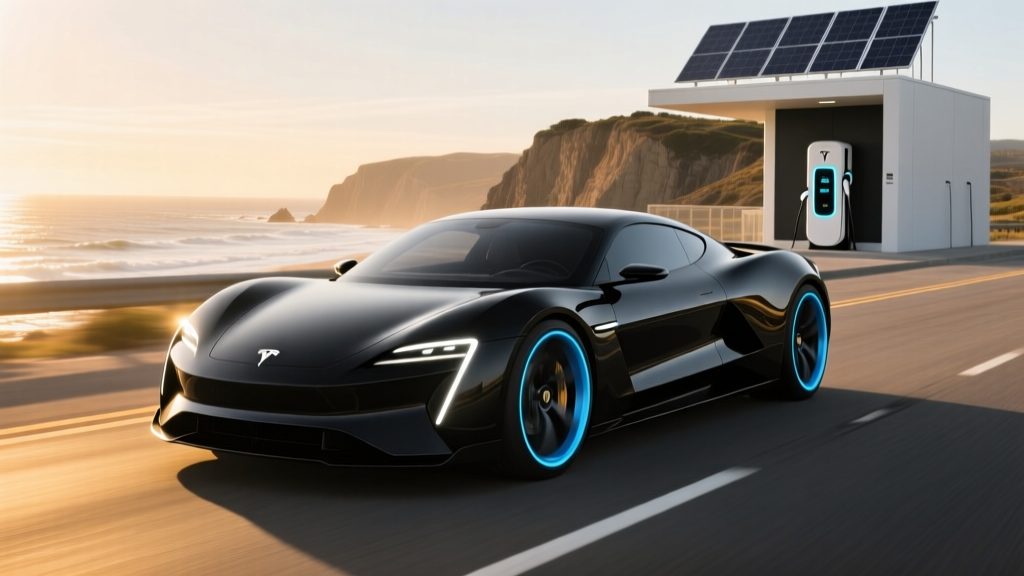
The Tesla Roadster V2 occupies a strange space in the EV landscape: announced in 2017, updated in 2019, and still not in production as of early 2026. Elon Musk has repeatedly signaled it is the next vehicle after Cybertruck, but Tesla's production roadmap has shifted multiple times. This profile treats the Roadster V2 as an announced, unreleased model — all specs below reflect Tesla's most recent published claims and should be considered preliminary until vehicles reach customer hands.
That said, the numbers Tesla has floated are staggering even by 2026 hypercar standards. Let's examine what we know, what we can reasonably project, and what buyers should expect when — and if — this car finally ships.
Announced Specifications at a Glance
| Attribute | Tesla Claim / Projected |
|---|---|
| EPA Range (Claimed) | 620 miles |
| Battery Capacity | 200 kWh (announced) |
| Battery Chemistry | Not confirmed; likely NMC/NCA high-nickel |
| 0–60 mph | 1.9 seconds (base); 1.1 seconds (with SpaceX package) |
| Top Speed | 250+ mph |
| Quarter Mile | 8.8 seconds (claimed) |
| Horsepower | Not officially published; estimated 1,000+ hp (tri-motor AWD) |
| Drivetrain | AWD, tri-motor (1 front, 2 rear) |
| Max DC Fast Charge | Not confirmed; projected 250–350 kW |
| Base MSRP (Announced) | $200,000 |
| Founders Series (Announced) | $250,000 |
| Reservation Deposit | $50,000 (fully refundable per Tesla) |
Range: The 620-Mile Claim and Real-World Reality
The 200 kWh battery pack, if it ships as announced, would be the largest ever fitted to a production passenger car. For context, the GMC Hummer EV uses a ~212 kWh pack but weighs over 9,000 lbs, sacrificing efficiency. Tesla's challenge is packaging that energy in a ~4,400-lb sports car while maintaining the efficiency needed for 620 miles. That implies an energy consumption target of roughly 32 kWh/100 mi — aggressive but not impossible for a low-drag, lightweight(ish) platform.
According to fueleconomy.gov, the most efficient long-range EVs in 2025-2026 achieve around 24–28 kWh/100 mi. A 620-mile Roadster would need to land near 32 kWh/100 mi given the 200 kWh pack — plausible for highway-optimized aero, but city-heavy driving and aggressive throttle use will push consumption higher.
Charging: What We Can Project
Tesla has not published official charging specs for the Roadster V2. However, we can make informed projections based on Tesla's current Supercharger V4 infrastructure and the pack's likely architecture.
| Charging Level | Power / Rate | Estimated Time or Range Added |
|---|---|---|
| Level 1 (120V) | ~1.4 kW | ~4–5 miles per hour |
| Level 2 (240V, 48A) | ~11.5 kW | ~35–40 miles per hour; 0–100% in ~18+ hours |
| DC Fast Charge (projected) | 250–350 kW peak | 10–80% in est. 25–35 minutes |
A 200 kWh battery creates a charging-time challenge. Even at a sustained 250 kW average (optimistic given charge-curve taper above 80% SoC), filling from 10% to 80% requires pushing ~140 kWh into the pack — roughly 33 minutes minimum. Tesla's 4680 cell architecture and potential 800V+ system could push peak rates toward 350 kW, but sustained rates matter more than peak. Expect the charge curve to taper significantly past 60% SoC, as is standard with all lithium-ion packs.
For home charging, a full Level 2 replenishment from near-empty will take well over 15 hours. Most owners will charge opportunistically rather than cycling the full pack. Tesla's Wall Connector at 48A/11.5 kW remains the practical home solution, though the Roadster's NACS connector will grant access to the full Supercharger network — currently over 6,000 V4 stalls in North America per Tesla's Supercharger page.
Performance: Tri-Motor AWD and the SpaceX Package
The Roadster V2 uses a tri-motor layout: one motor on the front axle, two on the rear. This enables torque vectoring across all four wheels and the kind of traction needed to put 1,000+ horsepower to the ground without excessive wheelspin.
The claimed 1.9-second 0–60 mph time would make it the quickest production car ever sold. The optional "SpaceX package" — which Tesla says includes cold-gas thrusters positioned around the vehicle — pushes that to an almost absurd 1.1 seconds. For reference, the Bugatti Chiron hits 60 in ~2.4 seconds, and Tesla's own Model S Plaid does it in 1.99 seconds (verified independently).
Quarter-mile claims of 8.8 seconds would rival dedicated drag cars. However, these numbers assume ideal surface conditions, warm tires, and a full state of charge. Real-world strip testing typically adds 0.1–0.3 seconds. The thruster-equipped variant raises additional regulatory and safety questions that remain unresolved.
Pricing, Tax Credits, and Ownership Economics
| Item | Detail |
|---|---|
| Base MSRP (Announced) | $200,000 |
| Founders Series MSRP | $250,000 |
| Federal §30D Tax Credit | Not eligible — MSRP cap for sedans/sports cars is $55,000 |
| State Incentives | Varies by jurisdiction; check local DMV/energy office |
| Estimated Insurance (Annual) | $4,500–$7,000+ (projected, based on comparable hypercars) |
The IRS §30D clean vehicle credit caps eligible MSRP at $55,000 for sedans and sports cars (and $80,000 for SUVs/trucks/vans). At a $200,000 base price, the Roadster V2 is far above this threshold and will not qualify for the federal $7,500 credit regardless of battery sourcing or buyer income. This is a vehicle purchased on performance and exclusivity, not incentive optimization.
Buyer income caps under §30D ($150K single / $300K joint AGI) are also a non-factor at this price point. State-level incentives (typically $1,000–$5,000) exist in some jurisdictions but are negligible relative to the purchase price. Consult a tax professional for your specific situation.
Interior, Cargo, and Daily Usability
Tesla has shown a 2+2 seating layout with a glass roof and a minimalist interior anchored by a central touchscreen. However, detailed cargo volume, legroom, and headroom figures have not been published for the production-intent version.
Based on the vehicle's proportions (low-slung sports car with a mid-mounted battery pack), expect:
- Front trunk (frunk): Minimal — likely 2–4 cu ft given the front motor and HVAC equipment
- Rear cargo area: Limited by the sloping roofline; possibly 8–12 cu ft behind the rear seats (if usable rear seats exist in production)
- Rear seats: Best described as parcel shelves with occasional child-seat capability — do not expect adult legroom
- Ground clearance: Likely 4.5–5.5 inches — speed bumps and steep driveways will require caution
This is not a grand tourer in the traditional sense. It's a performance statement. Buyers needing cargo space or four-adult comfort should look to the Model S or a Porsche Taycan Cross Turismo.
Tech, Driver Assistance, and Standout Features
The Roadster V2 will ship with Tesla's latest hardware suite, which in 2026 includes HW5 (AI5) computing and the company's camera-only vision stack. Expect:
- Autopilot: Standard lane-keeping, adaptive cruise, and traffic-aware features (SAE Level 2 — driver must remain fully engaged at all times)
- FSD (Supervised): Available as a paid option; still requires active driver supervision and does not constitute autonomous driving
- Infotainment: Large central display, likely 17-inch, with Tesla's streaming and gaming suite
- Removable glass roof panel: Shown in prototype — stores in the trunk (if it fits)
- Active aero: Deployable rear spoiler and active front elements for high-speed stability
Warranty and Battery Longevity
Tesla has not published Roadster-specific warranty terms. Based on the current Model S warranty structure, buyers can reasonably expect:
- Basic Vehicle Warranty: 4 years / 50,000 miles
- Battery & Drive Unit Warranty: 8 years / 150,000 miles with minimum 70% capacity retention
A 200 kWh NMC/NCA pack will degrade over time. Based on Tesla's fleet data and third-party studies, expect approximately 10–15% capacity loss over 150,000 miles under normal use. The Roadster's massive pack means that even with 12% degradation, usable range would still exceed 540 miles (EPA basis) — a comfortable buffer. However, replacement cost for a 200 kWh pack, if ever needed out of warranty, would likely exceed $30,000–$40,000 based on current battery pricing trajectories.
Competitor Comparison: Is It Worth the Wait?
| Spec | Tesla Roadster V2 (Announced) | Rimac Nevera | Lotus Evija | Porsche Taycan Turbo GT |
|---|---|---|---|---|
| Status | Not in production | In production (limited) | In production (limited) | In production |
| Price | ~$200,000 | ~$2,200,000 | ~$2,300,000 | ~$240,000 |
| 0–60 mph | 1.9s (claimed) | 1.85s | ~2.0s | 2.1s |
| Range (EPA/Equiv.) | 620 mi (claimed) | ~340 mi (WLTP ~490) | ~250 mi (WLTP ~400) | ~280 mi (EPA) |
| Battery | 200 kWh | 120 kWh | 70 kWh | 105 kWh (gross) |
| DC Fast Charge | ~250–350 kW (proj.) | 500 kW | 350 kW | 320 kW |
The Roadster's value proposition is clear on paper: Rimac Nevera performance at one-tenth the price, with triple the range. But "on paper" is doing enormous work in that sentence. The Nevera and Evija are real, delivered, and reviewed. The Taycan Turbo GT is a daily-drivable performance sedan with Porsche dealer support. The Roadster remains a $50,000 reservation and a promise.
Who Should Consider the Roadster V2?
This vehicle targets a narrow audience:
- Tesla loyalists who want the brand's halo car and can absorb the risk of a first-year, low-volume production run
- Hypercar collectors who see the $200K price as a relative bargain vs. European alternatives — assuming delivery actually happens
- Performance EV enthusiasts who prioritize straight-line acceleration above all else
It does not suit buyers who need a reliable daily driver, practical cargo space, proven service infrastructure, or a vehicle they can take delivery of this quarter. If you need an EV today with serious performance, the Model S Plaid ($89,990), Porsche Taycan Turbo GT ($240,000), or Lucid Air Sapphire ($249,000) are all shipping now with verified specs.
Reserve the Roadster V2 if: You're comfortable with an indefinite delivery timeline, want potential hypercar performance at a relative value, and already own a reliable daily driver.
Buy something else now if: You need a vehicle in 2026, value dealer service infrastructure, want verified (not claimed) performance data, or need more than two usable seats.
Frequently Asked Questions
What is the real-world range of the Tesla Roadster V2?
Tesla claims 620 miles EPA. Real-world highway driving will likely yield 465–530 miles in moderate weather and 370–430 miles in freezing conditions, based on efficiency patterns from comparable large-battery EVs. Final EPA certification numbers are not yet available since the vehicle is not in production.
How fast does the Roadster V2 charge?
Official charging specs haven't been published. Based on Tesla's Supercharger V4 network and the projected 250–350 kW peak charge rate, expect 10–80% DC fast charging in approximately 25–35 minutes. Home Level 2 charging at 11.5 kW will take 18+ hours for a full charge of the 200 kWh pack.
How much does the Roadster V2 cost after tax credits?
The announced base price is $200,000. It does not qualify for the federal §30D tax credit because the MSRP far exceeds the $55,000 cap for sedans/sports cars. The as-delivered price will be $200,000+ before destination fees, taxes, and optional upgrades like the SpaceX package.
Is the Roadster V2 worth buying vs. competitors?
On paper, it offers Nevera-rivaling performance at a fraction of the cost with far more range. In reality, the Rimac Nevera, Lotus Evija, and Porsche Taycan Turbo GT are all available now with verified specs and dealer support. The Roadster is worth a refundable reservation for collectors and enthusiasts who can afford to wait — but not worth banking on as a near-term purchase.
Does the Roadster V2 qualify for the federal EV tax credit?
No. Under current IRS §30D rules, the $7,500 clean vehicle credit requires an MSRP at or below $55,000 for sedans and sports cars. At $200,000 base, the Roadster V2 is ineligible regardless of battery sourcing, buyer income, or point-of-sale transfer provisions.
When will the Tesla Roadster V2 actually ship?
As of early 2026, Tesla has not confirmed a production start date. Elon Musk has suggested it would follow Cybertruck into production, but Tesla's historical timeline accuracy on new vehicles is poor. Reservation holders should treat any announced date with skepticism until VINs are being assigned and deliveries are confirmed.