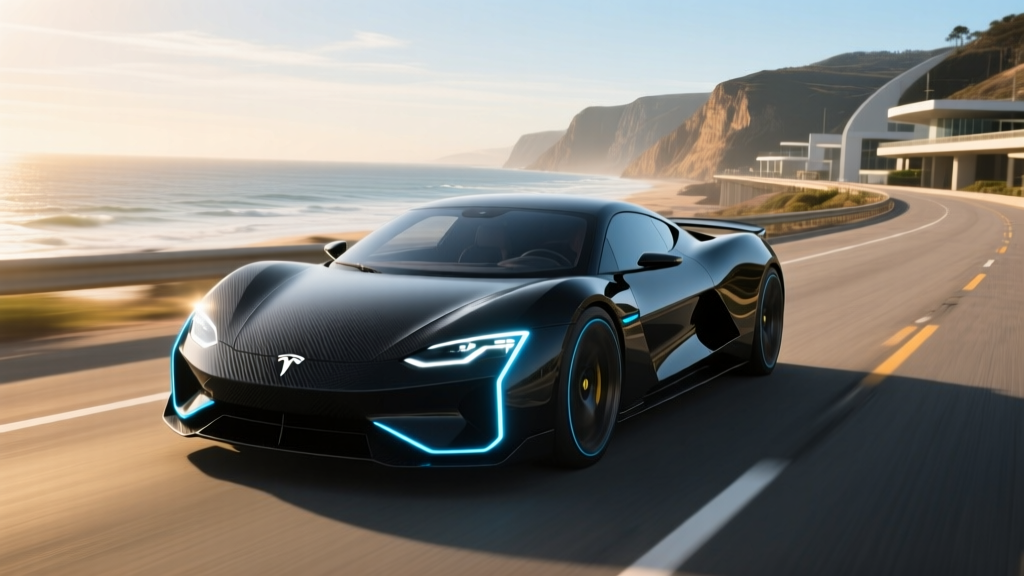
The Tesla Roadster has been the automotive world's most anticipated vaporware since its 2017 unveiling. As of early 2026, Tesla CEO Elon Musk has signaled production could begin late this year, making this the moment to separate confirmed engineering targets from hyperbole. For buyers researching Roadster Tesla speed claims, charging logistics, and whether this $200,000+ electric hypercar is worth reserving, this profile breaks down every published specification — and flags where real-world physics will inevitably trim the marketing numbers.
Tesla Roadster Speed and Performance Targets
The headline number — and the reason enthusiasts have kept deposits alive through years of delays — is acceleration. Tesla's published targets for the next-generation Roadster position it against internal-combustion hypercars costing three to five times as much.
| Specification | Tesla Roadster (Target) |
|---|---|
| 0–60 mph | 1.9 seconds (base); <1 sec with SpaceX package |
| Top Speed | 250+ mph (402+ km/h) |
| Quarter Mile | 8.8 seconds (target) |
| Horsepower | ~1,000+ hp (tri-motor AWD) |
| Drivetrain | All-Wheel Drive (tri-motor: 1 front, 2 rear) |
| Torque Vectoring | Yes, per-wheel |
The base 1.9-second 0–60 mph time already eclipses the original 2020 Roadster target and would make it one of the quickest production cars ever measured. The optional SpaceX cold-gas thruster package — using compressed air stored in carbon-fiber tanks — is claimed to enable sub-1-second runs, though Tesla has not detailed the system's weight, service intervals, or whether it will be street-legal in all jurisdictions.
Torque vectoring across three motors means the Roadster can overdrive the outside wheels in corners, generating lateral grip that Tesla claims will rival dedicated track cars. Whether a 4,400+ lb vehicle with a 200 kWh battery can sustain that grip through repeated hot laps without thermal throttling remains an open question that only production testing will answer.
Battery, Range, and Real-World Efficiency
The Roadster's 200 kWh battery pack is roughly double the capacity of a Tesla Model S Plaid and approximately four times that of a Chevrolet Equinox EV. Tesla has not confirmed cell chemistry, but industry analysis and Tesla's own supply-chain moves point toward high-nickel NMC (nickel-manganese-cobalt) or a next-generation NCA formulation to maximize energy density. LFP chemistry, while durable and cheaper, is too heavy for a performance hypercar application where every kilogram counts.
| Battery & Efficiency | Target / Estimate |
|---|---|
| Battery Capacity | ~200 kWh (usable) |
| Chemistry | NMC or NCA (likely 4680 cells) |
| EPA Range (Target) | 620 miles |
| Real-World Highway | ~480–540 miles (est.) |
| Cold Weather (20°F) | ~350–400 miles (est.) |
| Efficiency (Target) | ~32 kWh/100 mi (~105 MPGe) |
At 620 miles EPA, the Roadster would offer the longest range of any production EV sold in the United States. However, hypercar aerodynamics — optimized for downforce at 200+ mph rather than low-drag efficiency — will work against that figure at sustained highway speeds. Expect real-world highway range to land closer to 480–540 miles under normal summer conditions. In winter, the massive battery becomes an asset: even with a 35–45% cold-weather reduction, you'd still have 350+ miles — more than most EVs manage at their peak.
One important caveat: Tesla's efficiency target of roughly 32 kWh per 100 miles translates to about 105 MPGe. That's respectable for a 1,000-hp hypercar but significantly less efficient than a Tesla Model 3 Long Range (132 MPGe). You're paying for performance, not frugality.
Charging Speed: DC Fast and Home Level 2
A 200 kWh battery is only practical if you can refill it in reasonable time. The Roadster will use Tesla's proprietary NACS connector and have full access to the Supercharger network, which now exceeds 6,000 stations in North America. Tesla has not published a peak DC charge rate for the Roadster, but based on the Cybertruck's 800-volt architecture and 350 kW capability, we expect the Roadster to support at least 350 kW at V4 Superchargers.
| Charging Method | Power (kW) | Time / Rate |
|---|---|---|
| DC Fast Charge (V4 Supercharger) | ~350 kW (peak, est.) | 10–80% in ~30–40 min (est.) |
| Level 2 Home (Wall Connector) | 11.5–19.2 kW | ~44–75 mi/hr; full charge in 11–18 hrs |
| Level 1 (120V outlet) | ~1.4 kW | ~4 mi/hr; full charge in 50+ hrs |
Even at 350 kW peak, the sheer size of a 200 kWh pack means a 10–80% session will likely take 30–40 minutes — longer than a Model Y's ~18-minute session but still practical for road-trip rest stops. The charge curve will taper significantly above 80% State of Charge (SoC) to protect cell longevity, so plan to charge to 80% and go rather than waiting for a full top-off on the road.
At home on a 48-amp Wall Connector (11.5 kW), a full charge from empty takes roughly 17–18 hours. Upgrading to an 80-amp circuit with a 19.2 kW capable charger cuts that to about 11 hours — enough to fully replenish overnight. Most Roadster owners will rarely deplete the full pack, making daily top-ups on Level 2 entirely practical.
Pricing, Trims, and Federal Tax Credit Eligibility
The Tesla Roadster occupies a pricing tier where the federal EV tax credit is largely irrelevant to the buyer's decision — but the rules still apply, and understanding them matters for total cost planning.
| Item | Amount |
|---|---|
| Base MSRP (Roadster) | ~$200,000 |
| Founders Series | ~$250,000 (limited to first 1,000) |
| SpaceX Package (Option) | ~$50,000 (est.) |
| Federal Tax Credit (§30D) | $0 — exceeds MSRP cap |
| Reservation Deposit | $50,000 (fully refundable) |
Under IRS §30D rules, the federal clean vehicle credit has an MSRP cap of $80,000 for sedans and sports cars. At $200,000+, the Roadster far exceeds this threshold and does not qualify for the $7,500 credit regardless of the buyer's income or the battery's critical-mineral sourcing. This is a vehicle purchased for performance, not incentives.
The $50,000 reservation deposit has been required since 2017 and remains fully refundable. The Founders Series, limited to the first 1,000 units, demands the full purchase price upfront and includes exclusive badging and early delivery priority.
Interior, Cargo, and Daily Practicality
The Roadster is a 2+2 sports car, meaning two front seats and two small rear seats suitable for children or luggage overflow. Tesla's 2017 prototype showed a minimalist interior centered around a large touchscreen, but production details remain sparse.
- Seating: 2+2 configuration (4 passengers max)
- Cargo (rear trunk): Estimated 10–15 cu ft (sports car class)
- Frunk (front trunk): Estimated 3–5 cu ft
- Glass roof: Removable panel stored in trunk (per prototype)
- Infotainment: Expected 17-inch touchscreen, Tesla OS with streaming, gaming, and navigation
This is not a family hauler. Cargo space will accommodate a weekend bag for two, a set of golf clubs, or track-day gear — but not a Costco run. The removable glass roof adds an open-air element that no other EV hypercar offers, though owners should expect wind noise at highway speeds and potential water-sealing concerns over time.
Driver-Assistance Technology and Autonomy
The Roadster will ship with Tesla's latest Autopilot hardware and software, including the option for Full Self-Driving (Supervised). However, it's critical to understand what this system actually does.
For a hypercar, the driver-assist features matter less than in a commuter sedan. Most Roadster owners will want the raw, unfiltered driving experience. That said, Autopilot will be welcome on highway stretches between canyon roads or track days, reducing fatigue on long trips.
Warranty and Battery Longevity
Tesla has not published specific Roadster warranty terms, but based on the Model S Plaid and Cybertruck coverage, we can project the following:
- Basic Vehicle Warranty: 4 years / 50,000 miles
- Battery & Drive Unit: 8 years / 150,000 miles (with minimum 70% capacity retention)
- Roadside Assistance: 4 years / 50,000 miles
With a 200 kWh NMC pack, long-term degradation is a consideration. NMC chemistry typically retains 85–90% capacity after 150,000 miles when charged primarily on Level 2 and kept between 20–80% SoC for daily use. The Roadster's massive battery is actually an advantage here: because most drivers will use only a fraction of its range daily, shallow cycling should extend cell life well beyond the warranty period. A full battery replacement, if ever needed, would likely cost $25,000–$40,000 based on current cell pricing — a non-trivial sum even for a $200,000 car owner.
Roadster vs. Competitors: Is It Worth the Wait?
The Roadster doesn't have direct competitors — nothing else combines 1.9-second acceleration, 600+ mile range, and a sub-$250,000 price. But buyers at this tier cross-shop broadly:
✅ Pros
- Fastest-accelerating production car ever (if targets hold)
- 620-mile range eliminates range anxiety entirely
- NACS + Supercharger network = best road-trip infrastructure
- Tesla OTA updates improve the car over time
- Removable glass roof — unique open-air EV experience
❌ Cons
- Not yet in production — delivery timeline uncertain
- $200,000+ with no federal tax credit eligibility
- 2+2 seating limits practicality for families
- Unproven at sustained track use (thermal management unknown)
- Tesla service center capacity strained in many markets
Compared to the Rimac Nevera (1,914 hp, $2.2M, 1.85-sec 0–60, 340-mile range): The Nevera is faster and already in production, but costs 10x more and has half the range. The Roadster is a relative bargain if it delivers.
Compared to the Lotus Evija (1,972 hp, ~$2.3M, ~2.0-sec 0–60, ~250-mile range): Similar story — the Evija exists today but at a stratospheric price with limited range and CCS charging at just 350 kW.
Compared to the Tesla Model S Plaid (1,020 hp, $89,990, 1.99-sec 0–60, 396-mile range): The Plaid is available now, costs less than half, and is nearly as quick. The Roadster's advantages are the extra range, removable roof, and exclusivity — but the Plaid is the rational choice if you simply want Tesla performance today.
Frequently Asked Questions
What is the real-world range of the Tesla Roadster?
Tesla targets 620 miles EPA. In real-world highway driving at 70–80 mph during summer, expect approximately 480–540 miles. In cold weather (below 32°F), range could drop to 350–400 miles due to battery resistance and cabin heating demands. These figures are estimates until the EPA publishes official certification data.
How fast does the Tesla Roadster charge?
At a V4 Supercharger, expect a peak rate around 350 kW, enabling a 10–80% charge in approximately 30–40 minutes. At home on a Tesla Wall Connector at 11.5 kW, a full charge takes about 17–18 hours. An 80-amp home circuit at 19.2 kW reduces that to roughly 11 hours.
Does the Tesla Roadster qualify for the federal EV tax credit?
No. Under IRS §30D rules, the $7,500 federal clean vehicle credit has an MSRP cap of $80,000 for sedans and sports cars. The Roadster's ~$200,000 base price far exceeds this limit, making it ineligible regardless of buyer income or battery sourcing.
Is the Tesla Roadster worth buying vs. competitors?
If you want the fastest-accelerating EV with the longest range and can wait for production, the Roadster is compelling at $200,000 — far below the $2M+ Rimac Nevera or Lotus Evija. However, if you need a car today, the Tesla Model S Plaid delivers 90% of the performance for under $90,000. The Roadster is for buyers who value exclusivity, the open-air roof, and bragging rights over practicality.
When will the Tesla Roadster actually be available?
As of early 2026, Tesla has signaled production could begin late this year, but the company has a history of significant delays. The Roadster was originally announced for 2020 production. Reservation holders should plan for potential further delays into 2027.
How much does the Tesla Roadster cost after incentives?
The base Roadster is expected at ~$200,000. The Founders Series (first 1,000 units) is ~$250,000. With no federal tax credit eligibility and no state incentives applicable at this price point, the out-of-pocket cost equals the sticker price plus destination fees, taxes, and registration. Some states may offer non-income-based perks like HOV lane access, but direct financial incentives are essentially zero.
Sources: Tesla product pages, IRS Clean Vehicle Credits, EPA Fuel Economy. All Roadster specifications cited are Tesla-published targets and are subject to change upon final production and EPA certification.