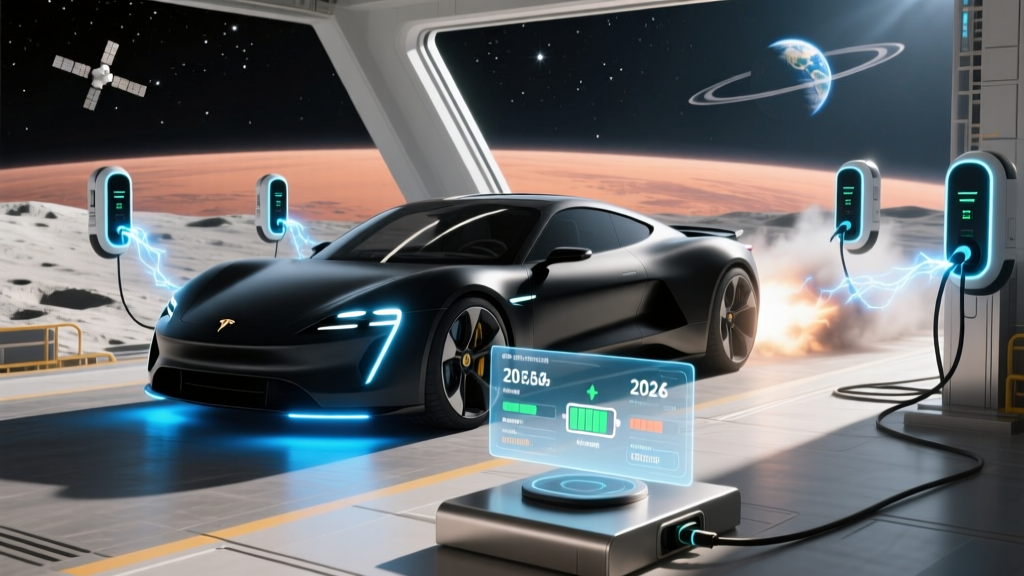
The original Tesla Roadster launched into orbit aboard a SpaceX Falcon Heavy on February 6, 2018, and the "Tesla Roadster in space live" stream became one of the most-watched internet moments in automotive history. As of 2026, that midnight-cherry Roadster is still drifting through a heliocentric orbit well past Mars, but the live camera feed went dark when the car's 12V battery depleted within hours of launch. Meanwhile, back on Earth, Tesla's second-generation Roadster has been repeatedly announced, repeatedly delayed, and remains unavailable for delivery. This article separates the orbital spectacle from the terrestrial reality, giving you every confirmed spec, realistic pricing expectation, and ownership practicality you need before putting down a deposit on what may be the most extreme EV ever proposed.
The Orbiting Roadster: What "Tesla Roadster in Space Live" Actually Means
When Elon Musk's personal first-generation Tesla Roadster served as the dummy payload for Falcon Heavy's maiden flight, it carried a spacesuit-clad mannequin dubbed "Starman" and a dashboard screen reading "DON'T PANIC." The livestream showed Earth receding against the blackness of space, set to David Bowie's "Space Oddity." That stream lasted roughly four hours before the Roadster's auxiliary battery ran flat.
As of 2026, the car continues on an elliptical solar orbit with an aphelion of approximately 1.66 AU and a perihelion near 0.99 AU, completing one orbit every ~557 days. It crossed Mars' orbital distance in late 2020 and continues to loop through the inner solar system. You can track its approximate position via the Where is Roadster? tracker, but there is no functioning camera, no live video, and no telemetry. The "Tesla Roadster in space live" phenomenon is now a cultural artifact, not an active broadcast.
Second-Gen Tesla Roadster: Announced Specs vs. Production Reality
Tesla first unveiled the second-generation Roadster in November 2017, promising figures that would dwarf every production car on the market. Since then, delivery timelines have slipped from 2020 to 2021, 2022, 2023, 2024, 2025, and now a tentative 2026–2027 window. Tesla's official Roadster page still lists the vehicle with preliminary specifications. Nothing below should be treated as a final, independently verified production spec until Tesla begins customer deliveries.
| Spec | Claimed / Estimated Figure | Status |
|---|---|---|
| EPA Range (target) | 620 miles | Announced, unverified |
| Battery Capacity | ~200 kWh (NMC chemistry expected) | Announced |
| 0–60 mph | 1.9 seconds (base); sub-1 sec with SpaceX package | Claimed |
| Top Speed | 250+ mph | Claimed |
| Drivetrain | Tri-motor AWD (1 front, 2 rear) | Announced |
| Peak Torque (wheel) | 10,000 N·m (~7,376 lb-ft) | Claimed |
| Seating | 2+2 (4 seats) | Announced |
| Roof | Removable glass panel | Announced |
| Base MSRP (announced) | $200,000 | Preliminary |
| Founders Series MSRP | $250,000 | Preliminary, limited to 1,000 units |
Range, Battery Chemistry, and Real-World Expectations
Tesla's stated 620-mile target would make the Roadster the longest-range production EV ever built, surpassing the Lucid Air Grand Touring's EPA-estimated 516 miles. Achieving this figure requires the ~200 kWh battery pack, which would be roughly double the capacity of a Model S Plaid's 100 kWh pack. The added mass of such a pack — likely 1,200–1,400 lbs for the cells alone — creates a physics problem: more weight demands more energy to accelerate and brake, partially offsetting the range advantage.
Chemistry-wise, Tesla is almost certain to use a high-nickel NMC (nickel manganese cobalt) or NCA (nickel cobalt aluminum) formulation. LFP (lithium iron phosphate) cells, used in standard-range Model 3 and Model Y variants, offer excellent cycle life but lower energy density — the wrong trade-off for a hypercar chasing 620 miles.
Charging Speed: DC Fast Charging and Home Level 2
Here is where a 200 kWh battery creates a practical headache. Even at a blistering 350 kW peak DC fast-charge rate — matching the best CCS/NACS infrastructure available in 2026 — filling a 200 kWh pack from 10% to 80% means pushing roughly 140 kWh into the cells. At sustained 350 kW (which no current production EV maintains for an entire session due to charge-curve taper), that math yields ~24 minutes. In reality, expect the Roadster to peak near 350 kW briefly, taper to ~200 kW through the mid-range, and slow further above 70% state of charge. A realistic 10–80% session will likely take 30–40 minutes.
| Charge Level | Power / Rate | Estimated Time or Miles/Hour |
|---|---|---|
| Level 1 (120V / 12A) | ~1.4 kW | ~4 miles per hour of charging |
| Level 2 (240V / 48A) | ~11.5 kW | ~33 miles per hour; full charge in ~17 hours |
| Level 2 (240V / 80A) | ~19.2 kW | ~55 miles per hour; full charge in ~10 hours |
| DC Fast Charge (NACS, peak) | ~350 kW (estimated peak) | 10–80% in ~30–40 minutes |
For home charging, most Roadster owners will need a Tesla Wall Connector on a 60-amp or 100-amp circuit. A 100-amp circuit requires a panel with at least 200 amps of total service capacity — older homes with 100-amp main panels will need a $2,000–$5,000 panel upgrade before installation can proceed. Always consult a licensed electrician for final specs.
Performance: Tri-Motor AWD and the SpaceX Thruster Package
The base Roadster's tri-motor AWD layout — one motor driving the front axle, two motors on the rear — enables torque vectoring and the claimed 1.9-second 0–60 mph time. For context, the Rimac Nevera holds the current production-car benchmark at 1.85 seconds, and it costs $2.2 million.
Tesla has also teased an optional "SpaceX package" featuring cold-gas thrusters mounted around the vehicle to improve cornering, braking, and acceleration. If implemented, Tesla claims sub-1-second 0–60 times. This would require compressed-gas tanks, plumbing, and nozzle assemblies that add weight and complexity, and it raises serious questions about street legality and NHTSA approval. Treat the SpaceX package as speculative until homologation details emerge.
Pricing, Trim Levels, and Federal Tax Credit Eligibility
The announced Roadster pricing structure is straightforward: $200,000 for the base model and $250,000 for the limited Founders Series (1,000 units, fully loaded). Reservations originally required a $50,000 deposit — $5,000 upfront and $45,000 later — though Tesla has adjusted reservation terms over the years.
| Item | Base Model | Founders Series |
|---|---|---|
| Announced MSRP | $200,000 | $250,000 |
| Federal §30D Credit | $0 (exceeds MSRP cap) | $0 (exceeds MSRP cap) |
| Estimated Out-the-Door | ~$205,000+ (dest., fees) | ~$255,000+ |
Under current IRS §30D rules, the federal clean vehicle credit has a hard MSRP cap: $55,000 for sedans and $80,000 for SUVs, vans, and pickup trucks. The Roadster, classified as a passenger car, would face the $55,000 ceiling. At $200,000 MSRP, it is ineligible for the $7,500 credit regardless of battery sourcing or buyer income. There is no workaround — the MSRP cap is absolute under current law.
Additionally, §30D imposes buyer income limits ($150,000 single / $300,000 joint modified AGI) and critical-mineral/battery-component sourcing requirements. Even if the Roadster somehow qualified on price, these rules would need independent verification at the time of purchase.
Cargo, Interior Space, and Daily Practicality
Tesla has described the Roadster as a 2+2, meaning two front seats and two small rear seats suitable for children or cargo overflow. Expect the rear seats to offer minimal legroom — likely under 28 inches — similar to a Porsche 911's rear quarters. Cargo space will be constrained by the mid-engine-equivalent battery layout:
- Frunk (front trunk): Estimated 3–5 cubic feet (battery packaging limits traditional frunk volume)
- Rear cargo area: Estimated 5–8 cubic feet behind rear seats
- Total cargo: ~10–13 cubic feet with rear seats folded (if foldable)
This is a grand-touring sports car, not a family hauler. If you need space for road-trip luggage, a child seat, or weekly grocery runs, a Model S or Lucid Air serves those needs far better.
Tech, Driver Assistance, and Warranty
The Roadster will ship with Tesla's latest infotainment hardware — likely a 17-inch center touchscreen, a digital instrument cluster, and over-the-air update capability. Autopilot will be standard, with Full Self-Driving (Supervised) available as an add-on. However, it is critical to understand that Autopilot and FSD are SAE Level 2 systems: they provide steering and acceleration assistance, but the driver must remain fully engaged, hands on or near the wheel, eyes on the road. This is not autonomous driving.
For warranty, Tesla's current high-performance vehicles (Model S Plaid) carry an 8-year / 150,000-mile battery and drive unit warranty with a minimum 70% capacity retention threshold. Expect the Roadster to match or slightly adjust this coverage given the extreme performance demands on the powertrain. Official warranty terms will be confirmed at launch.
Who Should Consider the Roadster (and Who Shouldn't)?
- You have $200,000+ in discretionary vehicle budget and want a halo electric sports car
- You prioritize straight-line acceleration and range above cargo, comfort, and practicality
- You already own a daily-driver EV and want a weekend/experience car
- You are willing to accept the risk of further delays or spec changes before delivery
- You need a family vehicle with real rear-seat space and cargo capacity (consider Model S, Lucid Air, or Porsche Taycan)
- You depend on federal tax credits to justify an EV purchase
- You want a car you can actually order and take delivery of today
- You prioritize proven reliability data and long-term ownership reviews
Pros and Cons: The Honest Assessment
Pros
- Claimed 620-mile range would shatter EV records if achieved
- Sub-2-second 0–60 mph in the base model; potential sub-1 sec with SpaceX package
- Tri-motor AWD with torque vectoring for exceptional handling
- Tesla Supercharger network access (NACS native)
- Removable glass roof for open-air driving
- OTA software updates and continuous feature improvements
Cons
- Not available for delivery as of early 2026 — repeated delays since 2017
- $200,000+ MSRP with zero federal tax credit eligibility
- 200 kWh pack means extremely long home-charging sessions (10–17 hours)
- 2+2 seating is impractical for families or adult rear passengers
- Unproven specs — no independent EPA testing, no third-party track verification
- SpaceX thruster package raises legality, safety, and maintenance concerns
- Insurance premiums on a 250+ mph, $200K EV will be substantial
Roadster vs. Competitors: How Does It Stack Up?
| Vehicle | 0–60 mph | EPA Range | Price | Availability |
|---|---|---|---|---|
| Tesla Roadster (announced) | 1.9 sec | 620 mi (claimed) | $200,000 | Not yet |
| Rimac Nevera | 1.85 sec | ~287 mi (WLTP) | $2,200,000 | Limited production |
| Lotus Evija | ~3.0 sec | ~217 mi (WLTP) | $2,300,000 | Limited production |
| Tesla Model S Plaid | 1.99 sec | 396 mi | $89,990 | Available now |
| Lucid Air Sapphire | 1.89 sec | 427 mi | $249,000 | Available now |
| Porsche Taycan Turbo GT | 2.1 sec | 269 mi | $230,000 | Available now |
The Model S Plaid delivers 95% of the Roadster's claimed acceleration at less than half the price, and you can drive it home today. The Lucid Air Sapphire matches the Roadster's 0–60 claim with verified, independently tested numbers and 427 miles of real EPA range. For buyers who need a car now, these are the rational alternatives.
FAQ: Tesla Roadster and the Space Stream
Is the Tesla Roadster in space live stream still active?
No. The livestream from the original first-generation Roadster launched on Falcon Heavy ended within hours of liftoff on February 6, 2018, when the car's 12V battery depleted. The car continues to orbit the sun, but there is no functioning camera or telemetry. You can track its approximate orbital position via third-party astronomy tools.
Can I buy the Tesla Roadster right now?
No. As of early 2026, the second-generation Tesla Roadster has not entered production. Tesla has accepted reservations in the past, but delivery timelines have been delayed repeatedly since the 2017 unveiling. No firm delivery date has been confirmed.
What is the real-world range of the Tesla Roadster?
Since no production units exist, there is no verified real-world or EPA-tested range. Tesla claims a 620-mile target. Based on EV physics, expect roughly 450–500 miles at highway speeds in mild weather and 350–400 miles in freezing conditions if the 200 kWh pack materializes as described.
How fast does the Roadster charge?
Estimated: ~350 kW peak DC fast charging (10–80% in roughly 30–40 minutes) and ~11.5–19.2 kW on Level 2 home charging, depending on your amperage. A full Level 2 charge of a 200 kWh pack takes 10–17 hours.
Does the Tesla Roadster qualify for the federal EV tax credit?
No. Under IRS §30D rules, the clean vehicle credit has an MSRP cap of $55,000 for passenger cars. At $200,000+ MSRP, the Roadster is ineligible regardless of battery sourcing or buyer income.
Is the Roadster worth the $200,000 price vs. a Model S Plaid?
On pure performance-per-dollar, the $89,990 Model S Plaid (1.99-sec 0–60, 396-mi EPA range, available today) is the rational choice. The Roadster's value proposition rests on exclusivity, the 620-mile range claim, and the novelty factor — but only if Tesla actually delivers it.
Will the SpaceX thruster package be street-legal?
Unclear. Cold-gas thrusters that expel compressed gas to generate downforce or lateral acceleration raise significant NHTSA and state-level regulatory questions. Tesla has not provided homologation details. Treat this feature as speculative.
The "Tesla Roadster in space live" phenomenon captured imaginations in 2018 and continues to generate search interest, but the car circling the sun is a spent artifact, not a product. The earthbound second-generation Roadster remains one of the most ambitious EV concepts ever announced — and one of the most delayed. If Tesla delivers on even 80% of its claims, the Roadster will be an engineering landmark. Until then, buyers seeking extreme electric performance have proven, available alternatives that don't require a leap of faith.