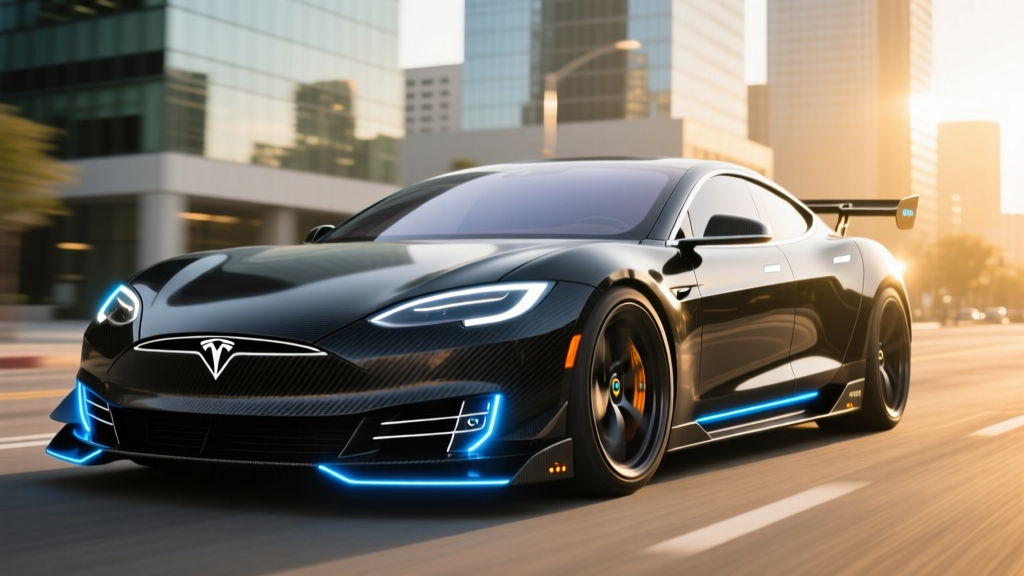
The phrase "Tesla rocket" has dominated EV forums and social media since Elon Musk first floated the idea of equipping the next-generation Tesla Roadster with cold-gas thrusters borrowed from SpaceX. As we move through 2026, the second-generation Roadster remains one of the most anticipated—and most delayed—vehicles in automotive history. While Tesla has confirmed reservations and teased performance targets, the car has not yet entered customer deliveries.
This profile synthesizes everything Tesla has officially disclosed about the Roadster and its optional "SpaceX Package" (colloquially called the "rocket" package), cross-referenced with real-world EV physics, current §30D tax credit rules, and the competitive hypercar landscape. If you're researching whether to hold your deposit or pivot to a Rimac Nevera or Lotus Evija, this is the data-driven breakdown you need.
The Tesla Roadster (Gen 2) is an announced vehicle. Specs below reflect Tesla's stated targets and engineering disclosures as of early 2026. Final EPA certification, production pricing, and delivery timelines remain unconfirmed. Treat all figures as preliminary estimates.
Tesla Roadster Rocket Package: Core Specifications (Announced)
| Attribute | Tesla Estimate / Target |
|---|---|
| EPA Range (targeted) | ~620 miles (base), ~500+ miles (SpaceX Package due to weight) |
| Battery Capacity | 200 kWh (stated by Musk, likely NMC chemistry) |
| Drivetrain | Tri-motor AWD (1 front, 2 rear) |
| Horsepower | 1,000+ hp (estimated, final TBD) |
| 0–60 mph | <1.0 second (with SpaceX Package thrusters); ~1.9s base |
| Top Speed | 250+ mph (targeted) |
| Max DC Fast Charge | 250+ kW (estimated, 400V architecture likely) |
| 10–80% DC Charge Time | ~35–45 minutes (estimated based on 200 kWh pack) |
| Level 2 Home Charging | ~48 kW capable (~170 miles/hr estimated) |
| Base MSRP (targeted) | $200,000 (base); $250,000 (Founders Series) |
| Federal Tax Credit | Not eligible (exceeds §30D MSRP cap) |
| Battery Warranty | Expected 8 yr / 150,000 mi (based on Tesla precedent) |
What the SpaceX 'Rocket' Package Actually Does
The so-called "rocket" package is officially called the SpaceX Package. It replaces the Roadster's rear seats with a cold-gas thruster system using compressed air (not combustion-based rocket fuel). Tesla and SpaceX have stated these thrusters are positioned around the vehicle to improve:
- Acceleration: Directed thrust assists launch, contributing to the sub-1.0-second 0–60 mph claim.
- Braking: Forward-facing thrusters can provide deceleration force beyond mechanical brakes.
- Cornering: Lateral thrusters increase effective downforce and grip mid-corner.
- Top speed stability: Active aero + thrusters manage airflow at 250+ mph.
This is not a combustion rocket. Cold-gas systems use stored high-pressure gas (likely nitrogen or compressed air) expelled through nozzles—similar to the reaction control systems on spacecraft. The tradeoff is weight: the thruster hardware, pressure vessels, and plumbing add significant mass, which is why the SpaceX Package variant will likely sacrifice some range compared to the base Roadster.
Real-World Range Expectations: Beyond the 620-Mile Target
A 200 kWh battery pack targeting 620 miles of EPA range implies an efficiency of roughly 32.3 kWh per 100 miles (or ~3.1 mi/kWh). That's achievable for a low-drag sports car under ideal conditions, but real-world physics tells a different story depending on how you drive.
- EPA Target: ~620 miles (base Roadster)
- Highway (70–80 mph sustained): Expect ~430–480 miles. Aerodynamic drag dominates at speed; the Roadster's low roofline helps, but 80 mph consumes roughly 30% more energy than the EPA mixed cycle.
- Cold weather (below 32°F): Expect ~370–430 miles. Lithium-ion cells lose efficiency in cold; cabin heating (even with a heat pump) draws additional load. A 200 kWh NMC pack will be particularly sensitive to cold-soak.
- Track use / aggressive driving: Range drops dramatically—potentially below 200 miles per charge under sustained high-load conditions.
The SpaceX Package variant, carrying additional thruster hardware weight, will likely see EPA range closer to 500–550 miles with similar real-world reductions applied.
Charging Speed: The 200 kWh Problem
Here's where a massive battery creates a practical challenge. Even if Tesla equips the Roadster with its latest V4 Supercharger hardware (capable of delivering up to 350 kW at the pedestal), the vehicle's charge acceptance rate and the thermal limits of a 200 kWh pack will govern actual charging speed.
| Charging Level | Power (kW) | Estimated Rate | Notes |
|---|---|---|---|
| Level 1 (120V) | ~1.4 kW | ~4–5 mi/hr | Emergency only; full charge in 140+ hours |
| Level 2 (240V, 48A) | ~11.5 kW | ~35–40 mi/hr | Home charging; full charge in ~18 hours |
| Level 2 (240V, 80A) | ~19.2 kW | ~60–65 mi/hr | Requires Tesla Wall Connector + 100A circuit; full charge in ~11 hours |
| DC Fast (V3 Supercharger) | 250 kW peak | ~15–20 min per 100 mi | 10–80% in ~35–45 min; taper above 80% |
| DC Fast (V4 Supercharger) | 350 kW peak (if supported) | ~12–15 min per 100 mi | Depends on Roadster's onboard charge acceptance |
The charge curve reality: A 200 kWh battery charging at 250 kW peak will only sustain that rate at low states of charge (roughly 10–30% SoC). As the pack fills, the battery management system (BMS) tapers current to protect cell health. Expect the 10–80% session to take 35–45 minutes at a V3 Supercharger. The last 20% (80–100%) will add another 30+ minutes. For road trips, plan 40-minute stops every ~350–400 real-world miles.
kW vs kWh reminder: kW (kilowatts) measures the rate of charging—like water flow from a hose. kWh (kilowatt-hours) measures the battery's total energy capacity—like the size of the tank. The Roadster's 200 kWh battery is the tank; a 250 kW charger is the hose filling it.
Performance: Tri-Motor AWD and the Sub-1-Second Claim
Tesla's tri-motor layout (one front, two rear) enables torque vectoring across the rear axle while the front motor provides all-wheel-drive traction and regenerative braking. In the base configuration, Tesla has targeted a 1.9-second 0–60 mph time—matching the Model S Plaid.
The SpaceX Package's sub-1.0-second claim relies on cold-gas thrusters augmenting mechanical grip during launch. If achieved, it would make the Roadster the quickest-accelerating production car in history, surpassing the Rimac Nevera's 1.85-second run. However, this figure likely requires specific surface conditions (prepped drag strip, warm tires) and may not reflect typical street launches.
Tesla has not published final horsepower or torque figures. Given the tri-motor architecture and the Plaid's 1,020 hp as a baseline, expect the Roadster to produce 1,000–1,200 hp, with the SpaceX Package variant potentially exceeding that through thrust augmentation during acceleration phases.
Pricing, Tax Credits, and Ownership Economics
The Tesla Roadster was originally announced with a $200,000 base price and a $250,000 Founders Series (limited to the first 1,000 reservations). A $50,000 reservation deposit was required, with Founders Series buyers paying the full amount upfront.
| Trim | Announced MSRP | §30D Tax Credit | Effective Price |
|---|---|---|---|
| Base Roadster | $200,000 | $0 (exceeds MSRP cap) | $200,000 |
| Founders Series | $250,000 | $0 (exceeds MSRP cap) | $250,000 |
| SpaceX Package (add-on) | +$50,000 (est.) | $0 | $250,000–$300,000 |
Federal tax credit reality: Under current IRS §30D rules, the clean vehicle credit is capped at vehicles with an MSRP of $55,000 (sedans) or $80,000 (SUVs, trucks, vans). The Roadster, as a sports car priced above $200,000, does not qualify regardless of battery sourcing or buyer income. Additionally, buyer income caps ($150,000 single / $300,000 joint for modified AGI) would exclude many potential buyers even if the MSRP cap didn't. There is no federal EV tax credit pathway for this vehicle.
Total cost of ownership considerations: Insurance for a 1,000+ hp, $200K+ electric hypercar will be substantial—expect annual premiums in the $8,000–$15,000 range depending on driving record and location. Tire wear on a heavy, high-torque AWD sports car will also be a recurring cost; expect to replace performance tires every 10,000–15,000 miles at $400–$600 per corner.
Interior, Cargo, and Daily Usability
The Roadster is a 2+2 coupe in its base configuration, though Tesla has indicated the rear seats are best suited for children or cargo. The SpaceX Package eliminates rear seating entirely to accommodate the thruster system and pressure vessels.
- Front legroom: Expected ~42 inches (sports car typical)
- Rear legroom (base only): Estimated ~28–30 inches (occasional use)
- Cargo (trunk + frunk): Estimated ~15–18 cu ft combined (sports car coupe typical)
- Cargo (SpaceX Package): Rear seat area becomes cargo space, potentially adding ~10 cu ft
Tesla's minimalist interior approach is expected: a central touchscreen (likely 17-inch, similar to Model S/X), yoke or conventional steering wheel (buyer's choice), and a glass roof panel (removable, per earlier disclosures). Do not expect the luxury materials of a Porsche Taycan or the bespoke craftsmanship of a Rimac Nevera—Tesla prioritizes performance and technology over traditional luxury finishes.
Tech, Driver Assistance, and the Autopilot Question
The Roadster will ship with Tesla's latest hardware suite (expected HW4 or newer), supporting:
- Autopilot: Standard lane-keeping, adaptive cruise, and traffic-aware features.
- Full Self-Driving (Supervised): Available as a paid option. Note: FSD is an SAE Level 2 driver-assistance system. The driver must remain fully engaged, hands on wheel (or yoke), eyes on road at all times. It is not autonomous driving.
- Infotainment: Tesla's proprietary OS with streaming, gaming, and navigation. Expect over-the-air (OTA) updates throughout ownership.
- Vehicle dynamics: Active suspension, torque vectoring, and (with SpaceX Package) thruster-assisted stability control.
Tesla Autopilot and FSD (Supervised) are SAE Level 2 systems. They do not make the Roadster self-driving. The driver is legally and practically responsible for all vehicle operation at all times. Track use at 250+ mph will disable all driver-assist features. See NHTSA guidance on automated vehicle safety for context.
Roadster vs. the Competition: Is It Worth the Wait?
The Roadster occupies a unique space: an electric hypercar priced below its European rivals but with a delivery timeline that has stretched from an original 2020 target to a still-unconfirmed date. Here's how it stacks up against vehicles you can actually buy today:
| Spec | Tesla Roadster (Announced) | Rimac Nevera | Lotus Evija | Porsche Taycan Turbo GT |
|---|---|---|---|---|
| Price | $200K–$250K | ~$2.2M | ~$2.3M | ~$230K |
| 0–60 mph | <1.0s (SpaceX) / 1.9s | 1.85s | <3.0s | 2.1s |
| Range (EPA/WLTP) | ~620 mi (target) | ~300 mi (WLTP) | ~217 mi (WLTP) | ~269 mi (EPA) |
| Battery | 200 kWh | 120 kWh | 70 kWh | 105 kWh |
| Availability | Not yet delivering | In production | In production | In production |
| Supercharger Access | Yes (native NACS) | No (CCS) | No (CCS) | No (CCS/NACS adapter) |
- Choose the Roadster if: You want the highest performance-per-dollar in the electric hypercar segment, you're a Tesla ecosystem loyalist who values Supercharger access, and you're willing to wait for an unconfirmed delivery date with a $50K deposit at risk.
- Choose the Porsche Taycan Turbo GT if: You want a $230K electric performance car you can drive today, with proven build quality, dealer service infrastructure, and a more practical four-door layout.
- Choose the Rimac Nevera if: Budget is not a constraint and you want a delivered, proven, record-setting electric hypercar with bespoke craftsmanship.
Pros and Cons: The Honest Assessment
- Sub-1.0s 0–60 mph would be a production car record (SpaceX Package)
- 620-mile target range dwarfs every other electric sports car
- Native Tesla Supercharger network access (NACS connector)
- OTA updates improve the car over time
- Price undercuts European hypercars by 10x
- Tri-motor AWD with torque vectoring
- Removable glass roof panel
- Still not delivering—years past original timeline
- No federal tax credit eligibility (MSRP far exceeds caps)
- SpaceX Package adds weight, reducing range
- Cold-gas thruster system is unproven in production road cars
- Tesla's build quality and service infrastructure may not match the price point
- Insurance costs will be extreme
- Final specs and pricing remain unconfirmed
- $50,000 reservation deposit tied up indefinitely
Frequently Asked Questions
What is the real-world range of the Tesla Roadster?
Tesla targets ~620 miles EPA for the base Roadster with its 200 kWh pack. In real-world highway driving at 70–80 mph, expect roughly 430–480 miles. In cold weather (below freezing), anticipate 370–430 miles. The SpaceX Package variant will likely see reduced range due to added thruster system weight.
How fast does the Tesla Roadster charge?
At a Tesla V3 Supercharger (250 kW peak), expect a 10–80% charge in approximately 35–45 minutes, adding roughly 15–20 miles of range per minute of charging at peak rate. The charge curve tapers significantly above 80% SoC. Home Level 2 charging at 48A/240V will add roughly 35–40 miles per hour, requiring an overnight session for a full charge of the 200 kWh pack.
Does the Tesla Roadster qualify for the federal EV tax credit?
No. Under current IRS §30D rules, the clean vehicle credit has an MSRP cap of $55,000 for sedans and sports cars. The Roadster's $200,000+ price disqualifies it entirely, regardless of battery sourcing or buyer income.
Is the Tesla Roadster worth buying vs. competitors?
If Tesla delivers on its targets, the Roadster offers hypercar performance at a fraction of the Rimac Nevera's $2.2M price. However, the Taycan Turbo GT is available now at a similar price point with proven reliability. The Roadster is a bet on Tesla's ability to execute—rewarding if they deliver, frustrating if delays continue.
What battery chemistry will the Roadster use?
Tesla has not officially confirmed, but a 200 kWh pack targeting extreme range and performance will almost certainly use NMC (nickel manganese cobalt) chemistry rather than LFP. NMC offers higher energy density, which is critical for fitting 200 kWh into a sports car form factor. LFP is heavier and better suited to standard-range, cost-focused vehicles.
When will the Tesla Roadster actually ship?
As of early 2026, Tesla has not provided a firm delivery date. The vehicle has been delayed multiple times since its 2017 unveiling. Reservation holders should monitor Tesla's quarterly earnings calls for production timeline updates and treat any announced date with cautious optimism until VINs are being assigned.