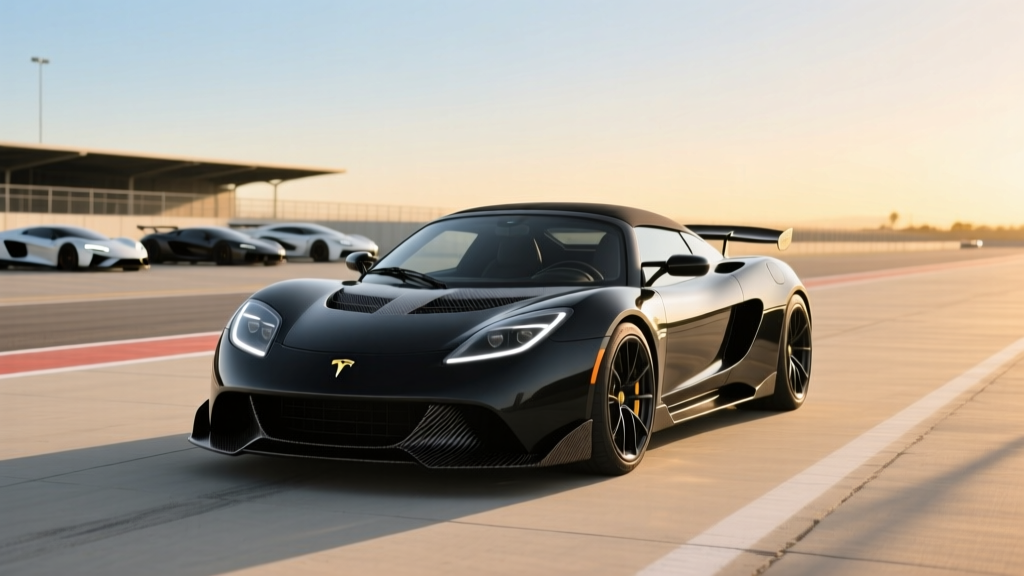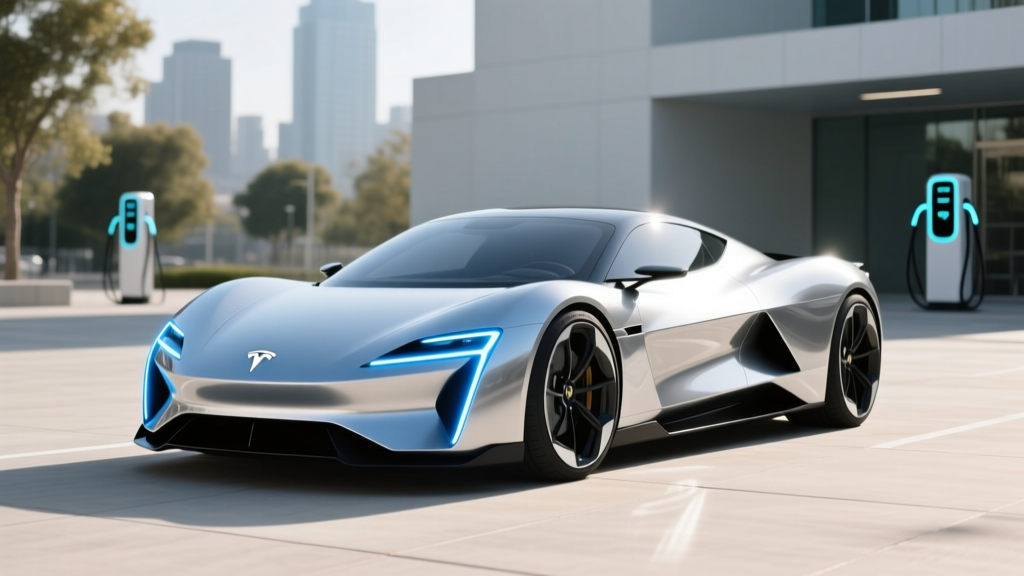
If you've been tracking the Tesla Roadster since its 2017 unveiling, you know the saga: repeated delays, shifting specs, and a reservation process that has left many deposit-holders wondering when — or if — they'll take delivery. As of early 2026, the next-generation Roadster remains an announced but unreleased vehicle. Tesla has not confirmed a firm production start date, and specifications below are based on Tesla's most recent public statements and earnings calls. Treat every number as preliminary until Tesla begins customer deliveries and the EPA publishes official ratings.
This guide breaks down what we know about the Roadster's battery, range, charging, performance, pricing, and tax-credit outlook — and helps you decide whether holding (or placing) a reservation for the Tesla Roadster makes financial and practical sense versus buying an available high-performance EV today.
Tesla Roadster Preliminary Specifications (2026 Estimate)
The table below aggregates Tesla's announced targets. None of these figures carry EPA certification yet. For comparison, we've included the closest current-market rival, the Rimac Nevera, and Tesla's own Model S Plaid.
| Spec | Tesla Roadster (Prelim.) | Tesla Model S Plaid | Rimac Nevera |
|---|---|---|---|
| EPA Range (est.) | 620 mi (claimed) | 396 mi (EPA) | N/A (WLTP ~340 mi) |
| Battery Capacity | ~200 kWh (announced) | 100 kWh (usable ~95) | 120 kWh |
| Battery Chemistry | Unconfirmed (likely NMC/NCA) | NMC/NCA | NMC |
| Peak DC Fast Charge | Unannounced (est. 250-350 kW) | 250 kW | 500 kW |
| 10-80% DC Charge Time | TBD | ~27 min | ~19 min |
| Level 2 Home Charge | TBD (est. 11.5 kW / 44 mi/hr) | 11.5 kW / 44 mi/hr | 22 kW |
| 0-60 mph | 1.9 sec (claimed, w/ SpaceX pkg) | 1.99 sec | 1.85 sec |
| Horsepower | 1,000+ HP (tri-motor AWD) | 1,020 HP | 1,914 HP |
| Drivetrain | Tri-motor AWD | Tri-motor AWD | Quad-motor AWD |
| Top Speed | 250+ mph (claimed) | 200 mph | 258 mph |
| Base MSRP | $200,000 (Founders Series $250K) | $89,990 | ~$2,200,000 |
| Seating | 2+2 (tight rear) | 5-passenger | 2-passenger |
| Cargo Volume | TBD (minimal, est. <5 cu ft combined) | 28 cu ft | Frunk only, ~3.5 cu ft |
| Battery Warranty | Likely 8 yr / 150,000 mi | 8 yr / 150,000 mi | 8 yr / 100,000 km |
Range Reality Check: 620 Miles Claimed vs. Real-World Physics
Real-World Expectation: 430–500 miles highway; 350–420 miles in cold weather (below 32°F); potentially 520+ miles in moderate city driving with regen.
Tesla's 620-mile claim would shatter every production EV record if it reaches EPA certification. But buyers should anchor expectations in physics, not marketing. A 200 kWh battery in a low-slung sports coupe with wide, sticky tires and aggressive aero will not deliver the efficiency of a Model 3 Long Range.
Here's how the math likely shakes out:
- Highway driving at 75 mph: Expect roughly 3.5–4.0 miles per kWh, yielding 430–500 miles from a 200 kWh pack (assuming ~190 kWh usable after buffer).
- City/regenerative driving: Regen recaptures significant energy at lower speeds; 500+ miles is plausible in mild conditions.
- Cold weather (below freezing): Lithium-ion cells lose 20–30% effective capacity in extreme cold, and cabin heating draws 3–6 kW continuously. Expect 350–420 miles.
- Track use: At sustained high-power output, consumption can exceed 1.5 mi/kWh. Plan for under 150 miles between charges on a circuit.
Tesla has hinted at a heat pump and advanced thermal management, which would mitigate cold-weather losses somewhat. Until EPA testing is published on fueleconomy.gov, treat 620 miles as a best-case laboratory figure — not what you'll see on I-5 in December.
Battery, Chemistry, and Charging Speed
The Roadster's rumored 200 kWh pack would be the largest ever installed in a production passenger vehicle. For context, the GMC Hummer EV carries a ~212 kWh pack but weighs over 9,000 lbs — a very different application.
Chemistry: Tesla has not confirmed the cell chemistry, but given the performance and energy-density requirements, an NMC (nickel manganese cobalt) or NCA (nickel cobalt aluminum) formulation is almost certain. LFP (lithium iron phosphate) cells are heavier and less energy-dense — incompatible with a lightweight sports car targeting 620 miles.
DC Fast Charging: Tesla has not published a peak charge rate. However, the Roadster will use the NACS connector and access the Tesla Supercharger network. Given the pack size, a 250 kW peak rate (V3 Supercharger) would require roughly 45–55 minutes for a 10–80% charge. If Tesla deploys V4 Superchargers at 350+ kW on key corridors, that time could drop to 30–40 minutes. Either way, charging a 200 kWh battery is fundamentally a longer affair than topping off a 75 kWh pack.
Level 2 Home Charging: Expect an 11.5 kW onboard charger (48A on a 60A circuit), consistent with Tesla's current architecture. That yields roughly 44 miles of range per hour of charging, or a full 0–100% charge in approximately 17–19 hours. Most owners will charge overnight to 80% and rarely need a full cycle.
Performance, Drivetrain, and the SpaceX Thruster Package
The Roadster's tri-motor all-wheel-drive layout — one front motor, two rear — mirrors the Model S Plaid architecture but is expected to push output well past 1,000 HP. Tesla claims a 1.9-second 0–60 mph time, though that figure is tied to the optional "SpaceX package" that includes cold-gas thrusters mounted around the rear license plate area.
Without the thruster package, 0–60 times are expected in the low 2-second range — still blisteringly quick and on par with the Model S Plaid's 1.99-second verified time.
Top speed is claimed at 250+ mph, which would require not just power but exceptional aerodynamic management and tire ratings. Few production tires are certified for sustained 250+ mph operation; expect the Roadster to ship with bespoke Michelin or Pirelli rubber.
Practical note: A sub-2-second 0–60 time is a party trick, not a daily-use feature. What matters more for real driving is the Roadster's mid-range acceleration, torque-vectoring capability, and suspension tuning — details Tesla has not yet shared in depth.
Pricing, Trims, and Federal Tax Credit Eligibility
| Trim | Base MSRP | Federal Tax Credit (§30D) | Effective Price |
|---|---|---|---|
| Roadster (Base) | $200,000 | $0 — exceeds MSRP cap | $200,000 |
| Founders Series | $250,000 | $0 — exceeds MSRP cap | $250,000 |
Here's the hard truth for reservation holders: the Tesla Roadster will not qualify for the $7,500 federal EV tax credit under IRS §30D. The credit applies only to vehicles with a base MSRP at or below $55,000 (sedans, coupes, wagons) or $80,000 (SUVs, trucks, vans). At $200,000+, the Roadster exceeds every MSRP cap by a wide margin.
Additionally, buyer income caps apply under §30D (adjusted gross income of $150,000 single / $300,000 joint filers for 2026), though most buyers in this price bracket will exceed those limits regardless. Battery sourcing and critical-mineral requirements add further complexity, but they're moot when the MSRP cap is this far out of reach.
For full details on current-year §30D rules, consult the IRS Clean Vehicle Credit page or speak with a tax professional.
Interior, Tech, and Daily Usability
The Roadster is a 2+2 coupe, meaning two front seats and two rear seats that are best described as luggage shelves with seatbelts. Expect minimal rear legroom — likely under 24 inches — and a combined cargo volume (frunk plus any rear storage) well under 5 cubic feet. This is a weekend car, not a Costco hauler.
Infotainment: Expect Tesla's latest hardware (HW5 or later) with a central touchscreen, likely 15–17 inches, running Tesla's proprietary OS. Navigation, streaming, gaming, and over-the-air updates will be standard.
Driver Assistance: The Roadster will ship with Tesla's Autopilot suite and the option to purchase FSD (Supervised). Per NHTSA and SAE classifications, this is a Level 2 driver-assist system — it does not make the car self-driving. The driver must remain fully engaged, hands on or near the wheel, eyes on the road, at all times.
Notable drawbacks: The Roadster's low ride height, wide body, and large wheels will make speed bumps, steep driveways, and potholes genuine concerns. Ground clearance is expected around 4.5–5 inches. A front-axle lift system (like the one on the Model S) is likely but unconfirmed.
Who Should Hold a Tesla Roadster Reservation?
Hold your reservation if:
- You want a halo EV sports car with unmatched claimed range and Tesla ecosystem integration
- You already own a practical daily driver and can wait indefinitely for delivery
- You value the potential collector/resale upside of a limited-production Tesla
Consider redirecting your deposit if:
- You need a car within 12 months — the Roadster's production timeline remains uncertain
- You want a practical performance EV today (Model S Plaid at $89,990 is available now)
- You're uncomfortable with a $200,000+ vehicle that cannot be test-driven or EPA-verified
- You want federal tax credit benefits (not available at this price point)
Reservation Process and Deposit Details
Tesla has historically required a $50,000 reservation deposit for the Roadster ($5,000 initial + $45,000 to secure a Founders Series or early production slot). Deposits have been listed as refundable on Tesla's website, though terms have shifted over the years. Before placing or maintaining a reservation, confirm the current refund policy directly on Tesla's Roadster page.
Given that Tesla has delayed the Roadster multiple times since 2017 — originally targeting 2020, then 2022, then 2025 — reservation holders should view their deposit as an expression of interest, not a firm purchase commitment. Production priority may depend on deposit date, trim selection, and Tesla's internal allocation decisions.
Tesla Roadster Pros and Cons
Pros
- Claimed 620-mile range would be the longest of any production EV
- Sub-2-second 0–60 mph (with SpaceX package) — hypercar performance
- Tri-motor AWD with advanced torque vectoring
- Tesla Supercharger network access (17,000+ NACS stalls in North America)
- Over-the-air updates and Tesla software ecosystem
- Potential collector value as a limited-production halo car
Cons
- Not yet in production — delivery timeline uncertain
- $200,000+ MSRP with no federal tax credit eligibility
- All specs are preliminary and unverified by EPA
- 2+2 seating with minimal cargo space — impractical as a daily driver
- 200 kWh battery means long DC charging sessions (45+ min 10–80%)
- Low ground clearance and wide body limit parking and road usability
- $50,000 deposit ties up capital for an indefinite period
Frequently Asked Questions
What is the real-world range of the Tesla Roadster?
Tesla claims 620 miles, but real-world highway driving at 75 mph will likely yield 430–500 miles, and cold-weather range could drop to 350–420 miles. These are estimates based on the announced 200 kWh pack; no EPA certification exists yet.
How fast does the Roadster charge at home and on DC fast chargers?
DC fast charging details are unannounced, but a 250–350 kW peak rate is plausible, translating to 45–55 minutes for 10–80% at a V3 Supercharger. Home Level 2 charging at 11.5 kW would add ~44 miles per hour, with a full charge taking roughly 17–19 hours.
Does the Tesla Roadster qualify for the $7,500 federal EV tax credit?
No. Under IRS §30D rules, the Roadster's $200,000+ MSRP far exceeds the $55,000 cap for coupes and sedans. Buyer income caps and battery-sourcing requirements further limit eligibility, though the MSRP alone disqualifies it.
Is the Roadster worth the reservation vs. buying a Model S Plaid now?
If you need a car soon, the Model S Plaid ($89,990, 1,020 HP, 396 mi EPA range, available now) delivers 90% of the performance for less than half the price. The Roadster makes sense only as a speculative halo/collector purchase for those who can wait.
When will Tesla Roadster reservations convert to actual deliveries?
Tesla has not confirmed a firm production date. Elon Musk has referenced 2025–2026 timeframes in earnings calls, but Tesla's history of delays (original target was 2020) warrants skepticism. Treat any announced date as aspirational until customer deliveries begin.
What happens to my reservation deposit if I cancel?
Tesla has historically listed Roadster deposits as refundable, but terms can change. Confirm the current refund policy on Tesla's website before committing or cancelling.