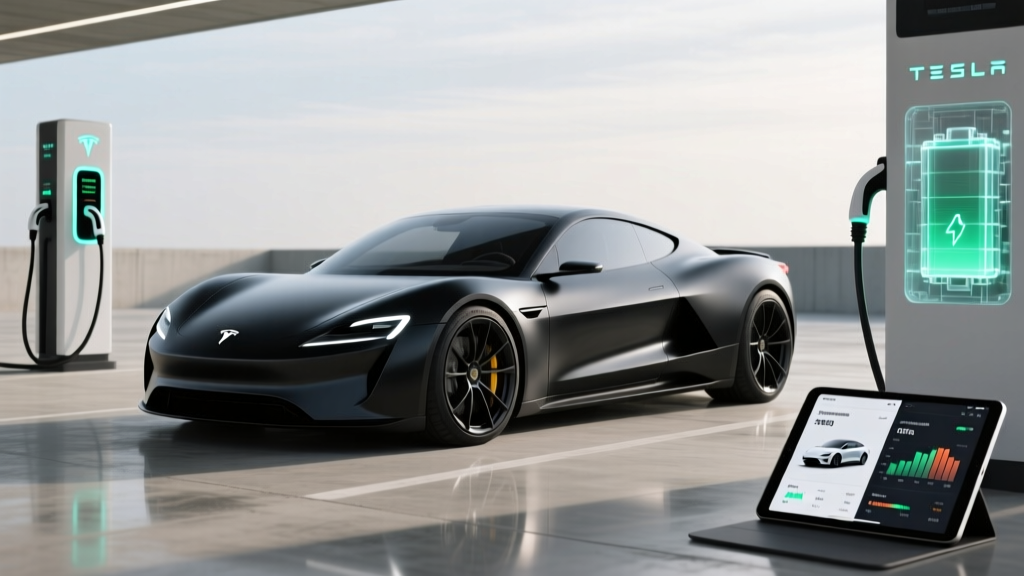
It has been nearly eight years since Tesla unveiled the second-generation Roadster, and as of early 2026, the halo sports car remains an announced vehicle — not yet in production, not yet on sale, and not yet independently tested by the EPA. For the thousands of buyers who placed refundable reservations (initially $50,000, later adjusted for some holders), the wait has prompted a quiet but growing question: should you cancel your Tesla Roadster reservation, hold your spot, or pivot to a competitor that actually exists?
This guide dissects what Tesla has officially claimed, what remains unverified, how the federal EV tax credit applies (or doesn't), and which real-world alternatives deliver comparable performance today. If you are evaluating a Tesla Roadster reservation cancellation, these are the data points you need.
Tesla Roadster: Announced Specifications at a Glance
Before assessing whether to cancel, here is everything Tesla has publicly stated about the next-generation Roadster. Important caveat: These are manufacturer claims from unveil events and earnings calls — not EPA-certified figures or independent test results. Tesla has a documented history of delaying timelines and adjusting specifications before production (the Cybertruck, Roadster 2.0 itself, and the Semi all experienced this).
| Attribute | Claimed Figure | Status |
|---|---|---|
| EPA Range (est.) | 620 miles | Unverified / Tesla claim |
| Battery Capacity | ~200 kWh (usable, est.) | Unverified |
| Battery Chemistry | Not disclosed (likely NMC/NCA) | Assumed |
| 0–60 mph | 1.1 sec (w/ SpaceX package) / 1.9 sec (base) | Unverified |
| Top Speed | 250+ mph | Unverified |
| Horsepower | ~1,000+ hp (tri-motor AWD) | Unverified |
| Drivetrain | AWD, tri-motor (one front, two rear) | Announced |
| Max DC Fast Charge | Not officially disclosed | Unknown |
| 10–80% DC Charge Time | Not officially disclosed | Unknown |
| Level 2 Home Charge Rate | Not officially disclosed | Unknown |
| Seating | 2+2 (4 seats, tight rear) | Announced |
| Cargo Volume | Not disclosed (frunk + rear trunk expected) | Unknown |
| Base MSRP (announced) | $200,000 (base) / $250,000 (Founders Series) | Preliminary |
| Reservation Deposit | $50,000 (fully refundable) | Active |
| Battery Warranty | Not disclosed (likely 8 yr / 150,000 mi) | Assumed per Tesla norms |
| Production Start | Tesla has suggested 2026–2027; no firm date | Unconfirmed |
Charging: The Big Unknown
Charging speed is arguably the most critical gap in Tesla's Roadster disclosures. With a rumored 200 kWh battery, even a 250 kW peak DC fast-charge rate would mean a 10–80% session lasting roughly 45–55 minutes — far longer than the 15–20 minutes owners of smaller-battery EVs experience. Tesla has not confirmed whether the Roadster will support 350 kW+ charging (which would require an 800V+ architecture, something Tesla has not yet deployed in any production vehicle).
| Charging Level | Power (kW) | Estimated Miles Added per Hour | 10–80% Time (est.) |
|---|---|---|---|
| Level 1 (120V household) | ~1.4 kW | ~4–5 mi/hr | Days (impractical) |
| Level 2 (240V, 48A Wall Connector) | ~11.5 kW | ~35–40 mi/hr | ~14–16 hours |
| DC Fast (250 kW peak — V3 Supercharger) | 250 kW peak, ~175 kW sustained | ~750–900 mi/hr (peak) | ~45–55 minutes |
| DC Fast (350 kW peak — hypothetical 800V) | 350 kW peak, ~250 kW sustained | ~1,000+ mi/hr (peak) | ~30–40 minutes |
For home Level 2 charging, a full overnight session on a Tesla Wall Connector (11.5 kW) would add roughly 350–400 miles — enough for most daily use but requiring a dedicated 60A circuit. If your home electrical panel cannot support this, an upgrade ($1,500–$4,000 from a licensed electrician) may be necessary.
Pricing, Tax Credits, and the $200,000 Question
Tesla's announced base price for the Roadster is $200,000, with the limited Founders Series at $250,000. These are preliminary figures — Tesla has adjusted pricing on other models between announcement and production, and inflation, supply-chain costs, and tariff changes between 2017 and 2026 could push final MSRP higher.
| Trim | Announced MSRP | §30D Federal Credit | Effective Price |
|---|---|---|---|
| Base Roadster | $200,000 | $0 (exceeds MSRP cap) | $200,000 |
| Founders Series | $250,000 | $0 (exceeds MSRP cap) | $250,000 |
Federal tax credit reality: Under current IRS §30D rules, the new clean vehicle credit is capped at $7,500 — but only for vehicles with an MSRP at or below $80,000 for SUVs/pickups/vans or $55,000 for sedans and other body styles (source: IRS.gov). The Roadster, as a sports car, falls under the $55,000 MSRP cap. At $200,000+, it exceeds this cap by over $145,000. The Roadster will not qualify for the federal EV tax credit.
Additionally, §30D imposes buyer income caps ($150,000 single / $300,000 joint modified AGI) and battery critical-mineral sourcing requirements. Even if the MSRP cap didn't disqualify it, these rules further restrict eligibility. Consult a tax professional for your specific situation.
Performance Claims vs. Real-World Physics
Tesla's headline claim — a 1.1-second 0–60 mph time with the optional SpaceX cold-gas thruster package — would make the Roadster the fastest production car ever built, surpassing the Rimac Nevera (1.85 sec) and Pininfarina Battista (1.79 sec). The base tri-motor configuration claims 1.9 seconds.
However, several caveats apply:
- 1.1 seconds is not independently verified. Tesla's 0–60 claims historically use a 1-foot rollout deduction (subtracting ~0.2–0.3 seconds). Actual standing-start times may be higher.
- The SpaceX thruster package uses compressed cold-gas jets — a technology never before homologated for street use in the U.S. Regulatory approval from NHTSA is not guaranteed.
- Tire wear and traction: Sustaining 1.1-second launches requires specialized tires that will wear rapidly under normal driving. Replacement costs for bespoke high-performance EV tires can exceed $600 per corner.
- Weight: A 200 kWh battery pack alone weighs approximately 1,800–2,200 lbs. Total curb weight will likely exceed 4,800 lbs, which impacts handling, braking distances, and tire consumption.
For context, the tri-motor Tesla Model S Plaid (1,020 hp, ~4,766 lbs) achieves a verified 1.99-second 0–60 mph. The Roadster's claimed advantage would need to come from the thruster package or significant weight reduction — neither of which has been demonstrated in a drivable prototype available to journalists.
Tesla Roadster vs. Competitors That Exist Today
The strongest argument for a Tesla Roadster reservation cancellation is that several rival hypercars and high-performance EVs are available now, with verified specs, independent reviews, and dealer support.
| Spec | Tesla Roadster (announced) | Lucid Air Sapphire | Porsche Taycan Turbo GT | Rimac Nevera |
|---|---|---|---|---|
| Status | Unreleased | In production | In production | Limited production |
| EPA Range | 620 mi (claimed) | 427 mi (EPA) | ~280 mi (est.) | ~300 mi (WLTP) |
| 0–60 mph | 1.1–1.9 sec (claimed) | 1.89 sec (verified) | 2.1 sec (verified) | 1.85 sec (verified) |
| Horsepower | 1,000+ hp (claimed) | 1,234 hp | 1,092 hp | 1,914 hp |
| Battery | ~200 kWh (est.) | 118 kWh (NMC) | 105 kWh (NMC) | 120 kWh (NMC) |
| Max DC Charge | Unknown | ~250 kW (est.) | 320 kW | 500 kW (claimed) |
| Price | $200,000+ | $249,000 | $230,000 | ~$2,200,000 |
| Federal Tax Credit | No | No | No | No |
The Lucid Air Sapphire delivers verified sub-2-second acceleration, genuine 400+ mile range, and a usable back seat — for $249,000. The Porsche Taycan Turbo GT offers world-class handling dynamics with 320 kW DC fast-charging capability (10–80% in approximately 18 minutes under ideal conditions). Neither requires you to hold a refundable deposit on an indefinite timeline.
Who Should Hold, and Who Should Cancel?
Hold your reservation if:
- You view the $50,000 deposit as an interest-free option on a potential collector car
- You already own a daily-driver EV and the Roadster is a speculative garage addition
- You believe in Tesla's long-term ability to deliver (as they eventually did with the Model 3, Model Y, and Cybertruck)
- You want potential Founders Series allocation priority and resale upside
Cancel your reservation if:
- The $50,000 deposit represents meaningful capital you could deploy elsewhere (investments, a home charger installation, or a down payment on an available EV)
- You want a verified, warrantied, insurable performance EV within the next 12 months
- Tesla's pattern of timeline delays (Roadster announced 2017, still not in production in 2026) has eroded your confidence
- You need federal or state EV incentives to justify the purchase — the Roadster will not qualify
- You are concerned about first-year production quality, as seen with early Cybertruck deliveries
Pros, Cons, and the Honest Assessment
- Record-breaking 620-mile range would eliminate range anxiety entirely
- Sub-2-second 0–60 mph (base) with potential 1.1 sec (SpaceX package)
- Tri-motor AWD with torque vectoring for exceptional cornering traction
- Tesla Supercharger network access (now the largest reliable DC network in the U.S.)
- 2+2 seating offers more practicality than most two-seat hypercars
- Over-the-air updates and Tesla's software ecosystem
- Potential collector-car appreciation for Founders Series
- Still not in production after 8+ years — no firm delivery date
- All specs are unverified manufacturer claims, not EPA or independent test data
- $200,000+ price with zero federal tax credit eligibility
- Charging a ~200 kWh battery will be slow by current standards (unknown peak kW)
- Extreme weight (~4,800+ lbs) may compromise handling vs. lighter rivals
- Insurance costs for a 1,000+ hp, $200K EV will be substantial ($800–$1,500+/month estimated)
- First-year production risk: panel gaps, software bugs, service delays
- SpaceX thruster package may never receive street-legal homologation
- Resale value uncertain — Tesla has depreciated sharply on recent models
How to Cancel Your Tesla Roadster Reservation
If you have decided to cancel, the process is straightforward:
- Log into your Tesla account at tesla.com
- Navigate to your Roadster reservation under "My Orders"
- Select the cancellation option — Tesla's reservation agreement states the deposit is fully refundable
- Refunds are typically processed to the original payment method within 2–4 weeks
Before cancelling, consider whether you want to redirect that $50,000 toward a reservation or purchase of an available performance EV, or simply hold it in a high-yield account while you wait to see if Tesla ever sets a firm production date.
Frequently Asked Questions
What is the real-world range of the Tesla Roadster?
There is no verified real-world or EPA range for the Tesla Roadster because the vehicle is not yet in production. Tesla claims 620 miles, but this is unverified. Based on physics and comparable EVs, expect approximately 465–525 miles in real-world highway driving in moderate temperatures, and 370–435 miles in cold weather (below 32°F). These are estimates, not test data.
How fast does the Tesla Roadster charge?
Tesla has not disclosed the Roadster's DC fast-charging rate or Level 2 home-charging rate. With an estimated ~200 kWh battery, even a 250 kW peak charge rate would result in a 10–80% session of approximately 45–55 minutes. Home Level 2 charging at 11.5 kW (Tesla Wall Connector) would require 14–16 hours for a full charge. These figures are estimates based on battery size, not official Tesla data.
How much does the Tesla Roadster cost after tax credits?
The Tesla Roadster will not qualify for the federal §30D EV tax credit because its announced MSRP ($200,000 base / $250,000 Founders Series) far exceeds the $55,000 cap for non-SUV body styles. The effective purchase price equals the full MSRP. State-level incentives vary by jurisdiction — check your local DMV or energy office for details.
Does the Tesla Roadster qualify for the federal EV tax credit?
No. Under current IRS §30D rules (source: IRS.gov), new clean vehicle credits are limited to cars with an MSRP of $55,000 or less (or $80,000 for SUVs/trucks/vans). The Roadster's $200,000+ price disqualifies it entirely. Buyer income caps and battery-sourcing requirements provide additional disqualification layers.
Is the Tesla Roadster worth waiting for vs. buying a Lucid Air Sapphire or Porsche Taycan Turbo GT?
If you want a verified, warrantied, insurable performance EV today, the Lucid Air Sapphire (1,234 hp, 427 mi EPA, $249,000) and Porsche Taycan Turbo GT (1,092 hp, 320 kW DC charging, ~$230,000) are proven alternatives. The Roadster is a speculative bet on Tesla delivering unprecedented specs at an undefined future date. For most buyers, the certainty of an available vehicle outweighs the potential upside of waiting.
Is Tesla's Autopilot or FSD on the Roadster self-driving?
No. Any driver-assistance system Tesla equips in the Roadster (Autopilot, FSD Supervised) will be an SAE Level 2 system, meaning the driver must remain fully engaged, hands on or near the wheel, and eyes on the road at all times. Level 2 is not autonomous driving. Only Level 4 services like Waymo operate without a human driver, and those are geofenced to specific cities.
When will the Tesla Roadster actually ship?
Tesla has not confirmed a production start date as of early 2026. Elon Musk originally unveiled the vehicle in November 2017 with a projected 2020 production date. Subsequent updates have pushed the timeline to 2023, then 2025, then a vague 2026–2027 window. Until Tesla begins delivering customer vehicles and the EPA publishes official range and efficiency data, all specifications remain preliminary.
Sources: Tesla official announcements; IRS §30D Clean Vehicle Credits; EPA Fueleconomy.gov for comparable EV data. All Roadster figures are manufacturer claims and have not been independently verified.