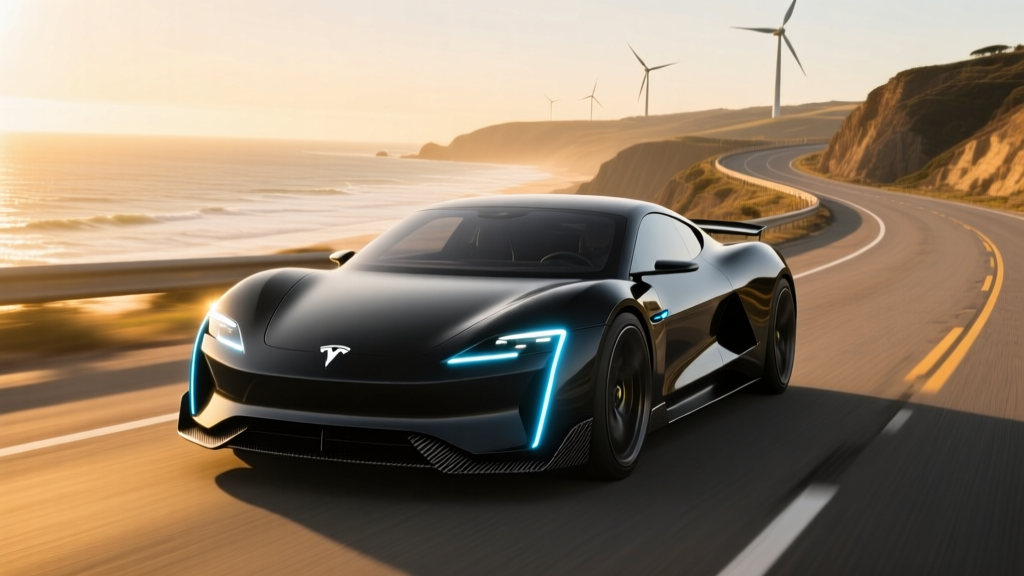
If you have been following the Tesla Roadster saga, you already know the punchline: Elon Musk announced the second-generation Roadster in November 2017 with a 2020 delivery target. It is now 2026, and the car still is not in production. So when will the Tesla Roadster come out? The most recent signals from Tesla point to a potential unveiling of a production-intent vehicle in late 2026 or 2027, with customer deliveries unlikely before 2028 — if the timeline holds this time.
That is the honest answer. What follows is everything we know about the Roadster's projected specifications, the history of its delays, what competing hypercars have done in the meantime, and whether reserving one still makes sense for your garage.
The Tesla Roadster Timeline: Every Delay, Explained
Understanding when the Roadster might actually ship requires looking at the pattern of announced milestones and missed deadlines:
- November 2017: Tesla unveils the Roadster prototype at the Semi event in Hawthorne, California. Musk promises a 620-mile range, 0-60 mph in 1.9 seconds, and a 2020 production start.
- 2019: Production pushed to 2021. Musk cites prioritization of the Model Y and Cybertruck programs.
- 2021: Delayed again to 2022, then 2023. Tesla's earnings calls repeatedly list the Roadster as a future product without firm dates.
- 2022–2023: Musk mentions a possible SpaceX cold-gas thruster package for "hovering" capability, adding engineering complexity.
- 2024: Tesla's Q4 earnings call references the Roadster as part of the "next-generation vehicle platform" without a specific date.
- 2025: Reports suggest Tesla has been quietly iterating on the powertrain and battery pack. Musk indicates a "design finalization" phase.
- 2026 (current): Industry consensus and supply-chain signals point to a production-intent reveal sometime in 2026–2027, with volume production no earlier than 2028.
Tesla has a well-documented history of aggressive timelines. The Cybertruck was announced in November 2019 and did not reach customers until late 2023 — a four-year gap. The Roadster's delay is even longer, complicated by the fact that it is a low-volume halo car that does not generate the revenue urgency of a mass-market truck or sedan.
Projected Specifications: What Tesla Has Claimed
Because the Roadster is not yet in production, every figure below is preliminary and based on Tesla's 2017 announcement plus subsequent Musk statements. Final specs may differ significantly at launch.
| Attribute | Claimed / Projected |
|---|---|
| EPA Range (est.) | 620 miles (unverified; likely 400–500 mi real-world) |
| Battery Capacity | ~200 kWh (announced); chemistry unconfirmed, likely NMC |
| Drivetrain | Tri-motor AWD (one front, two rear) |
| 0-60 mph | 1.9 seconds (claimed; with rollout subtracted) |
| Top Speed | 250+ mph (claimed) |
| Horsepower | Estimated 1,000+ hp (unconfirmed) |
| Peak DC Fast Charge | Unannounced; likely 250–350 kW based on Tesla's current architecture |
| 10-80% DC Charge Time | Estimated 25–35 minutes (projected, unverified) |
| Level 2 Home Charging | Expected 11.5 kW (48A) via Wall Connector, ~35-40 mi/hr |
| Seating | 2+2 (two front, two small rear seats) |
| Cargo Space | Not disclosed; likely minimal (estimated 5–8 cu ft combined frunk + rear) |
| Base MSRP (Reservation) | $200,000 (announced); final pricing TBD |
| Founders Series | $250,000 (limited run, first 1,000 units) |
| Battery/Powertrain Warranty | Expected 8 yr / 150,000 mi (based on Tesla's current performance-car warranty) |
Charging: The 200 kWh Problem
A 200 kWh battery creates a fundamental charging challenge. Even at Tesla's current V4 Supercharger peak of 350 kW, charging a 200 kWh pack from 10% to 80% (140 kWh) would take roughly 30–40 minutes under ideal conditions — and that assumes the battery can sustain peak charge rates, which is unlikely for a pack this large given thermal constraints and charge-curve taper above 50% state of charge.
| Charging Level | Power (kW) | Estimated Rate | Notes |
|---|---|---|---|
| Level 1 (120V) | 1.4 kW | ~4 mi/hr | Emergency/trickle only; full charge in ~140 hours |
| Level 2 (240V, 48A) | 11.5 kW | ~35-40 mi/hr | Overnight home charging; ~14-16 hours for a full charge |
| DC Fast Charge (V4 Supercharger) | 250-350 kW (peak) | ~800-1,100 mi/hr (peak) | 10-80% est. 25-40 min; sustained rate likely 150-200 kW average |
For context, the Tesla Model S with its 100 kWh pack charges at up to 250 kW and takes roughly 30 minutes for a 10-80% session. The Roadster's doubled battery capacity means either longer charge sessions or a fundamentally different charging architecture — possibly 800V or higher — that Tesla has not yet confirmed for this platform.
Home charging is also a consideration. A 200 kWh battery charged at 11.5 kW (Tesla's Wall Connector at 48 amps) would require approximately 16 hours from empty to full. Most owners will charge opportunistically rather than from zero, but the math underscores that Level 2 home charging is an overnight-plus affair for a pack this size.
Performance Claims vs. Physics
The headline 1.9-second 0-60 mph claim was astonishing in 2017. By 2026, it is less of an outlier — the Tesla Model S Plaid achieves 1.99 seconds with a production vehicle you can buy today, and the Lucid Air Sapphire hits 0-60 in roughly 1.89 seconds. The Rimac Nevera, a production electric hypercar, has been independently verified at 1.74 seconds.
So the Roadster's claimed acceleration is achievable with current technology. The tri-motor AWD layout with torque vectoring across the rear axle is a proven approach. The question is whether Tesla will prioritize a street-legal, daily-drivable experience or chase extreme track numbers that compromise usability.
The optional SpaceX cold-gas thruster package — mentioned by Musk in 2018–2019 — would theoretically improve braking, cornering, and acceleration by using compressed air jets. However, this system has never been homologated for road use and would face significant regulatory scrutiny from NHTSA. Treat the thruster package as speculative at best.
Pricing, Tax Credits, and the $200,000 Question
Tesla announced a base price of $200,000 for the Roadster and $250,000 for the limited Founders Series (the first 1,000 units). A $50,000 reservation deposit was required — $43,000 more than the standard Model S deposit — signaling this is a commitment vehicle for affluent enthusiasts.
Given inflation and Tesla's pricing history with the Cybertruck (which launched significantly above its announced starting price), a realistic production MSRP for the Roadster could land between $220,000 and $280,000 when it finally ships. The Founders Series could push past $300,000.
The Roadster vs. What Already Exists
The biggest argument against waiting for the Roadster is that the competitive landscape has moved on. In the eight years since the prototype was shown, several electric hypercars and high-performance EVs have reached production:
| Vehicle | Status | Range (EPA) | 0-60 mph | Starting Price |
|---|---|---|---|---|
| Tesla Roadster (Gen 2) | Announced (not in production) | 620 mi (claimed) | 1.9 sec (claimed) | $200,000 (announced) |
| Rimac Nevera | In production (limited) | ~287 mi (WLTP) | 1.74 sec (verified) | ~$2,200,000 |
| Lucid Air Sapphire | In production | 427 mi (EPA) | 1.89 sec (verified) | $249,000 |
| Tesla Model S Plaid | In production | 396 mi (EPA) | 1.99 sec (verified) | $89,990 |
| Porsche Taycan Turbo GT | In production | 269 mi (EPA) | 2.1 sec (verified) | $230,900 |
The Lucid Air Sapphire is the most direct threat to the Roadster's value proposition: it delivers verified sub-1.9-second acceleration, over 400 miles of real EPA range, and a usable back seat — all for roughly the Roadster's announced price, available today. The Model S Plaid offers 90% of the performance for less than half the cost.
If Tesla delivers the Roadster with its claimed 620-mile range, nothing else comes close on endurance. But that range figure depends on a 200 kWh pack that has not been validated in any production Tesla, and the real-world number will be substantially lower.
Tech, Interior, and What We Do Not Know
Tesla has revealed almost nothing about the Roadster's interior, infotainment, or driver-assistance suite. Based on the current Tesla product line, we can reasonably expect:
- A minimalist interior centered on a large touchscreen (likely 17-inch, similar to Model S/X)
- Tesla's latest Autopilot hardware (HW4 or successor) with FSD (Supervised) capability — a SAE Level 2 driver-assist system requiring full driver attention, not autonomous driving
- A glass roof panel (removable, as shown in the 2017 prototype)
- Over-the-air software updates and Tesla's Supercharger network access (now the NACS standard adopted industry-wide)
What we do not know includes: cargo capacity (the prototype appeared to have almost none), rear seat usability (the 2+2 layout showed very small rear seats), suspension tuning, NVH levels, build quality at this price point, and whether Tesla will offer any luxury appointments to justify a $200,000+ price tag against Porsche and Lucid interiors.
Should You Reserve a Tesla Roadster or Buy Something Now?
- Reserve the Roadster if: You have $200,000+ in discretionary vehicle budget, you view this as a collector/halo car rather than primary transportation, you are comfortable with a 2028+ delivery timeline that may slip further, and you want the potential range and Tesla ecosystem integration no other hypercar offers.
- Buy now if: You want a verified high-performance EV today. The Lucid Air Sapphire ($249,000) and Tesla Model S Plaid ($89,990) both deliver supercar acceleration with proven EPA range, real warranties, and immediate availability. The Porsche Taycan Turbo GT adds track credibility and build quality Tesla has not yet matched at this price point.
Pros (Projected)
- 620-mile claimed range would be unmatched by any production EV
- Sub-2.0-second 0-60 mph acceleration
- Access to Tesla's Supercharger network (NACS standard)
- OTA updates and Tesla software ecosystem
- Halo-car status and potential collector value
Cons (Known Risks)
- Not in production — 8+ years of delays with no firm delivery date
- $200,000+ price with no federal tax credit eligibility
- All specs are preliminary and unverified
- Lucid Air Sapphire offers similar performance today for similar money
- Minimal cargo and rear-seat space expected
- Tesla's build quality at this price point is unproven
- 200 kWh pack means very long home charging sessions
Frequently Asked Questions
When will the Tesla Roadster come out?
As of 2026, there is no confirmed production date. Based on Tesla's earnings call references and supply-chain indicators, the most realistic estimate is a production-intent reveal in 2026–2027 with customer deliveries beginning no earlier than 2028. Tesla has a pattern of announcing aggressive timelines and delaying by 2–4 years, so further slips are possible.
What is the real-world range of the Tesla Roadster?
Tesla claims 620 miles on a ~200 kWh battery pack, but this figure has not been EPA-verified. Based on typical EV highway efficiency losses (15–25% below EPA at 75 mph) and cold-weather degradation (20–30% loss below 32°F), expect a realistic range of 400–480 miles in mild highway driving and 320–380 miles in winter conditions. These are still class-leading numbers if achieved.
How fast does the Tesla Roadster charge?
Tesla has not published official charging specs. Based on the company's current V4 Supercharger architecture (up to 350 kW peak), a 200 kWh pack would likely charge from 10-80% in approximately 25–40 minutes under ideal conditions, with sustained average rates of 150–200 kW. Level 2 home charging at 11.5 kW would add roughly 35–40 miles per hour, requiring 14–16 hours for a full charge.
Does the Tesla Roadster qualify for the federal EV tax credit?
No. Under current IRS §30D rules, the $7,500 federal tax credit is limited to vehicles with an MSRP at or below $55,000 (sedans) or $80,000 (SUVs/trucks/vans). The Roadster's announced $200,000 base price exceeds both caps. Buyer income limits ($150,000 single / $300,000 joint) and battery sourcing requirements also apply. Do not budget for this credit.
Is the Tesla Roadster worth waiting for vs. buying a Lucid Air Sapphire or Model S Plaid?
For most buyers, no. The Lucid Air Sapphire delivers verified 1.89-second 0-60 mph acceleration and 427 miles of EPA range for $249,000, available today with a real warranty. The Model S Plaid offers 1.99-second acceleration for $89,990. The Roadster's advantages — potentially 400+ real-world miles and halo-car exclusivity — come with an indefinite wait, unverified specs, and significant execution risk. Reserve one only if you are a collector who views this as a speculative addition, not a primary vehicle.
Can I still reserve a Tesla Roadster?
Tesla's reservation page has been periodically available and unavailable. As of 2026, check Tesla's website for current reservation status. The deposit has historically been $50,000 (with $43,000 non-refundable after a window), which is a significant commitment for a vehicle with no delivery date. Compare that risk against placing a deposit on a vehicle you can take delivery of within weeks.
Will the SpaceX thruster package be available?
Elon Musk mentioned a cold-gas thruster option using compressed air to improve acceleration, braking, and cornering. This system has never been homologated for road use and would face regulatory scrutiny from NHTSA and potentially state DMVs. Treat it as speculative — if it ships at all, it would likely be a track-only option not legal for street use.