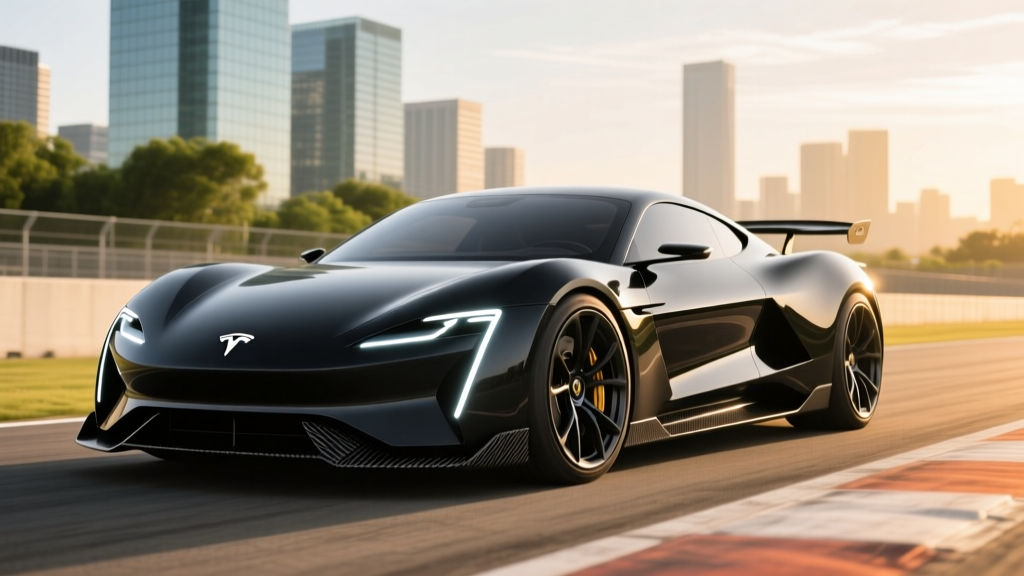
The Tesla Roadster is the longest-running vaporware story in the electric vehicle industry. First teased in November 2017 with jaw-dropping claims — 620 miles of range, a 0-60 mph time under two seconds, and a starting price around $200,000 — the second-generation Roadster has slipped through nearly a decade of delays. As of early 2026, the question remains urgent for reservation holders and EV enthusiasts: when does the Tesla Roadster come out?
Here is everything we know from Tesla's official statements, Elon Musk's timeline updates, and what the specs actually mean if and when this car reaches production. Because the Roadster is announced but not yet in production, all specifications below are preliminary and subject to change.
Tesla Roadster Release Timeline: A History of Delays
Understanding the Roadster's timeline requires tracking nearly eight years of shifting goalposts:
- November 2017: Roadster unveiled at a surprise event in Hawthorne, California. Initial production target: 2020. Base price announced at $200,000, with a $250,000 "Founders Series" limited to 1,000 units.
- 2019: Production pushed to 2021. Musk hints at "more than" the originally announced specs.
- 2021: At the Cybertruck unveiling follow-up, Musk confirms another delay to 2023, citing priority on Cybertruck development.
- 2023: Roadster pushed to 2024. Musk mentions the car will include "some fun rocket thrusters" as an optional SpaceX package.
- Mid-2024: Musk states on X (formerly Twitter) that the Roadster will begin production in late 2025.
- Early 2026: No production units have been confirmed delivered to customers. Tesla's official website still lists the Roadster with a "Reserve" button but no firm delivery date. Industry analysts expect a late 2026 or 2027 production start at the earliest, consistent with Tesla's historical pattern of announcing timelines 18-24 months ahead of actual delivery.
Reservation holders originally paid a $50,000 deposit (later reduced to $5,000 for new reservations). Tesla has not publicly confirmed how many active reservations remain.
Preliminary Tesla Roadster Specs: What Tesla Has Claimed
| Specification | Tesla Claim / Estimate |
|---|---|
| EPA Range (estimated) | 620 miles (unverified by EPA) |
| Battery Capacity | ~200 kWh (chemistry unconfirmed, likely NMC/NCA) |
| Drivetrain | Tri-Motor AWD |
| Horsepower | ~1,000+ hp (estimated from tri-motor config) |
| 0-60 mph | 1.1 seconds (claimed, with SpaceX thruster package) |
| Top Speed | 250+ mph |
| Quarter Mile | 8.8 seconds (claimed) |
| Max DC Fast Charge | ~350 kW (estimated, unconfirmed) |
| 10-80% DC Charge Time | ~25-30 minutes (estimated) |
| Level 2 Home Charge Rate | ~11.5 kW / 44 mi/hr (est. based on 48A onboard charger) |
| Seating | 2+2 (two front, two small rear seats) |
| Body Style | 2-door coupe with removable glass roof |
| Base MSRP | $200,000 (announced 2017; final price TBD) |
| Founders Series MSRP | $250,000 (limited to 1,000 units) |
| Reservation Deposit | $5,000 (current) / $50,000 (original) |
| Federal Tax Credit (§30D) | Not eligible — exceeds MSRP cap |
| Battery/Powertrain Warranty | Expected: 8 yr / 150,000 mi (based on Tesla precedent) |
Range Reality: 620 Miles Is a Claim, Not an EPA Rating
EPA Estimated Range: 620 miles (Tesla claim — not yet EPA-certified)
Real-World Expectation: If the 620-mile figure holds at EPA certification, expect approximately 520-560 miles on the highway at 70-80 mph, where aerodynamic drag dominates. In cold weather (below 32°F / 0°C), expect a further 20-30% reduction, bringing realistic winter range to roughly 400-450 miles. A 200 kWh battery pack is extraordinarily large — for context, the GMC Hummer EV carries a ~212 kWh pack — and the Roadster's efficiency advantage would need to come from a dramatically lighter and more aerodynamic chassis.
The 620-mile figure, if achieved, would make the Roadster the longest-range production EV ever sold. However, the physics of packing 200 kWh of cells into a sports car raise serious weight questions. Tesla has not disclosed the vehicle's curb weight. For comparison, the Hummer EV with a similarly sized battery weighs over 9,000 lbs. If the Roadster lands near 4,500-5,000 lbs, the efficiency math works; if it's heavier, the range claim becomes harder to achieve.
Tesla has hinted at using advanced cell chemistry — possibly next-generation 4680 cells with higher energy density — but has not confirmed whether the pack will use NMC (nickel manganese cobalt) or a newer formulation. LFP (lithium iron phosphate) chemistry is unlikely given the energy-density requirements of a 200 kWh pack in a sports car form factor.
Charging: How Fast Will the Roadster Actually Charge?
No official charging specs have been published, but we can extrapolate from Tesla's current architecture:
| Charging Level | Power (kW) | Rate / Time |
|---|---|---|
| Level 1 (120V household) | ~1.4 kW | ~5-6 mi/hr (est.) |
| Level 2 (240V, 48A Wall Connector) | ~11.5 kW | ~44 mi/hr (est.) |
| DC Fast Charge (Supercharger V4) | ~350 kW peak (est.) | 10-80% in ~25-30 min (est.) |
With a ~200 kWh battery, even at a sustained 350 kW peak (which is unlikely to hold for the full charge curve), a 10-80% charge would require moving roughly 140 kWh of energy. At an average sustained rate of ~280 kW (accounting for taper above 60% SoC), that's approximately 30 minutes. This is a fundamental physics challenge: larger batteries take longer to charge, even at high peak rates.
The Roadster will use Tesla's NACS (North American Charging Standard) connector natively and have full access to the Tesla Supercharger network, which as of 2026 includes over 6,500 V4 stalls in North America capable of up to 350 kW.
Performance: The 1.1-Second 0-60 Claim
Tesla's claimed 1.1-second 0-60 mph time would make the Roadster the quickest production car ever built, surpassing the Rimac Nevera (1.85 seconds) and the current Tesla Model S Plaid (1.99 seconds). However, this figure reportedly depends on the optional SpaceX cold-gas thruster package — a set of compressed-air thrusters mounted around the vehicle that provide additional downforce and acceleration boost.
Without the thruster package, a tri-motor AWD Roadster with ~1,000+ horsepower would likely achieve a 0-60 time in the 1.8-2.0 second range — still extraordinary, but within the envelope of existing hypercars.
The tri-motor layout (one front, two rear) mirrors the Model S Plaid's architecture but with likely higher-output motors. Tesla has not confirmed torque figures or whether the Roadster will use the same carbon-sleeved rotor motors found in the Plaid.
Pricing, Tax Credits, and the $200,000+ Question
The Roadster was announced in 2017 at $200,000 for the base model and $250,000 for the Founders Series (limited to 1,000 numbered units, requiring full payment upfront). Given nearly a decade of inflation, supply-chain cost increases, and the advanced technology involved, industry analysts widely expect the final production price to be significantly higher — potentially $250,000+ for the base model.
| Trim | Announced MSRP (2017) | Estimated 2026+ MSRP | Federal §30D Credit |
|---|---|---|---|
| Base Roadster | $200,000 | $225,000 - $275,000 | Not eligible (MSRP cap: $55,000 for coupes/sports cars) |
| Founders Series | $250,000 | $300,000+ | Not eligible |
| SPX / Thruster Pkg | TBD | +$50,000 (est.) | Not eligible |
Under current IRS §30D rules, the Roadster is categorically ineligible for the federal EV tax credit for multiple reasons:
- MSRP cap: §30D limits the credit to vehicles with an MSRP of $55,000 or less for sedans/coupes/sports cars. The Roadster exceeds this by a factor of four.
- Buyer income cap: Even if the MSRP somehow qualified, buyers must have an adjusted gross income below $150,000 (single) or $300,000 (joint) — thresholds that many Roadster buyers may exceed.
- Battery sourcing requirements: §30D requires increasing percentages of battery minerals sourced from the US or free-trade-agreement partners, and no battery components from foreign entities of concern. A 200 kWh pack's sourcing compliance would be extremely difficult to certify.
Bottom line: budget the full MSRP plus applicable state sales tax. No federal incentive applies.
Interior, Tech, and Practicality
Tesla has shown a minimalist interior with a large central touchscreen (likely 17-inch, similar to the Model S/X), a yoke-style steering wheel, and a 2+2 seating configuration. The rear seats are expected to be very small — suitable for children or cargo overflow, not adult passengers on any meaningful journey.
Cargo space has not been officially disclosed. The coupe body style with a mid/rear-mounted battery and tri-motor layout leaves minimal room for a traditional trunk. Expect roughly 5-8 cubic feet of combined storage (front trunk + rear shelf area), based on the vehicle's proportions. This is a sports car, not a grand tourer — packing light is mandatory.
Expected technology features include:
- Tesla's latest infotainment system with over-the-air updates
- Autopilot (Level 2 driver assistance) with optional FSD (Supervised) capability
- Adaptive air suspension with adjustable ride height
- Removable glass roof panel (targa-style)
- Premium audio system
- Track mode with real-time telemetry
Driver Assistance Note: Tesla Autopilot and Full Self-Driving (Supervised) are SAE Level 2 systems. The driver must remain fully engaged, hands on or near the wheel, and eyes on the road at all times. These are not autonomous driving systems.
Tesla Roadster vs. the Competition
If the Roadster reaches production, it enters a hypercar EV segment with established rivals:
| Vehicle | Range (EPA) | 0-60 mph | Price | Status |
|---|---|---|---|---|
| Tesla Roadster (claimed) | 620 mi | 1.1s (w/ thrusters) | $200,000+ | Announced — not in production |
| Rimac Nevera | 287 mi (WLTP) | 1.85s | $2,200,000 | In production (150 units) |
| Lotus Evija | 217 mi (WLTP est.) | ~2.8s | $2,300,000 | Limited production |
| Pininfarina Battista | 287 mi (WLTP est.) | 1.86s | $2,800,000 | In production (150 units) |
| Tesla Model S Plaid | 396 mi (EPA) | 1.99s | $89,990 | In production, available now |
The Roadster's value proposition — if it ships — is offering Rimac-rivaling performance at roughly one-tenth the price, with dramatically more range. The Model S Plaid already delivers 90% of the performance for less than half the expected Roadster price and is available today.
Pros and Cons
Pros
- Claimed 620-mile range would shatter all production EV records
- Sub-2-second 0-60 performance (tri-motor alone)
- Full Tesla Supercharger network access (NACS native)
- Potentially the best performance-per-dollar in the hypercar segment
- Over-the-air updates and Tesla's software ecosystem
- Removable glass roof adds open-air versatility
Cons
- Not in production — nearly 9 years of delays with no firm date
- All specs are unverified claims, not EPA-certified
- 200 kWh battery means long charge times even at 350 kW
- Expected curb weight likely 4,500+ lbs, impacting handling dynamics
- No federal tax credit eligibility
- Tiny rear seats and minimal cargo space
- Reservation deposit locked up for years with uncertain delivery
- Final price likely well above the 2017 announcement of $200,000
Who Should Wait — and Who Should Buy Something Else?
The Tesla Roadster, if it ever ships, suits a very specific buyer: someone who wants record-breaking acceleration and range in a Tesla ecosystem vehicle, has $250,000+ in discretionary auto budget, and doesn't need a daily driver. It's a weekend hypercar, a statement piece, and a technology showcase — not a practical vehicle.
If you need performance now, the Tesla Model S Plaid ($89,990, 1.99s 0-60, 396 mi EPA range) delivers 90% of the thrills at less than half the price and is available today. If you want exclusivity in the electric hypercar space, the Rimac Nevera is real, delivered, and proven — though at 11x the price.
Frequently Asked Questions
When does the Tesla Roadster come out?
As of early 2026, there is no confirmed production start date. Elon Musk indicated late 2025 production in mid-2024 statements, but no deliveries have occurred. Industry analysts project late 2026 or 2027 at the earliest, based on Tesla's historical pattern of announcing timelines well ahead of actual delivery.
Is the Tesla Roadster still being made?
The Roadster is still listed on Tesla's website with a reservation option, and Musk has reaffirmed the project in public statements. However, it remains in pre-production status. Tesla has prioritized Cybertruck, next-gen vehicle platforms, and AI/robotaxi development over the Roadster.
How much does the Tesla Roadster cost?
The base model was announced at $200,000 in 2017, with the Founders Series at $250,000. Given inflation and development costs, final pricing is expected to be higher — likely $225,000-$275,000 for the base model. The vehicle does not qualify for the $7,500 federal EV tax credit due to the MSRP cap.
Will the Roadster really get 620 miles of range?
Tesla claims 620 miles with a ~200 kWh battery pack, but this figure has not been EPA-certified. Real-world highway range would likely be 520-560 miles, with cold-weather range dropping to approximately 400-450 miles. The claim is physically plausible with advanced cell chemistry but remains unverified.
Does the Tesla Roadster qualify for the federal EV tax credit?
No. Under current IRS §30D rules, the Roadster far exceeds the $55,000 MSRP cap for coupes and sports cars. It is categorically ineligible regardless of the buyer's income or the battery's sourcing.
Can I still put down a reservation deposit?
Tesla's website currently allows a $5,000 reservation deposit. However, given the multi-year delay history, buyers should consider this deposit as money that may be tied up indefinitely. Tesla has historically refunded deposits upon request, but policies can change.
Is the Tesla Roadster self-driving?
No. The Roadster is expected to include Tesla Autopilot and optionally FSD (Supervised), both of which are SAE Level 2 driver-assistance systems requiring full driver engagement. Tesla does not currently offer autonomous (Level 4+) driving in any consumer vehicle.