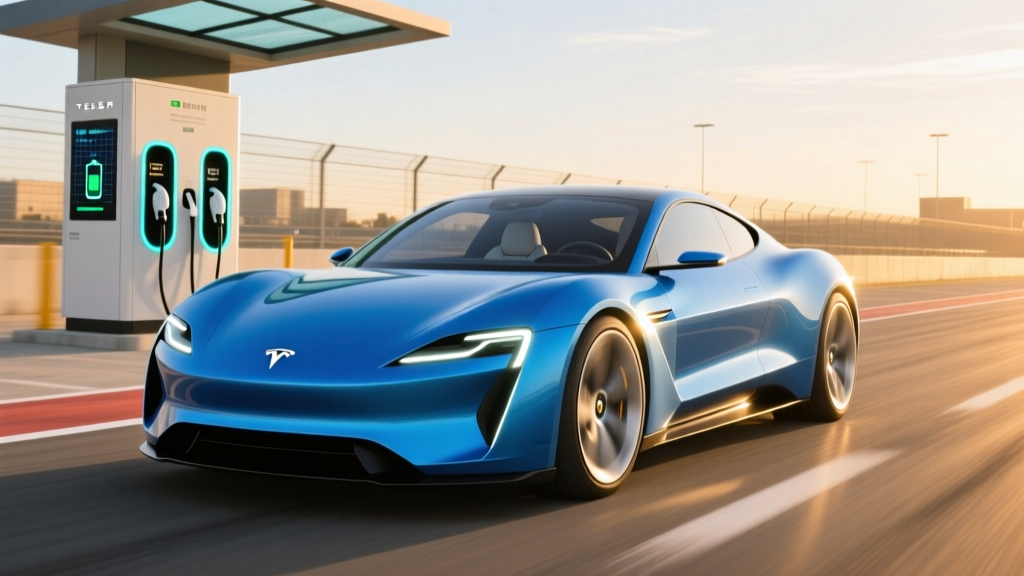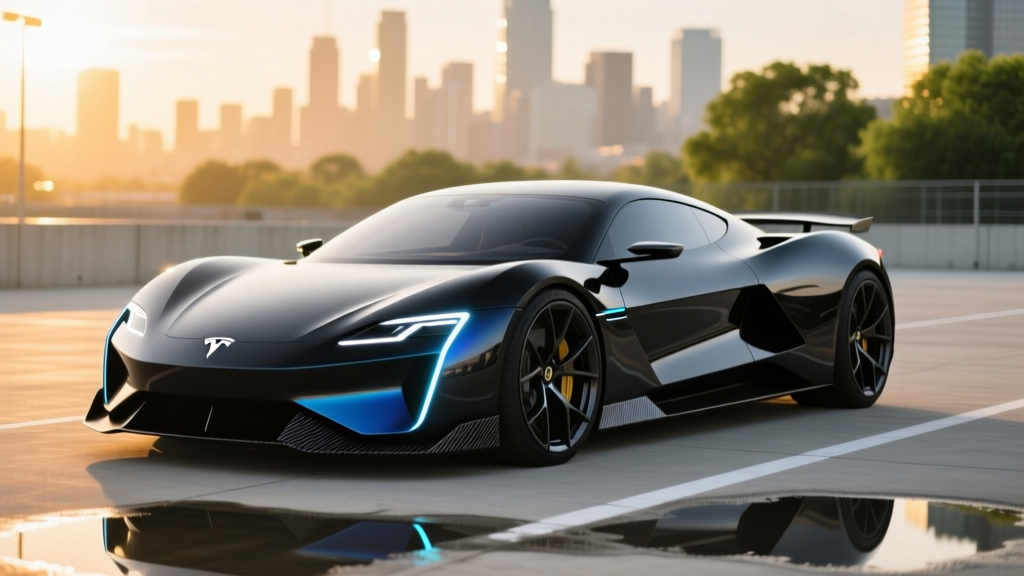
The Tesla Roadster has occupied a strange space in the EV world since Elon Musk first unveiled the second-generation model in November 2017. Nearly a decade later, the halo sports car remains unreleased, but Tesla has continued to reference it in earnings calls and product roadmaps heading into 2026. For buyers researching the price for Tesla Roadster, the picture is still one of estimates, preliminary specs, and shifting timelines — not a vehicle you can drive off a lot today.
This profile compiles every confirmed and reasonably projected data point available as of early 2026, clearly separating what Tesla has stated from what remains speculative. If and when the Roadster enters production, we'll update this page with tested EPA figures and real-world charging data.
Projected Tesla Roadster Specifications
| Attribute | Projected / Stated Value | Status |
|---|---|---|
| Base MSRP | ~$200,000 (base); $250,000 (Founders Series) | Estimated — 2017 pricing, likely higher at launch |
| EPA Range | 620 miles (stated target) | Unverified — no EPA certification |
| Battery Capacity | ~200 kWh (usable, estimated) | Projected based on range target |
| Battery Chemistry | NMC (nickel manganese cobalt) — high energy density | Expected; LFP too heavy for this application |
| 0–60 mph | 1.9 seconds (base); 1.1 seconds (with SpaceX package) | Stated by Tesla, untested |
| Top Speed | 250+ mph | Stated by Tesla |
| Horsepower | ~1,000+ hp (tri-motor AWD) | Estimated from torque claims |
| Drivetrain | AWD, tri-motor (1 front, 2 rear) | Confirmed by Tesla |
| Peak DC Fast Charge | Expected 250–350 kW (Supercharger V4 compatible) | Projected |
| 10–80% DC Charge Time | ~30–40 minutes (estimated, depending on taper) | Projected |
| Level 2 Home Charging | ~11.5 kW / ~35–40 mi/hr (est.) | Projected |
| Seating | 2+2 (two front, two small rear seats) | Confirmed by Tesla |
| Warranty | Expected 8 yr / 150,000 mi battery & drive unit | Projected based on Model S/X precedent |
What Is the Real-World Range of the Tesla Roadster?
Tesla has stated a target range of 620 miles for the Roadster, which would make it the longest-range production EV ever sold if achieved. However, that figure has not been submitted to or verified by the EPA. For context, the Lucid Air Grand Touring currently holds the production EV range record at 516 miles EPA with a 118 kWh battery.
Stated Target: 620 miles
Expected EPA (if produced): 500–580 miles (optimistic, given the ~200 kWh pack and sports-car aerodynamics)
Highway driving (75 mph): Expect 15–20% reduction from EPA — roughly 420–490 miles
Cold weather (below 32°F): Expect 25–35% reduction — roughly 325–430 miles
Aggressive/canyon driving: High-performance EVs can lose 40%+ under hard throttle use
Note: A 200 kWh battery is massive. Real-world efficiency will depend heavily on the Roadster's weight (likely 4,800–5,200 lbs) and whether Tesla achieves the claimed aerodynamic improvements. The 620-mile claim assumed extremely low consumption per mile that may not survive production reality.
The physics challenge is straightforward: energy density. Current NMC cells from suppliers like Panasonic and CATL deliver roughly 250–300 Wh/kg at the cell level. A 200 kWh pack would weigh approximately 660–800 lbs just for cells, before cooling systems, structural housing, and bus bars. Tesla's 4680 cell architecture may improve this equation, but the Roadster will still be a heavy vehicle. That mass works against range during aggressive driving and cold-weather operation, where battery internal resistance increases and cabin heating draws additional power.
Charging Speed: DC Fast Charging and Home Setup
Charging a ~200 kWh battery is one of the Roadster's biggest practical questions. Even at Tesla's current Supercharger V3 peak of 250 kW, filling 70% of a 200 kWh pack (140 kWh) would take roughly 35–40 minutes under ideal conditions — and that assumes the battery management system sustains peak rate, which it typically does not above 50–60% State of Charge.
| Charging Level | Power (kW) | Estimated Miles Added per Hour | Time for 10–80% |
|---|---|---|---|
| Level 1 (120V household) | ~1.4 kW | ~3–4 mi/hr | ~100+ hours (impractical) |
| Level 2 (240V / 48A) | ~11.5 kW | ~35–40 mi/hr | ~12–14 hours |
| DC Fast (V3 Supercharger, 250 kW) | 250 kW peak | ~750–900 mi/hr (peak, first 10 min) | ~35–40 min (est.) |
| DC Fast (V4 Supercharger, 350 kW) | 350 kW peak (if supported) | ~1,000+ mi/hr (peak) | ~25–30 min (est.) |
Charging curve reality check: No EV sustains its peak kW rate for the full session. Expect the Roadster to pull maximum power only between roughly 10–40% SoC, after which the charge rate tapers to protect cell longevity. With a 200 kWh pack, the taper phase (40–80%) could still take 20+ minutes even at high sustained rates. This is the single biggest ownership practicality concern for a battery this large — home Level 2 charging is an overnight necessity, not a convenience.
For home charging, the Roadster's 200 kWh pack means a standard 48-amp Level 2 charger (11.5 kW) would need roughly 12–14 hours for a 10–80% charge. Owners who drive the car hard or take long trips will want to install a 60-amp or 80-amp circuit with a high-output wall connector to reduce this window. Budget $1,500–$3,500 for a professional Level 2 installation depending on your electrical panel's capacity and distance from the panel to the charger location.
Performance: The Numbers Behind the Hype
If even half of Tesla's stated performance claims hold up in production, the Roadster will be the quickest-accelerating production car ever sold. Here is what Tesla has claimed:
- 0–60 mph: 1.9 seconds (base tri-motor); 1.1 seconds (with optional SpaceX cold-gas thruster package)
- Quarter-mile: 8.8 seconds (stated)
- Top speed: 250+ mph
- Peak torque: 10,000 Nm at the wheels (stated — this is wheel torque, not motor shaft torque, which is a different measurement)
- Drivetrain: Tri-motor all-wheel drive with torque vectoring
For comparison, the current Tesla Model S Plaid achieves 0–60 in 1.99 seconds with a tri-motor setup and roughly 1,020 horsepower. The Roadster's claimed 1.1-second time with the SpaceX package would require cold-gas thrusters (compressed air jets) to supplement tire grip — a technology never before used on a street-legal production car. Whether this package survives to production, and whether it's street-legal in all 50 states, remains an open question.
The more grounded concern is weight. A 200 kWh battery pack, tri-motor drivetrain, and reinforced chassis for 250+ mph operation will likely push the Roadster past 4,800 lbs. For a sports car, that mass will be felt in cornering, braking distances, and tire wear — regardless of how quickly it accelerates in a straight line. The Porsche Taycan Turbo GT, at roughly 5,100 lbs with a 105 kWh pack, is a useful analog for what a heavy, fast EV feels like on a track.
Tesla Roadster Price Breakdown and Tax Credit Eligibility
When Tesla first unveiled the Roadster in 2017, the stated pricing was $200,000 for the base model and $250,000 for the Founders Series (the first 1,000 units). Tesla required a $50,000 reservation deposit for the Founders Series and $5,000 for the base model. By 2026, those prices are almost certainly outdated — inflation, supply-chain costs, and Tesla's pattern of raising prices between announcement and production (see: Cybertruck) suggest the actual launch MSRP will be higher.
| Trim | 2017 Stated Price | 2026 Estimated Price | §30D Tax Credit |
|---|---|---|---|
| Base Roadster | $200,000 | $220,000–$250,000 (est.) | $0 — exceeds MSRP cap |
| Founders Series | $250,000 | $275,000–$300,000 (est.) | $0 — exceeds MSRP cap |
Federal Tax Credit: The Roadster Does Not Qualify
Under current IRS §30D rules, the federal clean vehicle tax credit has strict MSRP caps: $55,000 for sedans and $80,000 for SUVs, vans, and pickup trucks. The Roadster, classified as a passenger car, would need to be priced under $55,000 to qualify. At a projected $220,000+, the Roadster will not receive any portion of the $7,500 federal credit — regardless of buyer income, battery sourcing, or point-of-sale transfer eligibility.
Additionally, §30D imposes buyer income caps ($150,000 single / $300,000 joint MAGI) and critical-mineral/battery-component sourcing requirements. But for the Roadster, the MSRP cap alone disqualifies it entirely. Buyers should not factor any federal incentive into their purchase math.
Interior, Technology, and Practicality
The Roadster is a 2+2 coupe, meaning two full-size front seats and two small rear seats suitable for children or cargo overflow. Tesla has not released detailed interior dimensions, but based on the vehicle's exterior proportions and sports-car packaging constraints, expect:
- Front legroom: ~42 inches (estimated, similar to Model S)
- Rear legroom: ~28–30 inches (estimated — tight for adults)
- Cargo (rear hatch + frunk): ~15–20 cu ft combined (estimated)
- Removable glass roof panel: Confirmed — stows in the trunk
Infotainment and tech: Expect a next-generation Tesla touchscreen (likely 17+ inches, horizontally oriented) running Tesla's latest software, including navigation with Supercharger routing, over-the-air updates, and Tesla's app ecosystem. The Roadster will ship with Autopilot (SAE Level 2 driver assistance) and likely offer Full Self-Driving (Supervised) as an option. Both systems require continuous driver attention and hands-on-wheel engagement — neither is autonomous driving.
Notable drawbacks to consider:
- A ~200 kWh battery means long home charging times (12+ hours for a full cycle)
- Ground clearance will be minimal — expect scraping on steep driveways and speed bumps
- Rear seats are not practical for adults on anything beyond short trips
- Visibility from the low-slung cockpit and small rear window will be compromised
- Tire costs will be significant given the weight and performance demands
- Insurance premiums for a $250K+ performance EV will be substantial
Who Is the Tesla Roadster For?
The Roadster is not a commuter, a family hauler, or a practical daily driver. It exists as a halo vehicle — a statement of what electric propulsion can achieve when cost and practicality are secondary to performance and range. Here's how it maps to real use cases:
- You want the quickest-accelerating production car available and budget is not a constraint
- You value extreme range for grand-touring road trips with minimal charging stops
- You collect halo vehicles and understand the depreciation risk of low-volume production EVs
- You already have a practical daily driver and want a weekend/track-capable EV
- You need a daily commuter — a Model S, Lucid Air, or Taycan offers similar performance with proven reliability and available service networks
- You need rear-seat space for adults or significant cargo volume
- You want federal tax credit eligibility (MSRP cap disqualifies the Roadster)
- You are uncomfortable being an early adopter of an unproven, low-volume platform
Roadster vs. Key Competitors: Is It Worth the Wait?
| Spec | Tesla Roadster (Projected) | Lucid Air Sapphire | Porsche Taycan Turbo GT | Rimac Nevera |
|---|---|---|---|---|
| Price | ~$220K–$250K | $249,000 | $230,000 | $2,200,000 |
| EPA Range | 620 mi (unverified) | 427 mi | 269 mi | ~300 mi (WLTP) |
| 0–60 mph | 1.9s (claimed) | 3.3s | 2.1s | 1.85s |
| Horsepower | ~1,000+ | 1,234 | 1,092 | 1,914 |
| Battery | ~200 kWh (est.) | 118 kWh | 105 kWh | 120 kWh |
| Availability | Not yet in production | Available now | Available now | Limited production |
The honest assessment: if you want a high-performance luxury EV today, the Lucid Air Sapphire and Porsche Taycan Turbo GT are real, tested, warrantied, and deliverable. Both offer supercar-rivaling acceleration with proven build quality and established service networks. The Rimac Nevera holds the hypercar performance crown but at 10× the Roadster's projected price.
The Roadster's theoretical advantage is range — no competitor comes close to 620 miles. If Tesla achieves even 80% of that claim (roughly 500 miles EPA), it would redefine what's possible for electric grand touring. But "if" is doing a lot of work in that sentence.
Frequently Asked Questions
Can I buy the Tesla Roadster right now?
No. As of 2026, the second-generation Tesla Roadster is not in production and is not available for purchase or delivery. Tesla has accepted reservation deposits in the past, but no firm production start date has been announced. Tesla has a history of significant delays between vehicle announcement and production — the Roadster was first unveiled in 2017.
How much will the Tesla Roadster actually cost at launch?
Tesla's 2017 stated pricing was $200,000 (base) and $250,000 (Founders Series). Given inflation, supply-chain costs, and Tesla's pattern of pricing production vehicles higher than initially announced (the Cybertruck launched at prices significantly above its original reveal), a realistic 2026+ estimate is $220,000–$300,000 depending on trim and options. The optional SpaceX thruster package could add $50,000+ if offered.
Does the Tesla Roadster qualify for the $7,500 federal EV tax credit?
No. The IRS §30D clean vehicle credit imposes an MSRP cap of $55,000 for sedans and passenger cars. The Roadster's projected price of $220,000+ exceeds this cap by a wide margin. No buyer will receive a federal tax credit for this vehicle, regardless of income or battery sourcing.
Is 620 miles of range realistic?
It's theoretically possible with a ~200 kWh battery pack, but it would require exceptional efficiency (roughly 3.2 miles per kWh or 31 kWh/100mi). For a heavy, high-performance sports car, achieving that efficiency in real-world driving is unlikely. Expect real-world range to fall significantly below 620 miles — probably in the 420–500 mile range for mixed driving, and lower in cold weather or at highway speeds. The Lucid Air Grand Touring achieves 516 miles EPA with 118 kWh and a far more efficiency-optimized design.
What is the biggest risk in reserving a Tesla Roadster?
Timeline uncertainty. Tesla has delayed the Roadster for nearly a decade. Reserving one means locking up capital ($5,000–$50,000 depending on the reservation tier) with no guaranteed delivery date, and final production specs may differ from what was originally announced. Additionally, Tesla's reservation deposits have historically been refundable, but terms can change. Weigh the opportunity cost of your deposit against the uncertainty.
How does the Roadster compare to the original first-gen Tesla Roadster?
The first-generation Roadster (2008–2012) was based on the Lotus Elise chassis, had a 53 kWh battery, 245 miles of range, and a 3.9-second 0–60 time. The second-generation Roadster is a completely new, Tesla-designed platform that is larger, heavier, far more powerful, and targets roughly 2.5× the range. They share a name but very little else.
Bottom Line: Patience, Money, and Uncertainty
The Tesla Roadster remains one of the most ambitious EV projects ever announced — and one of the most delayed. For buyers specifically searching for the price for Tesla Roadster, the honest answer is that no one knows the final production MSRP, delivery date, or verified EPA range. What we do know is that it will be expensive ($200K+), it will not qualify for any federal tax credit, and it will be extraordinarily fast if Tesla delivers on even a fraction of its performance claims.
If you're in the market for a high-performance EV today, the Lucid Air Sapphire, Porsche Taycan Turbo GT, and Tesla Model S Plaid are proven, tested alternatives that deliver supercar performance with real-world usability and established service infrastructure. The Roadster is a bet on Tesla's future — and like all bets, it carries risk. Reserve only if you're comfortable with uncertainty and don't need the capital deployed elsewhere.
✅ Potential Pros
- Record-breaking range if 620-mile target is met
- Quickest-accelerating production car (if claims hold)
- Tri-motor AWD with torque vectoring
- Tesla Supercharger network access
- Removable glass roof panel
- OTA software updates and Tesla ecosystem
❌ Known Cons & Risks
- Not in production — no delivery date confirmed
- No federal tax credit eligibility (MSRP cap)
- 12–14 hour home charging with Level 2
- 2+2 seating — rear seats impractical for adults
- Extreme weight will compromise handling vs. lighter sports cars
- Nearly a decade of delays — production is not guaranteed
- Insurance and tire costs will be very high