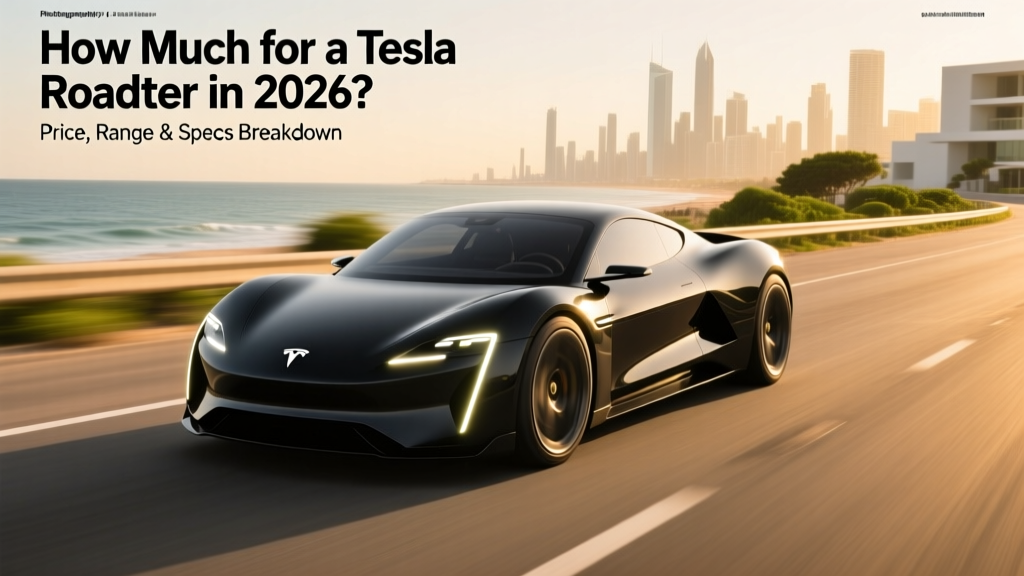
The next-generation Tesla Roadster has been one of the longest-running "coming soon" stories in the electric vehicle industry. First announced in 2017 with jaw-dropping claims — a sub-2-second 0-60 mph time, 620 miles of range, and a 250+ mph top speed — the Roadster has slipped through multiple production timelines. As of early 2026, Tesla CEO Elon Musk has stated that the Roadster is expected to begin production in late 2026 or 2027, though Tesla's track record with timelines warrants healthy skepticism.
If you're searching for how much for a Tesla Roadster, the short answer is that Tesla has not published final MSRP figures, and the vehicle is not yet available for purchase. What we do have are preliminary specifications, reservation deposit information, and enough context from Tesla's pricing history to build an informed estimate. Below, we break down everything confirmed, everything estimated, and what you need to know before putting money down.
What We Know About Tesla Roadster Pricing
Tesla has not released official MSRP figures for the next-generation Roadster. However, we can piece together a credible price estimate from several data points:
- Original 2017 announcement: Tesla stated a base price of $200,000, with a $50,000 deposit required to reserve. A limited "Founders Series" of 1,000 units was priced at $250,000 and required full payment upfront.
- Reservation updates: Tesla later increased the reservation deposit to $50,000 (from an initial lower amount), which is refundable. The Founders Series was capped at 1,000 units and is believed to be fully reserved.
- 2026 inflation adjustment: Given automotive cost increases since 2017, supply chain realities, and Tesla's tendency to price halo vehicles at premium tiers, a realistic base MSRP at launch is likely between $200,000 and $250,000, with potential performance or SpaceX package variants pushing higher.
| Variant | Estimated MSRP | Deposit Required | Availability |
|---|---|---|---|
| Base Roadster | $200,000–$225,000 | $50,000 (refundable) | Announced — not in production |
| Roadster (Performance/AWD) | $225,000–$250,000 | $50,000 (refundable) | Announced — not in production |
| Founders Series | $250,000 | Full payment | Limited to 1,000 units — likely sold out |
For context on Tesla's current pricing strategy, the Model S Plaid starts around $89,990 in 2026, while the Cybertruck's top trims have pushed past $100,000. The Roadster, positioned as Tesla's flagship sports car, would sit at the very top of the lineup.
Tesla Roadster Specifications: What Tesla Has Claimed
The following specs are based on Tesla's public statements and presentation materials. None have been independently verified through EPA testing or third-party review, as no production vehicles have been delivered.
| Specification | Claimed / Estimated Figure |
|---|---|
| EPA Range (estimated) | 620 miles (Tesla target) |
| Battery Capacity | ~200 kWh (Tesla stated) |
| Battery Chemistry | Unconfirmed — likely NMC for energy density |
| 0-60 mph | 1.9 seconds (Tesla claim) |
| 0-100 mph | 4.2 seconds (Tesla claim) |
| Top Speed | 250+ mph |
| Quarter Mile | 8.8 seconds (Tesla claim) |
| Horsepower | Estimated 1,000+ hp (tri-motor AWD) |
| Drivetrain | AWD — Tri-motor (1 front, 2 rear) |
| Torque | 10,000 Nm / 7,376 lb-ft wheel torque (Tesla claim) |
| Seating | 4 seats (2+2 configuration) |
| Roof | Removable glass roof |
Charging Speed: The 200 kWh Problem
One of the biggest practical questions about the Roadster is how long it will take to charge a 200 kWh battery. Tesla has not published official charging specs, but physics and existing infrastructure provide strong clues.
| Charging Method | Power Level | Estimated Time (10-80%) | Miles Added Per Hour |
|---|---|---|---|
| Level 1 (120V household) | ~1.4 kW | Not practical (100+ hours) | ~4–5 mi/hr |
| Level 2 (240V home Wall Connector) | 11.5–19.2 kW | 10–16 hours | ~35–60 mi/hr |
| DC Fast Charge (V4 Supercharger) | ~350 kW (peak est.) | ~25–35 minutes | ~400–600 mi/hr at peak |
| DC Fast Charge (legacy V3) | 250 kW | ~35–45 minutes | ~300–500 mi/hr at peak |
Charging curve reality: Peak charge rates are never sustained across the full session. A 200 kWh battery charging at 350 kW peak would likely taper significantly above 50–60% state of charge (SoC). Expect the 10-80% session to average closer to 200–250 kW sustained, which is why the estimated 10-80% time is 25–35 minutes rather than a theoretical 20 minutes. The larger the battery, the more pronounced the taper effect becomes as the battery management system protects cell health.
For home charging, most residential electrical panels support a 48-amp (11.5 kW) Level 2 circuit. Fully replenishing 200 kWh from empty at that rate takes roughly 17 hours. Owners who drive the Roadster regularly will want a dedicated 60-amp or higher circuit to enable overnight top-ups within a practical 8–10 hour window.
Federal Tax Credit: Does the Roadster Qualify?
Under the current IRS §30D Clean Vehicle Credit rules, the Tesla Roadster faces significant hurdles to qualifying for the $7,500 federal tax credit:
- MSRP Cap: Sedans and sports cars must have an MSRP under $55,000. SUVs, vans, and trucks cap at $80,000. The Roadster (estimated $200,000+) exceeds the cap by a wide margin.
- Buyer Income Cap: Modified adjusted gross income must not exceed $150,000 (single), $225,000 (head of household), or $300,000 (joint). Many Roadster buyers may clear these thresholds, but it's a secondary concern given the MSRP cap.
- Battery Sourcing: Critical minerals and battery components must meet escalating domestic/free-trade-partner sourcing percentages. Tesla's supply chain compliance is unconfirmed for the Roadster.
- Point-of-Sale Transfer: Eligible buyers can transfer the credit to the dealer for an immediate price reduction — but only if the vehicle qualifies in the first place.
Bottom line: The Tesla Roadster will almost certainly not qualify for the $7,500 federal EV tax credit due to the MSRP cap. Buyers should not factor the credit into their purchase calculations. Consult a tax professional for personalized guidance, as rules can change and individual circumstances vary.
Real-World Usability: Cargo, Comfort, and Daily Use
The Roadster is a 2+2 sports car, meaning two front seats and two small rear seats best suited for children or extra cargo. Tesla has shown a removable glass roof panel that stores in the trunk, but cargo capacity is expected to be minimal — likely 4–8 cubic feet combined (trunk plus any frunk space), typical of the sports car segment.
Tesla has not published official dimensions, but based on the prototype shown, expect:
- Front legroom: Approximately 42–44 inches (sports car typical)
- Rear legroom: Approximately 28–32 inches (minimal — children or bags only)
- Cargo volume: Estimated 5–8 cu ft total
- Curb weight: Estimated 4,400–4,800 lbs (200 kWh battery packs are extremely heavy)
This is not a daily driver for most buyers. It's a weekend car, track toy, and statement piece. If you need practical cargo space, a Tesla Model S or Model X serves that role far better.
Tech, Driver Assistance, and the SpaceX Package
Tesla's current tech stack will carry over to the Roadster, likely including:
- Infotainment: A large central touchscreen (likely 17+ inches) with Tesla's latest UI, navigation, streaming, and gaming capabilities
- Autopilot / FSD (Supervised): Tesla's Level 2 driver-assistance system. This requires full driver attention at all times — it is not self-driving. Features include adaptive cruise, lane-keeping, auto lane-change, and traffic-light recognition.
- Over-the-air updates: Continuous feature additions and performance tweaks via software
The SpaceX Package: Tesla has teased an optional "SpaceX package" that would use cold-gas thrusters (compressed air) around the vehicle to improve cornering grip, braking, and acceleration. Elon Musk has claimed this could reduce the 0-60 mph time to approximately 1.1 seconds. This package has not been demonstrated on a production vehicle and remains entirely unconfirmed. If offered, it would likely add $50,000+ to the price and may not be street-legal in all jurisdictions.
Tesla Roadster vs. the Competition
The Roadster occupies a unique niche: an electric hypercar at a (relative) bargain compared to traditional exotics. Here's how it stacks up against key rivals, keeping in mind the Roadster specs are preliminary:
| Spec | Tesla Roadster (est.) | Rimac Nevera | Lotus Evija | Porsche Taycan Turbo GT |
|---|---|---|---|---|
| Price | ~$200,000–$250,000 | ~$2,200,000 | ~$2,300,000 | ~$230,000 |
| 0-60 mph | 1.9 sec (claimed) | 1.85 sec | ~2.8 sec | 2.1 sec |
| Range (EPA) | 620 mi (claimed) | ~340 mi (WLTP) | ~250 mi (WLTP) | ~269 mi (EPA) |
| Battery | ~200 kWh | 120 kWh | 70 kWh | 105 kWh |
| Horsepower | 1,000+ hp | 1,914 hp | 2,012 hp | 1,092 hp |
| Production Status | Announced | In production | In production | In production |
The Roadster's value proposition, if it ships as described, is extraordinary: hypercar performance at one-tenth the price of a Rimac or Lotus, with vastly superior range. The catch is the word "if." The Porsche Taycan Turbo GT is a real, purchasable, tested vehicle today with a proven track record and dealer support network.
Pros, Cons, and Who Should Reserve
- Claimed 620-mile range would be the longest of any production EV
- Sub-2-second 0-60 mph (if achieved) is hypercar territory
- Price undercuts Rimac/Lotus by $2M+
- Access to Tesla Supercharger network (20,000+ stalls globally)
- Tesla OTA updates and tech ecosystem
- 2+2 seating adds marginal practicality vs. 2-seat exotics
- Not in production — no delivery date guaranteed
- All specs are unverified manufacturer claims
- $50,000 refundable deposit ties up capital indefinitely
- 200 kWh battery means very long home charging times
- No federal tax credit eligibility (MSRP cap)
- Tesla's history of significant timeline delays
- Unknown build quality, reliability, and service support for a low-volume halo car
- Curb weight likely 4,400+ lbs — impacts handling dynamics vs. lighter sports cars
Who should consider reserving: Existing Tesla owners with disposable income who view the $50,000 deposit as a low-risk option on a future halo car. Collectors who want early-build allocation. Enthusiasts who believe in Tesla's engineering trajectory and are willing to wait 1–3+ years for delivery.
Who should look elsewhere: Anyone who needs a vehicle in the next 12 months. Buyers who want independently verified specs before committing. Those who prioritize proven build quality and dealer service networks over bleeding-edge claims.
Frequently Asked Questions
How much for a Tesla Roadster in 2026?
Tesla has not published final MSRP figures. Based on the original 2017 announcement and inflation adjustments, the base Roadster is estimated at $200,000–$225,000, with higher trims potentially reaching $250,000 or more. The Founders Series was priced at $250,000 and is likely fully reserved. The vehicle is not yet in production.
Is the Tesla Roadster available to buy right now?
No. As of 2026, the Roadster is an announced vehicle with no confirmed production start date. Tesla has indicated late 2026 or 2027 production is possible, but Tesla's historical timeline accuracy is low. You can place a $50,000 refundable reservation deposit on Tesla's website, but delivery is not guaranteed within any specific timeframe.
What is the real-world range of the Tesla Roadster?
Tesla claims 620 miles of range from a 200 kWh battery pack. No EPA testing has been conducted. In real-world highway driving at 70–80 mph, expect approximately 450–520 miles. In cold weather (below freezing), range could drop to 350–450 miles due to battery chemistry limitations and cabin heating demands. These are estimates based on physics and comparable large-battery EVs, not tested data.
How fast does the Tesla Roadster charge?
Tesla has not published official charging specs. With a 200 kWh battery, expect DC fast charging at up to ~350 kW peak on V4 Superchargers, with a 10-80% session taking approximately 25–35 minutes due to charge-curve taper. Home Level 2 charging at 11.5 kW would take 10–17 hours for a full charge. A higher-amperage home circuit (60A+) is recommended for practical overnight charging.
Does the Tesla Roadster qualify for the $7,500 federal EV tax credit?
Almost certainly not. Under current IRS §30D rules, sports cars and sedans must have an MSRP below $55,000 to qualify. The Roadster's estimated $200,000+ price far exceeds this cap. Consult a tax professional for personalized advice, but do not factor the credit into your purchase decision.
Is the Roadster worth the $50,000 reservation deposit?
The deposit is refundable, so the financial risk is limited to the opportunity cost of tied-up capital. If you strongly want early allocation and believe Tesla will deliver on its claims, the deposit secures your place. If you need verified specs, proven build quality, or a vehicle within 12 months, the deposit is not worthwhile. Consider it a no-cost option on a future vehicle, not a purchase commitment.
What's the warranty on the Tesla Roadster?
Tesla has not published Roadster-specific warranty terms. For reference, the current Model S includes an 8-year/150,000-mile battery and drive unit warranty with a minimum 70% capacity retention threshold. Given the Roadster's price and halo status, equal or better coverage is expected, but nothing is confirmed until production begins.
Sources: Tesla Roadster official page, IRS §30D Clean Vehicle Credit rules, EPA Fuel Economy (for comparable EV efficiency data).