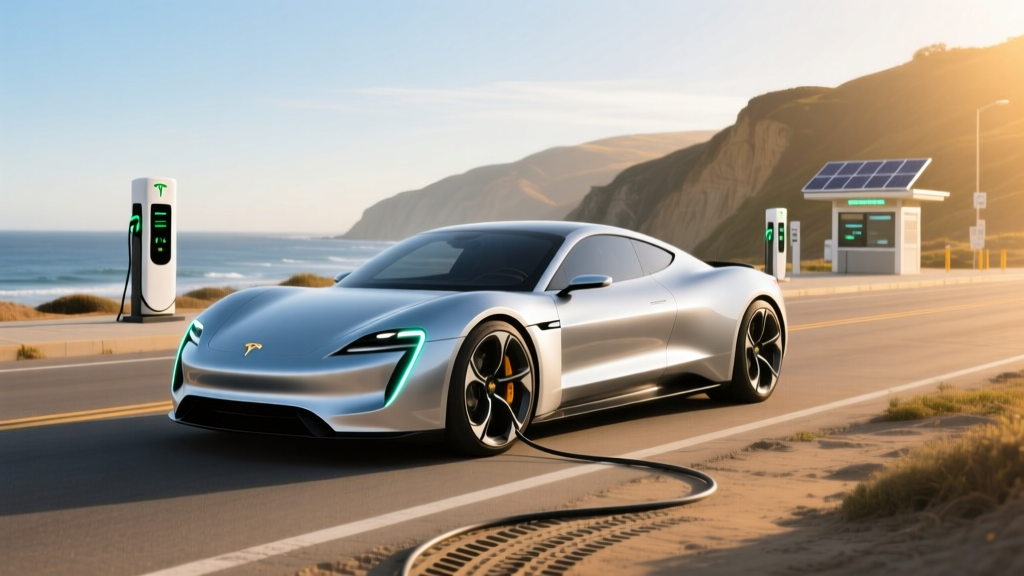
If you've been searching for pictures of a Tesla Roadster, you've likely seen the same set of images: the low-slung, glacier-white prototype Elon Musk unveiled in November 2017, followed by sporadic concept renderings and a 2019 reveal event where a Cybertruck window famously shattered. Nearly a decade later, the second-generation Roadster remains Tesla's most anticipated—and most delayed—vehicle. As of early 2026, Tesla has not begun production or deliveries, but the company continues to list the model on its website with updated (though still preliminary) specifications.
This profile compiles every confirmed and estimated data point available, separates Tesla's marketing claims from physics-grounded expectations, and explains what the Roadster's eventual arrival would mean for the hypercar-EV segment. If you're researching whether to reserve one or simply evaluating Tesla's technology roadmap, this is the most data-dense breakdown available.
What Tesla Claims: The Roadster's Announced Specifications
Tesla's official figures for the next-generation Roadster have shifted several times since 2017. The most recent numbers published on Tesla's website and referenced in earnings calls position the car as a record-setting electric sports car. Below is a consolidated spec sheet reflecting Tesla's latest announced targets. All figures remain preliminary until EPA certification and production validation.
| Specification | Tesla Claim / Estimate | Status |
|---|---|---|
| EPA Range (target) | 620 miles | Unverified — no EPA certification |
| Battery Capacity | ~200 kWh (usable, est.) | Preliminary |
| Battery Chemistry | NMC / high-nickel (likely 4680 cells) | Estimated based on Tesla architecture |
| Peak DC Fast Charge | ~350 kW (est.) | Preliminary |
| 10–80% DC Charge Time | ~25–30 minutes (est.) | Estimated |
| Level 2 Home Charge Rate | ~11.5 kW / ~34 mi/hr (est.) | Estimated |
| 0–60 mph | 1.9 seconds (base) / <1 sec (SpaceX package) | Tesla claim — unverified |
| Top Speed | 250+ mph | Tesla claim |
| Horsepower | ~1,000+ hp (tri-motor AWD) | Estimated |
| Drivetrain | Tri-motor AWD (1 front, 2 rear) | Announced |
| Base MSRP | $200,000 (Founders Series $250,000) | Tesla published price |
| Reservation Deposit | $50,000 (fully refundable historically) | Tesla published |
| Federal EV Tax Credit (§30D) | Not eligible — exceeds MSRP cap | Confirmed per IRS rules |
| Warranty (battery/powertrain) | 8 yr / 150,000 mi (est.) | Estimated based on Tesla Model S |
Range Reality: 620 Miles on Paper, but What About the Real World?
Real-World Expectation: ~420–480 miles highway at 70 mph; ~350–400 miles in cold weather (below 32°F); ~520–560 miles mixed city driving with moderate regen.
The headline 620-mile figure would shatter every production EV record if certified. It relies on an enormous ~200 kWh battery pack—roughly double the capacity of a Tesla Model S Long Range. But battery mass is the enemy of efficiency. A pack that large likely pushes the Roadster's curb weight above 4,800 lbs, which means real-world highway efficiency could drop to 300–340 Wh/mi, compared to the Model S's ~250 Wh/mi.
In cold weather, lithium-ion cells face increased internal resistance, and cabin heating draws significant energy. Based on observed cold-weather losses in the Model S and Model 3 (typically 20–30% range reduction at highway speeds below freezing), expect the Roadster to deliver roughly 350–400 miles on a full charge in winter conditions. That's still extraordinary, but far from the 620-mile sticker.
Tesla has also mentioned a potential "SpaceX package" with cold-gas thrusters for extreme acceleration. If this package trades battery capacity for pressurized air tanks, range would decrease further. No specifications on this variant have been confirmed.
Charging Speed: Can a 200-kWh Battery Charge Quickly?
This is the Roadster's biggest engineering question mark. A 200 kWh battery is so large that even at a blistering 350 kW peak charge rate, a 10–80% session would require moving ~140 kWh of energy. At a sustained 350 kW (which no current Tesla Supercharger V4 stall consistently delivers for a full session), that math yields roughly 24 minutes—but real-world charge curves taper significantly above 50–60% State of Charge (SoC).
| Charging Level | Power (kW) | Rate | Time / Notes |
|---|---|---|---|
| Level 1 (120V / 12A) | ~1.4 kW | ~4 mi/hr | Impractical — ~100+ hrs for full charge |
| Level 2 (240V / 48A) | ~11.5 kW | ~34 mi/hr | ~15–18 hrs for 10–80% |
| DC Fast Charge (Supercharger V4) | ~350 kW peak | ~1,000+ mi/hr peak | 10–80% in ~25–30 min (est.) |
For home charging, owners would need a 60-amp dedicated circuit (48A continuous) on a 240V line to achieve ~11.5 kW. Most residential electrical panels can support this, but a panel upgrade to 200A service may be necessary if the home currently has 100A service—adding $1,500–$3,000 to installation costs. Overnight Level 2 charging would replenish roughly 340 miles in a 10-hour session, which is adequate for most daily use but means a full charge from near-empty requires nearly a full day.
Tesla's Supercharger network continues to expand V4 cabinets capable of 350+ kW to compatible vehicles. The Roadster, as a flagship, would almost certainly support the highest available rates. However, sustained peak charging depends on battery thermal management—and a 200 kWh pack generates substantial heat during fast charging. Expect the charge curve to taper meaningfully above 60% SoC.
Performance: 1.9 Seconds to 60 — Is It Physically Possible?
Tesla's claimed 1.9-second 0–60 mph time would make the Roadster one of the quickest production cars ever built, rivaling or exceeding the Rimac Nevera (1.85 seconds) and Pininfarina Battista (1.8 seconds). The tri-motor AWD layout—one front motor, two rear motors—enables precise torque vectoring and maximum traction off the line.
Physics check: achieving 1.9 seconds requires roughly 1,000+ wheel horsepower and exceptional tire grip. Tesla's Plaid powertrains in the Model S Plaid already deliver 1,020 hp. The Roadster's lighter, lower body and wider contact patch make the claim plausible, though independent testing will be needed for verification. The "SpaceX package" with cold-gas thrusters supposedly enables sub-1-second times by adding downward force and direct thrust—a claim that enters hypercar-experimental territory and has no production precedent.
Quarter-mile times, top-speed runs, and track lap data are entirely unavailable. Tesla has not released the Roadster for independent testing by Car and Driver, MotorTrend, or any other outlet.
Pricing, Tax Credits, and Ownership Costs
The Tesla Roadster carries a published base price of $200,000, with the limited Founders Series at $250,000 (requiring the full amount upfront as a deposit at the time of reservation). These figures place the Roadster firmly in hypercar territory, competing against the Rimac Nevera (~$2.4M), Lotus Evija (~$2.1M), and upcoming electric offerings from Porsche and Ferrari.
| Trim | MSRP | §30D Tax Credit | Effective Price |
|---|---|---|---|
| Roadster (base) | $200,000 | $0 — exceeds MSRP cap | $200,000 |
| Founders Series | $250,000 | $0 — exceeds MSRP cap | $250,000 |
Under IRS §30D rules, the federal clean vehicle credit is capped at vehicles with an MSRP of $55,000 for sedans and $80,000 for SUVs, vans, and pickups. The Roadster, classified as a passenger car, would need an MSRP at or below $55,000 to qualify. At $200,000+, it is categorically ineligible for the $7,500 federal credit regardless of buyer income or battery sourcing. Additionally, §30D imposes adjusted gross income caps ($150,000 single / $300,000 joint) that many Roadster buyers would likely exceed.
State-level incentives vary. Some states offer rebates or HOV lane access regardless of price, but many mirror the federal MSRP cap. Consult your state's energy office or a tax professional for specifics.
Insurance: Expect premiums in the $5,000–$10,000+ annual range, consistent with other high-performance EVs and hypercars. Tesla's own insurance product may offer competitive rates based on real-time driving data (Safety Score), but availability varies by state.
Interior, Cargo, and Daily Usability
Tesla has released very few interior details. Based on prototype images and the car's dimensions (a two-seat roadster layout with a removable glass roof panel), expect:
- Seating: 2 passengers, fixed sport bucket seats
- Cargo: Minimal — estimated 3–5 cu ft rear trunk space, plus a small front trunk (frunk) for a carry-on bag or charging cable kit
- Infotainment: Likely a centrally mounted touchscreen (15–17 inches), running Tesla's current software stack with navigation, streaming, and gaming
- Driver Assistance: Tesla Autopilot (SAE Level 2) with Adaptive Cruise Control and Autosteer; Full Self-Driving (Supervised) capability likely available as an option
Practical daily usability is limited. The Roadster is a weekend car, a collector piece, and a technology showcase—not a commuter or family vehicle. Ground clearance appears very low (likely under 4 inches), which means speed bumps, steep driveways, and parking garages will be constant challenges. The removable glass roof panel adds open-air appeal but raises questions about long-term seal durability and cabin noise.
Pros, Cons, and the Biggest Unknowns
Pros
- Record-breaking range target (620 mi) if achieved
- Sub-2-second 0–60 mph would set a production-car benchmark
- Access to Tesla Supercharger network (17,000+ stalls in North America)
- Tri-motor AWD with torque vectoring
- Removable glass roof for open-air driving
- Tesla software ecosystem, OTA updates, and Supercharger reliability
Cons
- Not yet in production — no delivery timeline confirmed as of 2026
- All specs are preliminary and unverified by EPA or independent testers
- $200,000+ price with zero federal tax credit eligibility
- Massive ~200 kWh battery means long home-charge times and heavy curb weight
- Two seats and minimal cargo — no practical daily utility
- Tesla's track record of multi-year delays on announced vehicles (Cybertruck: 4 years; Roadster: 8+ years)
- Insurance costs will be extreme
Who Is the Tesla Roadster Actually For?
The Roadster is not a rational purchase. It targets a very specific buyer:
- Hypercar collectors who want an electric statement piece alongside a Rimac, Porsche 918, or McLaren P1
- Tesla loyalists who funded the original 2008 Roadster and want the full-circle bookend
- Performance-curious early adopters willing to pay a premium for the quickest production car on paper
- Technology investors who view the reservation as a refundable bet on Tesla's engineering trajectory
If you need a practical daily-driver EV with strong range, Tesla's own Model S (402-mile EPA range, ~$75,000) or the Lucid Air Grand Touring (516-mile EPA range, ~$125,000) deliver extraordinary performance and range today, with verified EPA data, independent safety ratings, and actual delivery timelines.
Skip the Roadster and buy today if: You need a verified, deliverable EV with real EPA data, warranty coverage, and independent safety testing. The Lucid Air, Porsche Taycan, and Tesla Model S Plaid all exist now and deliver exceptional performance.
Frequently Asked Questions
What is the real-world range of the Tesla Roadster?
Tesla targets 620 miles EPA, but no certification exists. Based on the physics of a ~200 kWh pack and estimated vehicle weight, expect 420–480 miles in real-world highway driving and 350–400 miles in cold weather. These are estimates until Tesla delivers production vehicles for testing.
How fast does the Roadster charge at home and on DC fast chargers?
Estimated Level 2 home charging at 11.5 kW would add roughly 34 miles per hour, requiring 15–18 hours for a 10–80% charge. DC fast charging at a Supercharger V4 stall (350 kW peak) could achieve 10–80% in approximately 25–30 minutes, though the charge curve will taper above 60% SoC.
Does the Tesla Roadster qualify for the federal EV tax credit?
No. Under current IRS §30D rules, the $7,500 clean vehicle credit is limited to passenger cars with an MSRP at or below $55,000. The Roadster's $200,000+ price disqualifies it regardless of buyer income or battery sourcing.
Is the Tesla Roadster available to buy right now?
No. As of early 2026, the Roadster is not in production and has no confirmed delivery date. Tesla accepts reservations with a deposit, but the company has delayed the program repeatedly since its 2017 announcement. All specifications remain preliminary.
How does the Roadster compare to the Rimac Nevera or Lotus Evija?
The Rimac Nevera ($2.4M, 1,914 hp, 1.85-sec 0–60, ~340-mile WLTP range) and Lotus Evija ($2.1M, 1,972 hp, ~3.0-sec 0–60, ~217-mile WLTP range) are both in limited production with verified performance data. The Roadster undercuts them dramatically on price but has yet to prove any of its claims. If Tesla delivers on 620 miles and 1.9 seconds at $200K, it would offer unmatched value in the hypercar segment—but that "if" is enormous.
Can I charge the Roadster at non-Tesla charging stations?
Tesla vehicles sold in North America now use the NACS (North American Charging Standard) connector. The Roadster would ship with NACS natively and could use adapters for legacy CCS1 stations. Access to the Supercharger network is the strongest charging-infrastructure advantage Tesla offers.
What battery chemistry will the Roadster use?
Tesla has not officially confirmed, but the energy density required for 620 miles in a sports car footprint virtually rules out LFP (lithium iron phosphate). Expect a high-nickel NMC (nickel manganese cobalt) or NCA chemistry, likely in Tesla's 4680 cell format, which offers higher energy density than the older 2170 cells.
The Bottom Line
The pictures of a Tesla Roadster that circulate online represent a promise—one that has remained unfulfilled for over eight years. The specifications, if achieved, would be genuinely transformative: 620 miles of range, sub-2-second acceleration, and a $200,000 price point that undercuts European hypercars by an order of magnitude. But every figure remains preliminary, unverified, and subject to the same delays that have defined Tesla's most ambitious programs.
For buyers who need a high-performance EV today, the market offers compelling, real, and tested alternatives. For those who view a $50,000 refundable reservation as a low-risk lottery ticket on Tesla's engineering ambitions, the Roadster remains the most speculative—and potentially rewarding—bet in the EV world.