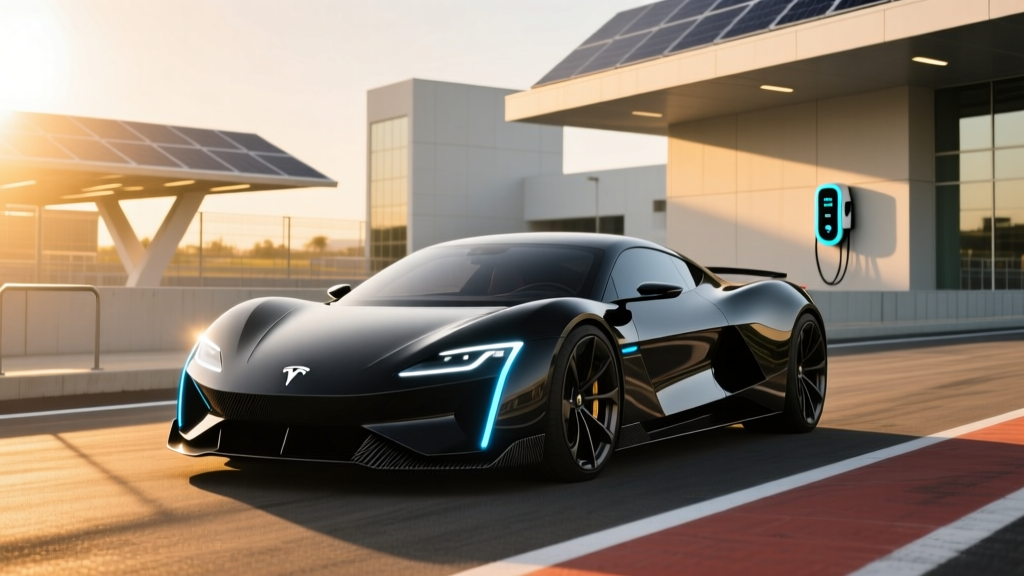
The Tesla Roadster has lived in the "coming soon" category since Elon Musk first unveiled the second-generation prototype in November 2017. As of early 2026, Tesla has not opened retail orders, published a final spec sheet, or delivered a single production unit to a customer. What we do have is a trail of executive statements, patent filings, and prototype sightings that let us piece together a credible picture of the Roadster's expected pricing, performance, and engineering.
If you've been searching for Tesla Roadster MSRP information to decide whether to reserve one or redirect that budget toward a Porsche Taycan Turbo GT or a Lotus Evija, this guide consolidates every confirmed and reasonably estimated data point available today — and flags exactly where the numbers remain speculative.
Expected Tesla Roadster MSRP and Trim Pricing
Tesla has never published an official window sticker for the second-generation Roadster. The original 2017 reveal quoted a base price of $200,000, with a $50,000 "Founders Series" limited to the first 1,000 reservations (requiring full payment upfront). That Founders Series sold out almost immediately.
Given inflation, battery material costs, and Tesla's shifting product strategy between 2017 and 2026, industry analysts broadly expect the production Roadster's MSRP to land between $200,000 and $250,000 before options, depending on whether Tesla simplifies the lineup to a single high-performance trim or adds a lower-output variant. The Founders Series, if revived, would likely command a significant premium.
| Trim / Variant | Estimated MSRP | Reservation Deposit | Status |
|---|---|---|---|
| Roadster (Base) | ~$200,000 | $50,000 (historically) | Announced — not on sale |
| Founders Series | ~$250,000 | $250,000 (full prepay) | Sold out (2017 allocation) |
Tax credit reality check: Under IRS §30D Clean Vehicle Credit rules, the Roadster would almost certainly not qualify for the $7,500 federal tax credit. The credit caps eligible vehicles at an MSRP of $80,000 for sedans, coupes, and wagons (and $55,000 for other body styles, though sports cars fall under the $80K threshold). At roughly $200,000+, the Roadster is well outside this limit. Buyer income caps ($150,000 single / $300,000 joint AGI) would also eliminate some buyers independently. Do not factor any federal credit into your Roadster budget.
Battery, Range, and Efficiency Estimates
The 2017 prototype was announced with a 200 kWh battery pack — roughly double the capacity of a Model S Long Range. Musk later suggested a "SpaceX package" with cold-gas thrusters and an even larger effective capacity. Tesla has not confirmed the chemistry of the production pack, but a vehicle targeting extreme range and sustained high-power discharge would almost certainly use an NMC (nickel manganese cobalt) or NCA cell chemistry rather than LFP, which trades energy density for cost and cycle life.
Real-World Expectation: If Tesla achieves the 620-mile EPA sticker, expect roughly 480–530 miles on highway road trips at 75 mph in moderate temperatures. Cold-weather highway driving (below 32°F) could reduce that to 380–440 miles due to battery heating loads and reduced regenerative braking efficiency. These are estimates based on typical EV highway/cold-weather losses of 15–30% from EPA combined figures; actual results depend on the production vehicle's aerodynamics, thermal management, and tire spec.
A 200 kWh pack pushing a sports car with a low drag coefficient could yield an efficiency figure around 30–34 kWh/100 miles (roughly 100–112 MPGe combined), though Tesla's published efficiency numbers for the Roadster remain unavailable. For context, the current Lucid Air Grand Touring achieves 146 MPGe combined with a 112 kWh pack — but it's a luxury sedan, not a two-door sports car with performance-tuned rolling resistance.
Charging Speed: DC Fast and Home Level 2
Tesla has not released official charging specifications for the Roadster. However, the vehicle will charge on the Tesla Supercharger network using the NACS connector, and it will be compatible with the latest V4 Supercharger cabinets capable of up to 350 kW for capable vehicles.
| Charging Level | Power / Rate | Estimated Speed | Notes |
|---|---|---|---|
| Level 1 (120V) | ~1.4 kW | ~3–4 miles/hour | Emergency/trickle only; a full charge would take days |
| Level 2 (240V, 48A) | ~11.5 kW | ~30–35 miles/hour | Standard home Wall Connector; overnight fills ~80% in 5–6 hours |
| DC Fast Charge (Supercharger V4) | Up to ~350 kW (estimated peak) | 10–80% in ~20–25 min (est.) | 200 kWh pack requires sustained high C-rate; expect taper above 60% SoC. Actual curve unconfirmed. |
Charging-curve reality: A 200 kWh battery can absorb enormous energy at low states of charge, but thermal management becomes the limiting factor as the pack fills. Even if the Roadster peaks at 350 kW, expect the sustained average rate from 10–80% to be closer to 200–250 kW, which is still blistering for a pack this large. Preconditioning the battery via in-car navigation routing to a Supercharger will be essential for achieving peak rates.
Performance: 0-60, Horsepower, and Drivetrain
This is where the Roadster's announced figures border on the absurd — and where Tesla has the engineering credibility to potentially deliver.
| Metric | Announced / Estimated Value |
|---|---|
| 0–60 mph | 1.9 seconds (announced); 1.1 sec with SpaceX package (claimed) |
| Top Speed | 250+ mph (announced) |
| Quarter Mile | 8.8 seconds (announced) |
| Horsepower | ~1,000+ hp (estimated; three-motor AWD) |
| Drivetrain | Tri-motor AWD (one front, two rear) |
| Torque Vectoring | Expected — individual rear motor control |
The tri-motor layout — one motor driving the front axle and two independent motors on the rear axle — enables torque vectoring across the rear wheels, critical for a car with this much power. The 1.9-second 0–60 claim would make the Roadster one of the quickest production cars ever built, rivaling or exceeding the Rimac Nevera (1.85 sec) and the Pininfarina Battista (1.8 sec).
The optional "SpaceX package" with cold-gas thrusters mounted around the vehicle is, as of 2026, still unconfirmed for production. Musk has described thrusters that could improve cornering, braking, and acceleration by applying directed thrust — but the regulatory, safety, and practical hurdles of road-legal compressed-gas propulsion remain substantial.
Interior, Cargo, and Practicality
The Roadster is a 2+2 sports car with a removable glass roof panel. Interior details remain sparse, but based on the prototype and Tesla's current design language:
- Seating: Two front sport seats with two small rear seats suitable for children or cargo overflow. Expect minimal rear legroom — this is a sports car, not a family hauler.
- Cargo: A rear trunk and a front trunk (frunk) are expected, though Tesla has not published cubic-footage figures. Total cargo space is likely in the 10–15 cu ft range combined — adequate for weekend luggage for two.
- Infotainment: Expect a centrally mounted touchscreen (likely 17-inch, similar to Model S/X) with Tesla's latest UI, over-the-air updates, and integrated navigation with Supercharger routing.
- Driver Assistance: Tesla Autopilot is expected as standard, with Full Self-Driving (Supervised) available as an option. Note: FSD is an SAE Level 2 system requiring continuous driver supervision — it is not autonomous driving.
Warranty and Ownership Considerations
Tesla has not published Roadster-specific warranty terms. Based on the current Model S/X warranty structure, a reasonable expectation is:
- Battery & Drive Unit: 8 years / 150,000 miles (whichever comes first), with a minimum 70% capacity retention threshold over the warranty period.
- Vehicle Limited Warranty: 4 years / 50,000 miles.
For a $200,000+ vehicle, buyers should also budget for:
- Insurance: High-performance EVs carry steep premiums. Expect $4,000–$7,000+ annually depending on driving record, location, and coverage level. Insurers price the Roadster against the Rimac Nevera and Porsche Taycan Turbo GT, not the Model 3.
- Tires: Performance tires on a 4,500+ lb tri-motor EV with instant torque will wear quickly. Budget $1,500–$3,000 per set, with replacement every 10,000–15,000 miles under spirited driving.
- Maintenance: Minimal compared to ICE supercars (no oil changes, fewer brake replacements thanks to regen), but suspension components, cabin air filters, and brake fluid still require periodic service.
Who Should Wait for the Tesla Roadster?
- You want a halo EV sports car with 600+ miles of range and sub-2-second 0–60 performance
- You're already a Tesla ecosystem loyalist and value Supercharger network integration
- You're willing to accept the risk of further delays and spec changes before delivery
- Your budget comfortably absorbs a $200,000+ car with no federal tax credit offset
- You need a vehicle in the next 12 months — the Roadster's production timeline remains unconfirmed
- You want a proven, warrantied, independently reviewed hypercar (see: Rimac Nevera, Lotus Evija)
- Practicality, rear-seat space, or daily-driver comfort are priorities
- You want to qualify for the §30D federal EV tax credit
Key Competitors: Roadster vs. the Hypercar EV Field
The Roadster doesn't compete with the Model S Plaid or the Porsche Taycan — it targets the electric hypercar tier:
| Vehicle | 0–60 mph | Range (EPA/WLTP) | MSRP | Availability |
|---|---|---|---|---|
| Tesla Roadster | 1.9 sec (ann.) | 620 mi (ann. EPA target) | ~$200,000 | Not on sale |
| Rimac Nevera | 1.85 sec | ~340 mi (WLTP) | $2,200,000 | In production (150 units) |
| Lotus Evija | ~3.0 sec | ~250 mi (WLTP) | $2,300,000 | Limited production |
| Pininfarina Battista | 1.8 sec | ~300 mi (WLTP) | $2,800,000 | Limited production |
The Roadster's value proposition, if it reaches production at the announced price, is radical: hypercar performance at roughly one-tenth the cost of a Rimac or Lotus. The trade-off is exclusivity, provenance, and the uncertainty of actually receiving the car.
Frequently Asked Questions
What is the real-world range of the Tesla Roadster?
Tesla's announced EPA target is 620 miles, but this figure has not been independently verified by the EPA or tested in production form. In real-world highway driving at 75 mph in moderate temperatures, expect roughly 480–530 miles. Cold-weather highway range could drop to 380–440 miles. These are estimates until Tesla delivers production vehicles for independent testing.
How fast does the Tesla Roadster charge?
Official charging specs have not been published. On a Tesla V4 Supercharger, the Roadster is expected to peak at up to ~350 kW, with an estimated 10–80% charge time of 20–25 minutes. Home Level 2 charging at 11.5 kW (48A) would add roughly 30–35 miles per hour, requiring 5–6 hours for an 80% charge on the ~200 kWh pack.
How much does the Tesla Roadster cost after tax credits?
The Roadster does not qualify for the $7,500 federal §30D EV tax credit because its MSRP far exceeds the $80,000 cap for sedans and coupes. Expect to pay the full MSRP (~$200,000+) plus destination charges, sales tax, and registration. Some states may offer their own incentives, but most state EV credits also have MSRP caps.
Is the Tesla Roadster worth buying vs. competitors?
If Tesla delivers the announced specs at the announced price, the Roadster would offer the best performance-per-dollar in the electric hypercar segment by a wide margin. However, the Rimac Nevera and Lotus Evija are real, deliverable, warrantied cars today. The Roadster remains speculative. Buyers who need a car now and can afford $2M+ should consider the Nevera. Buyers willing to wait and accept execution risk may find the Roadster's value proposition compelling at $200K.
What are the biggest pros and cons of the Tesla Roadster?
- 620-mile EPA range target — longest of any announced EV
- 1.9-second 0–60 mph with tri-motor AWD
- ~$200,000 MSRP — a fraction of comparable hypercars
- Tesla Supercharger network access (NACS)
- Removable glass roof panel
- Over-the-air software updates
- Not on sale — no confirmed production date as of 2026
- All specs are preliminary and subject to change
- No federal tax credit eligibility (MSRP cap exceeded)
- Insurance costs likely $4,000–$7,000+/year
- Minimal rear-seat and cargo practicality
- SpaceX thruster package may not reach production or may face regulatory barriers
- Unproven at this price point for Tesla (no $200K+ vehicle delivered to date)
Does the Tesla Roadster qualify for the federal EV tax credit?
No. Under current IRS §30D rules, new clean vehicle credits are limited to vehicles with an MSRP at or below $80,000 (for sedans, coupes, and wagons). The Roadster's estimated $200,000+ MSRP disqualifies it regardless of battery sourcing or buyer income. Consult a tax professional for your specific situation, but do not plan your purchase around federal credits for this vehicle.
When will the Tesla Roadster be available?
Tesla has repeatedly delayed the Roadster. As of early 2026, no firm production start date has been announced. Musk has suggested a potential reveal of the production design, but volume manufacturing has not been confirmed. Buyers should treat any timeline as speculative until Tesla opens final configurations and begins deliveries.
Sources: Tesla product announcements, IRS §30D Clean Vehicle Credit guidelines, fueleconomy.gov for comparison efficiency data. All Roadster specifications cited are preliminary/announced and subject to change before production.