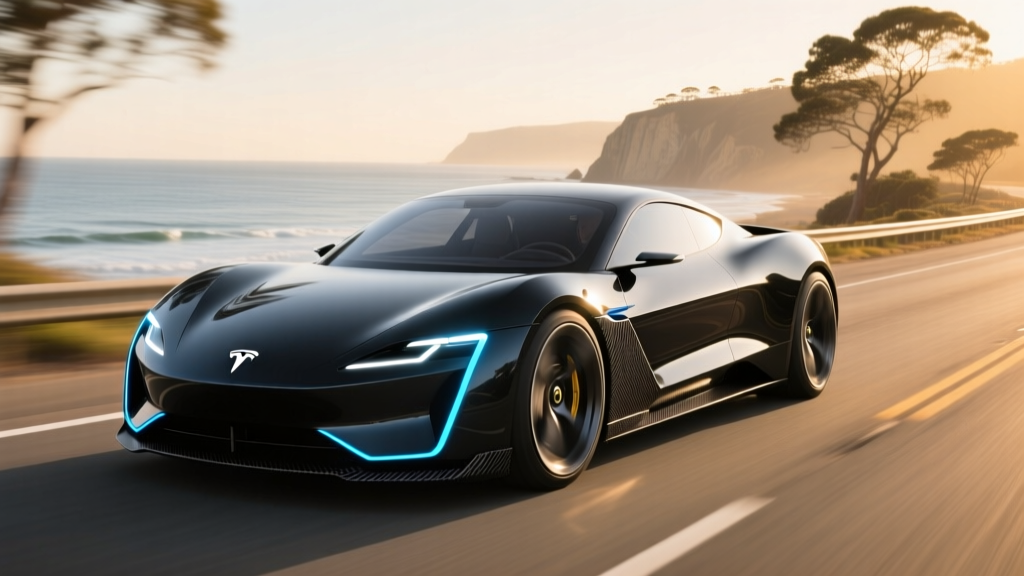
The Tesla Roadster has lived in a state of perpetual "almost" since Elon Musk first pulled the tarp off the second-generation prototype in November 2017. Now, as Tesla pushes toward limited production in late 2026, the conversation has shifted from vaporware accusations to hard manufacturing questions: Can Tesla actually build a 200 kWh battery pack that fits in a two-seat sports car chassis? Will the claimed 620-mile EPA range survive real-world highway driving? And what does the production engineering reality look like behind the marketing slides?
This profile examines the Tesla Roadster through the lens a manufacturing engineer would use — tolerances, cell sourcing, thermal management constraints, and production scalability — while giving buyers the concrete specs, pricing, and ownership data needed to decide whether to reserve or wait.
EPA Range vs. Real-World Expectation
Tesla claim: 620 miles (preliminary, pending final EPA certification)
Real-world estimate: 480–540 miles at 70 mph highway; 380–440 miles in sub-30°F cold weather with cabin heating. The 200 kWh pack provides massive energy reserve, but aerodynamic drag at speed and thermal loads compress usable range significantly below the sticker figure.
What the Manufacturing Engineering Challenges Reveal
Building the Roadster is not simply a matter of dropping a larger battery into an existing platform. From a manufacturing engineer's standpoint, the vehicle presents at least four production constraints that explain the repeated delays:
Cell packaging density. A 200 kWh pack using Tesla's 4680 cells requires roughly 2,400+ cells in a structural battery pack. Fitting this into a low-slung sports car floorpan — while maintaining ground clearance, crash-structure integrity, and torsional rigidity — demands tighter manufacturing tolerances than the Model S or Cybertruck lines currently achieve at scale.
Thermal management at extreme discharge. The claimed 1.9-second 0–60 mph time means the battery must sustain discharge rates exceeding 10C momentarily. This requires advanced cooling channels integrated into the cell modules, plus high-flow coolant pumps that add weight and complexity to the assembly process.
Spaceframe and body panel tooling. The Roadster uses a mixed-material chassis (aluminum extrusions, carbon-fiber roof panel, stamped steel subframes). Multi-material joining — structural adhesives, self-piercing rivets, laser welds — requires dedicated tooling that Tesla's Fremont and Austin lines do not currently have in place for high-volume runs.
Supply chain for the "SpaceX Package." The optional cold-gas thruster system (compressed air tanks for cornering and braking augmentation) introduces aerospace-grade components into an automotive assembly line, requiring entirely different quality-control protocols and supplier certifications.
These constraints don't make the Roadster impossible — they make it a low-volume, high-cost build, which aligns with Tesla's stated strategy of limited initial production rather than mass-market scaling.
Full Specifications: Battery, Performance, and Drivetrain
| Specification | 2026 Tesla Roadster (Preliminary) |
|---|---|
| Battery Capacity | 200 kWh (usable, estimated) |
| Cell Chemistry | NMC (Nickel Manganese Cobalt) — high energy density required for range target |
| Cell Format | 4680 cylindrical |
| EPA Range (claimed) | 620 miles (pending certification) |
| Drivetrain | Tri-motor AWD (1 front, 2 rear) |
| Horsepower | ~1,000+ hp (combined peak) |
| 0–60 mph | 1.9 seconds (with rollout subtracted, SpaceX Package) |
| Top Speed | 250+ mph (electronically limited) |
| Quarter Mile | 8.8 seconds (claimed) |
| Curb Weight (est.) | 4,400–4,700 lbs |
| Seats | 2+2 (rear seats suitable for children/cargo only) |
| Roof | Removable glass panel (stored in trunk) |
The tri-motor layout mirrors the Model S Plaid architecture, but with higher-output rear motors to handle the torque-vectoring demands of a lightweight sports car. The NMC chemistry choice is deliberate: LFP cells, while cheaper and longer-lasting, lack the energy density needed to hit 200 kWh in a package this size. Expect NMC to carry the typical 8-year/120,000-mile battery warranty with a 70% capacity retention threshold.
Charging Speed: DC Fast, Level 2, and the 200 kWh Problem
| Charging Level | Power | Estimated Speed | Notes |
|---|---|---|---|
| DC Fast Charge (peak) | 350 kW | ~180 miles in 10 min (10–30% SoC) | Peak rate sustained only below 40% SoC |
| DC Fast Charge (10–80%) | 350 → 80 kW taper | ~40–45 minutes | Heavy taper above 60% due to pack size |
| Level 2 Home (48A / 11.5 kW) | 11.5 kW | ~34 miles per hour of charging | Full 0–100% charge: ~17–18 hours |
| Level 2 Home (80A / 19.2 kW) | 19.2 kW | ~57 miles per hour of charging | Requires 100A circuit; full charge: ~10–11 hours |
| Level 1 (120V / 12A) | 1.4 kW | ~4 miles per hour | Effectively unusable for daily top-ups on a 200 kWh pack |
The charging-curve reality for a 200 kWh pack is a manufacturing engineer's headache and an owner's inconvenience. Even at 350 kW peak — achievable only on Tesla V4 Superchargers with adequate grid supply — the pack's massive capacity means that 10–80% charging will take 40+ minutes. That's roughly double the time a Model 3 Long Range (82 kWh, ~250 kW peak) requires for the same session. The physics are unforgiving: more kWh to fill means more minutes at the charger, even at identical peak kW.
For home charging, owners will want a hardwired 80A Level 2 installation (19.2 kW). A standard 48A Wall Connector (11.5 kW) will technically work but requires nearly 18 hours for a full charge — impractical if you arrive home at 10% and need a full pack by morning. Budget $1,200–$2,500 for an 80A circuit installation, including panel evaluation and potential service upgrade to 200A or 400A.
Pricing, Tax Credits, and Total Cost Reality
| Item | Amount |
|---|---|
| Base MSRP (Roadster) | $200,000 (reservation holders) |
| Founders Series (limited) | $250,000 |
| SpaceX Package (thrusters) | +$50,000 (estimated) |
| Federal §30D Tax Credit | $0 — exceeds MSRP cap ($55,000 for sports cars per IRS rules) |
| State Incentives | Varies; check IRS §30D guidelines and state energy office |
| Destination Fee | ~$1,500–$2,500 (estimated) |
| Estimated Out-the-Door (base) | ~$203,000–$208,000 |
The IRS §30D clean vehicle credit caps eligible MSRP at $55,000 for sedans and sports cars (and $80,000 for SUVs, trucks, and vans). At a $200,000 base price, the Roadster is categorically ineligible for the $7,500 federal credit regardless of battery sourcing or buyer income. This is straightforward: the vehicle was never designed for incentive qualification. Buyers at this price point are purchasing performance and exclusivity, not tax optimization.
Insurance will be a significant ongoing cost. Based on comparable vehicles (Rimac Nevera, Porsche Taycan Turbo GT), expect annual premiums of $6,000–$10,000 depending on state, driving record, and coverage level. Factor in tire replacement at $800–$1,200 per set (custom-spec Michelin Pilot Sport Cup 2 or equivalent), and the five-year cost of ownership will approach $250,000+ even without incident.
Efficiency, Cargo, and Livability
Efficiency in a 4,500-lb, 1,000-hp sports car is relative. Tesla has not published official MPGe figures (pending EPA certification), but based on the 200 kWh pack and 620-mile claim, the implied efficiency is approximately 322 Wh/mile or roughly 105 MPGe combined. For comparison, the Model S Plaid achieves 120 MPGe combined with a 100 kWh pack. The Roadster's heavier pack and wider tires will reduce efficiency below that benchmark.
Practical space is minimal by design:
- Front trunk (frunk): ~3.5 cu ft (limited by front motor and cooling hardware)
- Rear trunk: ~6.5 cu ft (with glass roof panel stored; ~4.0 cu ft with panel in place)
- Rear seats: Suitable for children under ~5'4" or soft cargo; no LATCH anchors expected
- Front legroom: ~42 inches (estimated, based on Tesla sports-seat architecture)
- Headroom (with roof panel): ~38 inches
This is not a grand-touring car in the traditional sense. It's a weekend weapon with just enough practicality for overnight trips. Road-trip charging will require planning: with 40+ minute DC fast-charge sessions, you'll want to align stops with meal breaks on any drive exceeding 400 miles.
Technology, Driver Assistance, and Software
The Roadster will ship with Tesla's latest hardware suite (HW5/AI5), supporting:
- Autopilot: Standard adaptive cruise, lane-keeping, auto lane-change
- Full Self-Driving (Supervised): Optional ($8,000–$12,000); Level 2 driver-assist — driver must remain fully engaged at all times
- Infotainment: 17-inch center touchscreen, gaming-capable GPU, premium 22-speaker audio
- Vehicle dynamics: Active torque vectoring, adjustable suspension, configurable drive modes (including a "Track" mode with telemetry logging)
- Over-the-air updates: Continuous feature deployment, performance tuning, and UI refinement
ADAS Limitation Notice
Tesla Autopilot and FSD (Supervised) are SAE Level 2 driver-assistance systems. They do NOT make the vehicle self-driving. The driver must maintain steering-wheel contact, monitor the road, and be prepared to take over instantly. No Tesla vehicle currently achieves Level 3 or higher automation. Claims of "full self-driving" refer to the software package name, not the SAE automation level.
The standout tech feature is the optional SpaceX Package's cold-gas thruster system — compressed-air jets positioned around the vehicle that provide up to ~50 lbs of directional thrust for enhanced cornering grip, shorter braking distances, and improved launch traction. This is genuinely novel in a production road car, though it adds weight, complexity, and requires periodic tank refills (estimated $200–$400 per service).
Competitor Comparison: Is the Roadster Worth It?
| Attribute | Tesla Roadster | Rimac Nevera | Lotus Evija | Porsche Taycan Turbo GT |
|---|---|---|---|---|
| Price | $200,000 | $2,200,000 | $2,400,000 | $240,000 |
| Range (claimed/EPA) | 620 mi | 340 mi (WLTP) | 250 mi (WLTP) | 269 mi (EPA) |
| 0–60 mph | 1.9s | 1.85s | <2.0s | 2.1s |
| Battery | 200 kWh | 120 kWh | 70 kWh | 105 kWh |
| Production Volume | Limited (est. 2,000–5,000/yr) | 150 total | 130 total | Mass production |
| Charging (DC peak) | 350 kW | 500 kW | 350 kW | 320 kW |
The Roadster's value proposition is clear when viewed against hypercar competitors: it offers 90% of the Rimac Nevera's performance at less than 10% of the price, with vastly superior range. Against the more practical Taycan Turbo GT, the Roadster trades daily usability and dealer service infrastructure for raw acceleration and exclusivity.
Pros
- Class-leading range (620 mi claimed) obliterates range anxiety
- Sub-2-second 0–60 mph — among the fastest production cars ever built
- Price undercuts hypercar competitors by $2M+
- Tesla Supercharger network access (20,000+ stations in North America)
- OTA updates and continuous software improvement
- Removable glass roof for open-air driving
Cons
- Not yet in production — delivery timeline uncertain
- No federal tax credit eligibility (MSRP far exceeds caps)
- 40+ minute DC fast-charge sessions due to 200 kWh pack
- Minimal cargo space; rear seats are token gesture
- Insurance costs will be extreme ($6K–$10K/year)
- Tesla service-center capacity may not support low-volume specialty vehicle
- SpaceX Package adds complexity, weight, and maintenance cost
Who Should Buy the Tesla Roadster?
Best fit: Affluent enthusiasts who want record-breaking acceleration, massive range for canyon-carving day trips, and the exclusivity of owning one of the first 5,000 units. This is a garage-of-one car — the weekend toy, not the daily driver.
Consider alternatives if: You need practical cargo space, daily-driver comfort, dealer-level service infrastructure, or if the $200,000+ price point makes you flinch. The Porsche Taycan Turbo GT delivers 95% of the thrills with full practicality, mass-production reliability, and a real service network. The upcoming Chevrolet Corvette ZR1 (hybrid) will offer similar performance at a fraction of the cost with established dealer support.
FAQ: Tesla Roadster Ownership Questions
What is the real-world range of the Tesla Roadster?
Tesla claims 620 miles (pending EPA certification). In real-world highway driving at 70 mph, expect 480–540 miles. In cold weather (below 30°F) with cabin heating, that drops to 380–440 miles. The 200 kWh pack provides enormous reserve, but aerodynamic drag and thermal loads compress usable range below the sticker number — as with all EVs.
How fast does the Roadster charge at home and on the road?
On a Tesla V4 Supercharger, peak rate is 350 kW, but 10–80% takes approximately 40–45 minutes due to the massive pack size and charge-curve taper above 60% SoC. At home, an 80A Level 2 charger (19.2 kW) adds about 57 miles per hour and fully charges in 10–11 hours. A standard 48A charger takes 17–18 hours for a full cycle.
Does the Tesla Roadster qualify for the federal EV tax credit?
No. The IRS §30D credit caps eligible MSRP at $55,000 for sports cars and sedans. The Roadster's $200,000 base price disqualifies it entirely, regardless of battery sourcing or buyer income. State-level incentives vary — check your state energy office for details.
Is the Roadster worth buying vs. the Rimac Nevera or Porsche Taycan?
If budget is the primary constraint and you want hypercar performance, the Roadster at $200,000 is dramatically more accessible than the $2.2M Nevera. If daily usability, dealer service, and immediate availability matter more, the Porsche Taycan Turbo GT ($240,000) is a more practical choice that you can actually buy and service today.
When will the Tesla Roadster actually be available?
Tesla has indicated limited production could begin in late 2026 or early 2027, but the company has a history of timeline slips (the Roadster was originally announced for 2020). Reservation holders ($50,000 deposit) will receive priority. No firm delivery date has been confirmed as of mid-2026.
What battery chemistry does the Roadster use?
NMC (Nickel Manganese Cobalt) in the 4680 cylindrical cell format. NMC is chosen for its higher energy density versus LFP, which is necessary to achieve 200 kWh in a sports-car floorpan. Expect the standard Tesla battery warranty: 8 years / 120,000 miles with a minimum 70% capacity retention guarantee.
Can I daily-drive the Roadster?
Technically yes, but practically it's a compromise. Cargo space is under 10 cu ft total, the ride is firm in performance mode, and 40-minute charging sessions make long commutes tedious. Most owners will treat it as a weekend and track-day vehicle with a second car for daily use.