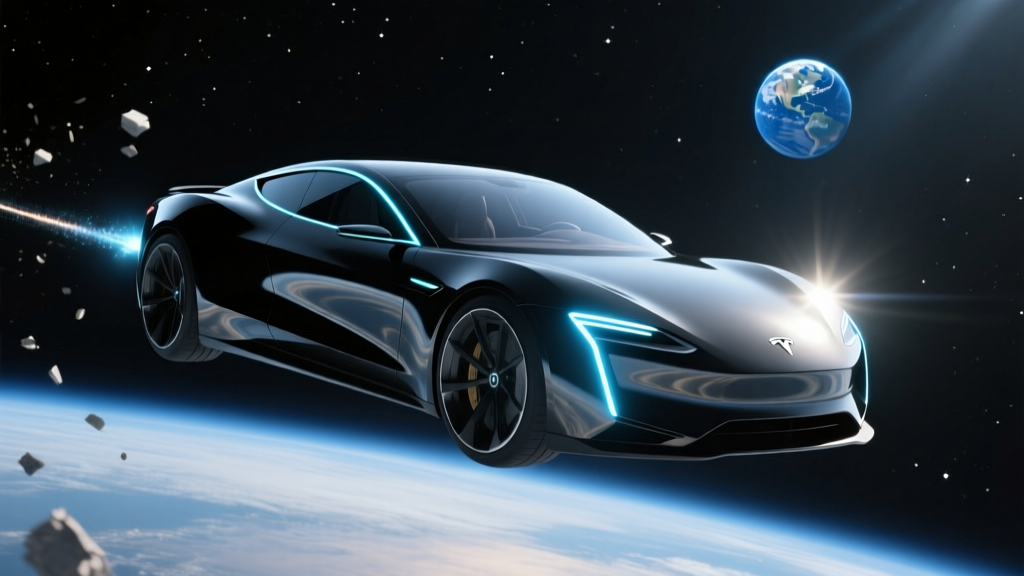
On February 6, 2018, SpaceX CEO Elon Musk strapped his personal first-generation Tesla Roadster to the nose of a Falcon Heavy rocket and launched it toward a heliocentric orbit that crosses Mars. A mannequin in a SpaceX pressure suit — dubbed "Starman" — sat behind the wheel, David Bowie's "Space Oddity" playing on loop. It remains the most surreal marketing moment in automotive history: a production electric car, traveling at roughly 25,000 mph relative to Earth, past the orbit of Mars by 2020.
But for EV buyers in 2026, the question is practical, not orbital: what did the Tesla that launched into space actually teach us about electric vehicles, battery longevity, and where Tesla's lineup stands today? This profile traces the original Roadster's specs, its spaceflight significance, and how Tesla's current vehicles — particularly the 2026 Model S and the long-rumored next-gen Roadster — carry that legacy forward.
The Original Roadster: Specs of the Car That Left Earth
The first-generation Tesla Roadster (2008–2012) was the vehicle that proved a lithium-ion battery pack could power a highway-capable sports car. Built on a modified Lotus Elise chassis, it was low-volume, expensive, and transformative.
| Spec | Value |
|---|---|
| Battery Capacity | 53 kWh (usable ~48 kWh), lithium-cobalt oxide (NMC-type) |
| EPA-Equivalent Range | 244 miles (original Tesla claim; pre-EPA standardized testing for EVs in 2008) |
| Motor | Single rear-mounted AC induction, 288 hp / 295 lb-ft torque |
| 0–60 mph | 3.7 seconds |
| Top Speed | 125 mph (electronically limited) |
| Charging | Proprietary 70-amp connector; ~3.5 hours on 240V (Level 2 equivalent) |
| Curb Weight | 2,690 lbs |
| Units Produced | ~2,450 worldwide |
| Original MSRP | $109,000 (base), $128,000 (Signature) |
Elon Musk's personal Roadster — the midnight-cherry example now in space — was one of those ~2,450 units. It had already accumulated significant real-world miles before being retired to its new career as an interplanetary test payload.
Why Launching a Tesla Into Space Mattered for EV Perception
The Falcon Heavy demo flight needed a dummy payload. Musk chose his Roadster for a reason that blended engineering theater with brand strategy:
- Proof of concept for EV durability: A production electric car surviving launch vibrations (peak ~6G), vacuum, and extreme temperature cycling (–250°F to +250°F in direct sunlight vs. shadow) demonstrated that EV powertrains have fewer failure points than internal-combustion engines in extreme environments. No fuel to freeze or ignite, no oil to cavitate, no air intake to starve.
- Public perception shift: In 2018, many consumers still associated EVs with golf carts and compliance cars. A Tesla orbiting Mars at escape velocity reframed the brand as performance- and technology-forward. Tesla's stock rose approximately 4% in the week following the launch.
- Battery chemistry validation: The Roadster's lithium-cobalt cells, while energy-dense, were also thermally volatile — a factor in early Tesla safety debates. SpaceX engineers encased the pack in additional shielding, but the fact that the cells survived launch without thermal runaway was a data point for the industry.
How Tesla's 2026 Lineup Compares to That Original Roadster
The 2008 Roadster was a proof of concept. Tesla's 2026 lineup — the Model S, Model 3, Model X, Model Y, and Cybertruck — represents the mass-market realization of everything that first car promised. Here's how the flagship 2026 Model S stacks up against the car that left Earth:
| Spec | 2008 Roadster | 2026 Model S Long Range |
|---|---|---|
| Battery | 53 kWh, Li-Co | ~100 kWh usable, NMC (4680 cells) |
| EPA Range | 244 mi (est.) | 402 mi |
| Motor / Drivetrain | Single RWD, 288 hp | Dual-motor AWD, 670 hp |
| 0–60 mph | 3.7 sec | 3.1 sec |
| Max DC Fast Charge | N/A (no DCFC) | 250 kW (V3 Supercharger) |
| 10–80% DCFC Time | N/A | ~28 min |
| Level 2 Home Charge | ~3.5 hrs (full) | 44 mi/hr at 11.5 kW (Wall Connector) |
| Efficiency | ~220 Wh/mi (est.) | 124 MPGe / 28 kWh/100 mi |
| Cargo Space | Minimal (trunk only) | 28 cu ft (rear) + frunk |
| Base MSRP (2026) | $109,000 (2008) | $74,990 |
| Battery Warranty | 3 yr / 36,000 mi | 8 yr / 150,000 mi (min 70% retention) |
The generational leap is enormous: nearly double the range, more than double the power, DC fast charging that didn't exist in 2008, and a lower inflation-adjusted price. The EPA's fueleconomy.gov listing confirms the 2026 Model S Long Range at 402 miles and 124 MPGe combined.
2026 Tesla Model S: Range, Charging, and Real-World Ownership
For buyers considering a Tesla today — whether drawn in by the brand's space-age mythology or simply by its Supercharger network — the Model S remains the range and tech flagship. Here are the numbers that matter:
Charging Speed Breakdown
| Level | Power | Speed |
|---|---|---|
| Level 1 (120V household) | ~1.4 kW | ~3–4 mi/hr |
| Level 2 (240V Wall Connector) | 11.5 kW | ~44 mi/hr (~10 hrs for full charge) |
| DC Fast Charge (V3 Supercharger) | Peak 250 kW | 10–80% in ~28 min; adds ~200 mi in 15 min |
| DC Fast Charge (CCS adapter / 350 kW stations) | Peak ~250 kW (car-limited) | Similar to V3; taper above 80% SoC |
Charging curve reality: The Model S peaks at 250 kW only when the battery is preconditioned (via navigation to a Supercharger) and at low state of charge (~10–20%). Above 50% SoC, the rate tapers to ~150 kW, and above 80% it drops sharply to ~50 kW or less. This is why the 10–80% metric matters more than peak kW — and why Tesla's navigation-based preconditioning is a practical advantage at public chargers.
Performance and Drivetrain
The 2026 Model S Long Range uses a dual-motor all-wheel-drive setup producing 670 horsepower. The Plaid variant (tri-motor, 1,020 hp) achieves 0–60 mph in a staggering 1.99 seconds — though at a $94,990 starting price and with range dropping to 359 miles EPA.
For context, the original Roadster's 3.7-second 0–60 was supercar territory in 2008. Today, a $42,000 Tesla Model 3 Performance does it in 2.9 seconds. The democratization of EV performance is perhaps the Roadster's most tangible legacy.
Interior, Cargo, and Tech
- Passenger space: 42.4 inches front legroom, 35.4 inches rear legroom — adequate for adults but tighter than the Model X or competitors like the Lucid Air.
- Cargo: 28 cubic feet behind the rear seats, plus a front trunk (frunk) suitable for a carry-on bag. Fold the rear seats for roughly 50 cu ft.
- Infotainment: 17-inch center touchscreen with a secondary 8-inch rear passenger display. Tesla's UI remains industry-leading in responsiveness, though Apple CarPlay/Android Auto are still not supported.
- Driver assistance: Basic Autopilot is standard (adaptive cruise + lane centering). Full Self-Driving (Supervised) is an $8,000 option — note that this is SAE Level 2, requiring continuous driver attention. It is not autonomous driving.
The Next-Gen Roadster: Announced, Delayed, Still Not Here
Tesla announced the second-generation Roadster in November 2017 with breathtaking claims: 620 miles of range, 0–60 in 1.9 seconds, a 250+ mph top speed, and a "SpaceX package" with cold-gas thrusters for cornering and braking assist. Musk initially targeted a 2020 production date. As of early 2026, the next-gen Roadster remains announced but not in production. Tesla has not published a firm delivery timeline, and the vehicle is not currently available for purchase.
What we know from Tesla's announcements:
- 200 kWh battery pack (estimated, NMC chemistry)
- Tri-motor AWD with torque vectoring
- Target 620-mile EPA range (unverified)
- Base price announced at $200,000; $250,000 Founders Series (sold out)
- "SpaceX package" option with cold-air thrusters for enhanced handling — a direct callback to the original Roadster's spaceflight
Buyer caution: Until Tesla begins deliveries and the EPA certifies range figures, treat all next-gen Roadster specs as preliminary. Tesla has a history of ambitious timeline projections that slip by years. If you're shopping for a Tesla today, the Model S Plaid delivers supercar performance with a proven production platform.
Pricing, Tax Credits, and the 2026 Model S Value Equation
| Trim | Base MSRP | Federal §30D Credit Eligible? | Effective Price (if eligible) |
|---|---|---|---|
| Long Range | $74,990 | No — exceeds $55,000 sedan MSRP cap | $74,990 |
| Plaid | $94,990 | No — exceeds $55,000 sedan MSRP cap | $94,990 |
Under current IRS §30D rules, the federal EV tax credit of up to $7,500 applies only to new EVs with an MSRP at or below $55,000 for sedans (or $80,000 for SUVs/pickups). The Model S, priced well above $55,000, does not qualify. Additionally, buyers must meet income caps ($150,000 single / $300,000 joint MAGI) and the vehicle must meet critical-mineral and battery-component sourcing requirements.
The Model S does not receive the point-of-sale credit transfer that cheaper EVs like the Model 3 ($38,990 base) or Model Y ($44,990 base, qualifies under the $80,000 SUV cap) may receive. Buyers should consult a tax professional for their specific situation and verify current-year rules at IRS.gov, as sourcing requirements tighten annually.
Warranty Coverage
- Battery & Drive Unit: 8 years / 150,000 miles, whichever comes first, with minimum 70% battery capacity retention
- Vehicle Limited Warranty: 4 years / 50,000 miles
Tesla's battery warranty is competitive with the industry standard. Real-world data from Tesla's Impact Reports and third-party fleet analyses (such as those compiled by Recurrent Auto) suggest that NMC packs in the Model S typically retain 85–90% capacity at 100,000 miles — well within the warranty threshold.
Who Should Buy a Tesla in 2026 — and Who Should Look Elsewhere?
- You want access to the Supercharger network — still the most reliable and extensive DC fast-charging ecosystem in North America, with over 6,000 U.S. stations
- Software integration, OTA updates, and infotainment responsiveness are top priorities
- You value proven EV powertrain reliability with hundreds of billions of fleet miles logged
- You want strong resale value in the EV segment
- You want Apple CarPlay / Android Auto (Tesla still refuses to support either)
- Build quality and panel-gap consistency matter — Tesla's Fremont factory has improved, but competitors like BMW and Hyundai still lead in fit-and-finish
- You want a luxury sedan with a more traditional interior aesthetic (Lucid Air, Mercedes EQS)
- Federal tax credit eligibility is a dealbreaker — the Model 3 and Model Y qualify, but the S and X do not
Pros and Cons: The Tesla Legacy in 2026
✓ Pros
- Industry-leading Supercharger network (now opening to NACS-equipped non-Teslas)
- Exceptional efficiency — Tesla's powertrain and thermal management remain benchmark
- Over-the-air updates continuously add features years after purchase
- Strong performance across the lineup (even base models are quick)
- Brand cachet — the "car that went to space" legacy still resonates
✗ Cons
- No Apple CarPlay or Android Auto — a dealbreaker for some
- Model S/X do not qualify for federal tax credit (MSRP cap)
- Build quality, while improved, still trails legacy luxury automakers
- FSD (Supervised) remains Level 2 — expensive for what it delivers
- Service center availability can be limited in rural areas
Frequently Asked Questions
Is the Tesla that was launched into space still orbiting?
Yes. As of 2026, Elon Musk's first-gen Roadster and the Starman mannequin remain in a heliocentric orbit that crosses the paths of Earth and Mars. The car completes roughly one orbit around the Sun every 535 days. It is not in any danger of returning to Earth and will likely remain in orbit for millions of years, slowly degrading from micrometeorite impacts and UV radiation.
What was the real-world range of the original 2008 Roadster?
Tesla claimed 244 miles per charge, but real-world owners typically saw 180–220 miles depending on driving style and temperature. The lithium-cobalt chemistry was sensitive to heat and degraded faster than modern NMC or LFP packs. By 2026 standards, the range is modest — a Model 3 Long Range delivers 363 miles EPA for less than half the original Roadster's inflation-adjusted price.
How fast does the 2026 Model S charge compared to competitors?
The Model S peaks at 250 kW on V3 Superchargers, achieving a 10–80% charge in roughly 28 minutes. This is competitive but no longer class-leading — the Hyundai Ioniq 5 and Kia EV6 (with 800V architecture) can peak at 350 kW and achieve 10–80% in ~18 minutes on compatible chargers. The Lucid Air Grand Touring charges at up to 300 kW. Tesla's advantage remains the ubiquity and reliability of the Supercharger network rather than raw peak charge rate.
Does any Tesla qualify for the $7,500 federal EV tax credit in 2026?
The Model 3 (base $38,990) and Model Y (base $44,990) may qualify, depending on battery-sourcing compliance, which tightens each year under the Inflation Reduction Act. The Model S and Model X do not qualify due to the $55,000 sedan / $80,000 SUV MSRP caps. All buyers must also meet income limits ($150K single / $300K joint). Verify current eligibility on IRS.gov and consult a tax professional.
Will the next-gen Tesla Roadster ever be produced?
Tesla has not canceled the next-gen Roadster, but it has missed every announced production target since 2017. As of early 2026, no firm timeline exists. Elon Musk has suggested it could enter production after Tesla's higher-priority projects (next-gen compact platform, Cybertruck ramp, Optimus robot). Treat all published specs as preliminary until EPA certification and deliveries begin.
What happened to the Roadster's battery in space?
The lithium-ion cells are fully discharged and inert. In the vacuum of space, the electrolyte has likely outgassed or frozen, and repeated extreme thermal cycling (–250°F to +250°F) has degraded the cell internals beyond any functional use. The battery pack now serves as structural mass — a dead weight orbiting the Sun. It will never be recharged, but it proved a point: EV powertrains can survive conditions that would destroy a gasoline engine.