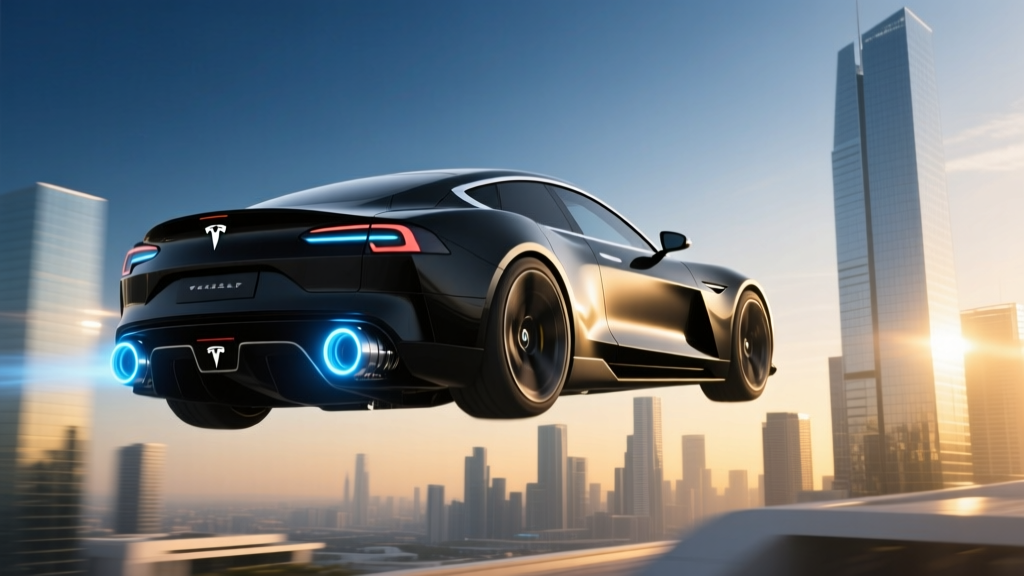
The phrase "Tesla Roadster flying car" has circulated since Elon Musk first teased cold-gas thrusters on the next-generation Roadster in 2018. As of 2026, the Tesla Roadster remains in announced/preliminary status — not yet available for purchase or delivery — but Tesla has continued to reference the vehicle in earnings calls and social media updates. Here is a comprehensive breakdown of what is known, what is estimated, and what buyers should realistically expect when (and if) this EV reaches production.
Tesla Roadster Status: Announced, Not Yet On Sale
Let's be direct: the Tesla Roadster (second generation) has not entered production as of early 2026. Tesla first revealed the vehicle in November 2017, initially promising deliveries by 2020. That timeline has slipped repeatedly. Musk has confirmed the vehicle is still in development, with the SpaceX thruster package — the feature driving most "flying car" search queries — described as an optional cold-gas thruster system mounted around the vehicle's body.
Preliminary Specs: What Tesla Has Claimed
| Spec | Claimed / Estimated |
|---|---|
| EPA Range | 620 miles (claimed, pre-EPA certification) |
| Battery Capacity | ~200 kWh (estimated, NMC chemistry) |
| Drivetrain | Tri-motor AWD |
| 0-60 mph | 1.9 sec (base); sub-1.0 sec (with SpaceX package, claimed) |
| Horsepower | ~1,000+ HP (estimated, tri-motor) |
| Top Speed | 250+ mph (claimed) |
| Max DC Fast Charge | TBD (likely 350+ kW on V4 Supercharger architecture) |
| 10-80% DC Charge | Estimated 20-25 min (based on 200 kWh pack and 350 kW peak) |
| Level 2 Home Charging | ~11.5 kW / ~34 mi/hr (estimated, Tesla Wall Connector) |
| Seating | 2+2 (two front, two small rear seats) |
| Cargo Volume | Minimal — estimated 3-5 cu ft (front trunk + rear shelf) |
| Base MSRP | $200,000 (base reservation price, last confirmed) |
| Founders Series | $250,000 (limited run, sold out) |
Note: All specs are preliminary and subject to change. Tesla has not submitted the Roadster for EPA certification. Figures reflect claims made by Tesla and Elon Musk between 2017 and 2025.
The SpaceX Thruster Package: How the "Flying Car" Feature Works
The feature generating the "Tesla Roadster flying car" search queries is the optional SpaceX package. According to Musk, this system uses approximately 10 cold-gas thrusters positioned around the vehicle — behind the rear bumper, in the front fascia, and along the side skirts. These thrusters use compressed air stored in tanks (not combustion-based rocket fuel) to provide directional thrust.
What the thrusters are designed to do:
- Increase straight-line acceleration by pushing the car forward and downward
- Improve braking performance by thrusting against the direction of travel
- Enhance cornering grip by applying lateral downforce
- Potentially allow brief "hover" moments over rough terrain (Musk has mentioned ~3 feet of hover, though this remains unverified)
What they will NOT do:
- Provide sustained flight or aerial commuting
- Replace conventional wheels for normal driving
- Meet current NHTSA or FMVSS safety standards without significant regulatory work — compressed air tanks and external thrusters present novel crash-safety questions
Range and Efficiency: Reconciling 620 Miles With Reality
Real-World Expectation: ~450-500 miles in mixed driving; ~380-420 miles sustained highway at 75+ mph; ~300-350 miles in cold weather (below 32°F) with cabin heating.
A 200 kWh battery pack is enormous — roughly double the capacity of a Tesla Model S Long Range. Even with the Roadster's aggressive performance tuning and low-slung sports car aerodynamics, the energy density required to hit 620 miles implies an efficiency target around 32 kWh/100mi. For context, the current Tesla Model S achieves roughly 28-32 kWh/100mi in real-world mixed driving.
The Roadster's wider tires, heavier battery, and higher power output will likely push real-world consumption higher. Cold weather remains a significant factor for any EV: lithium-ion batteries lose 20-30% of usable capacity in sub-freezing temperatures, and cabin heating (even with a heat pump, which Tesla is expected to include) draws substantial energy. A 620-mile EPA sticker would realistically translate to 350-400 miles on a cold Midwestern winter highway run.
Charging: What a 200 kWh Battery Means for Charge Times
| Charging Level | Power (kW) | Miles Added per Hour | Estimated Time (10-80%) |
|---|---|---|---|
| Level 1 (120V) | ~1.4 kW | ~4 mi/hr | ~100+ hours |
| Level 2 (240V, 48A) | ~11.5 kW | ~34 mi/hr | ~14-16 hours |
| DC Fast (V4 Supercharger) | ~350 kW (peak) | ~1,000+ mi/hr (peak) | ~20-25 min |
The physics of a 200 kWh pack create a charging challenge. Even at a sustained 350 kW peak — which Tesla's V4 Supercharger cabinets can deliver — the charge curve will taper significantly above 50-60% State of Charge (SoC) to protect battery health. Expect the Roadster to sustain peak charge rates only in the 10-40% SoC window, then taper progressively. A realistic 10-80% session will likely take 20-25 minutes under ideal conditions (preconditioned battery, warm ambient temperature, V4 stall availability).
For home charging, an 11.5 kW Tesla Wall Connector on a 60A circuit will add roughly 34 miles per hour. Fully replenishing a depleted 200 kWh pack overnight is not realistic — plan for 14-16 hours from 10% to full. Most owners will charge opportunistically, topping up between 20-80% for daily use, which is also the recommended practice for NMC battery longevity.
Performance: Tri-Motor AWD and the Sub-1-Second 0-60 Claim
The base Roadster is claimed to achieve a 1.9-second 0-60 mph time using its tri-motor AWD configuration — one motor on the front axle, two on the rear. This would place it among the quickest production cars ever made, rivaling the Rimac Nevera and current Tesla Model S Plaid.
The SpaceX package pushes the claimed 0-60 below 1.0 second by using cold-gas thrusters to supplement wheel traction. This is theoretically possible — tire grip is the limiting factor for sub-2-second launches, and downward/forward thrust could overcome that limitation. However, no independent testing body has verified this claim, and the infrastructure required to safely test a sub-1-second launch (specialized drag strip, safety barriers, data acquisition) is substantial.
Tesla's driver-assistance suite — Autopilot and Full Self-Driving (Supervised) — is expected to be included. Remember that FSD is a SAE Level 2 system requiring constant driver supervision. It is not autonomous driving.
Pricing, Tax Credits, and the $200,000+ Reality
| Trim | MSRP (Last Confirmed) | §30D Tax Credit | Effective Price |
|---|---|---|---|
| Roadster Base | $200,000 | $0 (exceeds MSRP cap) | $200,000 |
| Roadster + SpaceX Pkg | Est. $250,000+ | $0 (exceeds MSRP cap) | $250,000+ |
| Founders Series | $250,000 | $0 (exceeds MSRP cap) | $250,000 |
The IRS §30D federal EV tax credit caps eligible vehicles at $55,000 MSRP for sedans and $80,000 for SUVs, trucks, and vans. The Roadster, as a sports car priced above $200,000, does not qualify under any interpretation of current law. There is no income cap workaround that would make a $200K vehicle eligible — the MSRP cap is absolute.
Additionally, battery-sourcing and critical-mineral requirements under §30D would need to be met, though this is moot given the price exclusion. Buyers should budget the full MSRP plus state sales tax, registration, and likely higher insurance premiums given the vehicle's performance profile and repair-cost expectations.
Warranty, Ownership, and Practicality
Tesla has not published Roadster-specific warranty terms. Based on current Tesla practice for high-performance vehicles (Model S Plaid), expect:
- Basic Vehicle Warranty: 4 years / 50,000 miles
- Battery & Drive Unit Warranty: 8 years / 150,000 miles (with minimum 70% capacity retention)
The SpaceX cold-gas thruster system introduces components with no automotive precedent. Air storage tanks, valves, and thruster nozzles will likely carry separate warranty terms — and replacement costs are unknown. If a thruster assembly or compressed air tank requires service, there is no existing body-shop expertise or aftermarket supply chain.
Cargo and practicality: As a 2+2 sports car, the Roadster offers minimal cargo space — estimated 3-5 cubic feet across a front trunk (frunk) and rear shelf. Rear seats are expected to accommodate small children or cargo overflow, not adults on any trip longer than a few miles. This is a weekend car, not a daily driver for families.
Who Should Consider the Tesla Roadster (If It Arrives)?
- You want a halo performance EV and can absorb a $200K+ purchase with no tax credit
- You already own a practical daily driver and want a weekend/experience car
- You are willing to accept first-year production risk (panel gaps, software bugs, thruster system reliability unknowns)
- You want to own a piece of EV history — the Roadster is likely to be a collector vehicle
- You need a daily driver with cargo space, rear-seat usability, or practical ground clearance
- You want verified EPA range and independent crash-test ratings before purchasing
- You need a vehicle within the next 12 months — the Roadster timeline remains uncertain
- You want federal tax credit assistance with your purchase
Key Competitors at the $200K+ Performance EV Tier
If the Roadster's timeline or practicality concerns push you toward alternatives, the current high-performance EV market offers verified, purchasable options:
- Rimac Nevera: 1,914 HP, 1.85-sec 0-60, ~$2.2M, limited production
- Lotus Evija: 1,972 HP, sub-3-sec 0-60, ~$2.1M, limited production
- Tesla Model S Plaid: 1,020 HP, 1.99-sec 0-60, ~$90K, EPA 396 mi, in production now
- Lucid Air Sapphire: 1,234 HP, 1.89-sec 0-60, ~$250K, EPA 427 mi, in production now
The Model S Plaid and Lucid Air Sapphire deliver comparable acceleration at a fraction of the Roadster's price, with verified EPA range, established service networks, and current availability.
Pros (Projected)
- Sub-2-second 0-60 mph (base); potentially sub-1-second with SpaceX package
- 620-mile claimed range would be the longest of any production EV
- Tri-motor AWD provides exceptional traction and torque vectoring
- Tesla Supercharger network access (NACS native)
- Collector/halo-car status and brand cachet
Cons (Known Risks)
- Not yet in production — delivery timeline unknown
- $200,000+ price with zero federal tax credit eligibility
- SpaceX thruster package faces unproven regulatory and safety hurdles
- Minimal cargo and rear-seat practicality
- 200 kWh battery means very long Level 2 home charge times
- First-year production quality risk (Tesla panel gaps, software issues)
Frequently Asked Questions
Is the Tesla Roadster actually a flying car?
No. The SpaceX thruster package uses compressed cold-gas thrusters to improve acceleration, braking, and cornering — not sustained flight. Musk has mentioned brief "hover" capability of roughly 3 feet, but this is unverified and faces significant regulatory approval hurdles before it could be road-legal.
When will the Tesla Roadster be available to buy?
Tesla has not confirmed a production start date as of early 2026. The vehicle has been delayed multiple times since its 2017 unveiling. Reservation holders remain in queue, but no firm delivery timeline has been published.
Does the Tesla Roadster qualify for the $7,500 federal EV tax credit?
No. Under current IRS §30D rules, the Roadster's MSRP (above $200,000) far exceeds the $55,000 cap for sedans/sports cars. There is no income-based workaround for the MSRP cap.
What is the real-world range of the Tesla Roadster?
Tesla claims 620 miles, but this is pre-EPA certification. Realistically, expect 450-500 miles in mixed driving, 380-420 miles on sustained highway runs at 75+ mph, and 300-350 miles in cold weather with cabin heating active.
How fast does the Roadster charge at home and on DC fast chargers?
Estimated ~350 kW peak DC fast charging (10-80% in 20-25 minutes under ideal conditions) and ~11.5 kW on Level 2 home charging (~34 miles added per hour). A full Level 2 charge from near-empty would take 14-16 hours due to the massive 200 kWh battery.
Is the Roadster worth waiting for vs. buying a Model S Plaid or Lucid Air Sapphire?
If you need a car now, no. The Model S Plaid ($90K, 1.99-sec 0-60, 396-mi EPA range) and Lucid Air Sapphire ($250K, 1.89-sec 0-60, 427-mi EPA range) are available today with verified specs, established service networks, and full tax-credit or lease incentive eligibility where applicable. The Roadster is a speculative purchase for collectors and enthusiasts willing to wait.