The Tesla Roadster has occupied a strange space in the EV world since its 2017 unveiling: part halo car, part vaporware, part engineering flex. As of early 2026, Tesla has confirmed the next-generation Roadster will enter production later this year, and the variant generating the most search interest is the one equipped with the so-called Tesla Roadster fly mode — a cold-gas thruster package developed in partnership with SpaceX that promises to fundamentally alter what a street-legal car can do. This profile breaks down every confirmed and estimated spec, the real-world implications of a 200 kWh battery, charging expectations, pricing, and whether the Roadster's thruster system is a gimmick or a genuine performance breakthrough.
What Is Tesla Roadster Fly Mode?
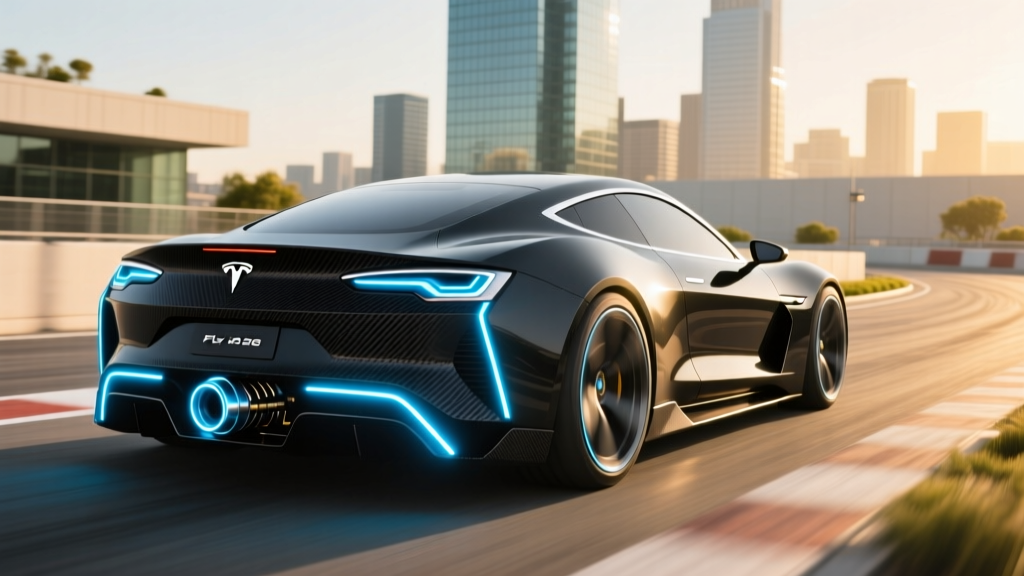
The "fly mode" refers to Tesla's optional SpaceX Package — a set of cold-gas thrusters positioned around the vehicle's body that use compressed air to generate downforce, reduce drag, or apply lateral and longitudinal acceleration beyond what tire grip alone can deliver. Elon Musk has stated that the system includes approximately 10 small thrusters placed around the front and rear of the car. These are not rocket engines in the traditional sense; they expel compressed gas (not combustion exhaust), which is safer for road use but still provides measurable vectoring force.
In practical terms, the thruster package is designed to:
- Improve cornering: Lateral thrusters push the car into turns, theoretically increasing cornering G-forces beyond the mechanical grip limit of the tires.
- Boost acceleration: Rear-facing thrusters supplement the electric drivetrain during hard launches.
- Enhance braking: Forward-facing thrusters act as supplemental air brakes.
- Enable brief "hover" moments: Musk has claimed the car could "hover" very close to the ground for short durations, though this is more marketing language than sustained flight.
No production road car has ever shipped with a cold-gas thruster system. Regulatory approval for road use remains an open question, and Tesla has not published detailed safety certifications for the package.
Estimated Specs: Range, Battery & Drivetrain
| Specification | Value |
|---|---|
| EPA Range (estimated) | ~620 miles |
| Battery Capacity | ~200 kWh (usable) |
| Battery Chemistry | NMC (Nickel Manganese Cobalt) — high energy-density cells |
| Drivetrain | Tri-Motor AWD (1 front, 2 rear) |
| Horsepower | ~1,000+ hp (est.) |
| 0-60 mph | 1.9 seconds (without thrusters); sub-1s claimed with SpaceX package |
| Top Speed | 250+ mph |
| Quarter Mile | 8.8 seconds (claimed) |
| Seats | 2+2 (rear seats extremely limited) |
| Cargo (frunk + rear) | ~5 cu ft total (est.) |
| Base MSRP | $200,000 (base); $250,000 (Founders Series) |
| SpaceX Thruster Package | $50,000 add-on (estimated) |
Charging: DC Fast Charge & Home Level 2
A 200 kWh battery creates an unusual charging challenge. Even at peak DC fast-charge rates, filling this pack from 10-80% will take meaningfully longer than smaller-battery EVs unless Tesla deploys a radically higher charge rate.
| Charging Level | Power (kW) | Estimated Time / Rate |
|---|---|---|
| DC Fast Charge (V4 Supercharger, peak) | ~350 kW (est.) | 10-80% in ~35-40 minutes |
| DC Fast Charge (250 kW V3 Supercharger) | 250 kW | 10-80% in ~50-55 minutes |
| Home Level 2 (Tesla Wall Connector, 48A) | 11.5 kW | ~3-4 miles per hour; 0-100% in ~18+ hours |
| Home Level 2 (80A circuit, if supported) | 19.2 kW | ~5-6 miles per hour; 0-100% in ~11 hours |
| Level 1 (120V standard outlet) | ~1.4 kW | ~1 mile per 20 minutes (emergency only) |
Key takeaway: The Roadster's massive battery means home charging on a standard 48A Level 2 circuit will take the better part of a full day from empty. Most owners will need to charge opportunistically — plugging in nightly and rarely arriving at a full charge from a single session. For road trips, Tesla's V4 Supercharger network (rolling out 350+ kW stalls through 2025-2026) will be essential to keep stops reasonable. The charge curve will likely taper significantly above 80% SoC to protect the NMC cells, so plan to charge to 80% on road trips and move on.
Performance & the Thruster Package in Detail
Even without the SpaceX thruster package, the Roadster's tri-motor AWD powertrain puts it in hypercar territory. A claimed 1.9-second 0-60 mph time would tie or beat the current Model S Plaid and Rimac Nevera. The tri-motor setup enables precise torque vectoring across the rear axle, which should translate to exceptional launch traction.
The SpaceX thruster package takes this further. Cold-gas thrusters don't replace the electric motors — they supplement them. During a hard launch, rear-facing thrusters add forward thrust independent of tire grip, which is how Tesla claims a sub-1-second 0-60 time. For context, no production car has ever recorded a sub-1-second 0-60 on street tires. The physics here rely on the thrusters providing force that doesn't depend on the friction coefficient between rubber and asphalt.
Cornering is where the thrusters may matter more for real driving. By generating lateral downforce on demand, the system could theoretically allow the Roadster to sustain higher cornering speeds than its mechanical grip alone would permit. Tesla has not published skidpad or slalom numbers, and independent testing from organizations like IIHS or automotive media has not yet occurred since the car is not yet in customer hands.
Pricing, Trims & Federal Tax Credit Eligibility
| Trim / Configuration | MSRP | Federal §30D Credit | Effective Price |
|---|---|---|---|
| Roadster Base | $200,000 | $0 (exceeds MSRP cap) | $200,000 |
| Roadster + SpaceX Package | ~$250,000 | $0 (exceeds MSRP cap) | ~$250,000 |
| Founders Series (limited) | $250,000 | $0 (exceeds MSRP cap) | $250,000 |
The IRS §30D federal tax credit caps eligibility at vehicles with an MSRP of $55,000 or less for sedans/coupes (or $80,000 for SUVs/pickups/vans). The Roadster, at $200,000+, exceeds this cap by a massive margin and will not qualify for any federal EV tax credit. Additionally, the buyer income caps ($150,000 single / $300,000 joint AGI) would disqualify many potential buyers even if the vehicle price were eligible.
State-level incentives vary by jurisdiction and some have no MSRP cap, so check your local DMV or energy office for potential rebates — but at this price point, most incentive programs are irrelevant to the purchase decision.
Interior, Tech & Practicality
The Roadster is a 2+2 sports car, which means the rear seats are essentially upholstered shelves — suitable for a jacket or a small bag, not an adult passenger for any meaningful distance. Cargo space is estimated at roughly 5 cubic feet total between the front trunk (frunk) and a small rear parcel area. This is a weekend car, not a grocery getter.
Expected tech features based on Tesla's current platform:
- Infotainment: 17-inch center touchscreen with Tesla's latest UI, navigation with Supercharger routing, and over-the-air updates.
- Driver Assistance: Tesla Autopilot (SAE Level 2) with optional Full Self-Driving (Supervised). This is not autonomous driving — the driver must remain fully engaged at all times. FSD capability on a low-slung sports car with unique aerodynamics may behave differently than on a Model 3/Y.
- Glass Roof: Removable glass panel stored in the trunk (per original design claims).
- Steering: Likely yoke-style steering, though Tesla has been offering round wheel options again on recent models.
- Thruster Controls: A dedicated interface for the SpaceX package showing thruster status, compressed air reserves, and deployment modes (launch, corner, brake). Details remain unconfirmed.
Battery Warranty & Longevity
Tesla has not published specific warranty terms for the 2026 Roadster, but based on current Tesla coverage across its lineup:
- Battery & Drive Unit: 8 years / 150,000 miles (minimum 70% capacity retention) — this is Tesla's standard for higher-end models like Model S/X.
- Vehicle Limited Warranty: 4 years / 50,000 miles.
- Thruster System: Unknown — the SpaceX package is unprecedented and Tesla has not disclosed warranty terms for the compressed-air system, valves, or thruster nozzles.
The 200 kWh NMC pack will generate significant thermal load during fast charging and hard driving. Tesla's thermal management system (liquid-cooled) will be critical to longevity. NMC chemistry typically shows 10-15% degradation over 150,000 miles under normal use, though a pack this large provides a substantial buffer — even at 80% State of Health, you'd still have ~496 miles of estimated range.
Who Should Buy the Tesla Roadster?
Pros & Cons
- Potentially the longest-range production EV (~620 mi estimated)
- Sub-2-second 0-60 mph (sub-1s with thrusters)
- SPACEX thruster package is a world-first for road cars
- Access to Tesla Supercharger network
- OTA software updates and continuous improvement
- Removable glass roof
- $200,000+ with no federal tax credit eligibility
- 200 kWh battery means very long home charge times
- Thruster package legality uncertain in many states
- 2+2 seating is impractical for passengers
- Minimal cargo space (~5 cu ft)
- Production delays are a Tesla hallmark — delivery timeline uncertain
- No independent testing or real-world data yet
Tesla Roadster Fly Mode FAQ
Can the Tesla Roadster actually fly?
No. The "fly mode" is marketing language for the cold-gas thruster system, which can briefly increase downforce or provide supplemental thrust. Musk's "hover" claims refer to momentary ground-effect lift at very low altitude, not sustained flight. The car does not leave the ground in any meaningful or controlled way for transportation purposes.
How fast does the Tesla Roadster charge at home?
On a standard Tesla Wall Connector (48A, 11.5 kW), expect roughly 3-4 miles of range per hour of charging. A full 0-100% charge on Level 2 would take approximately 18 hours. An upgraded 80A circuit (19.2 kW) cuts this to about 11 hours. Most owners will charge incrementally overnight rather than from empty.
Does the Tesla Roadster qualify for the $7,500 federal EV tax credit?
No. Under current IRS §30D rules, the Roadster's MSRP of $200,000+ far exceeds the $55,000 cap for sedans and coupes. It is not eligible for any portion of the federal new clean vehicle credit regardless of buyer income or battery sourcing.
When will the Tesla Roadster be available to buy?
Tesla has indicated production will begin in 2026, following multiple delays from the original 2020 target. Reservations have been accepted with a $50,000 deposit (or $250,000 for the Founders Series). Exact delivery timelines remain unconfirmed, and Tesla's history with the Cybertruck and original Roadster suggests further delays are possible.
What competitors match the Roadster's performance?
The Lucid Air Sapphire (1,234 hp, 0-60 in ~1.89s, $249,000, EPA 427 mi) is the closest four-door competitor with verified production specs. The Rimac Nevera (1,914 hp, 0-60 in 1.85s, ~$2.2M) is the closest hypercar benchmark. The Pininfarina Battista shares the Nevera's platform. None offer a thruster system, but all have verified, independently tested performance figures — something the Roadster cannot yet claim.
Is the SpaceX thruster package safe?
Tesla has not published detailed safety data or crash-test results for the thruster-equipped Roadster. The system uses compressed air rather than combustible propellant, which reduces fire risk. However, high-pressure vessels in a collision, thruster deployment near pedestrians, and noise levels are all unresolved safety questions. Regulatory approval will likely vary by state and country.