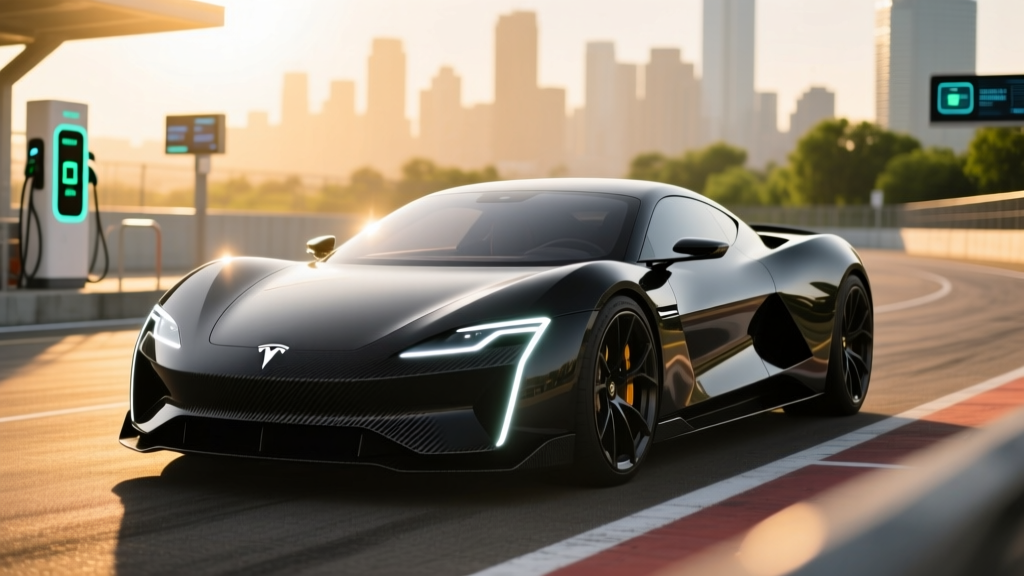
The Tesla Roadster was first promised in 2017. Nearly a decade later, Tesla's flagship sports car remains one of the most anticipated — and most delayed — vehicles in automotive history. As of early 2026, the next-generation Roadster has been announced but is not yet available for purchase. Tesla CEO Elon Musk has reiterated a production timeline targeting late 2026 or 2027, but given the company's history of timeline slippage, buyers should treat all figures below as preliminary manufacturer estimates, not finalized EPA-certified specs.
This Tesla Roadster first look compiles every official claim Tesla has made, contextualizes those numbers against real-world EV physics, and tells you exactly what to expect — and what to doubt — before putting down a reservation.
Tesla Roadster Preliminary Specifications
| Specification | Tesla Claim (Preliminary) | Notes |
|---|---|---|
| Target Range | 620 miles | Tesla estimate, not EPA-certified |
| Battery Capacity | ~200 kWh (usable) | Expected NMC chemistry |
| 0–60 mph | 1.9 seconds (base) / 1.1s (SpaceX package) | With rollout subtracted |
| Top Speed | 250+ mph | Base model claim |
| Quarter Mile | 8.8 seconds | SpaceX package claim |
| Drivetrain | Tri-motor AWD | One front, two rear motors |
| Horsepower | ~1,000+ hp (estimated) | Tesla has not published official HP |
| Seating | 2+2 (tight rear seats) | Rear seats best for cargo/children |
| Base MSRP (target) | $200,000 | Founders Series: $250,000 |
| Reservation Deposit | $50,000 | Refundable terms vary |
| Availability | Announced — not on sale | Production targeted late 2026/2027 |
Range Reality: 620 Miles Is a Target, Not a Guarantee
Tesla's claimed 620-mile range would shatter every production EV record if certified. For context, the Lucid Air Grand Touring currently holds the production crown at an EPA-rated 516 miles. But a 620-mile figure from a 200 kWh battery pack implies an efficiency of roughly 323 Wh/mile — achievable in a low-drag sedan at moderate speeds, but extremely optimistic for a sports car driven in real-world conditions.
- Tesla target: 620 miles (not EPA-certified)
- Likely EPA rating: 500–560 miles (if/when certified)
- Highway driving (75 mph): Expect 380–440 miles — aerodynamic drag dominates at speed
- Cold weather (below 32°F): Expect 30–40% range reduction, yielding ~310–390 miles
- Track/aggressive driving: Range drops precipitously; 200 miles or less under hard use
Note: These are analyst estimates based on comparable high-performance EVs. Final EPA data does not exist yet.
The physics of a 200 kWh pack are undeniable — more stored energy means more potential range. But sports cars are driven hard, and hard driving destroys efficiency. Anyone expecting 620 miles during canyon carving will be deeply disappointed. The real value of a 200 kWh pack is usable range flexibility: even at 50% real-world reduction, you still have 300+ miles — enough for most road trips between DC fast-charge stops.
Charging: The 200 kWh Problem
Here is where the Roadster's massive battery becomes a double-edged sword. Charging a 200 kWh pack from 10% to 80% is a fundamentally different proposition than charging a 75 kWh Model 3.
| Charging Level | Estimated Power | Estimated Speed | 10–80% Time (Est.) |
|---|---|---|---|
| Level 1 (120V / 12A) | ~1.4 kW | ~3 mi/hr | ~110+ hours (impractical) |
| Level 2 (240V / 48A) | ~11.5 kW | ~28 mi/hr | ~14–16 hours |
| Level 2 (240V / 80A) | ~19.2 kW | ~47 mi/hr | ~9–10 hours |
| DC Fast Charge (V4 Supercharger) | Peak ~350 kW (est.) | ~800+ mi/hr at peak | ~35–45 minutes |
The charge-curve reality: Even if Tesla's V4 Superchargers deliver a peak 350 kW, that rate will not be sustained across the entire 10–80% window. Expect peak rates only between roughly 10–30% State of Charge (SoC), with significant tapering above 50%. A 200 kWh pack charging at an average of 250 kW still needs approximately 35 minutes for a 10–80% session — roughly double the time a Model 3 Long Range requires.
For home charging, a standard 48-amp Level 2 wall connector will need overnight and then some to fill this pack. Roadster owners will likely want an 80-amp circuit (19.2 kW) to make overnight charging viable, which may require a 200-amp electrical panel upgrade in many homes — a $1,500–$3,500 additional cost on top of the charger itself.
Performance: The Numbers That Define the Roadster
If the Roadster ever reaches production as specified, its performance figures will be extraordinary — even by 2026 standards where sub-3-second 0–60 times are increasingly common in the EV space.
The claimed 1.9-second 0–60 mph (base tri-motor) would place it among the quickest production cars ever built. The optional SpaceX package, which Tesla claims will incorporate cold-gas thrusters for enhanced acceleration and cornering, pushes the claim to 1.1 seconds — a figure that enters dragster territory and should be treated with extreme skepticism until independently verified.
The tri-motor AWD layout (one front motor, two rear) is proven technology from the Model S Plaid, which delivers 1,020 hp and a tested 1.99-second 0–60. The Roadster, being lighter and lower, should match or exceed these figures in base form. However, Tesla has not published official horsepower or torque figures for the Roadster, so the "1,000+ hp" estimate is extrapolated from the Plaid powertrain.
Practical performance note: Tires are the limiting factor for any sub-2-second car. Expect the Roadster to require specialized (and expensive) Michelin or Pirelli rubber, with replacement intervals measured in thousands of miles, not tens of thousands.
Pricing, Tax Credits, and the $200,000 Question
Tesla's announced base price of $200,000 (with the Founders Series at $250,000) places the Roadster firmly in supercar territory — competing against the Porsche Taycan Turbo GT, Rimac Nevera (at 10× the price), and traditional exotics from Ferrari and Lamborghini.
| Item | Amount |
|---|---|
| Base MSRP (target) | $200,000 |
| Founders Series MSRP | $250,000 |
| Federal §30D Tax Credit | $0 — not eligible |
| Estimated delivery/destination | $2,500–$3,500 (est.) |
| Estimated out-the-door (base) | ~$203,000–$205,000+ |
Federal tax credit reality: The Roadster will not qualify for the IRS §30D Clean Vehicle Credit. The law imposes an MSRP cap of $55,000 for sedans and $80,000 for SUVs, trucks, and vans. At $200,000+, the Roadster exceeds every cap by a massive margin. Additionally, buyers must meet adjusted gross income limits ($150K single / $300K joint) — though at this price point, most buyers would likely exceed income thresholds anyway.
State-level incentives vary and some have no MSRP caps, but they typically range from $1,000–$5,000 — a rounding error on a $200,000 purchase. Consult your state's energy office and a tax professional for specifics.
Interior, Tech, and Daily Usability
The Roadster is a 2+2 sports car, meaning two full-size front seats and two small rear seats best suited for children or cargo overflow. Tesla has not published official cargo volume or interior dimensions, but based on the vehicle's proportions:
- Front trunk (frunk): Expected ~3–5 cu ft (small, given front motor and electronics)
- Rear cargo area: Likely ~8–12 cu ft with rear seats folded (estimated)
- Rear legroom: Expected under 28 inches — essentially a parcel shelf with seatbelts
The removable glass roof panel (a Roadster hallmark from the original) is expected to return, stowing in the trunk. Tesla's latest-generation infotainment system, a minimalist yoke or round steering wheel, and the full Autopilot / FSD (Supervised) hardware suite are expected.
Tesla's Autopilot and FSD (Supervised) are SAE Level 2 driver-assistance systems. The driver must remain fully engaged, hands on or near the wheel, and eyes on the road at all times. These systems do not make the Roadster self-driving. Only Level 4 services like Waymo operate without a human driver — and those are geofenced robotaxis, not consumer vehicles.
Notable drawbacks to anticipate:
- Visibility will be compromised by the low roofline and thick rear pillars
- Ride quality on rough roads — sports car suspension is inherently firm
- The 200 kWh pack will make this a heavy car (~4,800–5,000 lbs estimated), affecting tire wear and braking distances
- Insurance premiums for a 1,000+ hp, $200K EV will be substantial — expect $500–$900+/month
Warranty and Battery Longevity
Tesla has not published Roadster-specific warranty terms. Based on current Tesla warranties for the Model S and Model X, we can reasonably expect:
- Basic vehicle warranty: 4 years / 50,000 miles
- Battery and drive unit warranty: 8 years / 150,000 miles (with minimum 70% capacity retention)
The battery chemistry is expected to be NMC (nickel manganese cobalt), which offers higher energy density than LFP (lithium iron phosphate) — essential for packaging 200 kWh into a sports car chassis. NMC cells typically see 10–15% degradation over 150,000 miles under normal use. However, the Roadster's performance-oriented use case (frequent hard acceleration, high discharge rates) could accelerate degradation compared to a commuter sedan.
A 200 kWh battery replacement, should it ever be needed out of warranty, would likely cost $25,000–$40,000+ based on current NMC cell pricing and labor. This is a worst-case scenario that most owners will never face within the warranty period.
Roadster vs. the Competition: Is It Worth the Wait?
Pros (If Delivered as Specified)
- Unmatched claimed range (620 mi target) — if certified
- Sub-2-second 0–60 in a road-legal production car
- Tri-motor AWD with proven Tesla powertrain tech
- Access to the Tesla Supercharger network (NACS connector)
- Removable glass roof — open-air driving without a convertible mechanism
- OTA updates and continuous feature improvement
Cons
- Not available for purchase — years of delays erode trust
- All specs are preliminary and unverified by EPA or independent testing
- $200,000+ price with zero federal tax credit eligibility
- 200 kWh pack means very long charging sessions (35–45 min DC fast)
- Heavy weight (~5,000 lbs) undermines sports car dynamics
- Tiny rear seats, limited cargo, compromised visibility
- Insurance and tire costs will be extreme
Choose the Roadster (reservation) if: You want a halo EV sports car, have $200K+ to spend, can tolerate an indefinite wait, and value straight-line performance and range above all else.
Buy something else now if: You need a vehicle in 2026. The Model S Plaid delivers 1,020 hp, a 1.99-second 0–60, and 396 miles of EPA range for ~$90,000. The Porsche Taycan Turbo GT offers 1,019 hp, track-bred handling, and is actually available. The Lucid Air Sapphire provides 1,234 hp and 427 miles of range for ~$250,000.
Frequently Asked Questions
What is the real-world range of the Tesla Roadster?
Tesla targets 620 miles, but this is not EPA-certified. Based on comparable high-performance EVs, expect an eventual EPA rating of roughly 500–560 miles. In real-world highway driving at 75 mph, anticipate 380–440 miles. In cold weather (below 32°F), range could drop to 310–390 miles. Aggressive or track driving will reduce range far more dramatically.
How fast does the Tesla Roadster charge?
On a V4 Supercharger (estimated peak 350 kW), expect a 10–80% session to take approximately 35–45 minutes due to the massive 200 kWh pack and charge-curve tapering. At home on a 48-amp Level 2 charger (11.5 kW), a full charge requires 14–16 hours. An 80-amp Level 2 circuit (19.2 kW) cuts this to roughly 9–10 hours.
How much does the Tesla Roadster cost after tax credits?
The Roadster does not qualify for the federal §30D tax credit due to the $55,000/$80,000 MSRP caps. The expected out-the-door price is approximately $203,000–$205,000 for the base model and $253,000+ for the Founders Series, plus state registration, taxes, and insurance.
Is the Tesla Roadster worth buying vs. competitors?
If Tesla delivers the claimed specs, the Roadster offers unmatched range and acceleration for its price class. However, it is not yet available, and all specs are preliminary. The Model S Plaid ($90K, available now) covers most of the performance envelope. The Lucid Air Sapphire and Porsche Taycan Turbo GT are real, purchasable alternatives with verified specs.
Does the Tesla Roadster qualify for the federal EV tax credit?
No. Under current IRS §30D rules, the Roadster's $200,000+ MSRP far exceeds the $55,000 sedan cap and $80,000 SUV/truck cap. Additionally, buyer income limits ($150K single / $300K joint) would exclude many buyers at this price point. Battery critical-mineral and sourcing requirements are moot — the MSRP cap alone disqualifies it.
When will the Tesla Roadster actually be available?
Tesla has targeted production for late 2026 or 2027, but the company has a well-documented history of missing production deadlines. The Roadster was originally announced in November 2017 with a 2020 target. Buyers should not make purchase plans around a firm Roadster delivery date.
What battery chemistry will the Roadster use?
The Roadster is expected to use NMC (nickel manganese cobalt) cells to achieve the energy density required for a 200 kWh pack in a sports car form factor. LFP chemistry, while more durable and less expensive, is too heavy and bulky for this application. Tesla is expected to use next-generation 4680-format cells.
Editorial note: This article is based on Tesla's announced specifications and industry analysis as of early 2026. The Tesla Roadster is an announced vehicle not yet available for purchase. All specifications, pricing, and performance claims are preliminary and subject to change. Final EPA ratings, NHTSA safety data, and independent testing results do not yet exist. We will update this profile when certified data becomes available.