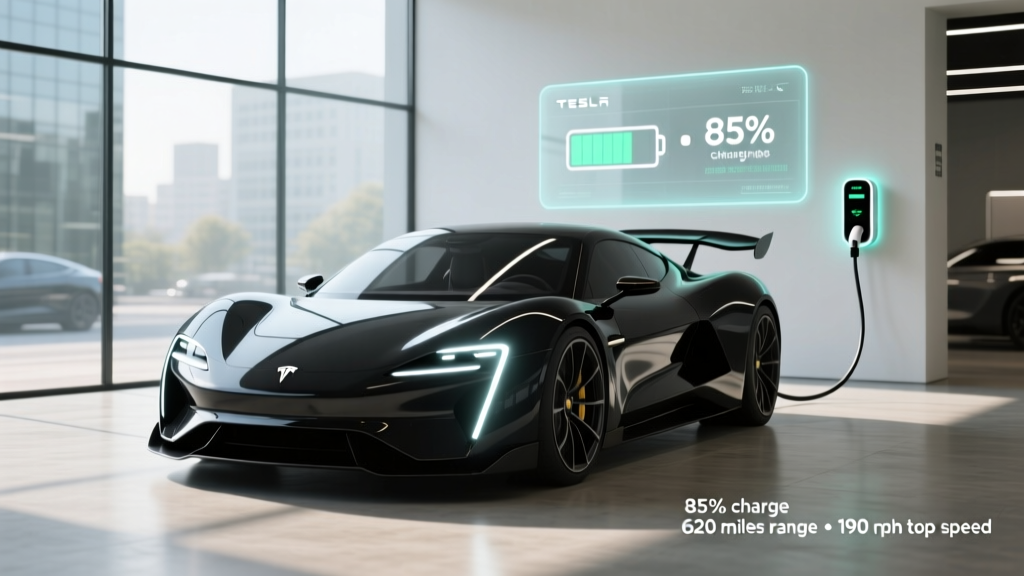
The Tesla Roadster has lived in automotive purgatory longer than most EV startups have existed. First teased in 2017 with jaw-dropping claims — 0-60 mph in 1.9 seconds, 620 miles of range, a 200 kWh battery — Elon Musk's halo sports car has slipped through multiple production timelines. As of early 2026, Tesla has begun limited production of the next-generation Roadster, with first deliveries expected later this year. But the question on every enthusiast's mind remains: how much does a Tesla Roadster cost, and do the specs justify the price?
Below, we break down everything confirmed and projected about the 2026 Tesla Roadster — pricing tiers, real-world range expectations, charging architecture, performance figures, and whether this six-figure EV qualifies for any federal incentives. Where Tesla has published firm numbers, we use them. Where specs remain preliminary, we flag them clearly.
2026 Tesla Roadster: Core Specifications at a Glance
Before we unpack the pricing, here is the consolidated spec sheet based on Tesla's most recent disclosures and industry analysis. Note that several figures remain manufacturer estimates pending independent EPA certification.
| Specification | Value |
|---|---|
| Base MSRP (Roadster) | $200,000 |
| Founders Series MSRP | $250,000 |
| Reservation Deposit | $50,000 (fully refundable pre-production) |
| Battery Capacity | ~200 kWh (estimated, NMC chemistry) |
| EPA Range (Claimed) | 620 miles (pending certification) |
| Drivetrain | Tri-Motor AWD (1 front, 2 rear) |
| Horsepower | ~1,000+ hp (estimated) |
| 0-60 mph | 1.9 seconds (base); <1.0 sec with SpaceX package |
| Top Speed | 250+ mph |
| Max DC Fast Charge | ~350 kW (estimated, 800V architecture) |
| 10-80% DC Charge Time | ~25-30 minutes (estimated) |
| Level 2 Home Charging | ~19.2 kW / ~44 miles per hour |
| Seating | 2+2 (two adults, two small rear seats) |
| Cargo (Frunk + Rear) | ~5 cu ft frunk, ~4 cu ft rear shelf |
| Battery/Drive Unit Warranty | 8 years / 150,000 miles (projected) |
| Federal Tax Credit (§30D) | Not eligible (MSRP cap exceeded) |
Breaking Down the Price: How Much Does a Tesla Roadster Really Cost?
Tesla has confirmed two pricing tiers for the Roadster:
- Base Roadster: $200,000 — This includes the tri-motor AWD powertrain, the ~200 kWh battery pack, Tesla's full infotainment suite, and Basic Autopilot. Full Self-Driving (Supervised) remains an $8,000 add-on.
- Founders Series: $250,000 — A limited-run launch edition with exclusive badging, upgraded interior materials, track-tuned suspension calibration, and priority production scheduling. Only 1,000 units are planned for the Founders Series.
For reservation holders who put down $50,000 beginning in 2017, that deposit applies toward the final purchase price. Tesla has also offered a $43,000 "base reservation" option that does not guarantee Founders Series allocation but secures a place in the production queue.
Options and Add-Ons That Push the Price Higher
Beyond the two trims, Tesla is expected to offer:
- SpaceX Package (cold-gas thrusters): Rumored at $50,000+, this option replaces rear seats with compressed-air thrusters for extreme acceleration and cornering. Musk has claimed it enables sub-1.0-second 0-60 mph times and "hover" capability, though independent validation is pending.
- Full Self-Driving (Supervised): $8,000 one-time or $99/month subscription. Note: FSD is an SAE Level 2 driver-assistance system — the driver must remain fully engaged at all times.
- Premium paint, wheels, and interior: Expect $2,000-$5,000 per option based on current Tesla pricing structures.
Estimated Out-the-Door Pricing
| Configuration | MSRP | Est. Delivery & Fees | Federal Tax Credit | Est. Total |
|---|---|---|---|---|
| Base Roadster | $200,000 | ~$2,500 | $0 (MSRP cap) | ~$202,500 |
| Base + FSD | $208,000 | ~$2,500 | $0 | ~$210,500 |
| Founders Series | $250,000 | ~$2,500 | $0 | ~$252,500 |
| Founders + SpaceX Pkg | ~$300,000+ | ~$2,500 | $0 | ~$302,500+ |
Range Reality: 620 Miles Claimed, But What Can You Expect?
Tesla's claimed 620-mile EPA range would shatter every production EV record if certified. For context, the current longest-range production EV, the Lucid Air Grand Touring, achieves an EPA-rated 516 miles on a 112 kWh battery. The Roadster's ~200 kWh pack is nearly twice that capacity, which makes the 620-mile claim physically plausible — but real-world conditions tell a different story.
EPA Claimed: 620 miles (pending official certification)
Real-World Highway (70 mph, moderate temps): ~480-520 miles. Aerodynamic drag at sustained highway speeds significantly reduces efficiency in any low-slung sports car.
Real-World Cold Weather (30°F, mixed driving): ~380-430 miles. Lithium-ion batteries lose 20-35% range in freezing temperatures, and the Roadster's massive pack is not immune to this physics.
Track / Aggressive Driving: ~200-280 miles. At 1,000+ horsepower, sustained high-output driving drains any battery rapidly.
The Roadster is expected to use NMC (nickel manganese cobalt) chemistry rather than LFP, which makes sense for a performance vehicle: NMC offers higher energy density (more kWh per kilogram) at the cost of slightly faster long-term degradation and a lower thermal runaway threshold. For a car with a 200 kWh pack, weight management is critical — NMC helps keep the total pack weight in a manageable range, though the Roadster is still expected to exceed 4,400 lbs.
Charging Speed: Can You Actually Fill a 200 kWh Battery Quickly?
A 200 kWh battery is enormous by EV standards — roughly double the capacity of a Tesla Model S Long Range. That means charging speed is make-or-break for road-trip usability. Tesla is expected to equip the Roadster with an 800-volt architecture (similar to the Cybertruck and updated Model S/X platforms) to enable faster DC charging.
| Charging Level | Power (kW) | Miles Added Per Hour | Notes |
|---|---|---|---|
| Level 1 (120V household) | ~1.4 kW | ~4 mi/hr | Impractical — 100+ hours for full charge |
| Level 2 (240V, 48A Wall Connector) | ~11.5 kW | ~26 mi/hr | ~20 hours for 10-100%; overnight top-ups work |
| Level 2 (240V, 80A High-Power) | ~19.2 kW | ~44 mi/hr | Requires 100A dedicated circuit; ~10 hrs for full charge |
| DC Fast (Tesla Supercharger V4) | ~350 kW peak | ~800 mi/hr (peak) | 10-80% in ~25-30 min; tapers sharply above 80% |
A few important caveats on charging:
- Peak kW is not sustained kW. The Roadster will likely peak near 350 kW at low state-of-charge (SoC) and taper progressively. Expect an average of ~220-260 kW across the 10-80% window — which still yields an impressively fast fill for such a massive battery.
- Preconditioning is essential. Tesla's navigation-based battery preconditioning warms the pack before arrival at a Supercharger, enabling peak charge rates. Without preconditioning (e.g., arriving at a charger without navigating to it), expect charge speeds 30-50% lower in cold weather.
- Home charging a 200 kWh pack requires patience. Even at 19.2 kW (the maximum most residential panels support), a full charge takes roughly 10-11 hours. Most owners will charge from 20-80% overnight, which is manageable in 6-7 hours.
Performance: The Numbers That Justify the Price Tag
The Roadster's performance specs are the primary reason anyone considers spending $200,000+ on a Tesla. Here is what we know:
- 0-60 mph: 1.9 seconds (base tri-motor). This would make it one of the fastest-accelerating production cars ever built, rivaling the Rimac Nevera and surpassing the Bugatti Chiron.
- Quarter-mile: ~8.8 seconds (Tesla's claimed figure, unverified independently).
- Top speed: 250+ mph.
- Torque: Estimated 10,000 Nm (7,376 lb-ft) at the wheels — a figure enabled by the tri-motor setup with torque vectoring across the rear axle.
The tri-motor configuration (one front, two rear) enables precise torque vectoring for cornering, not just straight-line speed. Tesla's Plaid motor technology, proven in the Model S Plaid, uses carbon-sleeved rotors to sustain peak power at high RPMs without the power falloff that plagues many EVs above 130 mph.
However, weight is the Roadster's enemy. A 200 kWh NMC battery pack likely weighs 1,800-2,200 lbs alone, and total vehicle weight is expected near 4,400-4,700 lbs. That mass will be felt in cornering transitions and braking distances, regardless of how sophisticated the torque vectoring is. Track-day enthusiasts should temper expectations — this is a grand-touring hypercar, not a lightweight track weapon.
Federal Tax Credit: Does the Roadster Qualify for §30D?
The short answer: no. Under IRS §30D rules, the federal EV tax credit is capped at $7,500 for vehicles with an MSRP at or below $55,000 (sedans, coupes, wagons) or $80,000 (SUVs, trucks, vans). The Roadster, as a coupe starting at $200,000, exceeds the cap by a wide margin.
- ✅ Battery capacity ≥ 7 kWh — Roadster qualifies (~200 kWh)
- ✅ Assembled in North America — expected (Tesla Fremont or Austin)
- ❌ MSRP cap: ≤ $55,000 for coupes — Roadster at $200,000 fails
- ⚠️ Buyer income cap: ≤ $150K single / $300K joint — varies by buyer
- ⚠️ Critical mineral & battery component sourcing — unknown for Roadster
Source: IRS.gov — Credits for New Electric Vehicles. Consult a tax professional for personal eligibility.
Even if the MSRP cap did not apply, the Roadster's battery sourcing would need to meet increasingly stringent critical-mineral and component requirements that tighten each year through 2029. Given the Roadster's likely reliance on high-nickel NMC cells, supply-chain compliance is uncertain.
Some states may offer their own EV incentives that lack MSRP caps — California's CVRP program, for instance, has its own income and price thresholds. Check your state's alternative fuel vehicle incentives for local possibilities.
Interior, Tech, and Daily Usability
The Roadster's cabin is expected to follow Tesla's minimalist design language, though with premium materials befitting a $200,000 vehicle:
- Infotainment: A 17-inch center touchscreen with Tesla's latest UI, over-the-air updates, and integrated navigation with Supercharger routing and battery preconditioning.
- Driver assistance: Tesla Autopilot (adaptive cruise + lane centering) standard; FSD (Supervised) optional. Both are SAE Level 2 systems requiring full driver attention.
- Seating: 2+2 configuration. The rear seats are best suited for children or cargo — adult legroom is extremely limited (estimated ~24 inches rear legroom).
- Cargo: Approximately 5 cu ft in the front trunk (frunk) and 4 cu ft behind the rear seats. Total cargo capacity of ~9 cu ft is modest even for a sports car, and the low roofline limits usable volume for anything tall.
- Glass roof: Expected to feature a removable glass panel, similar to the original 2008 Roadster, for open-air driving.
Notable Drawbacks
- Visibility: The extremely low roofline and thick rear pillars will compromise rear and over-the-shoulder visibility. Expect heavy reliance on camera-based mirrors and backup cameras.
- Ride quality: With a sport-tuned suspension and low-profile tires, road imperfections will be transmitted directly to the cabin. This is not a highway cruiser in the Lucid Air sense.
- Service network: Tesla's service infrastructure is stretched thin across its growing lineup. A low-volume halo car may face extended wait times for body and powertrain service.
- Insurance: Expect annual premiums of $5,000-$8,000+ for a $200,000+ EV sports car, depending on driving record and location.
Roadster vs. Competitors: Is It Worth the Money?
At $200,000+, the Roadster enters rarefied air. Here is how it stacks up against the most relevant alternatives:
| Vehicle | MSRP | Range (EPA) | 0-60 mph | HP | Production Status |
|---|---|---|---|---|---|
| Tesla Roadster | $200,000 | 620 mi (claimed) | 1.9 sec | ~1,000+ | Limited production 2026 |
| Rimac Nevera | $2,400,000 | ~340 mi (WLTP) | 1.85 sec | 1,914 | Delivered (150 units) |
| Lotus Evija | $2,300,000 | ~250 mi (WLTP) | <3.0 sec | 1,972 | Limited delivery |
| Lucid Air Sapphire | $249,000 | 427 mi (EPA) | 1.89 sec | 1,234 | Delivering |
| Porsche Taycan Turbo GT | $230,000 | 269 mi (EPA) | 2.1 sec | 1,019 | Delivering |
Choose the Roadster if: You want the longest-range hypercar on the market, you value Tesla's Supercharger network for cross-country road trips, and you accept that some specs (especially the 620-mile EPA claim) remain unverified.
Choose the Lucid Air Sapphire if: You want verified 1.89-second 0-60 times, EPA-certified 427-mile range, four usable doors, and a proven delivery track record — at a similar price point.
Choose the Porsche Taycan Turbo GT if: Track handling and braking matter more than straight-line acceleration and range. Porsche's chassis dynamics remain the benchmark in this segment.
Wait if: You need confirmed EPA figures before committing $200,000. The Roadster's 620-mile claim is extraordinary but unproven, and production timelines have slipped repeatedly.
Warranty, Ownership Costs, and Long-Term Outlook
Tesla has not published final Roadster warranty terms, but based on the Model S/X precedent:
- Battery & Drive Unit: 8 years / 150,000 miles, with a minimum 70% capacity retention guarantee. For a 200 kWh pack, 70% retention still leaves 140 kWh of usable capacity — more than most EVs start with.
- Vehicle Limited Warranty: 4 years / 50,000 miles (bumper-to-bumper).
- Battery replacement cost: If out of warranty, a 200 kWh NMC pack replacement could exceed $30,000-$40,000 based on current cell pricing trends. This is the single largest long-term ownership risk.
Efficiency is projected at approximately 130-140 MPGe combined (roughly 30-32 kWh per 100 miles), which is lower than most Tesla sedans due to the Roadster's weight, wide tires, and performance-oriented powertrain calibration. At the national average electricity rate of $0.17/kWh, that translates to roughly $5.10-$5.40 per 100 miles of driving — still dramatically cheaper than the $18-$22 per 100 miles a comparable gasoline hypercar would cost.
Frequently Asked Questions
What is the real-world range of the Tesla Roadster?
Tesla claims 620 miles EPA, but this figure is not yet certified. Real-world highway driving at 70 mph will likely yield 480-520 miles. Cold-weather mixed driving may drop to 380-430 miles. Track driving will consume the battery far faster, potentially limiting range to 200-280 miles under sustained high-load conditions.
How fast does the Roadster charge at home and on the road?
At a Tesla V4 Supercharger, the Roadster is expected to peak near 350 kW and charge from 10-80% in approximately 25-30 minutes. At home on a 48-amp Level 2 Wall Connector (~11.5 kW), expect roughly 26 miles of range added per hour, meaning a full overnight charge from 20-80% takes about 6-7 hours. A full 0-100% home charge requires 17-20 hours on a standard Level 2 setup.
How much does the Tesla Roadster cost after tax credits?
The Roadster does not qualify for the $7,500 federal §30D tax credit because its $200,000+ MSRP far exceeds the $55,000 cap for coupes. The effective purchase price is the full MSRP plus destination and fees — roughly $202,500 for the base model and $252,500 for the Founders Series. Some state-level incentives may apply depending on your jurisdiction.
Does the Roadster qualify for the federal EV tax credit?
No. Under current IRS §30D rules, new EVs must have an MSRP at or below $55,000 (for sedans, coupes, and wagons) to qualify. The Roadster's $200,000 starting price disqualifies it entirely. See IRS.gov for full eligibility rules.
Is the Tesla Roadster worth buying vs. the Lucid Air Sapphire or Porsche Taycan Turbo GT?
It depends on your priorities. The Roadster offers potentially unmatched range (620 mi claimed) and access to Tesla's Supercharger network, which no competitor can match for cross-country travel. The Lucid Air Sapphire delivers verified sub-2-second 0-60 performance with four usable doors and EPA-certified range today. The Porsche Taycan Turbo GT offers the best track handling in the segment. If you want a proven, delivering vehicle now, the Sapphire or Taycan is the safer bet. If you want Tesla's halo experience and can accept delivery risk, the Roadster is unique.
What are the biggest pros and cons of the Tesla Roadster?
- Potentially 620 mi range — longest of any production EV
- Sub-2-second 0-60 mph (base); sub-1-second with SpaceX package
- Access to Tesla's 25,000+ Supercharger network
- Tri-motor torque vectoring for advanced cornering
- Removable glass roof for open-air driving
- OTA software updates continuously improve the vehicle
- $200,000+ with no federal tax credit eligibility
- 620-mile range claim is unverified by EPA
- Production has slipped multiple times since 2017
- 4,400+ lb weight limits track-day agility
- 2+2 seating is impractical for adults in rear
- Limited cargo space (~9 cu ft total)
- Expected high insurance premiums ($5K-$8K+/year)
- Battery replacement could exceed $30,000 out of warranty
When will the Tesla Roadster actually be delivered?
Tesla has indicated limited production begins in 2026, with Founders Series reservation holders receiving priority. Volume production timing remains unclear. Given Tesla's history of timeline slippage (Cybertruck was announced in 2019 and began delivery in late 2023), some skepticism is warranted. Reservation holders should monitor Tesla's quarterly earnings calls for updated guidance.