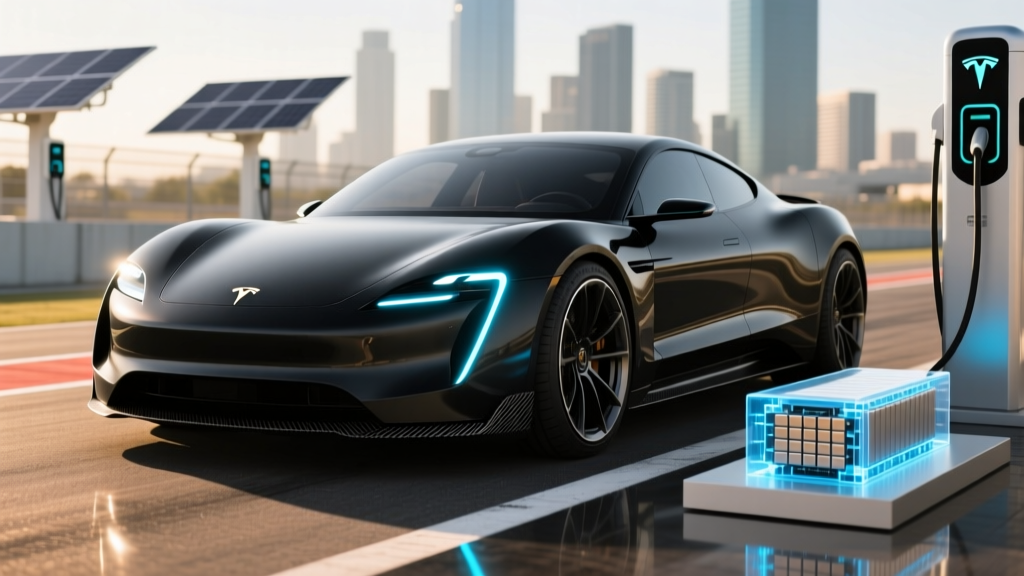
The Tesla Roadster has lived in a state of perpetual "almost" since Elon Musk first pulled the covers off the second-generation concept in November 2017. Nearly a decade later, the Tesla Roadster announcement cycle continues to generate outsized interest — and outsized skepticism. With Tesla targeting a 2026 production window for what it calls the "last call for gasoline," buyers and enthusiasts alike want hard numbers, not vaporware promises.
This profile synthesizes every confirmed and estimated specification Tesla has published or teased through mid-2026, layers in real-world EV ownership context, and flags what remains unproven. Because the Roadster is still a pre-production, announced vehicle, figures below marked "preliminary" are subject to change before the first customer delivery.
What the Latest Tesla Roadster Announcement Actually Confirms
Tesla's most recent public updates position the Roadster as a low-volume halo sports car — not a mass-market EV. Key claims from Tesla's own presentations and earnings calls include a 200 kWh battery pack, a 620-mile targeted range, a sub-2.0-second 0-60 mph time, and a 250+ mph top speed. Tesla has also teased an optional "SpaceX package" featuring cold-gas thrusters for extreme acceleration and braking.
What remains unconfirmed as of this writing: final EPA certification, third-party crash testing, production pricing beyond the original $200,000 Founders Series reservation, and a firm delivery date. Tesla has a documented history of shifting timelines — the original Roadster 2.0 was slated for 2020, then 2022, then 2024, and now 2026.
Tesla targets an EPA-estimated 620 miles of range. Real-world expectation: plan for ~480–540 miles on mixed highway driving at 70–80 mph, and ~370–420 miles in sub-freezing temperatures. A 200 kWh pack pushing a 4,400-lb sports car at high speeds will consume energy rapidly — aerodynamic drag scales with the cube of velocity. Treat 620 miles as a best-case city/low-speed scenario, not a road-trip guarantee.
Preliminary Specifications: Tesla Roadster (Announced / Pre-Production)
| Specification | Tesla Roadster (Preliminary) |
|---|---|
| Targeted EPA Range | 620 miles |
| Battery Capacity | ~200 kWh (estimated usable) |
| Battery Chemistry | Expected NMC/NCA (high energy density); LFP unlikely for this application |
| Drivetrain | Tri-motor AWD (1 front, 2 rear) |
| Horsepower | ~1,000+ hp (wheel torque: 10,000 Nm claimed) |
| 0-60 mph | 1.9 seconds (base); <1.0 sec with SpaceX package claimed |
| Top Speed | 250+ mph |
| Quarter Mile | 8.8 seconds (claimed) |
| Max DC Fast Charge | Expected 250–350 kW (V4 Supercharger compatible) |
| 10-80% DC Charge | ~30–40 minutes (preliminary) |
| Level 2 Home Charging | ~11.5 kW / ~34 mi/hr (est. via Wall Connector) |
| Seating | 2+2 (rear seats nominal) |
| Cargo Volume | Not disclosed; expected <5 cu ft total (frunk + rear shelf) |
| Base MSRP (Target) | ~$200,000 (Founders Series); base TBD |
| Federal Tax Credit | Not eligible — exceeds §30D MSRP cap for passenger cars |
| Battery/Powertrain Warranty | Expected 8 yr / 150,000 mi (based on Tesla precedent) |
Charging the 200 kWh Pack: Speed, Curve, and Practical Expectations
A 200 kWh battery is roughly double the capacity of a Tesla Model S Long Range. That creates a fundamental charging challenge: even at a peak rate of 350 kW, filling 140 kWh (10-80%) takes a minimum of 24 minutes under ideal conditions — and charge curves are never ideal across the full session.
| Charging Level | Power (kW) | Miles Added per Hour | Full Charge Time (est.) |
|---|---|---|---|
| Level 1 (120V / 12A) | 1.4 kW | ~4 mi/hr | ~140+ hours |
| Level 2 (240V / 48A) | 11.5 kW | ~34 mi/hr | ~17–18 hours |
| DC Fast (V3 Supercharger) | 250 kW peak | ~750 mi/hr (peak) | 10-80% in ~35–40 min |
| DC Fast (V4 Supercharger) | 350 kW peak | ~1,000 mi/hr (peak) | 10-80% in ~28–35 min |
Critical nuance: Peak kW is not sustained kW. Tesla's charge curve typically tapers significantly above 50% SoC and again above 80%. Expect the Roadster to spend most of a DC fast-charging session averaging 150–200 kW, not holding 350 kW the entire time. Battery preconditioning — which the Roadster will support via navigation-routed charging — is essential for reaching peak rates. Without it, cold-soak in winter could add 10–15 minutes to your 10-80% time.
For home charging, a full 0-100% session on a 48-amp Level 2 Wall Connector will take approximately 17 hours. Most owners will charge overnight from 20-80%, which takes roughly 10 hours — feasible for daily use if you plug in every evening.
Performance: The Numbers Behind the 1.9-Second Claim
Tesla's claimed 1.9-second 0-60 mph time (and sub-1.0-second claim with the SpaceX thruster package) would make the Roadster the quickest production car ever sold. For context, the current Model S Plaid achieves 1.99 seconds with its tri-motor setup and ~1,020 hp.
The Roadster's tri-motor AWD configuration — one motor up front, two in the rear with torque vectoring — is the same architecture proven in the Plaid lineup. Where the Roadster diverges is weight: a 200 kWh pack adds significant mass (likely 1,200+ lbs for the battery alone), pushing total curb weight toward 4,400–4,800 lbs. Achieving sub-2-second times at that mass requires extraordinary tire grip, launch control software, and possibly the cold-gas thruster system Tesla has described for the SpaceX package.
Real-world note: 1.9-second launches require a prepped surface, warm tires, and ideal conditions. On a public road with standard asphalt, expect 2.2–2.5 seconds — still blisteringly quick and faster than virtually any production car on sale.
Pricing, Tax Credits, and the $200,000 Question
The original 2017 Roadster announcement listed a $200,000 base price, with a $250,000 Founders Series requiring full payment upfront for early delivery. Tesla has not updated these figures publicly, and inflation plus the cost of a 200 kWh pack and tri-motor drivetrain suggest the final MSRP could land between $200,000 and $300,000 depending on options.
| Pricing Element | Amount |
|---|---|
| Expected Base MSRP | ~$200,000 (preliminary) |
| Founders Series (if offered) | ~$250,000 |
| Federal §30D Tax Credit | $0 — Exceeds $55,000 MSRP cap for passenger cars |
| Estimated Destination Fee | ~$1,500–$2,500 |
| Estimated Out-the-Door | ~$202,000–$255,000+ |
Tax credit reality: Under current IRS §30D rules, the Roadster is categorically ineligible for the $7,500 federal EV tax credit. The credit applies only to passenger cars with an MSRP at or below $55,000 (and SUVs/trucks at or below $80,000). At $200,000+, the Roadster misses the cap by a factor of four. Buyer income caps ($150,000 single / $300,000 joint AGI) are moot at this price point — buyers are paying full sticker regardless.
Technology, Interior, and Driver Assistance
Expect the Roadster to ship with Tesla's latest hardware suite: a next-generation infotainment system, a yoke or traditional steering wheel (buyer's choice based on Model S/X precedent), and the full Tesla Autopilot / FSD (Supervised) stack.
ADAS clarification: Tesla's Full Self-Driving (Supervised) is a SAE Level 2 driver-assistance system. The driver must remain fully engaged, eyes on the road, hands available to take over at any moment. This is not autonomous driving. For true Level 4 driverless operation, only services like Waymo currently qualify — and those operate in geofenced urban areas, not in consumer vehicles.
Tesla FSD (Supervised) does NOT make the Roadster self-driving. It handles highway lane-keeping, on-ramp-to-off-ramp navigation, and some city-street scenarios, but requires continuous driver supervision. Performance degrades in heavy rain, construction zones, and unmapped areas. Expect occasional disengagements requiring immediate manual takeover.
Standout tech features expected:
- Removable glass roof panel (targa-style, as shown in concept)
- Active aerodynamics with deployable rear spoiler
- 200 kWh pack with advanced thermal management for sustained track use
- Over-the-air software updates for performance tuning and feature additions
- Vehicle-to-load (V2L) capability (unconfirmed but likely given Tesla's Cybertruck precedent)
Notable drawbacks: The 2+2 seating is nominal — rear "seats" are best suited for children or cargo overflow. Cargo space is expected to be minimal (no official cubic-foot figure released). Ground clearance will be low. Insurance premiums for a 1,000-hp, $200,000+ EV will be substantial — expect $5,000–$10,000+ annually depending on your profile and location.
Who Should Consider the Tesla Roadster (And Who Shouldn't)
- You want a halo electric sports car with unmatched straight-line performance
- You already own a practical daily driver and want a weekend/track toy
- You have access to home Level 2 charging and live near Supercharger corridors
- Budget is not a primary constraint ($200K+ with no tax credit)
- You need a practical daily commuter with cargo space and rear-seat usability
- You want federal tax credit savings (consider the Model 3, Model Y, or competitors)
- You need a confirmed, deliverable vehicle today — not a reservation for an announced model
- You prioritize proven reliability data over bleeding-edge performance claims
Tesla Roadster vs. Key Competitors
At this price and performance tier, the Roadster's competitive set is small but formidable:
- Rimac Nevera — 1,914 hp, 1.85-sec 0-60, ~$2.2M. Proven and delivered, but 10x the price.
- Lotus Evija — 1,972 hp, ~$2.3M. Limited to 130 units; similarly vaporware-adjacent for most buyers.
- Porsche Taycan Turbo GT — 1,019 hp, 2.1-sec 0-60, ~$230K MSRP. Available now, proven reliability, but ~400 miles less range.
- Lucid Air Sapphire — 1,234 hp, 1.89-sec 0-60, ~$250K. Available now, EPA 427-mile range, 4-door practicality.
The Roadster's unique value proposition — if delivered as promised — is 620 miles of range combined with sub-2-second acceleration at a fraction of the Nevera's price. But "if delivered" is doing enormous work in that sentence.
- Targeted 620-mile range would shatter all production EV records
- Sub-2.0-second 0-60 mph (base) with tri-motor AWD
- Access to Tesla's Supercharger network (20,000+ stalls globally)
- OTA updates could improve performance post-delivery
- Removable roof panel for open-air driving
- Still announced/pre-production — no confirmed delivery date
- No federal tax credit eligibility (MSRP far exceeds §30D cap)
- 200 kWh pack means long Level 2 home charge times (~17 hrs full)
- Nominal rear seats and minimal cargo space
- Tesla's track record of timeline delays is extensive
- Insurance costs will be extreme
Frequently Asked Questions
What is the real-world range of the Tesla Roadster?
Tesla targets a 620-mile EPA estimate, but real-world highway driving at 75 mph will likely yield 480–540 miles. In cold weather (below 32°F), expect 370–420 miles. The 200 kWh battery is enormous, but high-speed aerodynamic drag and the car's weight work against efficiency.
How fast does the Roadster charge at home and on the road?
At a V4 Supercharger (350 kW peak), expect a 10-80% session in roughly 28–35 minutes, though sustained rates will average 150–200 kW due to charge-curve taper. At home on a 48-amp Level 2 Wall Connector (11.5 kW), a full charge takes approximately 17 hours. Overnight 20-80% charging takes about 10 hours.
Does the Tesla Roadster qualify for the federal EV tax credit?
No. Under IRS §30D rules, the $7,500 credit for new clean vehicles applies only to passenger cars with an MSRP of $55,000 or less. The Roadster's expected $200,000+ price disqualifies it entirely. Buyer income caps and battery-sourcing requirements are irrelevant at this MSRP.
Is the Tesla Roadster worth buying vs. the Lucid Air Sapphire or Porsche Taycan Turbo GT?
If you can wait for an unconfirmed delivery and prioritize maximum range plus straight-line acceleration, the Roadster's spec sheet is unmatched. If you need a car today with proven build quality, dealer support, and independent crash-test data, the Lucid Air Sapphire (available now, 1.89-sec 0-60, 427-mile EPA range) or Porsche Taycan Turbo GT are safer bets.
When will the Tesla Roadster actually ship?
Tesla has targeted 2026 for production, but the company has delayed the Roadster multiple times since its 2017 announcement (originally 2020, then 2022, then 2024). Until Tesla confirms a firm production start date and begins VIN-stamped builds, treat any timeline as preliminary.
What battery chemistry will the Roadster use?
Tesla has not officially confirmed the chemistry, but a 200 kWh pack optimized for energy density and performance will almost certainly use NMC (nickel manganese cobalt) or NCA (nickel cobalt aluminum) cells. LFP (lithium iron phosphate) is used in Tesla's standard-range vehicles for cost and longevity, but its lower energy density makes it impractical for a 620-mile sports car application.
Is Tesla's FSD self-driving on the Roadster?
No. Tesla FSD (Supervised) is an SAE Level 2 driver-assist system. You must keep your eyes on the road and hands ready to intervene. It is not autonomous driving. The Roadster will not drive itself without supervision under any current or announced software version.
All specifications listed for the Tesla Roadster are preliminary and based on manufacturer announcements as of mid-2026. Final EPA certification, pricing, and delivery timelines are subject to change. Consult Tesla's official Roadster page and the IRS §30D guidance for the latest information before making a purchase decision.