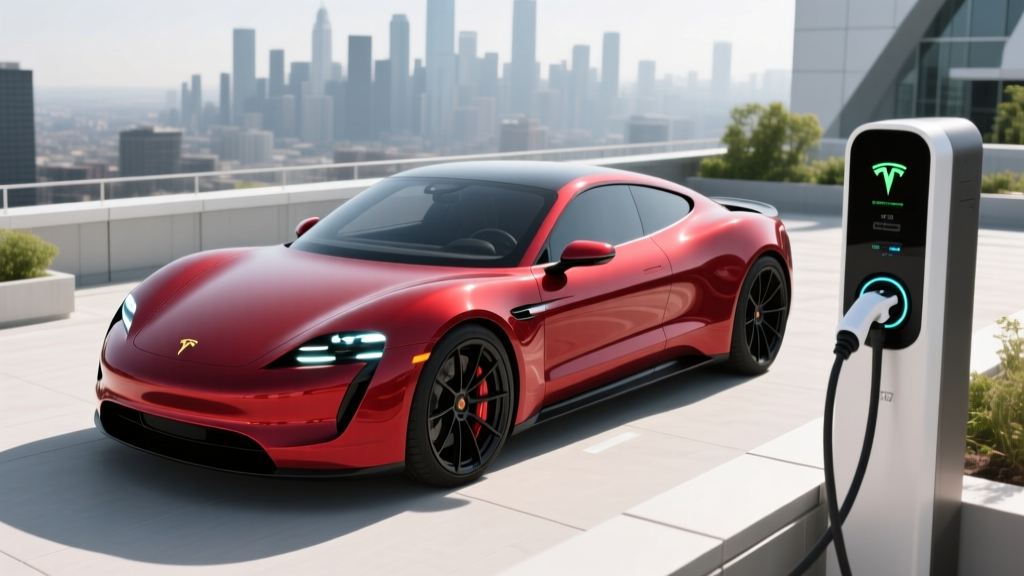
If you've been searching "how much are Tesla Roadsters" expecting a straightforward sticker price, buckle up — the answer is layered with reservation deposits, shifting timelines, and a spec sheet that reads more like a physics experiment than a car brochure. The next-generation Tesla Roadster, first teased in 2017 and repeatedly delayed, remains in announced/pre-order status as of early 2026. Tesla has not begun customer deliveries, and final EPA certification is pending. What we do have are Tesla's published claims, engineering breadcrumbs from earnings calls, and enough industry context to separate plausible from fantasy.
This profile treats the Roadster as an announced vehicle with preliminary specs. Nothing here constitutes a buyable configuration today. If Tesla adjusts pricing, battery chemistry, or performance targets before production begins — as it has done with Cybertruck and the original Roadster 2.0 timeline — we'll update accordingly.
How Much Are Tesla Roadsters? Pricing Breakdown
Tesla has communicated two pricing tiers for the Roadster, though neither has appeared on a live configurator as of Q1 2026:
| Tier | MSRP (Estimated) | Deposit Required | Status |
|---|---|---|---|
| Base Roadster | ~$200,000 | $50,000 (reservation) | Pre-order |
| Founders Series | ~$250,000 | $250,000 (full payment) | Limited, sold out |
The Founders Series was capped at 1,000 units and required full payment upfront — a strategy Tesla previously used for the original Roadster and early Model S signatures. The base model's $200,000 figure has been floated by Elon Musk in various interviews, though Tesla's official site has at times listed "expected" pricing without firm commitment.
For context, the Tesla Roadster product page has historically shown a base price in the $200,000 range, but without a firm production date or configurator access, treat this as a target, not a guarantee. Inflation, supply-chain shifts, and battery cost fluctuations between 2017 and a potential 2026-2027 production window could push final pricing higher.
Federal Tax Credit Reality
Under current IRS §30D rules, the Roadster faces immediate disqualification on multiple fronts:
- MSRP Cap: §30D limits eligible vehicles to $55,000 for sedans/sports cars. At ~$200,000, the Roadster exceeds this by roughly 4×.
- Income Cap: Buyers must have AGI below $150,000 (single) / $300,000 (joint). Most buyers in this price bracket exceed these thresholds.
- Battery Sourcing: Critical-mineral and battery-component sourcing requirements must be met — unknown for the Roadster at this stage.
Bottom line: Do not factor the $7,500 federal credit into your Roadster budget. This is a full-price, luxury-halo purchase. Consult IRS §30D guidelines for the latest eligibility rules, and speak with a tax professional before making any financial commitment.
Range, Battery & the 620-Mile Claim
Tesla has claimed a target range of 620 miles on a single charge for the Roadster — a figure that would obliterate every production EV on the market if certified by the EPA. For reference, the Lucid Air Grand Touring currently holds the production crown at 516 miles EPA.
Claimed target: 620 miles
Expected EPA (if certified): ~500–580 miles (based on Tesla's historical EPA-to-claim ratios)
Real-world highway (75 mph, 70°F): ~380–440 miles
Cold-weather (32°F, mixed driving): ~300–350 miles
Note: These are projections based on battery capacity and comparable Tesla models. Final EPA numbers will depend on vehicle weight, aero tuning, and thermal management at production time.
The math behind the 620-mile claim rests on a rumored 200 kWh battery pack — roughly double the capacity of a Model S Plaid's ~100 kWh pack. At a hypothetical efficiency of 3.0 miles/kWh (achievable in a low-drag sports car at moderate speeds), 200 kWh yields 600 miles. Push to 3.1 mi/kWh and you hit 620.
Battery Chemistry: What We Know (and Don't)
Tesla has not confirmed the Roadster's cell chemistry. Two possibilities exist:
| Chemistry | Energy Density | Cycle Life | Likelihood |
|---|---|---|---|
| NMC (Nickel Manganese Cobalt) / NCA | High (~250-300 Wh/kg cell-level) | 1,000–2,000 cycles | Most likely for 620-mi target |
| LFP (Lithium Iron Phosphate) | Lower (~160-180 Wh/kg) | 3,000+ cycles | Unlikely — too heavy for this range target |
For a 200 kWh pack to fit in a sports-car footprint without exceeding ~5,000 lbs, Tesla almost certainly needs high-nickel NMC or a next-generation 4680 cell variant. LFP's lower energy density would push the pack weight well beyond practical limits for a performance vehicle.
Charging Speed: The 200 kWh Problem
A massive battery is only useful if you can refill it in reasonable time. Here's where the Roadster faces physics constraints:
| Charging Level | Power / Rate | Time / Speed | Notes |
|---|---|---|---|
| Level 1 (120V) | ~1.4 kW | ~2-3 mi/hr | Not practical for 200 kWh |
| Level 2 (240V, 48A) | ~11.5 kW | ~17-18 hours (0-100%) | Overnight + daytime needed |
| Level 2 (240V, 80A) | ~19.2 kW | ~10-11 hours (0-100%) | Requires high-capacity wall connector + panel |
| DC Fast Charge (V4 Supercharger) | ~350 kW (peak, claimed) | 10-80% in ~30-40 min (projected) | Sustained rate will taper; curve unknown |
The charge-curve reality: Even at a peak 350 kW, a 200 kWh battery cannot sustain that rate across the full 10-80% window. Expect the Roadster to peak near 350 kW in the 10-30% SoC range, then taper progressively. The 30-40 minute 10-80% estimate assumes an average sustained rate of ~200-250 kW, which is aggressive but plausible with Tesla's latest thermal management.
For home charging, a 200 kWh battery is a genuine infrastructure challenge. At 11.5 kW (a typical 48A Level 2 setup), a full charge takes 17+ hours. Most Roadster owners will operate in a 20-80% daily window (~120 kWh used, ~10-11 hours to refill at 11.5 kW) and rely on Superchargers for road-trip top-ups.
Performance: 0-60, Horsepower & the SpaceX Thruster Option
Tesla's performance claims for the Roadster border on hypercar territory:
| Metric | Claimed Figure | Context |
|---|---|---|
| 0-60 mph | 1.9 seconds (base) ~1.1 sec (with SpaceX package) | Base would beat Model S Plaid (1.99s); SpaceX pkg uses cold-gas thrusters |
| Top Speed | 250+ mph | Electronically limited |
| Quarter Mile | 8.8 seconds | Would rival Bugatti Chiron territory |
| Drivetrain | Tri-motor AWD | One front, two rear motors (expected) |
| Horsepower | ~1,000+ hp (estimated) | Not officially confirmed; derived from tri-motor torque claims |
| Torque | 10,000 Nm (wheel torque, claimed) | Wheel torque, not motor torque — marketing distinction |
The "SpaceX package" deserves a reality note: Tesla has mentioned optional cold-gas thrusters positioned around the vehicle to improve cornering, braking, and acceleration. This is not a flight system — it's a traction-enhancement concept borrowed from aerospace. Whether it survives to production, passes NHTSA scrutiny, or proves practical for street use remains an open question.
Efficiency, Interior & Practicality
Efficiency
For a 200 kWh battery delivering a claimed 620 miles, the implied efficiency is roughly 32 kWh/100 miles (or ~3.1 mi/kWh). That translates to an estimated 105-110 MPGe — respectable for a performance vehicle but not class-leading. The Lucid Air achieves 131 MPGe combined with far less battery. The Roadster trades efficiency for raw capacity.
Interior, Cargo & Daily Use
The Roadster is a 2+2 sports car (two front seats, two small rear seats), not a grand tourer. Expect:
- Seating: 4 (tight rear seats, best for children or luggage overflow)
- Cargo: Estimated 5-8 cu ft combined (front trunk + rear shelf area) — minimal by any standard
- Infotainment: Likely a 15-17" center touchscreen running Tesla's current UI, with over-the-air updates
- Driver Assistance: Tesla Autopilot standard; FSD (Supervised) available as an add-on — this is an SAE Level 2 system requiring full driver attention, not autonomous driving
- Roof: Removable glass roof panel (claimed), stowage in the trunk
This is a halo car for Tesla enthusiasts, collectors, and buyers who want the fastest-accelerating production vehicle on earth. It is not a daily commuter, family hauler, or practical road-trip car. Think of it as Tesla's answer to the Rimac Nevera or Lotus Evija — with the Supercharger network advantage.
Warranty, Ownership Costs & Competitor Comparison
Warranty (Projected)
Tesla has not published Roadster-specific warranty terms. Based on current Model S/X coverage, expect:
- Battery & Drive Unit: 8 years / 150,000 miles (whichever comes first), with minimum 70% capacity retention
- Vehicle Limited Warranty: 4 years / 50,000 miles
For a $200,000+ vehicle, this warranty is less generous than competitors like Lucid (8yr/100,000mi battery) or Porsche (8yr/100,000mi on the Taycan). Out-of-warranty battery replacement on a 200 kWh pack could exceed $40,000-$60,000 based on current cell pricing trajectories.
Competitor Comparison
| Spec | Tesla Roadster | Rimac Nevera | Lotus Evija | Lucid Air Sapphire |
|---|---|---|---|---|
| Price | ~$200,000 | ~$2,200,000 | ~$2,400,000 | $249,000 |
| Range (claimed/EPA) | 620 mi (claimed) | ~340 mi (WLTP) | ~250 mi (claimed) | 427 mi (EPA) |
| 0-60 mph | 1.9s (claimed) | 1.85s | <3.0s | 3.3s |
| Charging Network | Tesla Supercharger | CCS public | CCS public | NACS + Supercharger access |
| Production Status | Announced | In production (150 units) | In production (130 units) | In production |
The Roadster's primary advantage is price-to-performance ratio — if Tesla delivers on its claims, no vehicle under $1M matches its acceleration. Its primary risk is delivery risk: Tesla has delayed this program for nearly a decade, and production timelines remain unconfirmed.
Pros, Cons & the Bottom Line
✅ Pros
- Unmatched claimed acceleration (1.9s 0-60)
- 620-mile range would shatter EV records if certified
- Supercharger network access — a real road-trip advantage over Rimac/Lotus
- Relative value: $200K vs. $2M+ for comparable hypercar performance
- Tesla OTA updates and software ecosystem
❌ Cons
- Not available — production has been delayed since 2017
- Final specs, EPA certification, and pricing are unconfirmed
- No federal tax credit eligibility (§30D MSRP cap)
- 200 kWh battery means very long home charging times
- 2+2 seating and minimal cargo limit practicality
- SpaceX thruster package may not reach production or pass regulation
- $50,000 reservation deposit ties up capital indefinitely
Frequently Asked Questions
What is the real-world range of the Tesla Roadster?
Tesla claims 620 miles, but real-world highway driving at 75 mph in moderate temperatures would likely yield 380-440 miles based on the projected 200 kWh pack and comparable Tesla efficiency data. Cold weather (below freezing) could reduce that to 300-350 miles. No EPA certification exists yet.
How fast does the Roadster charge?
Projected DC fast charging peaks around 350 kW on V4 Superchargers, with a 10-80% time of approximately 30-40 minutes (sustained rates will taper). Home Level 2 charging at 11.5 kW (48A) takes roughly 17 hours for a full charge — impractical for daily full refills.
How much does the Tesla Roadster cost after tax credits?
The Roadster does not qualify for the $7,500 federal §30D tax credit due to its ~$200,000 MSRP (the cap for sports cars/sedans is $55,000) and likely buyer income levels. Expect to pay full MSRP plus state registration, insurance, and any applicable luxury taxes. Some states may offer separate incentives — check your local DMV or energy office.
Is the Tesla Roadster worth buying vs. competitors?
If Tesla delivers on specs at $200,000, the Roadster offers hypercar performance at a fraction of the Rimac Nevera's $2.2M price. However, you're accepting significant delivery risk and tying up a $50,000 deposit indefinitely. Buyers who want a guaranteed, available ultra-performance EV today should look at the Lucid Air Sapphire ($249,000, 427 mi EPA, in production now) or the Porsche Taycan Turbo GT.
Does the Tesla Roadster qualify for the federal EV tax credit?
No. Under current IRS §30D rules, new clean vehicle credits are limited to cars with an MSRP under $55,000 (sedans/sports cars). The Roadster's ~$200,000 price disqualifies it immediately, regardless of battery sourcing or buyer income.
Can I order a Tesla Roadster right now?
You can submit a reservation on Tesla's website with a $50,000 deposit, but this is not a purchase order. Production has not begun, no delivery date has been confirmed, and Tesla has a history of significantly delaying announced vehicles (Cybertruck was announced in 2019 and delivered in late 2023; the Roadster was announced in 2017). Treat the deposit as a speculative commitment, not a reservation with a timeline.
Sources: Tesla Roadster product page, IRS §30D Clean Vehicle Credits, EPA Fuel Economy (for competitor EPA data). All Roadster specs are preliminary and subject to change.