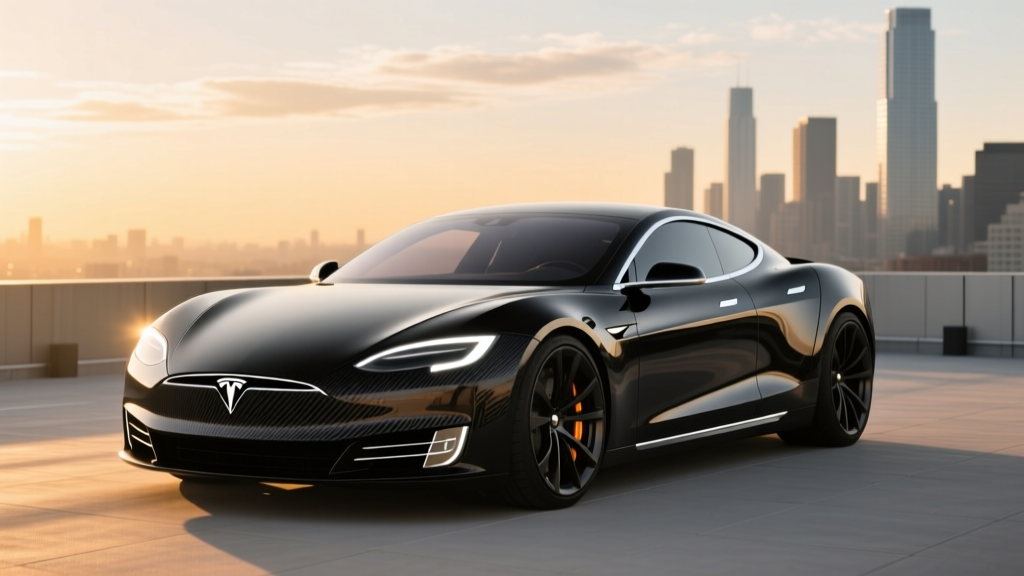
When Elon Musk unveiled the second-generation Tesla Roadster in November 2017, the specs sounded like science fiction: 620 miles of range, a 1.9-second 0-60 mph time, and a 250 mph top speed. The "2018" in its name referred to the originally promised production start, not the model year of delivery. As of 2026, the Tesla Roadster remains an announced but unreleased vehicle — not yet available for purchase, with no firm delivery date confirmed. This profile examines every known and estimated specification, the reality behind the numbers, and what buyers should actually expect if and when it finally ships.
Tesla Roadster 2018: Announced Specifications at a Glance
| Specification | Tesla Claim / Estimate |
|---|---|
| EPA Range (claimed) | 620 miles |
| Battery Capacity | ~200 kWh (announced) |
| Battery Chemistry | Unconfirmed; likely NMC or NCA |
| 0-60 mph | 1.9 seconds (claimed); 1.1s with SpaceX package |
| Top Speed | 250+ mph |
| Quarter Mile | 8.8 seconds (claimed) |
| Drivetrain | AWD, tri-motor (1 front, 2 rear) |
| Horsepower | ~1,000+ hp (wheel torque: 10,000 Nm claimed) |
| Peak DC Fast Charge | Not officially disclosed |
| Base MSRP (announced) | $200,000 (base); $250,000 (Founders Series) |
| Reservation Deposit | $50,000 (fully refundable) |
| Seating | 2+2 (4 seats) |
| Federal Tax Credit | Not eligible (§30D MSRP cap exceeded) |
The 620-Mile Range Claim: Real-World Expectations
Tesla's headline number for the Roadster is 620 miles of range — a figure that would make it the longest-range production EV ever announced by a wide margin. This claim rests on a massive ~200 kWh battery pack, roughly double the capacity of a Model S Long Range's ~100 kWh pack.
Claimed Range: 620 miles
Realistic Highway Expectation (70-80 mph): ~430–500 miles (based on typical 20-30% highway efficiency loss for high-performance AWD EVs)
Cold-Weather Estimate (below 32°F): ~370–450 miles (NMC chemistry loses roughly 25-35% in freezing temps without preconditioning)
Note: No EPA test results exist. These estimates are extrapolated from comparable large-battery, high-performance EVs like the Lucid Air Grand Touring and Tesla Model S Plaid.
The physics of a 200 kWh pack are straightforward: more stored energy means more range, even in a heavy, powerful car. However, the Roadster's performance orientation — wide tires, aggressive aerodynamics at speed, and tri-motor power delivery — will work against highway efficiency. For context, the Lucid Air Grand Touring achieves roughly 4.5 miles per kWh on the EPA cycle; if the Roadster matches that efficiency, 200 kWh yields 900 miles, which is far above Tesla's claim. This suggests Tesla's 620-mile figure may already account for a more aggressive driving profile, or the usable pack capacity may be lower than 200 kWh (with a buffer for battery protection).
Battery chemistry matters here. A pack this large almost certainly uses NMC (nickel manganese cobalt) or NCA (nickel cobalt aluminum) cells rather than LFP (lithium iron phosphate). NMC offers higher energy density, which is essential for fitting 200 kWh into a sports car footprint. However, NMC degrades slightly faster than LFP over thousands of cycles and is more sensitive to sustained high-state-of-charge storage. Owners should expect to follow Tesla's recommended charging practices — daily charges to 80-90%, with 100% reserved for trips.
Charging Speed: What a 200 kWh Pack Means for Plug Times
Tesla has not officially disclosed the Roadster's maximum DC fast-charge rate. However, we can draw reasonable inferences from the current Tesla Supercharger network and the company's battery architecture.
| Charging Level | Power / Rate | Estimated Time / Range Added |
|---|---|---|
| Level 1 (120V household) | ~1.4 kW | ~3-4 miles/hour; full charge in 60+ hours |
| Level 2 (240V home, 48A) | ~11.5 kW | ~25-30 miles/hour; full charge in ~20 hours |
| DC Fast Charge (V4 Supercharger, est.) | 250-350 kW peak (est.) | 10-80% in ~30-45 min (est.); 150+ miles in 15 min |
The critical challenge for a 200 kWh pack is charge time. Even at a peak rate of 350 kW, charging from 10% to 80% (140 kWh) requires a minimum of 24 minutes under perfect conditions — and real-world charge curves taper significantly above 50-60% state of charge. Expect actual 10-80% times closer to 30-45 minutes on a V4 Supercharger, assuming Tesla equips the Roadster with its latest 4680 cells and thermal management.
Home charging is where the math gets painful. A standard 48-amp Level 2 home charger delivers roughly 11.5 kW. Charging a fully depleted 200 kWh pack at that rate takes approximately 20 hours. In practice, most owners will plug in overnight and rarely deplete the pack below 20-30%, making daily top-ups manageable in 6-10 hours. But a full recharge after a road trip will require patience or a DC fast-charging stop on the way home.
One practical note: the Roadster uses the NACS (North American Charging Standard) connector native to all Tesla vehicles, granting access to the full Supercharger network — the most reliable and extensive DC fast-charging infrastructure in the US as of 2026.
Performance: The Numbers That Redefined Expectations
The Tesla Roadster's performance claims remain staggering even by 2026 standards. A 1.9-second 0-60 mph time would make it the quickest production car ever sold. The tri-motor AWD layout — one motor driving the front axle and two motors on the rear — enables precise torque vectoring and all-wheel traction off the line.
Tesla also announced an optional "SpaceX package" featuring cold-gas thrusters mounted around the vehicle, claiming a 1.1-second 0-60 mph time. This package has not been demonstrated in production form and should be treated as highly preliminary.
The claimed 10,000 Nm of wheel torque is not the same as motor shaft torque — it's multiplied through the gear reduction. For reference, the Model S Plaid produces 1,020 horsepower and hits 60 mph in 1.99 seconds with a tri-motor setup. The Roadster, with presumably more power and less weight than a sedan, should comfortably meet or approach Tesla's acceleration claims — provided tire technology can handle the traction demands.
Top speed of 250+ mph places the Roadster in hypercar territory alongside the Bugatti Chiron and Koenigsegg Jesko. Sustaining that speed, however, will drain the battery at an extreme rate — likely consuming the full 200 kWh pack in well under 100 miles at maximum velocity.
Pricing, Tax Credits, and the §30D Reality
| Item | Details |
|---|---|
| Base MSRP (announced) | $200,000 |
| Founders Series MSRP | $250,000 (limited to first 1,000 units) |
| Reservation Deposit | $50,000 (fully refundable) |
| Expected Price at Launch (est.) | $200,000–$250,000+ (adjustments likely given 8+ year delay) |
| IRS §30D Federal Tax Credit | Not eligible — MSRP exceeds the $55,000 sedan / $80,000 SUV/truck cap |
| State Incentives | Varies by jurisdiction; check local programs |
The IRS §30D clean vehicle credit imposes strict MSRP caps: $55,000 for sedans and $80,000 for SUVs, vans, and pickup trucks. At a $200,000 base price, the Roadster exceeds these limits by a factor of nearly four. No buyer will qualify for the $7,500 federal tax credit regardless of income, battery sourcing, or any other eligibility factor.
Additionally, the §30D credit has buyer income caps ($150,000 single / $300,000 joint modified AGI) and critical-mineral/battery-component sourcing requirements. But for Roadster buyers, the MSRP cap is the disqualifying factor — making the discussion moot.
At this price point, buyers should also anticipate higher insurance premiums (performance EVs in the $200K+ range typically cost $4,000-$8,000+ annually to insure), premium registration fees in some states, and maintenance costs for high-performance tires and brake components.
Interior, Cargo, and Daily Practicality
The Roadster is a 2+2 sports car, meaning two front seats and two small rear seats. Tesla has shown a minimalist interior with a central touchscreen and a removable glass roof panel (a "targa" style). Cargo space is limited — expect a small front trunk (frunk) and a rear shelf area behind the seats. Total cargo volume will likely be in the 8-12 cubic foot range, comparable to a Porsche 911 or Chevrolet Corvette.
Legroom and headroom figures have not been published, but the Roadster's low-slung sports car profile means entry and exit will require more effort than a sedan or crossover. Rear seats are best suited for children or additional storage — not adult passengers on longer trips.
As a daily driver, the Roadster will work for singles or couples without child-seat requirements who prioritize performance over practicality. It is not a family vehicle, a towing platform, or a road-trip cruiser in the traditional sense — though its claimed 620-mile range would theoretically allow long-distance travel with fewer stops than any current EV.
Tech, Driver Assistance, and the Autopilot Question
The Roadster is expected to ship with Tesla's full suite of driver-assistance features, including Autopilot (standard) and Full Self-Driving (Supervised) as an option. As of 2026, FSD Supervised remains a SAE Level 2 system — meaning the driver must remain fully engaged, hands on or near the wheel, and eyes on the road at all times. It is not autonomous driving.
Tesla Autopilot and FSD (Supervised) are SAE Level 2 systems. The vehicle can manage steering, acceleration, and braking under certain conditions, but the human driver is fully responsible for monitoring the environment and intervening at any moment. This is fundamentally different from Level 4 robotaxi services like Waymo, which operate without a human driver in geofenced areas.
Infotainment will run on Tesla's latest software platform, featuring a large central touchscreen, over-the-air updates, streaming media, gaming, and Tesla's navigation with real-time Supercharger routing. The Roadster may also debut new UI elements or performance telemetry displays specific to the model.
One unique feature: the removable glass roof panel stores in the trunk, offering an open-air driving experience rare in the EV space. Tesla has also hinted at active aerodynamic elements, though details remain scarce.
Pros, Cons, and the Competitor Landscape
- Unmatched claimed range (620 miles) if realized
- Hypercar-rivaling acceleration (1.9s 0-60)
- Access to Tesla Supercharger network (NACS)
- Over-the-air software updates and Tesla ecosystem
- Open-air driving with removable roof panel
- Tri-motor AWD with torque vectoring
- Not available — announced in 2017, still not in production as of 2026
- $200,000+ price with no federal tax credit eligibility
- 200 kWh pack means very long home charge times (~20 hrs from empty)
- 2+2 seating limits practicality; minimal cargo space
- Final specs unverified; production delays span 8+ years
- Insurance and registration costs will be substantial
- No independent crash-test data (NHTSA/IIHS) available
How the Roadster Compares to Available Alternatives
For buyers with $200,000+ to spend on a high-performance EV, several production vehicles are available now:
- Lucid Air Sapphire ($250,000): 1,234 hp, 1.89s 0-60, EPA 427 miles, available and shipping. A four-door sedan, not a sports car, but the closest match in acceleration and tech.
- Rimac Nevera (~$2,200,000): 1,914 hp, 1.85s 0-60, WLTP 340 miles. A true hypercar, but at 10x the Roadster's price and extremely limited production.
- Porsche Taycan Turbo GT (~$230,000): 1,019 hp, 2.1s 0-60, EPA 269 miles. Available now with Porsche build quality and dealer support.
- Tesla Model S Plaid (~$90,000): 1,020 hp, 1.99s 0-60, EPA 396 miles. A fraction of the Roadster's price and available immediately.
The Roadster's unique proposition is combining hypercar acceleration with 600+ mile range at a (relatively) accessible price for the segment. But until it ships, that proposition remains theoretical.
Who Should Wait — and Who Should Buy Something Else
- Wait for the Roadster if: You've already placed a $50,000 refundable deposit, you want a halo-car collectible with Tesla branding, and you have other daily vehicles. You accept that delivery may not occur until 2027 or later, and final specs may differ from announcements.
- Buy the Lucid Air Sapphire if: You want hypercar acceleration (1.89s 0-60) in a usable four-door sedan with 427 miles of EPA range, available now with a full warranty.
- Buy the Model S Plaid if: You want Tesla's tri-motor performance at a fraction of the cost ($90K vs $200K+), with immediate availability and proven reliability data.
- Buy the Porsche Taycan Turbo GT if: You prioritize build quality, dealer service infrastructure, and track-day credibility over maximum range.
Battery Warranty and Longevity Considerations
Tesla has not published specific warranty terms for the Roadster. Based on current Tesla warranties, a reasonable expectation would be:
- Battery: 8 years / 150,000 miles (whichever comes first), with a minimum 70% capacity retention threshold — consistent with Model S/X coverage.
- Drive Unit (powertrain): 8 years / 150,000 miles.
- Vehicle: 4 years / 50,000 miles limited warranty.
With a 200 kWh NMC pack, long-term degradation will depend heavily on charging habits. NMC chemistry typically retains 85-90% capacity after 1,000 full charge cycles when properly managed (avoiding frequent 100% charges and deep discharges). For a 620-mile-range vehicle, 1,000 cycles equates to roughly 620,000 miles — well beyond any realistic ownership horizon. However, the high-performance nature of the Roadster (frequent hard acceleration, high-speed driving) will generate more heat stress on the cells, potentially accelerating degradation compared to a commuter-oriented EV.
Frequently Asked Questions
Can I buy the Tesla Roadster right now?
No. As of 2026, the second-generation Tesla Roadster remains an announced vehicle. Tesla has not begun production or deliveries. You can place a $50,000 refundable reservation deposit on Tesla's website, but there is no confirmed delivery timeline.
What is the real-world range of the Tesla Roadster?
Tesla claims 620 miles, but no EPA testing has been conducted. Based on comparable high-performance EVs, expect approximately 430-500 miles at highway speeds (70-80 mph) and 370-450 miles in cold weather (below 32°F). These are estimates — actual figures will depend on the final production configuration.
Does the Tesla Roadster qualify for the federal EV tax credit?
No. The IRS §30D credit caps eligible vehicle MSRP at $55,000 for sedans and $80,000 for SUVs/trucks. At $200,000+, the Roadster is disqualified regardless of buyer income or battery sourcing.
How fast does the Roadster charge?
Tesla has not published official charge rates. Based on current Supercharger architecture (V4, up to 350 kW), a reasonable estimate is 10-80% in 30-45 minutes on DC fast charge. Home Level 2 charging at 11.5 kW would take approximately 20 hours for a full charge of the ~200 kWh pack.
Is the Roadster self-driving?
No. The Roadster is expected to include Tesla Autopilot and FSD (Supervised), both of which are SAE Level 2 driver-assistance systems. The driver must remain fully engaged at all times. These are not autonomous or "self-driving" systems.
Why has the Roadster been delayed so long?
Tesla has redirected engineering resources to higher-volume products — the Model Y, Cybertruck, Semi, and next-generation platform. The Roadster, as a low-volume halo car, has been repeatedly deprioritized. Elon Musk indicated in 2024 that the design was being revised with input from the SpaceX team, further extending the timeline. As of 2026, no firm production date has been announced.
What happens to my $50,000 deposit if the Roadster is never produced?
Tesla's reservation deposits are fully refundable. If the vehicle is canceled or if you choose to cancel your reservation, you can request a full refund through your Tesla account.
Is the Roadster worth waiting for versus buying a Lucid Air Sapphire or Model S Plaid?
If you need a vehicle now, no — both the Sapphire and Plaid offer comparable or superior acceleration with confirmed specs, warranties, and immediate availability. The Roadster is worth waiting for only if you specifically want a two-door Tesla sports car as a collectible or halo vehicle, and you're comfortable with indefinite timing uncertainty.