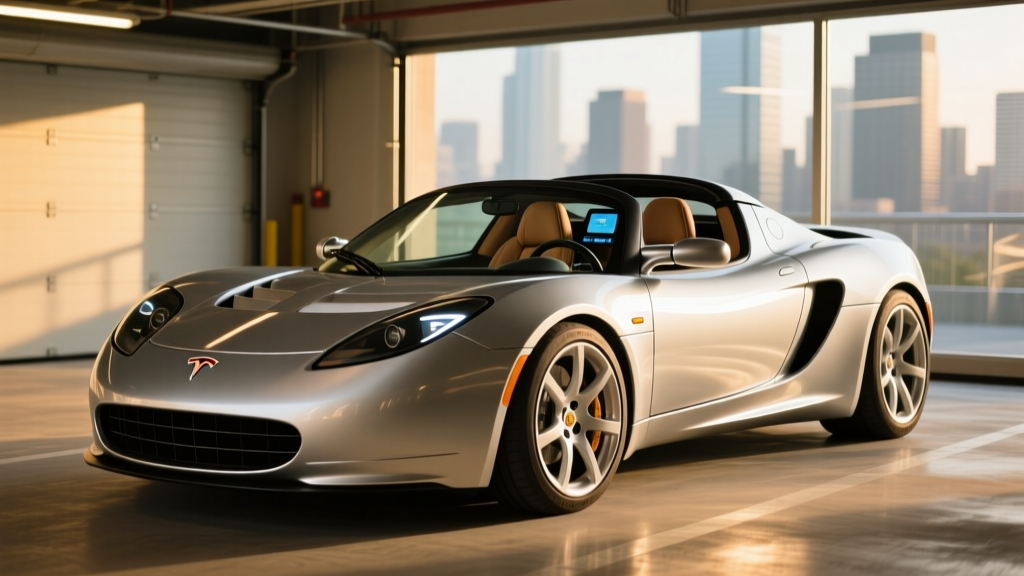
The original Tesla Roadster didn't just launch a company — it proved that a battery-electric car could outperform a Porsche at a stoplight while emitting nothing from its tailpipe. Built on a Lotus Elise chassis and produced from 2008 through 2012, the Roadster remains one of the most historically significant EVs ever made. But in 2026, the Tesla Roadster 2009 is a 17-year-old collector vehicle, not a daily driver. This guide breaks down exactly what you're getting into if you're considering buying one today — from real-world range and battery health to charging logistics and the brutal economics of a potential battery replacement.
The 2009 Tesla Roadster at a Glance: Core Specifications
Before we get into ownership realities, here are the hard numbers that define this car. Note that Tesla produced the Roadster in two main variants: the original Roadster (2008–2009) and the Roadster Sport (2009–2012), with a later "3.0" battery upgrade package offered by Tesla for existing owners.
| Spec | Roadster (Standard) | Roadster Sport |
|---|---|---|
| EPA Range (Original) | 244 miles | 244 miles |
| Battery Capacity (Usable) | ~53 kWh (ESS) | ~53 kWh (ESS) |
| Battery Chemistry | Lithium-cobalt (NMC-type, 18650 cells) | Lithium-cobalt (NMC-type, 18650 cells) |
| Motor Output | 248 hp / 200 lb-ft | 288 hp / 295 lb-ft |
| 0–60 mph | 3.9 seconds | 3.7 seconds |
| Top Speed | 125 mph (electronically limited) | 125 mph |
| Drivetrain | RWD, single-speed (after 2009 gearbox fix) | RWD, single-speed |
| Efficiency (EPA) | ~128 MPGe combined | ~128 MPGe combined |
| Energy Consumption | ~26 kWh/100 mi | ~26 kWh/100 mi |
| Curb Weight | 2,690 lbs | 2,690 lbs |
| Cargo Volume | ~4.0 cu ft (rear trunk) | ~4.0 cu ft |
| Seats | 2 | 2 |
| Original MSRP (2009) | $109,000 | $128,500 |
| Current Used Market (2026) | $100,000–$180,000+ | $120,000–$200,000+ |
Real-World Range: What the 244-Mile EPA Sticker Actually Means
The Roadster's 53 kWh Energy Storage System (ESS) was a marvel in 2009 — it used 6,831 individual 18650 lithium-ion cells arranged in 11 modules, a configuration that directly informed Tesla's later battery packs in the Model S. The chemistry is a lithium-cobalt oxide (LiCoO₂) variant, which offered excellent energy density for the era but ages differently than the NMC and LFP chemistries used in modern EVs.
Battery degradation is the single most critical factor when evaluating a used Roadster. After 15+ years, most original batteries have lost 15–30% of their original capacity, depending on how the car was stored, charged, and driven. A Roadster that was regularly charged to 100% and stored in hot climates (Arizona, Texas) will show more degradation than one kept at 50–70% state of charge in a climate-controlled garage. Tesla's diagnostic tools can read individual cell-module health, and any serious buyer should insist on a pre-purchase battery health report.
Tesla did offer the Roadster 3.0 battery upgrade starting in 2016, which replaced the original 53 kWh pack with a ~70 kWh pack using improved cells, restoring range to roughly 280–300 miles EPA-equivalent. However, very few Roadsters received this upgrade (estimated under 100 units), and finding one on the used market commands a significant premium.
Charging the 2009 Roadster: Speeds, Connectors, and Modern Compatibility
This is where owning a 2009 Roadster in 2026 gets genuinely complicated. The car predates modern charging standards, and you'll need adapters and patience.
| Charging Method | Power (kW) | Rate | Time (10–80%) | Notes |
|---|---|---|---|---|
| Level 1 (120V, OEM cord) | ~1.4 kW | ~5 miles/hour | ~35+ hours | Emergency/trickle only |
| Level 2 (240V, Tesla HPC) | ~16.8 kW (max) | ~56 miles/hour | ~3.5–4 hours | Proprietary Tesla connector (pre-J1772 standard) |
| Level 2 (240V, J1772 w/ adapter) | ~6.6–7.2 kW (adapter-limited) | ~22–25 miles/hour | ~8–9 hours | Requires aftermarket J1772-to-Roadster adapter |
| DC Fast Charging | Not supported | N/A | N/A | No DC fast-charge capability whatsoever |
Let's be direct: the 2009 Tesla Roadster cannot DC fast charge. There is no CCS, no CHAdeMO, no Supercharger compatibility. This car was designed before DC fast charging existed in any consumer-facing form. Every charge you do will be AC Level 1 or Level 2.
The Roadster's native charging connector is Tesla's proprietary High Power Connector (HPC), which predates even the Tesla-specific J1772 adapter used on early Model S vehicles. To charge on modern public Level 2 stations (which use the J1772 standard), you'll need an aftermarket adapter — companies like Setec and independent EV parts fabricators have produced limited-run J1772-to-Roadster adapters, typically costing $300–$600 on the secondary market.
At home, the best-case scenario is installing a dedicated 240V/70A circuit with the original Tesla HPC wall connector (if you can source one), which delivers the Roadster's maximum 16.8 kW onboard charge rate. More realistically, most buyers install a standard 240V/40A NEMA 14-50 outlet and use an adapter setup, which delivers roughly 7–9 kW — adequate for overnight charging but slower than the car's maximum capability.
For a 2026 buyer, this means the Roadster is fundamentally a home-charge-only vehicle. You cannot pull into an Electrify America or EVgo station and top up in 20 minutes. Every road trip requires advance planning around overnight stops with Level 2 access — and even then, a full charge takes 4+ hours.
Performance, Driving Dynamics, and the Lotus Connection
The driving experience is where the Roadster still earns its legend status. Based on the Lotus Elise chassis, the Roadster weighs just 2,690 pounds — roughly 1,500 pounds less than a modern Tesla Model 3. That low mass, combined with instant electric torque, delivers a raw, analog performance feel that no current EV replicates.
The standard Roadster's 248 hp and 200 lb-ft of torque propel it to 60 mph in 3.9 seconds. The Sport variant bumps output to 288 hp and 295 lb-ft, dropping the 0–60 time to 3.7 seconds. These numbers were supercar territory in 2009 and remain genuinely quick today, even in a world of 1,020-hp Tesla Model S Plaid variants.
What separates the Roadster from modern EVs is the feel. The steering is unassisted and communicative. The chassis is stiff and responsive. There's no massive touchscreen, no over-the-air updates, no Autopilot — just a simple digital dash, a basic infotainment screen (added in later model years), and the sound of the electric motor whirring behind your head. It's a purist's EV, closer in spirit to a Caterham than a Model Y.
Early 2008–2009 Roadsters used a two-speed automatic transmission that was notoriously unreliable. Tesla replaced this with a single-speed fixed-gear reduction unit (the "Gearbox Replacement Program"), and virtually all surviving 2009 Roadsters have been converted. Confirm this with the seller — a Roadster still running the original two-speed gearbox is a liability.
Used Pricing, Ownership Costs, and the Tax-Credit Question
The 2009 Tesla Roadster is not a budget EV. It's a collector car with a six-figure price tag, and the economics are entirely different from buying a new or used daily-driver electric vehicle.
| Item | Cost / Detail |
|---|---|
| Original MSRP (2009) | $109,000 (base) / $128,500 (Sport) |
| Current Used Market (2026) | $100,000–$180,000+ (condition/mileage dependent) |
| Roadster 3.0 Battery Upgrade | $29,000 (when offered by Tesla; now rarely available) |
| Original Battery Replacement | $30,000–$45,000 (third-party/specialist, if available) |
| Annual Insurance (collector policy) | $1,500–$3,500/year (varies by mileage limits) |
| Federal EV Tax Credit (§30D New) | NOT eligible — credit applies only to new EV purchases |
| Used EV Tax Credit (§25E) | NOT eligible — vehicle exceeds $25,000 price cap |
| Annual Registration (varies by state) | $100–$500+ (some states add EV registration fees) |
To address the tax-credit question directly: the 2009 Tesla Roadster does not qualify for any federal EV tax credit. The IRS §30D new clean vehicle credit applies only to new EV purchases meeting MSRP caps ($55,000 for sedans, $80,000 for SUVs/trucks), buyer income limits, and battery-sourcing requirements. The §25E used clean vehicle credit caps eligibility at a $25,000 sale price — well below the Roadster's six-figure market value. There is no federal incentive available for this purchase.
Battery replacement is the existential cost risk. If the original 53 kWh pack degrades beyond usability, sourcing a replacement is extremely difficult. Tesla no longer manufactures Roadster battery packs as standard inventory. A handful of specialist shops (including Gruber Motor Company in Arizona) have performed third-party battery rebuilds using modern cells, but costs range from $30,000 to $45,000+ and wait times can stretch to months. Factor this into your purchase decision — a Roadster with a confirmed-healthy battery is worth a significant premium over one with unknown cell health.
Warranty, Reliability, and What Breaks
The original Tesla Roadster warranty was 3 years/36,000 miles for the vehicle and 5 years/100,000 miles for the battery and powertrain. In 2026, every Roadster is well outside all factory warranty coverage. You are buying this car entirely as-is unless you negotiate a third-party extended warranty (which is rare and expensive for a vehicle this specialized).
Common failure points and maintenance items for a 2009 Roadster include:
- Battery degradation — the primary concern; capacity loss of 15–30% is typical at this age
- PEM (Power Electronics Module) — known to fail on early cars; replacement costs $5,000–$10,000
- Air conditioning compressor — electric A/C units can fail; parts are scarce
- 12V auxiliary battery — standard replacement item; if it dies, the car cannot power on the main contactors
- Suspension components — Lotus-sourced; bushings and dampers wear like any 17-year-old sports car
- Brake components — regenerative braking means the friction brakes are rarely used, which can lead to seized calipers and corroded rotors from disuse
The Roadster community is small but dedicated. Owner forums (Tesla Motor Club, Lotus-specific groups) are invaluable resources for parts sourcing, specialist recommendations, and troubleshooting. Before buying, join these communities and read extensively.
Interior, Technology, and Daily Usability
The Roadster's interior is essentially a Lotus Elise interior with Tesla badges. That means: minimal. You get two seats (with very limited adjustment), a small center console, manual windows, and a basic audio system. Early 2008–2009 models had no touchscreen at all — just a small digital instrument cluster and physical buttons. Later models (2010+) received a small touchscreen with Bluetooth audio, but by 2026 standards, the infotainment is archaic.
There is no navigation system, no backup camera, no blind-spot monitoring, no lane-keeping assist, no adaptive cruise control — none of the driver-assistance technology that defines modern EVs. This is a SAE Level 0 vehicle: the driver performs all driving tasks with no automation support.
Cargo space is limited to a small rear trunk offering roughly 4.0 cubic feet — enough for a weekend bag or a couple of backpacks, nothing more. There is no frunk (front trunk); the space ahead of the driver houses the motor and power electronics. Legroom is adequate for drivers under 6'2" but tight for taller occupants, and the fixed-seat position means the steering wheel adjusts but the seat base does not slide on most models.
As a daily driver, the Roadster is impractical. No rear seats, minimal storage, no fast charging, a stiff ride, and a removable soft-top roof that's noisy at highway speeds. This is a weekend car, a collector piece, or a show vehicle — not a commuter.
Who Should Buy a 2009 Tesla Roadster — and Who Shouldn't
This EV is for you if:
- You want a piece of automotive history — the car that proved EVs could be desirable
- You're a collector adding to a garage of special-interest vehicles
- You value raw, lightweight driving dynamics over tech and comfort
- You have reliable home Level 2 charging and don't need road-trip capability
- You understand and accept the risk of a $30,000+ battery replacement
Look elsewhere if:
- You need a daily driver with practical range, charging, and cargo space
- You want modern driver-assistance features or infotainment
- You need DC fast charging for road trips
- You're buying your first (or only) EV
- You're looking for federal tax credits or incentive savings
If you love the idea of an early Tesla but need something more practical, consider a used Tesla Model S (2012–2015) starting around $15,000–$25,000, or a Tesla Model 3 (2018–2020) in the $18,000–$28,000 range — both offer Supercharger access, modern safety tech, and far lower ownership risk.
Frequently Asked Questions
What is the real-world range of a 2009 Tesla Roadster today?
With an original battery in average condition, expect 160–200 miles in mixed driving, 140–170 miles at sustained highway speeds, and as little as 110–150 miles in cold weather (below 40°F). Cars with the rare Roadster 3.0 battery upgrade may achieve 220–260 miles. Always request a battery health diagnostic before purchase.
How fast does the 2009 Roadster charge at home and on the road?
At best, Level 2 charging via the proprietary Tesla HPC connector delivers ~16.8 kW, adding roughly 56 miles per hour of charging and reaching a full charge in about 3.5–4 hours. Using a J1772 adapter on public Level 2 stations drops this to ~7 kW (~25 miles/hour, 8–9 hours for a full charge). There is no DC fast charging of any kind.
Does the 2009 Tesla Roadster qualify for any federal EV tax credit?
No. The IRS §30D credit is for new vehicles only, and the §25E used EV credit requires a sale price at or below $25,000. The Roadster's $100,000+ market value disqualifies it from both programs. State-level collector-vehicle incentives vary by jurisdiction — consult a tax professional for your specific situation.
Is the 2009 Tesla Roadster worth buying vs. a modern EV?
Not as transportation. As a collector vehicle and piece of EV history, absolutely — if you can afford the purchase price and potential battery-replacement costs. A modern Tesla Model 3 or Porsche Taycan will outperform the Roadster in every measurable metric while offering Supercharger access, driver assists, and a warranty. The Roadster's value is emotional and historical, not rational.
What are the biggest pros and cons of owning a 2009 Roadster?
Pros: Lightweight Lotus chassis, instant electric torque, 3.7–3.9s 0–60, historical significance, appreciating collector value, passionate owner community, removable roof for open-air driving.
Cons: No DC fast charging, significant battery degradation risk, $30K–$45K replacement battery cost, no modern safety tech or driver assists, minimal cargo space, no federal tax credit, scarce parts for Tesla-specific components, proprietary charging connector requiring adapters.
Can I charge a 2009 Roadster at a Tesla Supercharger?
No. The Roadster predates the Supercharger network entirely and uses a different proprietary connector. There is no adapter available to connect a Roadster to a Supercharger, CCS station, or CHAdeMO station. The car charges exclusively via AC Level 1 or Level 2.
How do I check the battery health before buying?
Request that the seller take the car to a Tesla Service Center (or a qualified Roadster specialist) for a full battery diagnostic. This reads individual module voltages, internal resistance, and overall capacity as a percentage of original. A healthy pack should show 75–85%+ of original capacity. Below 70%, start budgeting for a replacement or rebuild.