The Car That Proved Electric Performance Was Possible
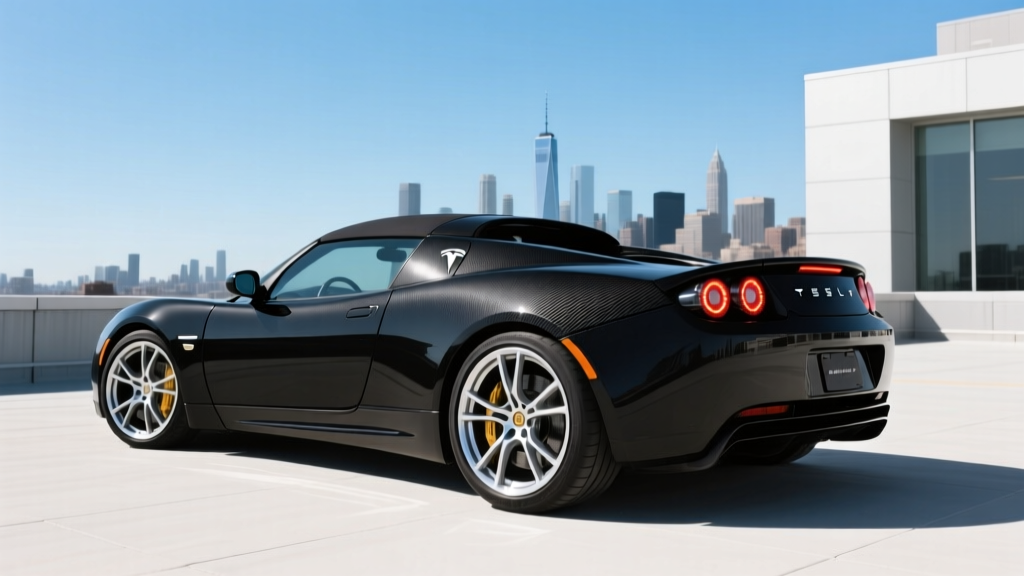
Before the Model S redefined luxury sedans, before the Model 3 brought EVs to the mass market, and long before NACS became an industry standard, there was the 2008 Tesla Roadster. Built on a modified Lotus Elise chassis and powered by a hand-built battery pack of 6,831 laptop-style lithium-ion cells, the original Roadster was the vehicle that forced the entire automotive industry to take electric propulsion seriously. Nearly two decades later, it remains a milestone machine — part collector's item, part engineering artifact, and a fascinating study in how far battery technology has come.
This profile examines the 2008 Tesla Roadster from a 2026 ownership perspective: what its specs mean today, how its battery has aged, what charging looks like on modern infrastructure, and whether this pioneering EV still holds up as a driver's car or a garage investment.
2008 Tesla Roadster: Core Specifications
| Specification | Value |
|---|---|
| EPA-Estimated Range (original) | 244 miles |
| Battery Capacity (usable) | ~53 kWh |
| Battery Chemistry | Lithium Cobalt Oxide (NMC variant, 18650 cells) |
| Motor Output | 288 hp (215 kW) |
| Torque | 295 lb-ft (two-speed) / 273 lb-ft (single-speed, later models) |
| 0–60 mph | 3.7 seconds (Sport) / 3.9 seconds (base) |
| Top Speed | 125 mph (electronically limited) |
| Drivetrain | Rear-wheel drive (single motor) |
| Curb Weight | ~2,723 lbs |
| Original Base MSRP (2008) | $109,000 |
| Production Run | 2008–2012 (~2,450 units built) |
A few notes on these figures: the Roadster's original EPA-equivalent range of 244 miles was remarkable for 2008 — it outdistanced the Nissan Leaf (which wouldn't arrive until 2010 with 73 miles of range) by a factor of three. However, that number came with caveats even when new, and those caveats have only grown more significant as the battery packs have aged.
Real-World Range: What to Expect in 2026
Original EPA estimate: 244 miles
Real-world expectation (new battery, 2010): ~200–220 miles in mixed driving
Real-world expectation (2026, original pack): ~120–170 miles depending on pack health
Cold weather / highway penalty: Expect 20–35% further reduction at 70+ mph or below 40°F
The Roadster's 53 kWh battery pack used a lithium-cobalt chemistry optimized for energy density rather than cycle longevity. Tesla estimated the pack would retain approximately 70% of its original capacity after 100,000 miles or five years — a projection that has proven roughly accurate for well-maintained examples. By 2026, most original Roadsters are running on packs that are 14 to 18 years old, and state of health (SoH) varies enormously depending on storage conditions, charge habits, and whether the pack was replaced under Tesla's battery replacement program.
Owners who stored their Roadsters at moderate state of charge (40–60%) in temperature-controlled environments report packs still delivering 150+ miles. Those who left vehicles plugged in at 100% for extended periods, or who live in hot climates without garage storage, may see usable range closer to 100–120 miles. The Roadster's battery management system (BMS) was pioneering for its era but lacks the sophisticated thermal management of modern packs — there is no active liquid cooling, only air-based thermal regulation.
Charging: J1772, No DC Fast Charging, and Adapter Life
The 2008 Roadster predates the modern DC fast-charging ecosystem entirely. Here is what charging looks like:
| Charging Level | Power (kW) | Time (0–Full) | Notes |
|---|---|---|---|
| Level 1 (120V standard outlet) | ~1.4 kW | ~38–44 hours | Emergency/trickle only |
| Level 2 (240V, Roadster HPC) | ~16.8 kW (70A) | ~3.5 hours | Required Tesla High Power Connector or J1772 adapter |
| Level 2 (240V, standard J1772) | ~6.6–7.2 kW (30–32A) | ~8 hours | With J1772 adapter (included with later models) |
| DC Fast Charging | Not supported | N/A | No CCS, CHAdeMO, or NACS DC capability |
The Roadster uses Tesla's proprietary connector (the predecessor to what eventually evolved into NACS, but physically and electrically incompatible with modern NACS plugs). Tesla provided a J1772 adapter with later production models, and aftermarket adapters remain available. The car's onboard charger accepts up to 16.8 kW on Tesla's High Power Wall Connector (HPWC) — an unusually high Level 2 rate that was possible because the Roadster carries a dual onboard charger setup. On a standard public Level 2 station limited to 32A (7.2 kW), a full charge takes roughly eight hours.
The absence of DC fast charging is the most significant practical limitation for 2026 ownership. This is strictly a car you charge at home or at destinations with Level 2 access. Road trips require meticulous planning around overnight stops — a 300-mile day means at least one extended layover. For a weekend toy or collector car, this is manageable. For daily use beyond a commute, it demands patience.
Performance and Driving Dynamics
The Roadster's 288-horsepower, single-motor rear-drive layout delivers performance that still feels urgent by modern standards. The 3.7-second 0–60 mph time (Sport model) was supercar territory in 2008, and while today's Model S Plaid or Lucid Air Sapphire have moved the goalposts to sub-2-second territory, the Roadster's acceleration remains genuinely thrilling — particularly given its 2,723-pound curb weight.
Early two-speed Roadsters (roughly the first 250 units) used a custom two-speed transmission that proved fragile; Tesla subsequently replaced it with a single-speed reduction gear, which is what most surviving examples carry. The single-speed cars sacrifice a marginal amount of low-end punch but gain significantly in reliability.
The driving experience is raw and analog by modern EV standards. There is no regenerative braking strong enough for one-pedal driving. The steering is unassisted at low speeds (it becomes power-assisted above ~15 mph). The cabin is spartan — Lotus Elise roots are everywhere, from the narrow door sills to the minimal sound insulation. This is a sports car that happens to be electric, not a luxury vehicle with an electric powertrain.
Ownership Economics: Pricing, Collector Value, and Tax Credits
The 2008 Roadster originally retailed for approximately $109,000 (the "Signature" series launched at $120,000). By 2026, the collector market has pushed prices well above original MSRP:
| Condition / Configuration | Approximate Market Price |
|---|---|
| Driver-quality, original pack, high miles | $130,000–$160,000 |
| Excellent condition, good SoH pack | $160,000–$200,000 |
| Low-mileage collector example | $200,000–$275,000+ |
| Original MSRP (2008) | $109,000 |
Federal Tax Credit Eligibility
Under current IRS §30D rules, the federal clean vehicle credit applies only to new vehicles purchased from a dealer, with MSRP caps ($55,000 for sedans, $80,000 for SUVs/trucks/vans), buyer income limits, and battery-sourcing requirements. The 2008 Roadster does not qualify for the new-vehicle credit.
The used clean vehicle credit (up to $4,000 or 30% of sale price, whichever is lower) has its own constraints: the vehicle must be purchased from a dealer (not private party), the sale price must be $25,000 or less, and the vehicle must be at least two model years old. Given that Roadster market prices far exceed the $25,000 cap, the used-EV credit is effectively unavailable for this model. Buyers should budget the full purchase price with no expectation of federal incentives.
Battery Longevity, Replacement, and the Drive Train Warranty
Tesla originally warranted the Roadster's battery for 5 years or 100,000 miles, with a capacity retention threshold of approximately 70%. That warranty expired over a decade ago for every surviving example. Tesla also offered a battery replacement program (sometimes called the "ESS replacement") at approximately $29,000–$35,000 — a figure that, adjusted for inflation and parts scarcity, would likely be higher today if parts are available at all.
The powertrain (motor and power electronics) was warranted for 5 years/100,000 miles as well. The Roadster's AC induction motor is mechanically simple and generally robust; failures are rare. The more common concern is the Power Electronics Module (PEM), which has known failure modes and is expensive to repair or replace given parts scarcity.
For 2026 buyers, the battery question is paramount. A Roadster with a verified high-SoH pack commands a significant premium. Independent EV shops with Roadster experience (there are a small number nationally) can perform cell-level diagnostics and, in some cases, module-level repairs — but this is specialist work, not a dealership service-counter transaction.
Technology, Interior, and What the Roadster Lacks
Evaluated as a 2026 daily driver, the Roadster's technology suite is almost comically minimal:
- Infotainment: A small touchscreen controlling climate, audio, and vehicle settings. No navigation, no Bluetooth audio streaming (on early models), no over-the-air updates.
- Driver Assistance: None. No Autopilot, no adaptive cruise control, no lane-keeping, no automatic emergency braking. This is a SAE Level 0 vehicle — the driver does everything.
- Connectivity: No built-in cellular, no app-based remote monitoring (the original Tesla mobile app provided limited data via a separate telematics module, but service has been inconsistent).
- Cargo: A small front trunk (frunk) offering roughly 5 cubic feet — enough for a weekend bag. No rear storage.
- Seating: Two seats, firmly bolstered, with minimal adjustment. Entry and exit require athleticism due to the wide door sills and low roofline.
These aren't flaws so much as the reality of a 2008 sports car. The Roadster was never designed to compete on technology — it was designed to prove that an electric car could be exciting. On that metric, it succeeded permanently.
- Historic significance — the car that launched the EV revolution
- Genuine sports-car performance (3.7s 0–60, 2,723 lbs)
- Strong and appreciating collector value
- Lotus-tuned chassis dynamics — sharp, communicative handling
- Low running costs if charged at home (no oil, minimal maintenance)
- No DC fast charging — road trips require overnight stops
- Aging battery packs with limited replacement options
- No modern safety or driver-assistance features
- Spartan, cramped interior with difficult ingress/egress
- Parts scarcity and specialist-only service network
- No federal tax credit eligibility at current market prices
Who Should Consider a 2008 Roadster in 2026?
- Choose the 2008 Roadster if: You are an EV enthusiast or collector seeking the most historically significant production electric car ever built. You want a weekend sports car with a compelling story, and you have access to home Level 2 charging plus a specialist mechanic.
- Look elsewhere if: You need a daily driver, require modern safety features, want road-trip capability, or expect a warranty-backed ownership experience. Consider a modern Model 3 Performance, Porsche Taycan, or BMW i4 M50 instead.
The Roadster is best understood as a blue-chip collectible that happens to be drivable. It competes less with modern EVs and more with air-cooled Porsches and low-production sports cars of historical importance. If you're buying one, you're buying a piece of automotive history — the car that convinced the world batteries could outperform gasoline.
Frequently Asked Questions
What is the real-world range of the 2008 Tesla Roadster today?
With an original battery pack in average condition (14–18 years old), expect 120–170 miles in mixed driving. Packs in excellent health can still deliver 180+ miles. Cold weather and sustained highway speeds above 70 mph reduce range by an additional 20–35%.
How fast does the 2008 Roadster charge?
On Tesla's High Power Wall Connector (240V, 70A), the Roadster charges at up to 16.8 kW, reaching a full charge in approximately 3.5 hours. On a standard public Level 2 charger (32A, 7.2 kW), expect roughly 8 hours. There is no DC fast-charging capability — the car cannot use Superchargers, Electrify America, or any CCS/CHAdeMO station.
Does the 2008 Roadster qualify for any federal EV tax credit?
No. The new-vehicle §30D credit does not apply (the car is not new), and the used clean vehicle credit requires a sale price of $25,000 or less from a dealer. Roadster market values of $130,000–$275,000+ far exceed this cap. Consult a tax professional regarding IRS §30D for your specific situation.
Is the 2008 Roadster worth buying versus a modern EV?
As a daily driver or practical EV, no — any modern Model 3, Model Y, or competing EV offers vastly more range, charging speed, safety, technology, and warranty coverage. As a collector vehicle and piece of automotive history, the Roadster occupies a unique position with strong appreciation potential. It competes with classic sports cars, not current EVs.
Can I use a Tesla Supercharger with the 2008 Roadster?
No. The Roadster uses Tesla's original proprietary connector, which is electrically and physically incompatible with the modern NACS Supercharger network. There is no adapter that enables DC fast charging on this vehicle.
What happens if the battery pack fails?
Battery replacement is possible but expensive ($29,000–$40,000+ depending on parts availability) and requires specialist knowledge. Some independent EV shops offer module-level repair as a lower-cost alternative. Given parts scarcity, securing a replacement pack is not guaranteed — factor this risk into any purchase decision.