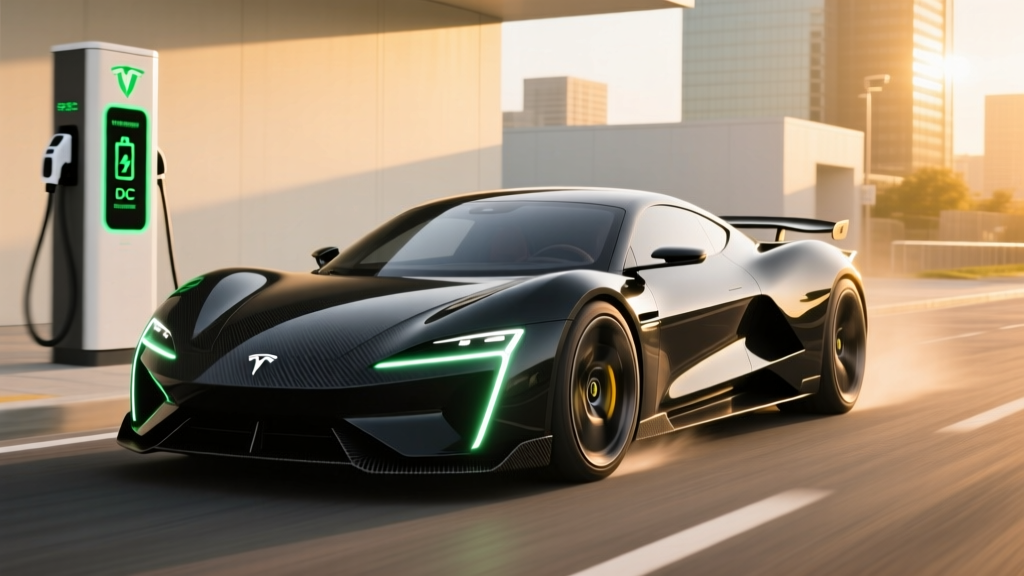
The Tesla Roadster was first announced in 2017 with a single, headline-grabbing claim: a 0-60 mph time of 1.9 seconds. Nearly a decade later, the car still isn't on sale, but Tesla has continued to tease updates — including a 2024 claim that the production version would be "even faster." For buyers and enthusiasts tracking the 0-60 Tesla Roadster benchmark, the question is no longer just about speed; it's about whether the physics, the battery, and the price actually add up when (or if) this car reaches driveways.
This profile compiles every confirmed spec, every executive statement, and every realistic caveat we can apply as of early 2026. Because the Roadster remains an announced, unreleased vehicle, figures below are Tesla's stated targets or well-sourced estimates — not EPA-certified numbers. We'll flag the difference at every step.
Quick Verdict: The Fastest EV Ever Built (On Paper)
If Tesla delivers even 80% of what it has promised, the next-generation Roadster will reset the performance ceiling for production cars. A claimed 1.9-second 0-60 mph, a 200 kWh battery pack, and a 620-mile targeted range would make it simultaneously the quickest and one of the longest-range EVs ever sold. The catch: a base price expected above $200,000, a production timeline that has slipped repeatedly, and engineering challenges around sustaining a 200 kWh pack's weight and thermal load in a two-seat roadster form factor.
Tesla's stated target: 620 miles
Real-world expectation: Plan for 480–540 miles in mixed highway driving at 70–75 mph. At sustained 80+ mph on a road trip, expect closer to 420–460 miles. Cold weather (below 30°F) could reduce usable range by 20–30%, dropping effective range to roughly 350–420 miles before you need a charger.
Tesla Roadster Spec Table: Confirmed and Estimated
| Specification | Stated / Estimated Value | Status |
|---|---|---|
| 0-60 mph | 1.9 seconds (base); <1 sec with SpaceX thruster package (claimed) | Announced target |
| Top Speed | 250+ mph | Announced target |
| Quarter Mile | 8.8 seconds (claimed) | Announced target |
| Drivetrain | Tri-motor AWD (one front, two rear) | Confirmed architecture |
| Horsepower | ~1,000+ hp (estimated from tri-motor output) | Unconfirmed |
| Battery Capacity | 200 kWh (usable) | Announced |
| Battery Chemistry | NMC (nickel manganese cobalt) — expected | Estimated |
| EPA Range (target) | 620 miles | Not EPA-certified |
| Max DC Fast Charge | ~350 kW (estimated, 800V+ architecture) | Estimated |
| 10-80% DC Charge Time | ~25-30 minutes (estimated) | Estimated |
| Level 2 Home Charging | ~11.5 kW / ~34 mi/hr (est. at 48A) | Estimated |
| Body Style | 2-door, 2+2 convertible (removable glass roof) | Confirmed design |
| Base MSRP | $200,000 (Founders Series: $250,000) | Announced pricing |
| Federal Tax Credit (§30D) | Not eligible — exceeds MSRP cap | Confirmed by rule |
Performance Deep Dive: Is a 1.9-Second 0-60 Real?
A 1.9-second 0-60 mph time would beat the Rimac Nevera (1.85s on prepped surface) and the Pininfarina Battista into a tie, while costing roughly a tenth of their price. But context matters. Tesla measured its original 1.9-second claim under optimal conditions — prepped drag strip, warm tires, low state of charge buffer management, and likely a slight downhill grade or rollout adjustment (the industry-standard 1-foot rollout shaves 0.1–0.3 seconds).
On a public road with standard asphalt and ambient conditions, expect real-world 0-60 times closer to 2.2–2.5 seconds — still absurdly quick and faster than any current production Tesla. The tri-motor layout with torque vectoring across the rear axle should deliver exceptional launch traction, and Tesla's Plaid-era motor technology (carbon-sleeved rotors capable of 20,000+ RPM) is proven in the Model S Plaid.
The wild card is the SpaceX cold-gas thruster package, announced as an option that uses compressed air stored in tanks behind the rear seats to push the car down (and forward) during launch. Elon Musk has claimed this could push 0-60 below 1 second. That number is almost certainly a theoretical peak under laboratory-grade conditions, and the safety, regulatory, and practical implications of strapping pressurized gas thrusters to a street car remain unresolved with NHTSA.
Battery, Range, and the 200 kWh Problem
A 200 kWh battery pack is roughly double the capacity of a Tesla Model S Long Range (100 kWh) and larger than the GMC Hummer EV's ~212 kWh Ultium pack. The Hummer weighs over 9,000 pounds. Tesla's original Roadster target weight was approximately 4,400 pounds — a physics challenge that may have contributed to years of delays.
Tesla's 4680 cell format, now in production for the Cybertruck and updated Model Y, offers improved energy density over the older 2170 cells. If the Roadster uses a next-generation 4680 variant with higher nickel content NMC chemistry, a 200 kWh pack weighing roughly 1,500–1,700 pounds becomes plausible, putting total vehicle weight in the 4,800–5,200 pound range. That's heavy for a sports car but manageable for the performance targets.
Energy density improvements also explain how a 620-mile range target is achievable: at roughly 320 Wh/mile (a reasonable figure for an aerodynamic, low-slung sports car with aggressive regen), 200 kWh gets you there on paper. Real-world highway efficiency will likely land between 340–380 Wh/mile depending on speed, temperature, and elevation.
Charging Speed: What 350 kW Means in Practice
| Charging Level | Power (kW) | Estimated Miles Added per Hour | Notes |
|---|---|---|---|
| Level 1 (120V outlet) | 1.4 kW | ~4 mi/hr | Emergency trickle only |
| Level 2 (240V, 48A) | 11.5 kW | ~34 mi/hr | Full overnight charge in ~18 hours |
| Level 2 (240V, 80A) | 19.2 kW | ~57 mi/hr | Requires high-amperage Wall Connector + panel capacity |
| DC Fast Charge (peak) | ~350 kW | ~1,000+ mi/hr (at peak) | Sustained only to ~40% SoC; tapers sharply above 80% |
The critical number for road trips is the 10-80% charge time, which we estimate at 25–30 minutes at a Tesla V4 Supercharger (capable of 350+ kW). A 200 kWh battery charging at a sustained average of ~280 kW from 10-80% would add 140 kWh in 30 minutes — roughly 450 miles of range. That's exceptional, but charging curves are never linear. Expect peak rates near 350 kW only between 10-40% state of charge, tapering to 150 kW by 60%, and below 50 kW past 85%.
Home charging a 200 kWh pack from empty is a commitment. At a standard 11.5 kW Level 2 setup, a full charge takes roughly 17-18 hours. Most owners will charge from 20-80% daily, which takes about 10 hours — fine for overnight, but it means you can't fully "top off" in a single evening if you arrive home nearly empty.
Pricing, Tax Credits, and the $200,000 Question
| Trim | Announced MSRP | §30D Federal Credit | Effective Price |
|---|---|---|---|
| Roadster (base) | $200,000 | $0 (exceeds MSRP cap) | $200,000 |
| Founders Series | $250,000 | $0 | $250,000 |
Under current IRS §30D rules, the federal EV tax credit caps eligible vehicles at an MSRP of $55,000 for sedans and $80,000 for SUVs, trucks, and vans. The Roadster, classified as a passenger car, would need to be priced below $55,000 to qualify — making it categorically ineligible at $200,000+. Buyers at this price point typically don't depend on the $7,500 credit, but it's worth noting for total-cost-of-ownership comparisons.
State incentives vary. Some states offer credits with no MSRP cap (check your local DMV and energy office). Commercial fleet buyers may qualify under §45W, but personal-use buyers will pay full MSRP plus any options, delivery, and applicable luxury taxes.
Interior, Cargo, and Daily Usability
The Roadster is a 2+2, meaning two front seats and two rear seats that are realistically suitable for children or cargo overflow. Based on Tesla's prototype reveals and the proportions of the original 2008 Roadster (which was strictly a two-seater), expect:
- Front legroom: ~42 inches (estimated, sports car proportion)
- Rear legroom: ~26-28 inches (emergency use only)
- Cargo (trunk): ~6-8 cu ft (rear trunk); no frunk expected due to front motor
- Roof: Removable glass panel stored in the trunk (confirmed by Tesla design renders)
This is a weekend car, a collector piece, and a performance statement — not a daily commuter for families. Cargo capacity is roughly equivalent to a Porsche 911's front trunk. The infotainment system will almost certainly use Tesla's current-generation 15-inch landscape touchscreen with AMD Ryzen processor, supporting the full Tesla app ecosystem, streaming, and gaming while parked.
Driver Assistance and Safety Technology
Tesla's Autopilot and Full Self-Driving (Supervised) are Level 2 driver-assistance systems. The driver must remain fully engaged, hands on or near the wheel, eyes on the road, at all times. The Roadster will not be a Level 4 autonomous vehicle — no production Tesla currently is.
The Roadster will ship with Tesla's latest Hardware 4 (or potentially Hardware 5) sensor suite: multiple cameras, enhanced radar or high-fidelity vision-only processing, and the neural network stack powering FSD Supervised. Expect standard features including adaptive cruise control, lane-keeping, automatic emergency braking, and blind-spot monitoring. Whether Tesla offers FSD as a purchase or subscription on the Roadster remains unconfirmed, but given the buyer profile, it will likely be included or bundled.
Warranty Coverage (Expected)
Tesla's current warranty structure for high-performance vehicles provides a reasonable baseline:
- Battery & Drive Units: 8 years / 150,000 miles (minimum 70% capacity retention) — expected for Roadster based on Model S/X precedent
- Vehicle Limited Warranty: 4 years / 50,000 miles
- Roadside Assistance: 4 years / 50,000 miles
Given the Roadster's price, some analysts expect Tesla to offer an enhanced warranty package, potentially including complimentary scheduled service for the first several years, similar to what luxury competitors like Porsche and Rimac provide.
Who Should Buy the Tesla Roadster?
Buy the Roadster if:
- You want the fastest-accelerating production car available, period
- You have $200K+ in discretionary vehicle budget and garage space for a weekend car
- You value being an early adopter of boundary-pushing EV technology
- You already own a practical daily driver and want a halo vehicle
Look elsewhere if:
- You need back-seat usability or meaningful cargo space
- You want a proven, currently purchasable vehicle (the Roadster is not yet on sale)
- You're looking for a luxury grand tourer — the Porsche Taycan, Mercedes AMG GT, or Lotus Eletre offer more refinement today
- Charging infrastructure in your area is limited (a 200 kWh pack is painful to charge on slow public infrastructure)
Roadster vs. Key Competitors
At $200,000+, the Roadster competes in rarefied air. Here's how the stated specs compare to existing hyper-EVs:
| Metric | Tesla Roadster (announced) | Rimac Nevera | Lotus Evija | Model S Plaid |
|---|---|---|---|---|
| 0-60 mph | 1.9s | 1.85s | <3.0s | 1.99s |
| Range | 620 mi (target) | ~340 mi (WLTP) | ~250 mi (WLTP) | 396 mi (EPA) |
| Price | $200,000 | $2,200,000 | $2,300,000 | $89,990 |
| Production | Not yet | 150 units | 130 units | On sale now |
The Roadster's value proposition is offering Nevera-adjacent performance at one-tenth the price — if it ships. The Tesla Roadster product page still accepts reservations, but delivery timelines have been pushed back multiple times.
Pros
- Sub-2-second 0-60 mph (if delivered as claimed)
- 620-mile target range would be the longest of any production EV
- 200 kWh battery enables genuine cross-country road trips with minimal stops
- Tri-motor AWD with torque vectoring for track and street performance
- Tesla Supercharger network access (17,000+ stalls in North America)
- Removable roof panel for open-air driving
Cons
- Not available for purchase — announced since 2017 with repeated delays
- $200,000+ base price with no federal tax credit eligibility
- 200 kWh pack means very long home charging times (17+ hours from empty)
- 2+2 seating is impractical for adults in rear seats
- Minimal cargo space; no front trunk due to motor placement
- Specs remain unverified by independent testing or EPA certification
- SpaceX thruster package raises serious regulatory and safety questions
Frequently Asked Questions
What is the real-world range of the Tesla Roadster?
Tesla targets 620 miles from a 200 kWh battery. Real-world highway driving at 70-75 mph will likely yield 480-540 miles. Cold weather and aggressive driving will reduce that further to roughly 350-420 miles. These figures are estimates — the car has not been EPA-certified.
How fast does the Tesla Roadster charge?
Estimated peak DC fast charging is around 350 kW, with a 10-80% charge time of approximately 25-30 minutes at a V4 Supercharger. Home Level 2 charging at 11.5 kW adds roughly 34 miles per hour, meaning a full charge from empty takes about 17-18 hours.
Does the Tesla Roadster qualify for the federal EV tax credit?
No. Under IRS §30D rules, passenger cars must have an MSRP below $55,000 to qualify for the $7,500 federal tax credit. The Roadster's $200,000 base price makes it categorically ineligible. Always verify current rules at IRS.gov.
Is the Tesla Roadster worth buying vs. competitors?
If you can wait for delivery and want the best performance-to-price ratio in the hypercar segment, the Roadster is theoretically unmatched. But it isn't on sale. If you need a car today, the Model S Plaid ($89,990, 1.99s 0-60, 396 mi range) delivers 90% of the performance at less than half the price — and it's available now.
What are the biggest pros and cons?
The Roadster's biggest strength is its combination of record-breaking performance and class-leading range at a fraction of the cost of European hyper-EVs. Its biggest weakness is that it doesn't exist yet, and its specs remain unverified. Secondary concerns include extremely long home charge times, minimal practicality, and no tax credit.
When will the Tesla Roadster actually ship?
Tesla has not confirmed a firm delivery date as of early 2026. Elon Musk stated in 2024 that the design was "done" and hinted at a reveal of the production version, but Tesla's historical timeline accuracy on new vehicles (Cybertruck was delayed by four years) suggests caution. Reservation holders should treat any announced date as preliminary.
How does the 0-60 Tesla Roadster time compare to the Model S Plaid?
The Roadster's claimed 1.9-second 0-60 is marginally quicker than the Model S Plaid's verified 1.99 seconds. In real-world conditions, both cars will likely deliver 2.1-2.5 second runs depending on surface, temperature, and tire condition. The Roadster's advantage may be more pronounced at higher speeds (quarter-mile and top speed) due to its tri-motor configuration and aerodynamic profile.