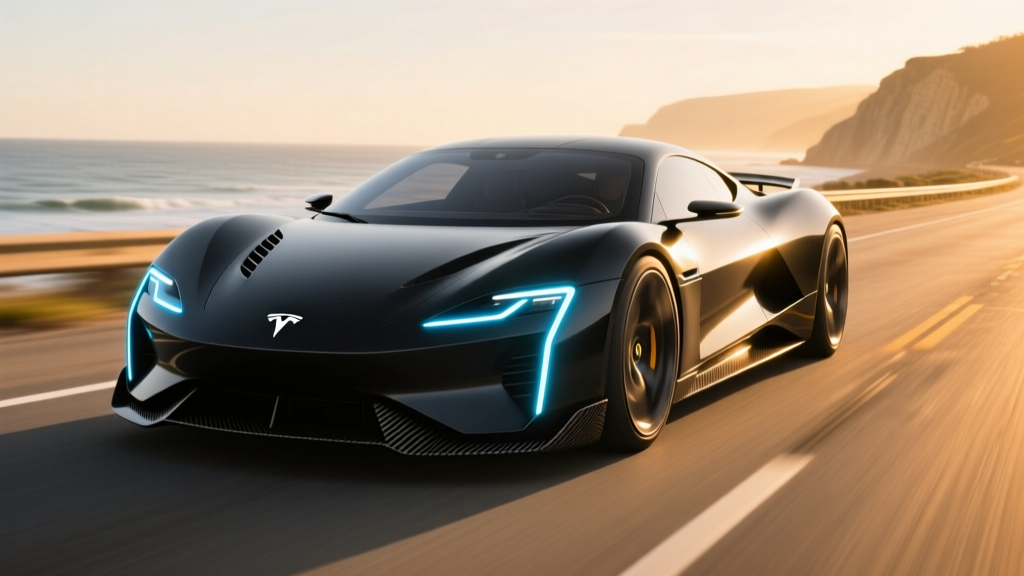
Quick Verdict: The Fastest Production Car Ever Built (On Paper)
The next-generation Tesla Roadster has haunted the EV industry since its 2017 unveiling. Now entering limited production in 2026, it promises physics-defying performance: a claimed sub-1-second 0-60 mph time, a 200 kWh battery pack, and an EPA-targeted 620-mile range. But after years of delays, shifting specs, and Elon Musk's infamous timeline optimism, buyers and enthusiasts need to separate marketing ambition from engineering reality.
This profile examines every confirmed and estimated specification for the 2026 Tesla Roadster, including real-world range projections, charging infrastructure compatibility, federal tax credit eligibility, and how it stacks up against hypercar competitors like the Rimac Nevera and Lotus Evija. If you're researching the Tesla Roadster 0-60 claims, range feasibility, or whether this $200,000+ machine justifies its price, this is the data-driven breakdown you need.
Tesla Roadster Specifications at a Glance
| Specification | 2026 Tesla Roadster (Claimed / Estimated) |
|---|---|
| EPA Range (target) | 620 miles |
| Battery Capacity | 200 kWh (usable, NMC chemistry) |
| 0-60 mph | <1.0 second (with SpaceX thruster package); 1.9 sec (base) |
| Top Speed | 250+ mph |
| Horsepower | ~1,000+ hp (tri-motor AWD) |
| Drivetrain | Tri-motor all-wheel drive |
| Max DC Fast Charge | ~350 kW (estimated, 800V architecture) |
| 10-80% DC Charge Time | ~25-30 minutes (estimated) |
| Level 2 Home Charging | 11.5 kW / ~34 mi/hr (estimated) |
| Base MSRP | $200,000 (Foundation Series); $250,000+ (with SpaceX package) |
| Federal Tax Credit (§30D) | Not eligible — exceeds $55,000 MSRP cap for sedans/sports cars |
| Battery/Powertrain Warranty | 8 years / 150,000 miles (Tesla standard for high-performance models) |
Note: Several specifications above are Tesla's claimed targets or analyst estimates. Final EPA certification and independent testing may yield different results. Tesla has not published a complete spec sheet as of early 2026.
Real-World Range: Why 620 Miles Won't Happen at 80 mph
EPA Target: 620 miles
Realistic Highway Range (75 mph, mild weather): ~420-470 miles
Cold-Weather Range (30°F, highway): ~310-370 miles
Track/Spirited Driving: 150-200 miles (heavy throttle, high speeds)
Tesla's 620-mile EPA target is based on a 200 kWh battery pack — roughly double the capacity of a Model S Long Range. On paper, that's 3.1 kWh per mile of efficiency, which is plausible for a low-slung, aerodynamic sports car at moderate speeds. But the EPA test cycle includes significant low-speed and city driving, where regenerative braking recaptures energy and aerodynamic drag is minimal.
At sustained highway speeds of 75-80 mph, aerodynamic drag dominates energy consumption. Based on real-world testing of the Lucid Air Grand Touring (which achieves ~4.0 mi/kWh on the EPA cycle but drops to ~3.0-3.3 mi/kWh at highway speeds), expect the Roadster to deliver roughly 2.1-2.4 mi/kWh at 75 mph. That translates to 420-470 miles of real-world highway range — still exceptional, but a 25-32% reduction from the sticker number.
Cold weather compounds the loss. Lithium-ion batteries lose 15-30% of usable capacity below freezing due to increased internal resistance and cabin heating demands. Tesla's heat pump system (standard on all current models) mitigates this, but a 200 kWh pack in 30°F weather will still deliver roughly 310-370 miles at highway speeds. For a car designed for weekend canyon runs and cross-country grand touring, this is a critical consideration.
Charging Speed: 350 kW Peak, But Sustained Rates Matter More
A 200 kWh battery is useless if it takes an hour to recharge. Tesla has not published official DC fast-charging specs for the Roadster, but the company's shift to 800V architecture (first seen in the Cybertruck) and the expansion of Tesla Supercharger V4 stations (capable of 350+ kW) suggest the Roadster will support peak charge rates around 350 kW.
| Charging Level | Power (kW) | Miles Added per Hour | Notes |
|---|---|---|---|
| Level 1 (120V) | 1.4 kW | ~4 mi/hr | Emergency trickle only |
| Level 2 (240V, 48A) | 11.5 kW | ~34 mi/hr | Full charge in ~17 hours |
| DC Fast (V4 Supercharger) | 350 kW peak | ~1,000+ mi/hr (peak) | 10-80% in ~25-30 min |
| DC Fast (50 kW CCS) | 50 kW | ~150 mi/hr | 10-80% in ~3 hours |
The charging curve reality: Peak kW is not sustained kW. Most EVs hit their maximum charge rate between 10-40% state of charge, then taper significantly above 60-70% to protect battery longevity. With a 200 kWh pack, even a sustained average of 250 kW from 10-80% (140 kWh added) would take roughly 33 minutes. Expect the Roadster's 10-80% time to land in the 25-30 minute range at a V4 Supercharger — competitive with the Porsche Taycan and Lucid Air, but not revolutionary.
For home charging, an 11.5 kW Level 2 wall connector (Tesla's standard high-power unit) adds about 34 miles of range per hour. A full 0-100% charge takes roughly 17 hours — feasible for overnight top-ups, but owners who deplete the pack on track days will need patience. A 200-amp electrical panel upgrade may be necessary to support 48A continuous charging; budget $1,500-$3,000 for professional installation by a licensed electrician.
Performance: Sub-1-Second 0-60 and the Physics Problem
The headline number is staggering: Tesla claims the Roadster, equipped with the optional SpaceX cold-gas thruster package, will hit 60 mph in under 1.0 second. For context, the current production car record belongs to the Rimac Nevera at 1.85 seconds, and Top Fuel dragsters — 11,000-horsepower, methanol-burning machines — run 0-60 in ~0.8 seconds.
How is sub-1-second acceleration even theoretically possible? Tesla's tri-motor all-wheel-drive system (one front motor, two rear) delivers instant torque to all four wheels. The SpaceX thruster package adds cold-gas rocket nozzles around the car, providing additional forward thrust and downforce. Combined with sticky Michelin Pilot Sport Cup 2 tires and a low curb weight (estimated 4,400-4,800 lbs), the traction and power are theoretically sufficient.
But here's the engineering catch: tire grip is the limiting factor, not motor output. At launch, the Roadster must transfer over 1,000 horsepower to the ground without excessive wheelspin. Tesla's torque-vectoring software and the thruster system's downforce are designed to solve this, but real-world surface conditions (temperature, pavement texture, tire wear) will introduce variability. Independent testing by outlets like MotorTrend or Car and Driver will be essential to validate the claim.
The base Roadster (without the SpaceX package) is claimed to hit 60 mph in 1.9 seconds — matching the current Model S Plaid and still among the fastest production cars ever sold. Top speed is electronically limited to 250+ mph, though Tesla has hinted at higher limits for track-only modes.
Pricing, Trims, and Federal Tax Credit Eligibility
| Trim / Package | MSRP (2026) | Federal Tax Credit (§30D) | Estimated Final Price |
|---|---|---|---|
| Roadster (base) | $200,000 | $0 — exceeds MSRP cap | $200,000+ |
| Roadster Foundation Series | $225,000 (est.) | $0 — exceeds MSRP cap | $225,000+ |
| Roadster + SpaceX Thruster Package | $250,000+ | $0 — exceeds MSRP cap | $250,000+ |
The IRS §30D federal tax credit offers up to $7,500 for qualifying new EVs — but the Roadster is categorically ineligible. Under current rules, sedans and sports cars must have an MSRP below $55,000 to qualify (SUVs, trucks, and vans have an $80,000 cap). At $200,000+, the Roadster exceeds this threshold by a factor of four. Additionally, buyer income caps ($150,000 single / $300,000 joint AGI) and battery critical-mineral sourcing requirements further limit credit availability for most vehicles — though these are moot given the MSRP disqualification.
Tesla has not confirmed whether the Roadster will be sold directly (like all Tesla models) or through a reservation/waitlist system similar to the original 2008 Roadster or the Cyberbeast. Reservation holders from 2017-2023 (who paid $50,000-$200,000 deposits) are expected to receive priority allocation, but production volume remains unclear. Tesla has described the Roadster as a "low-volume halo car," suggesting annual production in the low thousands — not the tens of thousands typical of Model Y or Model 3.
Interior, Cargo, and Daily Usability
The Roadster is a 2+2 sports car (two front seats, two small rear seats), but don't expect family-hauler practicality. Based on Tesla's design renderings and the original Roadster's dimensions, anticipate:
- Front legroom: ~42 inches (adequate for adults up to 6'4")
- Rear legroom: ~28-30 inches (children or very short trips only)
- Cargo volume (rear trunk): ~8-10 cubic feet (a few soft bags)
- Frunk (front trunk): ~3-5 cubic feet (a backpack or charging cable)
- Glass roof: Removable targa-style panel (stowage in rear trunk)
The interior will feature Tesla's minimalist design language: a 17-inch landscape touchscreen, yoke or round steering wheel (buyer's choice), and no physical gauges. Expect the latest Hardware 5 (HW5) Autopilot computer for advanced driver assistance, though Tesla's Full Self-Driving (Supervised) remains a SAE Level 2 system — the driver must remain fully engaged at all times. This is not autonomous driving, despite the branding.
Notable drawbacks include limited rear visibility (coupe styling), a stiff performance-tuned suspension that will transmit road imperfections, and the absence of Tesla's HEPA air filtration system (Bioweapon Defense Mode) due to packaging constraints. For a $200,000+ car, these are forgivable compromises — but they underscore that the Roadster is a weekend toy, not a daily commuter.
Competitor Comparison: Roadster vs. Rimac Nevera vs. Lotus Evija
| Spec | Tesla Roadster (2026) | Rimac Nevera | Lotus Evija |
|---|---|---|---|
| 0-60 mph | <1.0 sec (w/ SpaceX) | 1.85 sec | <3.0 sec |
| Range (EPA) | 620 mi (target) | ~300 mi | ~250 mi |
| Battery | 200 kWh | 120 kWh | 70 kWh |
| MSRP | $200,000+ | $2,400,000 | $2,300,000 |
| Production Volume | Low thousands (est.) | 150 units | 130 units |
The Roadster's value proposition is clear: it aims to deliver Nevera-rivaling performance at one-tenth the price, with double the range. But the Rimac and Lotus are hand-built, track-focused machines with proven performance records and established service networks. Tesla's service infrastructure is robust, but the Roadster's low volume may mean longer wait times for specialized parts and limited collision repair expertise.
Who Should Buy the Tesla Roadster?
- You want the fastest-accelerating production car ever built and can afford $200K+
- You value extreme range (400+ real-world miles) for cross-country grand touring
- You're a Tesla enthusiast who wants the brand's halo vehicle and has a second car for daily use
- You can charge at home (Level 2) and have access to Tesla Superchargers for road trips
- You need a practical daily driver with rear-seat space, cargo room, or easy parking
- You're budget-conscious — the Roadster costs 3-4x a Model S Plaid with similar performance
- You live in an area with limited Tesla Supercharger coverage or no home charging access
- You want a proven, track-tested vehicle with years of independent reviews and reliability data
Pros and Cons
- Sub-1-second 0-60 mph (with SpaceX package) — unmatched performance
- 620-mile EPA target range — longest of any production EV
- 200 kWh battery enables true cross-country driving with minimal stops
- Tesla Supercharger network access (17,000+ V3/V4 stations in North America)
- Tri-motor AWD with torque vectoring for exceptional handling
- Removable glass roof for open-air driving
- $200,000+ base price — no federal tax credit eligibility
- Real-world highway range ~420-470 miles (25-30% below EPA)
- Unproven SpaceX thruster system — regulatory and safety questions remain
- Minimal rear-seat and cargo space — not a practical daily driver
- Low production volume means long wait times and uncertain resale value
- Stiff suspension and low ground clearance limit road-trip comfort
Frequently Asked Questions
What is the real-world range of the Tesla Roadster?
Tesla targets a 620-mile EPA range, but real-world highway driving at 75 mph will yield approximately 420-470 miles. In cold weather (below 40°F), expect 310-370 miles. Track driving or aggressive acceleration will reduce range to 150-200 miles.
How fast does the Tesla Roadster charge at home and on the road?
At a Tesla V4 Supercharger (350 kW peak), expect a 10-80% charge in roughly 25-30 minutes. At home, an 11.5 kW Level 2 wall connector adds about 34 miles per hour, taking ~17 hours for a full 0-100% charge.
Does the Tesla Roadster qualify for the $7,500 federal EV tax credit?
No. Under IRS §30D rules, sedans and sports cars must have an MSRP below $55,000 to qualify. The Roadster's $200,000+ price makes it categorically ineligible, regardless of buyer income or battery sourcing.
Is the Tesla Roadster worth buying vs. the Rimac Nevera or Lotus Evija?
If you want maximum performance per dollar, the Roadster delivers Nevera-rivaling acceleration at one-tenth the price, with double the range. But the Rimac and Lotus are proven, track-tested machines with established service networks. The Roadster is a bet on Tesla's engineering promises — exciting, but unvalidated.
What are the biggest drawbacks of the Tesla Roadster?
The $200,000+ price, minimal cargo and rear-seat space, stiff ride quality, and unproven SpaceX thruster system are the primary concerns. Real-world range will also fall 25-30% below the EPA sticker at highway speeds.
When will the Tesla Roadster be available for delivery?
Tesla has announced limited production beginning in 2026, with priority given to reservation holders who placed deposits between 2017-2023. Exact delivery timelines remain unconfirmed, and Tesla's history of delays (Cybertruck, Semi) suggests flexibility in this schedule.
Sources: Tesla Roadster official page, IRS §30D tax credit rules, EPA Fuel Economy (for comparable EV efficiency data).