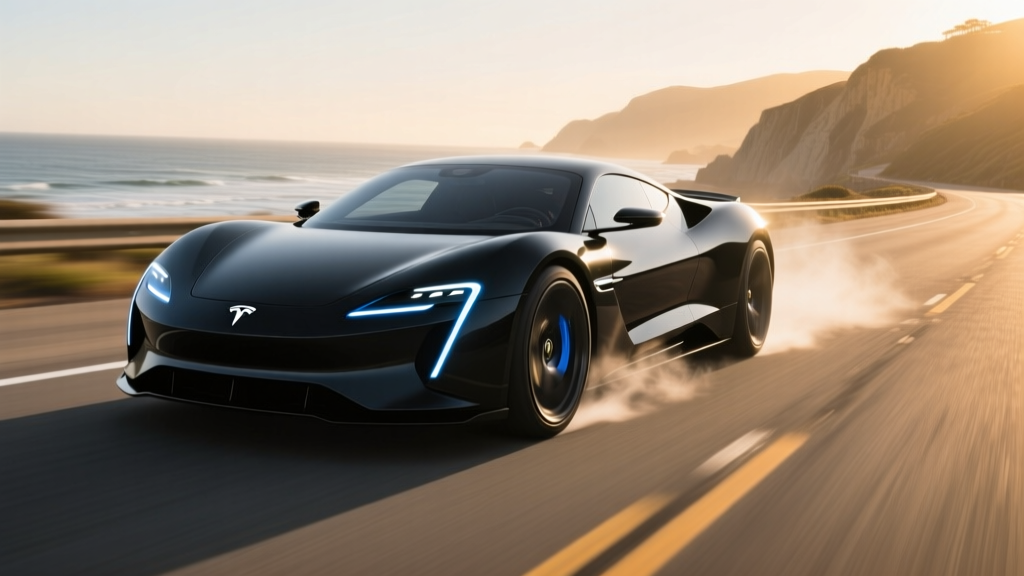
The Tesla Roadster has lived in the "announced but not yet shipping" category since Elon Musk first pulled the covers off the second-generation model in November 2017. As of early 2026, Tesla has reiterated a production target but has not confirmed deliveries to retail buyers. Every specification below reflects Tesla's most recently published figures and statements — treat them as preliminary until independent EPA testing and third-party track validation exist. If you are researching the Tesla Roadster 0-60 mph claim and what it actually means for a street-legal production car, this profile breaks down the physics, the caveats, and the ownership math.
Tesla Roadster 0-60 MPH: The 1.9-Second Claim Explained
Tesla's headline figure for the next-gen Roadster is a 0-60 mph time of 1.9 seconds (with the optional SpaceX cold-gas thruster package). Without that package, Tesla has referenced a 0-60 time in the low 2-second range. For context, the Bugatti Chiron Super Sport hits 60 mph in roughly 2.3 seconds, and the Rimac Nevera — currently the benchmark for production EV acceleration — clocks 1.74 seconds under controlled conditions.
Several engineering realities frame that 1.9-second number:
- Tire traction limits: Sub-2-second 0-60 times require specialized tires, a prepped surface, and optimal battery temperature. Real-world street launches on standard asphalt typically add 0.2–0.5 seconds.
- Thruster package dependency: The 1.9-second figure is tied to the SpaceX cold-gas thruster option, which uses compressed air to increase downforce and traction. This package has never been demonstrated on a production vehicle delivered to a customer.
- One-foot rollout: Like most manufacturer-published 0-60 times, Tesla's figure likely includes a one-foot rollout (subtracting the first ~0.3 seconds of movement). Drag-strip convention, but worth noting when comparing to independently timed results.
- Tri-motor AWD: The Roadster uses a tri-motor all-wheel-drive layout — one motor on the front axle, two on the rear — to vector torque and maximize grip off the line.
| Specification | Value |
|---|---|
| 0-60 mph | 1.9 sec (with thruster pkg); ~2.1 sec (base) |
| Top Speed | 250+ mph |
| Quarter Mile | 8.8 sec (claimed) |
| Horsepower | ~1,000+ hp (tri-motor combined, estimated) |
| Drivetrain | Tri-Motor AWD |
| Battery Capacity | 200 kWh (claimed usable) |
| Battery Chemistry | Not disclosed (likely NMC/NCA high-energy) |
| EPA Range (Est.) | 620 miles (manufacturer claim, unverified by EPA) |
| Max DC Fast Charge | ~350 kW (preliminary) |
| 10-80% DC Charge Time | Not published (est. 25-35 min at 350 kW) |
| Level 2 Home Charge | ~11.5 kW / 48A (est. 30-35 mi/hr) |
| Seating | 2+2 (rear seats best for cargo/children) |
| Cargo (rear + frunk) | Not published (est. 6-8 cu ft combined) |
| Base MSRP (Reservation) | $200,000 (base); $250,000 (Founders Series) |
| Federal Tax Credit | Ineligible (MSRP exceeds §30D sports-car cap) |
| Battery Warranty | Not published (est. 8 yr / 150,000 mi based on Tesla precedent) |
Range Reality: 620 Miles Claimed vs. What to Expect
EPA Range (Claimed): 620 miles
Real-World Expectation: 480–540 miles (mixed driving); 400–450 miles (sustained 80+ mph highway); significantly less in sub-freezing temperatures.
Tesla's 620-mile figure would shatter every production EV record if validated by the EPA. For reference, the Lucid Air Grand Touring currently holds one of the highest EPA-verified ranges at 516 miles from a 112 kWh battery pack.
Why the skepticism about 620 miles?
- Battery mass penalty: A 200 kWh NMC pack would weigh roughly 1,800–2,200 lbs alone. That mass increases rolling resistance and reduces efficiency at highway speeds, partially offsetting the capacity advantage.
- Aerodynamic drag at speed: Roadsters prioritize styling over the ultra-low drag coefficients of sedans like the Lucid Air (Cd 0.197). At 75 mph, aero drag dominates energy consumption.
- Cold-weather impact: NMC chemistry loses 20–30% of usable range in sub-30°F conditions without aggressive battery preconditioning. A 620-mile pack in January in Minnesota might deliver 430–470 miles.
- Driving style: A car with 1,000+ hp invites aggressive acceleration, which consumes energy at multiples of the rated efficiency.
If the Roadster achieves even 500 EPA-verified miles, it would still lead the market. But buyers should plan charging stops around a 400–450 mile real-world highway envelope for road-trip comfort — especially given the charging-curve taper discussed below.
Charging Speed: What 200 kWh Means at the Plug
Charging a 200 kWh battery is fundamentally different from charging a 75 kWh pack, even at high power. Tesla has not published official charging-curve data for the Roadster, but we can extrapolate from the Model S Plaid and Cybertruck's 800V-class architecture.
| Charging Level | Power | Approx. Miles Added per Hour | Notes |
|---|---|---|---|
| Level 1 (120V) | ~1.4 kW | ~3-4 mi/hr | Emergency/trickle only; full charge in ~6 days |
| Level 2 (240V, 48A) | 11.5 kW | ~30-35 mi/hr | Full charge in ~18 hours; overnight top-up viable |
| DC Fast (V3 Supercharger) | 250 kW peak | ~750 mi/hr (at peak) | 10-80% est. 30-40 min; taper above 80% |
| DC Fast (V4 / 350 kW) | 350 kW peak | ~1,050 mi/hr (at peak) | 10-80% est. 25-30 min; requires V4 cabinet |
The charge-curve reality: Peak kW is not sustained kW. Even at 350 kW, the Roadster's 200 kWh pack would likely hold peak rate only between roughly 10–40% state of charge before tapering to ~200 kW, then ~120 kW, then ~50 kW above 85%. The 10-80% time is the meaningful metric, and for a pack this large, expect 25–40 minutes at a V3/V4 Supercharger — longer than a Model Y but proportionally faster per mile added.
Home charging practicality: At 11.5 kW (48 amps on a NEMA 14-50 or hardwired Wall Connector), you'd add roughly 30–35 miles of range per hour. Overnight charging from 20% to 80% would take approximately 10–12 hours. Most owners will need to install a dedicated 60-amp circuit; consult a licensed electrician to verify your panel can support this load alongside other household circuits.
Performance, Drivetrain & Handling
Beyond the headline 0-60 number, the Roadster's tri-motor AWD system is designed for continuous power delivery, not just launch. Tesla has claimed:
- Quarter mile: 8.8 seconds — which would place it among the fastest production cars ever timed.
- Top speed: 250+ mph, electronically governed.
- Torque vectoring: Independent rear motors enable active torque vectoring across the rear axle, improving cornering agility beyond what a conventional limited-slip differential achieves.
The handling question remains open. Tesla's vehicles have historically prioritized straight-line performance over track-day balance. The Roadster's low center of gravity (200 kWh pack mounted in the floor) should help, but 4,400+ lbs of curb weight is a physics challenge no amount of software can fully overcome. Compare this to the Lotus Evija (~4,160 lbs, 1,972 hp) or Rimac Nevera (~4,740 lbs, 1,914 hp), which use extensive carbon-fiber construction to offset battery mass.
Tesla has also referenced active aerodynamics and the optional cold-gas thruster system for increased downforce. Neither has been independently validated on a customer-delivered vehicle.
Pricing, Trim Levels & Tax Credit Reality
| Trim / Configuration | MSRP | §30D Federal Tax Credit | Effective Price |
|---|---|---|---|
| Base Roadster | $200,000 | $0 (exceeds sports-car MSRP cap) | $200,000 |
| Founders Series | $250,000 | $0 (exceeds sports-car MSRP cap) | $250,000 |
| SpaceX Thruster Package | TBD (add-on) | $0 | TBD |
Under IRS §30D rules, the federal clean vehicle credit caps eligible sports cars at an $80,000 MSRP (sedans/SUVs/trucks at $55,000/$80,000 respectively). The Roadster at $200,000+ is ineligible regardless of battery sourcing or buyer income. Additionally, buyer income limits ($150K single / $300K joint AGI) would disqualify some prospective buyers even if the MSRP cap didn't apply.
Reservation status: Tesla has accepted $50,000 refundable deposits for the Roadster since 2017, with a $5,000 initial reservation and $45,000 to secure a Founders Series build slot. As of 2026, Tesla has not confirmed a firm delivery timeline. Reservation holders should treat their deposit as speculative — Tesla's production timelines have historically shifted by years.
Tech, Interior & Driver Assistance
Tesla has been sparse on interior details, but based on the current Tesla technology stack and what's visible in prototype sightings:
- Infotainment: Expect a 15–17-inch center touchscreen running Tesla's latest vehicle software, with over-the-air updates, streaming, and gaming capability.
- Driver assistance: Tesla's Autopilot (adaptive cruise + lane centering) will be standard. Full Self-Driving (Supervised) will likely be available as a paid add-on. Important: FSD Supervised is an SAE Level 2 system — the driver must remain fully engaged and hands-on at all times. It is not autonomous driving.
- Glass roof: Prototype images show a full glass canopy roof, consistent with Tesla's design language.
- Removable roof panel: Tesla has referenced a stowable glass roof panel, similar to the original Roadster and Corvette targa-top configuration.
- Rear seats: The 2+2 layout means the rear seats are best suited for children or additional cargo — not adult passengers on long trips.
Notable drawbacks to anticipate:
- Limited cargo space (sports car form factor)
- Likely firm ride quality given performance suspension tuning
- Visibility compromises from the low-slung, aerodynamic body
- No confirmed towing capacity (not a towing vehicle)
- Insurance premiums on a $200K+ EV with 1,000+ hp will be substantial — expect $500–$1,000+/month depending on driver profile and state
Who Should (and Shouldn't) Buy the Tesla Roadster
Pros
- Potential class-leading 0-60 mph and quarter-mile performance
- 620-mile claimed range (if validated, market-leading by 100+ miles)
- Tri-motor AWD with torque vectoring
- Access to Tesla Supercharger network (20,000+ stalls in North America)
- Over-the-air software updates and Tesla's tech ecosystem
- Halo-car status and likely strong initial resale value
Cons
- Not yet in production — delivery timeline remains uncertain
- $200,000+ MSRP with no federal tax credit eligibility
- Specs are manufacturer claims, not EPA-verified or independently tested
- Thruster package (required for 1.9-sec 0-60) is unproven on production vehicles
- Heavy curb weight likely limits track-day agility vs. lighter supercars
- Minimal cargo and rear-seat practicality
- Insurance costs will be extreme
The Roadster is for: High-net-worth enthusiasts who want an electric halo car, are comfortable with Tesla's history of production delays, and value straight-line performance above all else. It is a weekend car, a statement vehicle, and a technology showcase — not a daily commuter or family hauler.
The Roadster is NOT for: Buyers who need a confirmed delivery date, verified EPA range, practical cargo space, or tax-credit-assisted pricing. If you want a fast, available Tesla today, the Model S Plaid delivers 1,020 hp, a 1.99-second 0-60 (with rollout), and 396 miles of EPA range starting around $89,990 — and you can actually take delivery.
Competitor Comparison: Roadster vs. Available Electric Supercars
| Spec | Tesla Roadster (Claimed) | Rimac Nevera | Lotus Evija | Tesla Model S Plaid |
|---|---|---|---|---|
| 0-60 mph | 1.9 sec | 1.74 sec | ~2.8 sec (est.) | 1.99 sec |
| Horsepower | ~1,000+ | 1,914 | 1,972 | 1,020 |
| Range | 620 mi (claimed) | 340 mi (WLTP) | 217 mi (WLTP) | 396 mi (EPA) |
| Battery | 200 kWh | 120 kWh | 70 kWh | ~100 kWh |
| Price | $200,000+ | ~$2,200,000 | ~$2,300,000 | ~$89,990 |
| Availability | Not in production | Limited (150 units) | Limited (130 units) | In production |
The Roadster's claimed value proposition is radical: supercar performance at one-tenth the price of a Rimac or Lotus. The catch is availability. The Rimac Nevera and Lotus Evija are real, delivered, independently tested vehicles — at ten times the price. The Model S Plaid is the pragmatic alternative: nearly as quick, actually purchasable, and under the $80K sports-car MSRP cap (though the Plaid also currently falls above the cap at its MSRP, making it ineligible for §30D as well).
Frequently Asked Questions
What is the real-world range of the Tesla Roadster?
Tesla claims 620 miles, but this figure has not been verified by the EPA. Based on the physics of a heavy, high-performance sports car with a 200 kWh NMC pack, expect 480–540 miles in mixed driving, 400–450 miles at sustained highway speeds, and 20–30% less in cold weather. Even at the lower end, this would be class-leading.
How fast does the Tesla Roadster charge?
Tesla has not published official charging specs. Based on the Supercharger V3/V4 network, expect peak rates around 250–350 kW DC, with a 10–80% charge time of approximately 25–40 minutes. Home Level 2 charging at 11.5 kW would add roughly 30–35 miles per hour, requiring 10–12 hours for a 20–80% charge.
Does the Tesla Roadster qualify for the federal EV tax credit?
No. Under IRS §30D rules, sports cars must have an MSRP at or below $80,000 to qualify. The Roadster starts at $200,000, making it ineligible regardless of battery sourcing or buyer income. Consult a tax professional for your specific situation, and review current rules at IRS.gov.
Can I buy a Tesla Roadster right now?
No. As of 2026, the next-generation Tesla Roadster is not in production and is not available for purchase. Tesla has accepted $50,000 refundable deposits since 2017 but has not confirmed a firm delivery date. All specifications remain preliminary and subject to change.
Is the Tesla Roadster worth waiting for vs. buying a Model S Plaid?
If you need a vehicle today, the Model S Plaid offers 1,020 hp, a 1.99-second 0-60, 396 miles of EPA range, and immediate availability at ~$89,990. The Roadster promises more range and a lower price than European electric hypercars, but with no confirmed timeline. Waiting means betting on Tesla's execution; buying a Plaid means accepting a proven, available product.
What is the SpaceX thruster package on the Roadster?
Tesla has described an optional cold-gas thruster system developed with SpaceX that uses compressed air to increase downforce and traction, enabling the claimed 1.9-second 0-60 time. This technology has never been deployed on a production road vehicle and its legality, safety, and practicality for street use remain unproven.
What battery chemistry will the Roadster use?
Tesla has not disclosed the Roadster's battery chemistry. Given the 200 kWh capacity target and performance requirements, a high-nickel NMC (nickel-manganese-cobalt) or NCA (nickel-cobalt-aluminum) formulation is most likely. LFP (lithium iron phosphate) chemistry is unlikely due to its lower energy density, which would make a 200 kWh pack prohibitively heavy.
Disclaimer: The Tesla Roadster (next-generation) is an announced vehicle that is not yet in production or available for purchase as of 2026. All specifications cited are preliminary manufacturer claims and have not been independently verified by the EPA, NHTSA, or third-party testing organizations. Pricing, features, and availability are subject to change. Verify current tax-credit eligibility at IRS.gov and consult a tax professional before making purchase decisions based on incentive assumptions.