What Is Tesla's Regenerative Brake System?
Every Tesla sold today — from the refreshed Model 3 Highland to the Model Y Juniper and Cybertruck — uses a regenerative braking system that converts kinetic energy back into electrical energy during deceleration. Unlike traditional friction brakes that waste momentum as heat, Tesla's regen captures that energy and feeds it back into the traction battery, extending range and reducing brake-pad wear.
If you're searching for tesla regenerative brake settings or wondering why your Tesla slows aggressively when you lift off the accelerator, you're experiencing what Tesla calls one-pedal driving. In 2026, Tesla has standardized regen behavior across its lineup: there is no user-adjustable regen strength toggle in most models. The system is tuned for maximum energy recovery by default, and understanding how it works is essential for new owners and prospective buyers alike.
How Regenerative Braking Works in a Tesla
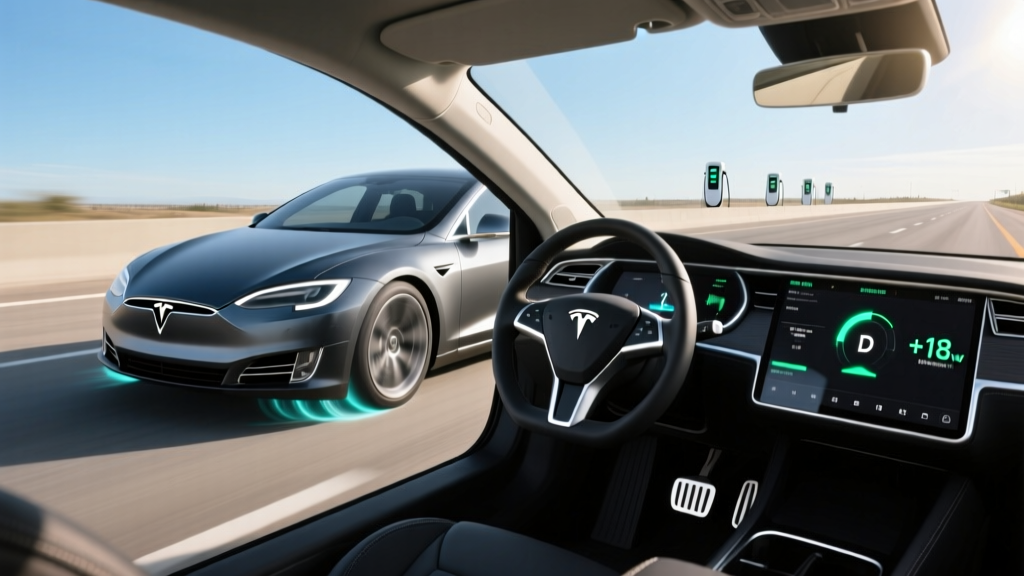
When you lift your foot off the accelerator pedal, the electric motor reverses its role. Instead of consuming electricity to spin the wheels, it acts as a generator — the wheels spin the motor, which produces electricity that flows back into the battery pack. This electromagnetic resistance creates a deceleration force that slows the vehicle without the friction brakes engaging.
Tesla's regen system is notably aggressive compared to some competitors. The deceleration force can reach approximately 0.2g to 0.3g depending on speed and battery state of charge (SoC), which is strong enough to bring the car to a complete stop in most city-driving scenarios without touching the brake pedal.
When Regen Is Reduced or Disabled
Regenerative braking is not always available at full strength. Several conditions limit its effectiveness:
- Cold battery: When the battery is cold (below ~50°F / 10°C), the system cannot accept charge as quickly. You'll see a dotted or dashed line on the energy bar in the Tesla app or instrument display indicating limited regen. Preconditioning the battery — by navigating to a Supercharger or using Scheduled Departure — mitigates this.
- High state of charge: At 100% SoC, the battery has nowhere to put recovered energy. Regen is significantly reduced until you've driven a few miles and dropped below ~98%. This is why Tesla recommends daily charging to 80% for NMC batteries and 100% for LFP batteries (which tolerate full charges better).
- Battery buffer and thermal limits: During extreme heat or sustained high-speed driving, thermal management may temporarily reduce regen acceptance rates to protect the pack.
Regen Across the 2026 Tesla Lineup: Model 3, Model Y, and Cybertruck
Tesla does not publish separate regen specifications by model — the system is integrated into each vehicle's motor controller and battery management system (BMS). However, the driving experience varies based on vehicle mass, motor configuration, and battery chemistry. Here's how the core specs compare across the three highest-volume models:
| Spec | Model 3 Long Range AWD | Model Y Long Range AWD | Cybertruck AWD |
|---|---|---|---|
| EPA Range | 363 mi | 320 mi | 340 mi |
| Battery (usable) | ~79 kWh (NMC) | ~78 kWh (NMC) | ~123 kWh (NMC) |
| Efficiency | 132 MPGe / 25 kWh/100mi | 122 MPGe / 27 kWh/100mi | 112 MPGe / 30 kWh/100mi |
| Max DC Fast Charge | 250 kW | 250 kW | 350 kW |
| 10–80% DCFC Time | ~25 min | ~27 min | ~18 min |
| Level 2 Home Charge | 11.5 kW (~44 mi/hr) | 11.5 kW (~44 mi/hr) | 11.5 kW (~37 mi/hr) |
| 0–60 mph | 4.2 sec | 4.8 sec | 4.1 sec |
| Horsepower | 346 hp | 384 hp | 600 hp |
| Drivetrain | Dual-Motor AWD | Dual-Motor AWD | Dual-Motor AWD |
| Cargo Space | 23 cu ft (trunk + frunk) | 76 cu ft (max) | ~67 cu ft (vault + frunk) |
| Base MSRP | $47,740 | $48,990 | $79,990 |
| Battery/Drive Unit Warranty | 8 yr / 120,000 mi | 8 yr / 120,000 mi | 8 yr / 150,000 mi |
Source: EPA / fueleconomy.gov, Tesla.com. Specs reflect 2025–2026 model year data.
Does Regenerative Braking Actually Extend Your Range?
Yes — but the magnitude depends heavily on your driving environment. In stop-and-go city traffic, regen can recover a meaningful percentage of kinetic energy that would otherwise be lost. Tesla's onboard energy app shows real-time regen contributions; on urban routes, it's common to see 15–30% of energy consumed being returned via regeneration.
On the highway, regen plays a smaller role. Most energy is spent overcoming aerodynamic drag at speed, and there are few deceleration events to recapture. This is why Tesla's efficiency advantage over competitors — driven partly by low drag coefficients (Model 3 at ~0.219 Cd) and heat-pump HVAC — matters more on road trips than regen alone.
Regen vs. Coasting: The Efficiency Debate
Some EV hypermilers argue that coasting in neutral (or with regen turned off, as some competitors allow) is more efficient than regen because each energy conversion (kinetic → electrical → chemical → electrical → kinetic) incurs losses. This is technically true in a physics sense — every conversion has inefficiency. However, in real-world driving with traffic signals, speed changes, and stops, the alternative to regen is friction braking, which recovers zero energy. Tesla's decision to maximize regen by default is the correct call for nearly all drivers.
Driving With Tesla Regen: Adaptation and Tips
New Tesla owners frequently report that the regen feels jarring for the first few days. The deceleration upon liftoff is immediate and strong — stronger than most other EVs from Hyundai, Ford, or BMW, which offer adjustable regen levels or paddles. Here's how to adapt:
- Modulate, don't stomp: Treat the accelerator as a speed dial. Slight lifts reduce speed gradually; full lifts engage maximum regen. You'll learn the "sweet spot" within a week.
- Anticipate stops: Begin lifting 200–300 feet before a red light. With practice, you'll time it so the car creeps to a stop without touching the brake pedal.
- Hold mode vs. Roll mode: In Settings > Driving > Stopping Mode, "Hold" keeps the car stationary at a stop without brake-pedal input (the car auto-holds). "Roll" lets it creep like an automatic transmission. Most one-pedal enthusiasts prefer Hold.
- Winter caution: On icy roads, aggressive regen on a single axle can induce instability. Tesla's traction control mitigates this, but consider reducing speed and increasing following distance. The friction brakes remain available for emergency stops.
Brake Pad Longevity: A Hidden Regen Benefit
Because regen handles the majority of daily deceleration, Tesla owners routinely report original brake pads lasting 100,000+ miles. Tesla's maintenance schedule recommends periodically applying the friction brakes to prevent rotor corrosion — the car will prompt you if it detects the brakes haven't been used in a while. This is a minor consideration but one that saves owners hundreds in brake service over the vehicle's life.
Pricing, Tax Credits, and Total Cost
Tesla pricing has shifted frequently over the past two years. As of early 2026, here is the current landscape for the most popular models:
| Model / Trim | Base MSRP | Under §30D MSRP Cap? | Est. Credit (if eligible) |
|---|---|---|---|
| Model 3 RWD | $38,990 | Yes (sedan cap: $55,000) | Up to $7,500 |
| Model 3 Long Range AWD | $47,740 | Yes | Up to $7,500 |
| Model Y Long Range AWD | $48,990 | Yes (SUV cap: $80,000) | Up to $7,500 |
| Model Y Performance | $52,490 | Yes | Up to $7,500 |
| Cybertruck AWD | $79,990 | Yes (truck cap: $80,000) | Up to $7,500 |
Critical caveats on the IRS §30D federal tax credit:
- Buyer income caps apply: AGI must not exceed $150,000 (single), $225,000 (head of household), or $300,000 (joint filing).
- Battery sourcing rules: The credit is split into two halves — $3,750 for critical-minerals sourcing and $3,750 for battery-component manufacturing. Current sourcing requirements may reduce the available credit for some Tesla trims depending on the model year and production batch. Check the latest fueleconomy.gov eligibility list before purchasing.
- Point-of-sale transfer: As of 2024, buyers can transfer the credit to the dealer at purchase, reducing the upfront cost rather than waiting for a tax refund. Tesla supports this at checkout.
Pros and Cons of Tesla's Regen Approach
✅ Pros
- Maximizes energy recovery in city driving — tangible range benefit
- Extends brake pad life to 100,000+ miles in typical use
- One-pedal driving reduces driver fatigue in traffic
- Consistent behavior across the fleet — no guesswork
- Regen strength adapts to battery temperature and SoC automatically
❌ Cons
- No user-adjustable regen level — you get Tesla's tune or nothing
- Reduced regen at 100% SoC or cold battery surprises new owners
- Aggressive deceleration can cause motion sickness for passengers
- Highway coasting enthusiasts can't disable regen entirely
- Competitors like Hyundai Ioniq 5 and BMW i4 offer more driver control
Who Is a Tesla With This Regen System Best For?
Tesla's fixed, aggressive regen calibration is ideal for urban and suburban commuters who encounter frequent stoplights, traffic, and speed changes. If your daily drive is 80% city, you'll extract maximum value from one-pedal driving and see real efficiency gains.
For long-distance road trippers, the regen matters less — Tesla's Supercharger network and low drag coefficients are the real range extenders on the interstate. For families, the Model Y's cargo capacity (76 cu ft max) and available third-row seating make it the clear pick, and regen smoothness improves with practice.
If you're coming from an EV that allows regen adjustment (Hyundai, Kia, BMW, Volkswagen) and prefer a coasting style, expect a two-week adaptation period. Most drivers who push through report they never want to go back.
Frequently Asked Questions
Can I turn off regenerative braking on my Tesla?
No. As of the 2026 model year, Tesla does not offer a toggle to disable or reduce regen strength in the Model 3, Model Y, or Cybertruck. Tesla removed the "Low" regen option from the Model 3 and Model Y several years ago. The system automatically reduces regen when the battery is cold or fully charged, but this is managed by the BMS, not the driver.
Does Tesla regen replace the friction brakes entirely?
No. The friction brakes (disc brakes on all four wheels) remain the primary emergency stopping system and are required for hard stops, ABS activation, and situations where regen is limited. Tesla recommends occasionally applying the friction brakes deliberately to keep rotors clean and prevent corrosion buildup.
How much range does regen actually add?
There is no single number — it depends on driving style, terrain, and traffic. In heavy city traffic with frequent stops, regen can recover enough energy to effectively extend your range by 10–20% compared to a hypothetical scenario with no regen. On a flat, open highway at steady speed, the contribution is minimal (under 2%). Hilly routes with long descents offer significant regen opportunities — you may watch the battery SoC climb on a downhill grade.
Does regenerative braking cause more tire wear?
Not meaningfully. Regen applies deceleration force through the drivetrain to the driven wheels, similar to engine braking in a gas car. It does not lock wheels or cause skidding. Tire wear in Teslas is more commonly attributed to the vehicle's higher weight (battery mass) and the instant torque available during acceleration.
Is Tesla's regen different from other EVs?
The physics are identical — every EV uses motor-generator regen. The difference is in calibration. Tesla defaults to maximum regen with no driver adjustment. Competitors like the Hyundai Ioniq 5, Kia EV6, and BMW i4 offer paddle-shifters or settings to choose between multiple regen levels, including a coasting mode. Some drivers prefer this flexibility; others find Tesla's single-mode simplicity preferable once they've adapted.
Does the Cybertruck's regen work differently because of its weight?
The Cybertruck's regen system operates on the same principles, but the truck's ~6,800 lb curb weight means there is significantly more kinetic energy to recover during deceleration. Combined with its 800-volt architecture and 350 kW peak DC charging capability, the Cybertruck can accept regen energy quickly. On downhill grades, owners report substantial SoC recovery. However, the truck's higher mass and less aerodynamic profile mean overall efficiency (kWh/100mi) is lower than the Model 3 or Model Y.