If you've searched for the Tesla recording feature and landed here wondering how it integrates with one of the most popular EVs on the road, you're in the right place. Tesla's onboard camera suite doesn't just power Autopilot — it doubles as a dashcam and security system through Dashcam and Sentry Mode. In this review, we'll break down exactly how these recording features work in the 2026 Tesla Model Y, then deliver the full buyer's-guide treatment: range, charging, pricing, tax credit eligibility, and whether it still holds up against fierce competition.
Tesla Recording Features Explained: Dashcam and Sentry Mode
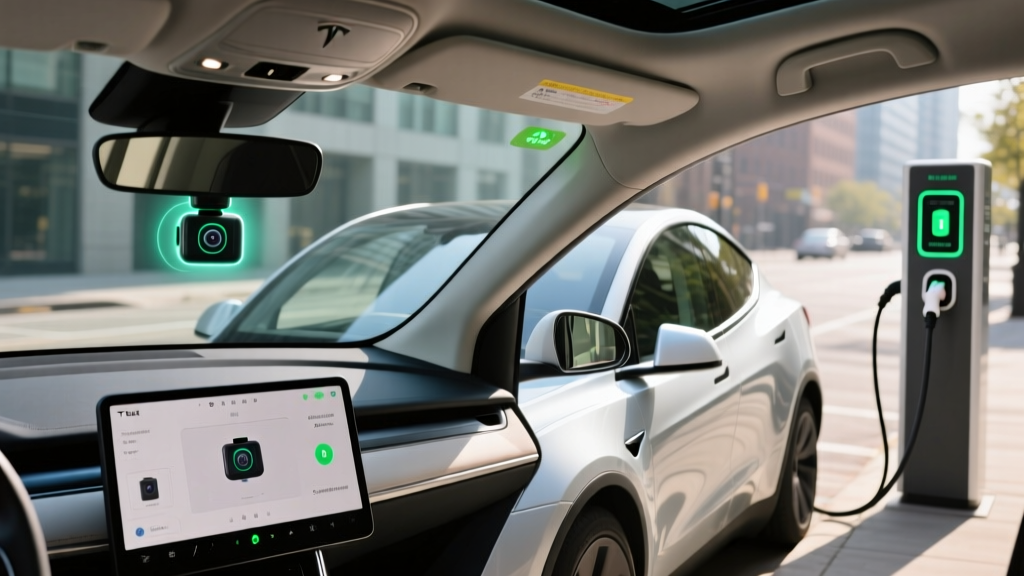
Tesla vehicles come equipped with eight external cameras primarily designed for the Autopilot and Full Self-Driving (Supervised) systems. But Tesla has repurposed these cameras into two recording features accessible directly from the touchscreen:
Dashcam
Tesla's built-in dashcam records video from up to four cameras (front, rear, left repeater, right repeater) simultaneously. It continuously saves the last 10 minutes of footage in a rolling loop. When you tap the dashcam icon or the car detects a collision, it saves the clip permanently to a USB drive (or glovebox SSD in newer 2026 builds). You can also manually trigger a save with a horn press if enabled in settings.
Sentry Mode
Sentry Mode turns your parked Tesla into a security monitor. When armed, the cameras activate upon detecting motion or impacts near the vehicle, recording events to the same USB storage. The system has three escalating states: Standby, Alert, and Alarm. An "Alert" saves a clip when motion is detected; an "Alarm" event (break-in, impact) saves footage and sends a notification to your phone via the Tesla app.
Storage Requirements (2026)
The 2026 Model Y continues to require a formatted USB-C drive (or uses the built-in SSD available on certain trims) for Dashcam and Sentry recordings. A 128 GB drive is recommended for Sentry-heavy users. Footage is organized into Recent, Saved, and Sentry folders, and you can view clips directly on the touchscreen or pull them to a computer.
2026 Model Y: Range, Battery, and Efficiency
The recording features are compelling, but the car has to deliver as an EV first. Here's what the 2026 Model Y lineup looks like under the skin.
| Spec | Long Range RWD | Long Range AWD | Performance |
|---|---|---|---|
| EPA Range | 320 mi | 294 mi | 277 mi |
| Battery (usable) | ~75 kWh (NMC) | ~75 kWh (NMC) | ~75 kWh (NMC) |
| Efficiency (MPGe) | 123 MPGe | 115 MPGe | 111 MPGe |
| kWh/100 mi | 27 | 29 | 30 |
| 0-60 mph | 5.8 sec | 4.8 sec | 3.5 sec |
| Horsepower | ~346 hp | ~384 hp | ~456 hp |
| Drivetrain | RWD (single motor) | AWD (dual motor) | AWD (dual motor) |
| Base MSRP | $44,990 | $47,990 | $52,490 |
Charging Speed: DC Fast, Level 2, and the Supercharger Advantage
Charging speed is where Tesla retains a meaningful edge, and it's the number one question we get from cross-shoppers.
| Charging Level | Max Rate | Speed / Notes |
|---|---|---|
| Level 1 (120V) | ~1.4 kW | ~4 mi/hr — emergency/top-up only |
| Level 2 (240V home) | 11.5 kW (48A) | ~37 mi/hr — full charge in ~7-8 hrs |
| DC Fast (Supercharger V4) | 250 kW peak | 10-80% in ~25 min; tapers significantly above 80% |
Charging curve reality: The 250 kW peak on the Model Y is not sustained. The car pulls peak power roughly between 10-30% SoC, then gradually tapers. By 60% SoC, you're typically seeing 100-130 kW, and above 80%, speeds drop below 50 kW. This is why Tesla (and best practice) recommends charging to 80% at DC fast chargers — the last 20% can take as long as the first 70%.
For home charging, a Tesla Wall Connector on a 60-amp circuit delivers the full 48 amps (11.5 kW), adding about 37 miles of range per hour. Most owners who plug in overnight wake up fully charged regardless of trim. Installation costs vary from $500 to $2,000+ depending on panel proximity and whether your home needs a 200-amp service upgrade — consult a licensed electrician for a site-specific quote.
Pricing, Trims, and Federal Tax Credit Eligibility
The 2026 Model Y starts at $44,990 for the Long Range RWD, positioning it as a premium compact SUV. Here's the pricing breakdown and how the federal tax credit factors in.
| Trim | MSRP | Est. Max §30D Credit | Effective Price (if eligible) |
|---|---|---|---|
| Long Range RWD | $44,990 | Up to $7,500 | ~$37,490 |
| Long Range AWD | $47,990 | Up to $7,500 | ~$40,490 |
| Performance | $52,490 | Up to $7,500 | ~$44,990 |
Critical caveat: The IRS §30D federal tax credit has strict eligibility requirements that change frequently:
- MSRP cap: SUVs/vans must be under $80,000 — all Model Y trims qualify.
- Income cap: Modified AGI must not exceed $150,000 (single), $225,000 (head of household), or $300,000 (joint filers).
- Battery sourcing: Critical minerals and battery components must meet phased-in percentage thresholds from U.S. or FTA-partner countries. Tesla has made significant progress in domestic sourcing, but the exact credit amount ($3,750 or $7,500) depends on the specific build's supply chain compliance at time of delivery.
- Point-of-sale transfer: As of 2024, eligible buyers can transfer the credit to the dealer at purchase, reducing the upfront price rather than waiting for a tax refund.
Always verify current eligibility on fueleconomy.gov and consult a tax professional before relying on credit estimates.
Interior, Cargo, and Technology
The 2026 Model Y continues Tesla's minimalist interior approach — a single 15.4-inch center touchscreen handles virtually all controls. There's no traditional instrument cluster; speed and navigation appear on the main display (and optionally on a rear passenger screen added in the Juniper refresh).
Cargo and Passenger Space
- Rear cargo (behind 2nd row): 30.2 cu ft
- Cargo (2nd row folded): 72.1 cu ft
- Front trunk (frunk): 4.1 cu ft — fits a carry-on or charging cables
- Rear legroom: 41.6 inches
- Front headroom: 40.8 inches
These dimensions place the Model Y squarely in competition with the Hyundai Ioniq 5 and Ford Mustang Mach-E in terms of interior volume, though the Model Y's sloping roofline cuts into rear cargo height compared to boxier rivals.
Standout Tech
- Dashcam & Sentry Mode (the Tesla recording features detailed above) — no aftermarket hardware needed
- Autopilot (standard): adaptive cruise, lane-keeping, auto emergency braking — SAE Level 2, requires driver supervision at all times
- Full Self-Driving (Supervised) ($8,000 option or $99/mo subscription): adds automatic lane changes, navigate-on-autopilot, traffic light/stop sign recognition, and parking assist. Still SAE Level 2 — you must keep hands on or near the wheel and monitor the road
- Over-the-air updates continuously add features and refinements
- Phone-as-key with Bluetooth proximity detection
- HEPA air filtration with Bioweapon Defense Mode
Pros, Cons, and Who Should Buy the 2026 Model Y
✅ Pros
- Best-in-class Supercharger network access (17,000+ U.S. stalls)
- Integrated Dashcam/Sentry recording features — no extra hardware
- Class-leading efficiency (27 kWh/100 mi on LR RWD)
- Strong OTA update pipeline keeps the car improving post-purchase
- Spacious cargo area with flat-fold rear seats
- 250 kW DC fast charging with reliable plug-and-charge experience
❌ Cons
- Minimalist interior lacks physical controls — climate, mirrors, glovebox all on-screen
- Sentry Mode drains battery during extended parking (~1-2%/hr)
- FSD (Supervised) remains Level 2 despite its name and $8,000 price tag
- Ride quality can feel firm over rough pavement compared to Ioniq 5
- Rear visibility limited by sloping roofline and small rear window
- Tax credit eligibility depends on battery sourcing — confirm at purchase
Who This EV Suits Best
Commuters and daily drivers who want a reliable, efficient EV with 250+ real-world miles and home charging will find the Long Range RWD an excellent fit. Tech-forward buyers who value integrated recording features, OTA updates, and the Supercharger network will appreciate Tesla's ecosystem. Small families will find adequate space for car seats and strollers, though larger families may want to cross-shop the three-row Kia EV9. Road-trippers benefit most from Tesla's charging infrastructure — the Supercharger network remains the most reliable and widespread DC fast-charging option in the U.S.
How the Model Y Stacks Up Against Competitors
The 2026 compact electric SUV segment is crowded. Here's how the Model Y compares to its closest rivals at a glance:
| Attribute | Tesla Model Y LR AWD | Hyundai Ioniq 5 Limited AWD | Ford Mustang Mach-E Premium AWD |
|---|---|---|---|
| EPA Range | 294 mi | 290 mi | 290 mi |
| DC Fast Charge Peak | 250 kW | 350 kW (800V) | 150 kW |
| 10-80% DC Time | ~25 min | ~18 min | ~38 min |
| Built-in Dashcam/Sentry | Yes (standard) | No | No |
| Charging Network Edge | Supercharger (native) | NACS adapter for SC access | NACS adapter for SC access |
| Base MSRP (AWD) | $47,990 | $53,600 | $48,995 |
The Ioniq 5 charges faster thanks to its 800V architecture, and the Mach-E offers a more traditional interior with physical controls. But the Model Y's combination of the Tesla recording features, Supercharger ecosystem, efficiency, and pricing keeps it near the top of the segment.
Frequently Asked Questions
What is the real-world range of the 2026 Tesla Model Y?
The EPA rates the Long Range RWD at 320 miles and the Long Range AWD at 294 miles. In real-world highway driving at 75 mph, expect roughly 265-285 miles (LR RWD) and 245-265 miles (LR AWD). In cold weather below freezing, subtract another 15-25%. City driving with regenerative braking typically matches or slightly exceeds EPA estimates.
How fast does the Model Y charge at home and on the road?
At home on a 240V Level 2 charger (48A/11.5 kW), the Model Y adds approximately 37 miles of range per hour, reaching a full charge from empty in about 7-8 hours. On a Tesla Supercharger V4 (250 kW peak DC), a 10-80% session takes roughly 25 minutes, though the charge curve tapers significantly above 60% SoC.
Does the 2026 Model Y qualify for the federal EV tax credit?
All Model Y trims fall under the $80,000 SUV MSRP cap for §30D eligibility. However, the full $7,500 credit depends on your income (under $150K single / $300K joint), and the vehicle's battery must meet critical-mineral and component sourcing thresholds that are subject to change. The credit can be transferred at point of sale to reduce your upfront cost. Always confirm with your tax advisor and check the latest data on fueleconomy.gov before purchasing.
Is the Tesla recording feature (Sentry Mode/Dashcam) standard?
Yes. Dashcam and Sentry Mode are built into every 2026 Model Y at no additional cost, using the same cameras that support Autopilot. You need only provide a USB-C storage drive (or use the built-in SSD if equipped). No aftermarket dashcam or security system is required.
Is the 2026 Model Y worth buying vs. the competition?
If you prioritize the Supercharger network, integrated security recording, software updates, and strong efficiency, the Model Y remains a compelling choice. If faster DC charging speeds are your top priority, the Hyundai Ioniq 5's 800V architecture is superior. If you prefer physical buttons and a more conventional cabin, the Ford Mach-E or Volkswagen ID.4 may suit you better. Test-drive all three before deciding.
What is the Model Y's battery warranty?
Tesla covers the Model Y battery and drive unit for 8 years or 120,000 miles (Long Range), whichever comes first, with a minimum 70% capacity retention guarantee. The basic vehicle limited warranty is 4 years or 50,000 miles.