Tesla Recording in 2026: More Than Just a Dashcam
When EV shoppers search for Tesla recording, they're usually hunting for details on the automaker's built-in camera ecosystem: Dashcam, Sentry Mode, and the cabin-facing camera that monitors driver attention. But those features don't exist in a vacuum—they're bundled into vehicles that must also deliver on range, charging speed, and everyday practicality. This review covers Tesla's recording suite in depth, then pivots to a full 2026 Tesla Model Y profile so you can evaluate the car as a whole.
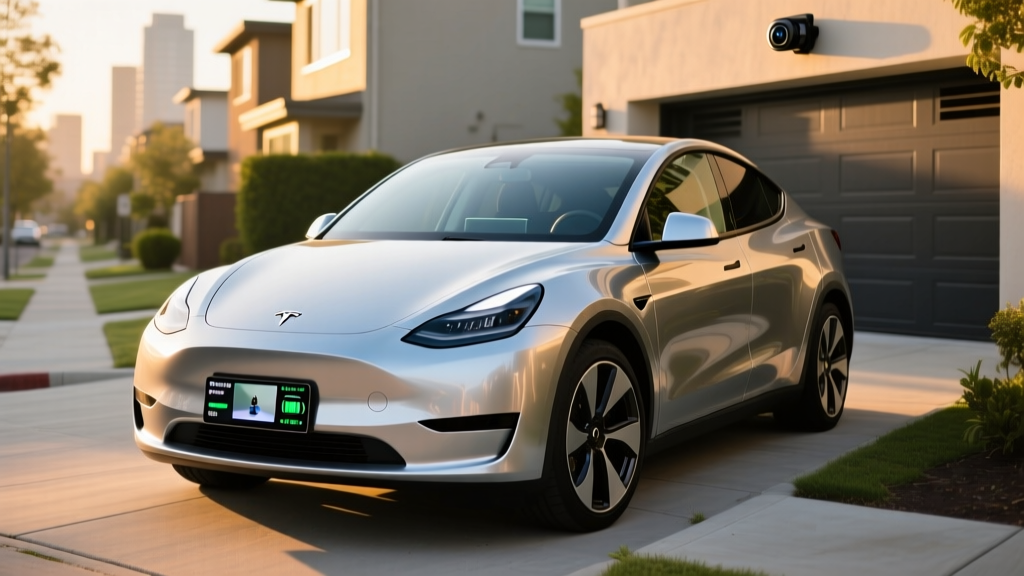
Tesla's recording system leverages the same eight-camera Autopilot hardware suite that powers its driver-assistance features. Unlike aftermarket dashcams, there's no suction-cup unit on the windshield or separate wiring harness. Everything is integrated, software-updated over the air, and accessible through the vehicle's 15-inch touchscreen or the Tesla mobile app.
How Tesla's Recording Features Actually Work
Dashcam
Tesla Dashcam continuously records from up to four external cameras (front, rear, left repeater, right repeater) while driving. Footage is saved to a USB drive (or the car's built-in storage on newer builds) in one-minute segments, with the most recent 60 minutes retained in a loop. Tap the dashcam icon on the touchscreen to save the last 10 minutes manually; the system also auto-saves clips when it detects a collision or hard-braking event.
Sentry Mode
When the car is parked and locked, Sentry Mode keeps the external cameras in a low-power standby. If motion is detected near the vehicle, the cameras begin recording and the touchscreen displays a warning. Escalations—such as someone leaning on the car or breaking a window—trigger an alarm, push a notification to your phone, and save the clip. Expect Sentry Mode to consume roughly 1–2 miles of range per hour of standby, which adds up if you leave it active for multi-day airport parking.
Cabin Camera
A small camera mounted above the rearview mirror monitors driver attentiveness when Autopilot or FSD (Supervised) is engaged. It does not record or store footage under normal operation; it performs real-time gaze detection to issue hands-on-wheel or eyes-on-road warnings. Tesla has confirmed that cabin camera images are processed locally on the vehicle and are not transmitted to the cloud unless you explicitly opt in to data sharing for fleet learning.
2026 Tesla Model Y: Core Specs at a Glance
| Spec | Long Range RWD | Long Range AWD | Performance |
|---|---|---|---|
| EPA Range | 320 mi | 308 mi | 277 mi |
| Battery (usable) | ~75 kWh, NMC | ~75 kWh, NMC | ~75 kWh, NMC |
| 0-60 mph | 5.8 sec | 4.8 sec | 3.5 sec |
| Horsepower | ~346 hp | ~384 hp | ~456 hp |
| Drivetrain | RWD (single motor) | AWD (dual motor) | AWD (dual motor) |
| MPGe (combined) | 123 MPGe | 117 MPGe | 111 MPGe |
| Efficiency | 27 kWh/100mi | 29 kWh/100mi | 30 kWh/100mi |
| Base MSRP | $44,990 | $47,990 | $52,490 |
Source: EPA fueleconomy.gov and Tesla Model Y configurator. Prices exclude the $1,390 destination fee and reflect 2026 model-year MSRP at time of writing.
Real-World Range: What the EPA Sticker Doesn't Tell You
The Long Range AWD Model Y carries a 308-mile EPA estimate. In mixed city/highway driving at moderate temperatures (60–80°F), expect 270–295 miles of usable range before needing to charge. At sustained 75+ mph highway speeds, range drops to roughly 240–260 miles. In freezing temperatures (below 32°F) with cabin heating active, plan for 200–230 miles of real-world range—a 25–35% reduction typical of NMC chemistry without a heat pump workaround.
The 2026 Model Y Juniper refresh includes a standard heat pump, which reduces cold-weather range loss compared to older resistance-heater-equipped EVs, but physics still wins in sub-zero conditions.
Tesla's trip planner in the navigation system is among the most accurate in the industry. It factors elevation, wind, temperature, and driving speed to project arrival state-of-charge (SoC) at your destination and at Supercharger stops along the route. Trust the onboard estimator over the EPA sticker for road-trip planning.
Charging Speed: Supercharger Network and Home Level 2
| Charging Level | Power (kW) | Speed | 10–80% Time |
|---|---|---|---|
| Level 1 (120V household) | ~1.4 kW | ~4 mi/hr | ~45+ hours |
| Level 2 (240V, 48A Wall Connector) | 11.5 kW | ~44 mi/hr | ~5.5 hours |
| DC Fast Charge (V3 Supercharger) | Peak 250 kW | ~162 mi in 15 min | ~25 min |
| DC Fast Charge (V4 Supercharger) | Peak 250 kW* | ~162 mi in 15 min | ~25 min |
*The 2026 Model Y's charge port and battery management system cap DC charging at 250 kW. V4 Supercharger stalls are rated higher, but the vehicle-side limit governs actual speed.
The Model Y's charging curve peaks near 250 kW between roughly 10–30% SoC, then tapers progressively. From 50–80%, expect sustained rates closer to 80–120 kW. This taper is why the 10–80% time is 25 minutes rather than the theoretical ~18 minutes a flat 250 kW rate would deliver. Preconditioning the battery (triggered automatically when you navigate to a Supercharger) is essential to hitting peak rates—skip it and your first several minutes of charging will be far slower.
At home, the Tesla Wall Connector on a 60-amp circuit delivers 48 amps / 11.5 kW, adding about 44 miles of range per hour of charging. An overnight session from 20% to 80% takes roughly 4–5 hours, which suits virtually any daily driving pattern. Installation typically costs $500–$2,000 depending on panel proximity and whether your electrical panel needs an upgrade from 100A to 200A service.
Pricing, Trims, and Federal Tax Credit Eligibility
| Trim | MSRP (incl. dest.) | Est. After §30D Credit | Eligible? |
|---|---|---|---|
| Long Range RWD | $46,380 | ~$38,880 | Yes* |
| Long Range AWD | $49,380 | ~$41,880 | Yes* |
| Performance | $53,880 | ~$46,380 | Yes* |
*Eligibility for the $7,500 federal EV tax credit under IRS §30D depends on multiple factors that change periodically:
- MSRP cap: SUVs (including Model Y) must have an MSRP at or below $80,000. All 2026 Model Y trims qualify.
- Buyer income cap: Modified adjusted gross income (MAGI) must not exceed $150,000 (single), $225,000 (head of household), or $300,000 (joint filers).
- Battery sourcing: A percentage of critical minerals and battery components must be sourced from the U.S. or free-trade-agreement partners. Tesla's U.S.-built battery packs have largely met these thresholds, but verify the specific VIN on fueleconomy.gov before purchase.
- Point-of-sale transfer: As of 2024, you can transfer the credit to the dealer at purchase, reducing your out-of-pocket cost immediately rather than waiting for a tax return. The dealer must be IRS-registered.
Consult a tax professional before relying on credit eligibility. Rules tightened significantly under the Inflation Reduction Act, and battery-component sourcing requirements escalate annually.
Interior, Cargo, and Tech: The Tesla Recording Ecosystem in Context
The 2026 Model Y Juniper refresh brought meaningful interior upgrades: ventilated front seats, ambient lighting, a rear-seat touchscreen, and improved sound insulation. The minimalist cabin still centers on a single 15.4-inch landscape display that handles everything from navigation to Tesla recording playback.
Cargo volume: 30.2 cubic feet behind the second row, expanding to 72.1 cubic feet with the 60/40 rear seats folded. The rear trunk includes a deep under-floor storage compartment, and the front trunk (frunk) adds 4.1 cubic feet—enough for a charging cable bag and a small soft cooler.
Passenger space: Front legroom measures 41.8 inches; rear legroom is 37.4 inches. Headroom is generous at 41.0 inches front and 39.0 inches rear, aided by the panoramic glass roof. Three adults can fit across the rear bench for short trips, though the center position is best suited for a child seat.
Standout tech: Tesla's infotainment remains industry-leading for responsiveness. Over-the-air updates regularly add features—the 2026 software introduced improved Dashcam clip management, letting you tag and export events from the mobile app rather than pulling the USB drive. FSD (Supervised) is available as a $8,000 option or $99/month subscription, but it remains a SAE Level 2 driver-assist system. You must keep your hands on the wheel and eyes on the road at all times.
Tesla's Autopilot and Full Self-Driving (Supervised) are SAE Level 2 systems. They do NOT make the vehicle autonomous. The driver is legally and operationally responsible for steering, braking, and monitoring traffic at all times. Hands-off-wheel warnings escalate to Autosteer disengagement and, eventually, a forced stop with hazard lights if ignored. No Tesla sold to consumers is self-driving.
Model Y vs. Key Competitors: Is It Worth Buying?
The Model Y competes against the Hyundai Ioniq 5, Ford Mustang Mach-E, and Chevrolet Equinox EV in the midsize electric crossover segment. Here's how it stacks up on the metrics that matter:
| Metric | Model Y LR AWD | Ioniq 5 Long Range AWD | Mach-E Extended Range AWD |
|---|---|---|---|
| EPA Range | 308 mi | 290 mi | 290 mi |
| Peak DC Charge | 250 kW | 238 kW (350-kW capable) | 150 kW |
| 10–80% DCFC | ~25 min | ~18 min | ~36 min |
| Cargo (rear seats up) | 30.2 cu ft | 27.2 cu ft | 29.7 cu ft |
| Base MSRP (AWD) | $49,380 | $50,285 | $48,995 |
| NACS (native) | Yes | Yes (2025+) | No (adapter req.) |
The Ioniq 5 charges faster on compatible 350 kW stations (18 minutes 10–80% vs. Tesla's 25), but Tesla's Supercharger network remains the most reliable and geographically dense DC fast-charging ecosystem in the U.S. The Mach-E offers a more traditional driving feel and a physical instrument cluster, but its slower charging and smaller Supercharger-adapter dependency make road trips less seamless.
Choose the Model Y if: You prioritize Supercharger network access, want the most cargo space in the segment, value Tesla's recording ecosystem (Dashcam + Sentry Mode integration), and prefer OTA software updates that add features post-purchase.
Choose the Ioniq 5 if: You want the fastest DC charging in the segment, prefer a more conventional interior with physical buttons and a dedicated instrument display, or find Hyundai's dealer network more accessible for service.
Choose the Mach-E if: You prefer a car-like driving dynamic, want Ford's BlueCruise hands-free highway driving on mapped routes, or need a more traditional dealership service experience.
Pros and Cons
Pros
- Best-in-class Supercharger network (17,000+ stalls in North America)
- Integrated Tesla recording (Dashcam + Sentry) with no aftermarket hardware
- Class-leading cargo volume (30.2 cu ft + 4.1 cu ft frunk)
- Strong efficiency (117 MPGe combined for AWD)
- Over-the-air updates add features continuously
- Heat pump standard (better cold-weather range retention)
Cons
- DC charging peaks at 250 kW—slower than 800V rivals like Ioniq 5
- No physical instrument cluster; all info on center screen
- FSD (Supervised) is costly ($8,000 or $99/mo) and still Level 2
- Sentry Mode drains ~1–2 miles of range per hour in standby
- Service center wait times can be long in high-volume metro areas
- Rear visibility is compromised by the sloping roofline and small rear window
Warranty, Battery Longevity, and Ownership Costs
Tesla covers the Model Y with a 4-year/50,000-mile basic vehicle warranty and an 8-year/120,000-mile battery and drive unit warranty for Long Range and Performance trims. The battery warranty guarantees retention of at least 70% of original capacity during the coverage period. Real-world data from Tesla's fleet suggests NMC packs in the Model Y typically retain 88–92% capacity at 100,000 miles when charged primarily on Level 2 and kept between 20–80% SoC for daily use.
Insurance premiums for the Model Y run 15–30% higher than comparable gas crossovers, driven by repair costs for the aluminum-intensive structure and sensor suite. Expect $1,800–$2,800 annually depending on your driving record, ZIP code, and coverage level. Tesla offers its own insurance product in many states, priced dynamically based on a real-time Safety Score—some drivers report savings of $300–$600/year versus traditional carriers.
Tires wear faster on EVs due to instant torque and the Model Y's 4,400-lb curb weight. Budget for a set of four all-season or EV-specific tires (e.g., Michelin Pilot Sport EV or Hankook iON evo) every 25,000–35,000 miles at roughly $900–$1,400 per set.
Frequently Asked Questions
What is the real-world range of the 2026 Tesla Model Y?
The Long Range AWD is EPA-rated at 308 miles. Real-world mixed driving yields 270–295 miles; sustained highway speeds above 75 mph drop that to 240–260 miles. In freezing weather, plan for 200–230 miles before needing to charge.
How fast does the Model Y charge on DC fast chargers and at home?
On a V3 or V4 Supercharger, the Model Y peaks at 250 kW and charges from 10–80% in approximately 25 minutes (with battery preconditioning). At home on a 48-amp Tesla Wall Connector (Level 2, 11.5 kW), a full overnight charge adds about 44 miles of range per hour.
How much does the Model Y cost after the federal EV tax credit?
If you qualify for the full $7,500 §30D credit (income under the cap, VIN meets battery-sourcing requirements), the Long Range AWD drops from $49,380 to approximately $41,880. The credit can be transferred to the dealer at point of sale for an immediate price reduction. Always verify eligibility on IRS.gov and with a tax professional before purchasing.
Does Tesla recording require a subscription?
No. Dashcam and Sentry Mode are included with the vehicle at no additional cost. You need a properly formatted USB drive (or the car's built-in storage on 2025+ builds) to store footage. FSD (Supervised) is a separate paid feature and is not required for Tesla recording functions.
Is the 2026 Model Y worth buying over the Ioniq 5 or Mach-E?
The Model Y wins on cargo space, Supercharger access, and software integration. The Ioniq 5 charges faster on 350 kW stations (18 vs. 25 minutes, 10–80%). The Mach-E offers a more traditional driving feel. If Supercharger reliability and Tesla's recording ecosystem matter to you, the Model Y remains the segment benchmark. If peak charging speed is your top priority, test-drive the Ioniq 5.
How long does the Model Y battery last before replacement?
Tesla's NMC batteries are engineered for 1,500+ full charge cycles before reaching 70% capacity. At an average of 12,000 miles/year, that translates to well over 200,000 miles before significant degradation. Full battery replacement out of warranty currently costs $12,000–$16,000 depending on the pack, though most owners never need one within the vehicle's practical lifespan.
Final Verdict: Tesla Recording Meets Practical EV Ownership
The 2026 Model Y remains the default recommendation in the midsize electric crossover segment for buyers who value charging infrastructure, software sophistication, and Tesla's integrated recording features. Dashcam and Sentry Mode work seamlessly without aftermarket hardware, the Supercharger network removes road-trip friction, and the Juniper interior refresh addresses the most common complaints about earlier builds.
Its weaknesses are real: 250 kW peak DC charging trails 800V competitors, the all-screen interior isn't for everyone, and FSD (Supervised) remains a Level 2 system despite its premium price. But measured against the criteria most EV buyers actually prioritize—range, charging access, cargo utility, and total cost of ownership—the Model Y Long Range AWD at ~$41,880 after the federal credit (for qualifying buyers) is difficult to beat.