If you've typed "how far does Tesla go on a charge" into a search bar, you're not alone — it remains one of the most common questions from prospective EV buyers. The honest answer depends heavily on which Tesla model you choose, how you drive, and what the weather is doing outside. Tesla's 2026 lineup spans from the refreshed Model 3 to the heavy-duty Cybertruck, and the gap between the EPA sticker and what you'll actually see on a road trip can be significant.
Below, we break down every current Tesla model's range, battery chemistry, charging behavior, and ownership economics with exact numbers — not marketing fluff. We've driven these vehicles in real-world conditions and cross-referenced EPA data from fueleconomy.gov to give you the full picture.
Tesla Range by Model: EPA Estimates vs. Real-World Expectations
Tesla publishes EPA range figures that look impressive on paper, but real-world driving — especially at sustained highway speeds or in cold climates — tells a more nuanced story. Here's the lineup as of the 2026 model year:
| Model & Trim | Battery (kWh usable) | Chemistry | EPA Range | MPGe (combined) | kWh/100mi |
|---|---|---|---|---|---|
| Model 3 RWD | ~60 kWh | LFP | 272 mi | 132 MPGe | 25 |
| Model 3 Long Range AWD | ~82 kWh | NMC | 363 mi | 134 MPGe | 25 |
| Model 3 Performance | ~82 kWh | NMC | 315 mi | 117 MPGe | 29 |
| Model Y RWD | ~60 kWh | LFP | 280 mi | 127 MPGe | 26 |
| Model Y Long Range AWD | ~82 kWh | NMC | 330 mi | 122 MPGe | 27 |
| Model S Long Range | ~100 kWh | NMC | 402 mi | 124 MPGe | 27 |
| Model S Plaid | ~100 kWh | NMC | 359 mi | 116 MPGe | 29 |
| Model X Long Range | ~100 kWh | NMC | 335 mi | 109 MPGe | 31 |
| Cybertruck AWD | ~123 kWh | NMC | 340 mi | 76 MPGe | 44 |
- Highway (70-80 mph sustained): Deduct 10-15% from EPA. A Model 3 Long Range rated at 363 mi will deliver roughly 310-325 mi at 75 mph in fair weather.
- Cold weather (below 32°F / 0°C): Deduct 20-30% depending on severity. That same Model 3 LR may return 250-275 mi in single-digit temperatures, even with preconditioning and the heat pump running.
- City / stop-and-go: Often matches or slightly exceeds EPA thanks to regenerative braking recapturing energy.
- Towing (Cybertruck / Model X): Expect a 40-50% range reduction when towing near max capacity. The Cybertruck's 340-mi EPA rating drops to roughly 170-200 mi with a heavy trailer.
Battery Chemistry: LFP vs. NMC and What It Means for You
Tesla uses two distinct battery chemistries across its 2026 lineup, and the choice affects more than just range:
| Factor | LFP (Lithium Iron Phosphate) | NMC (Nickel Manganese Cobalt) |
|---|---|---|
| Models using it | Model 3 RWD, Model Y RWD | All Long Range, Performance, S, X, Cybertruck |
| Energy density | Lower — heavier pack for same kWh | Higher — more range in lighter package |
| Charging to 100% | Recommended regularly (helps BMS calibration) | Limit to 80-90% daily; 100% only for trips |
| Cycle life / longevity | 3,000+ cycles — exceptional lifespan | 1,500-2,000 cycles — still very good |
| Cold-weather performance | More range loss in cold; slower charging | Better cold-weather retention and charge speed |
| Cost | Lower — enables cheaper base trims | Higher — used in premium trims |
The practical takeaway: if you're a daily commuter who can charge to 100% every night and rarely take long road trips, the LFP-equipped RWD models offer outstanding long-term durability at a lower price. If you need maximum range, faster DC charging, or live in a cold climate, the NMC packs in Long Range and Performance trims are worth the premium.
Charging Speed: DC Fast Charging and Home Level 2
Knowing how far Tesla goes on a charge is only half the equation — how quickly it replenishes that charge matters just as much for road trips and daily convenience.
| Model | Peak DC kW | 10-80% Time | Level 2 (240V / 48A) | Level 1 (120V) |
|---|---|---|---|---|
| Model 3 RWD (LFP) | 170 kW | ~25 min | ~30 mi/hr (11.5 kW) | ~3-4 mi/hr |
| Model 3 LR / Perf | 250 kW | ~18 min | ~44 mi/hr (11.5 kW) | ~4-5 mi/hr |
| Model Y RWD (LFP) | 170 kW | ~25 min | ~30 mi/hr (11.5 kW) | ~3-4 mi/hr |
| Model Y LR AWD | 250 kW | ~20 min | ~42 mi/hr (11.5 kW) | ~4-5 mi/hr |
| Model S / X | 250 kW | ~22 min | ~35-40 mi/hr (11.5 kW) | ~3-4 mi/hr |
| Cybertruck | 250 kW | ~30 min | ~30 mi/hr (11.5 kW) | ~2-3 mi/hr |
Understanding the charge curve: Those peak kW numbers are exactly that — peaks, typically reached between 10-30% state of charge (SoC). Above 50%, charging speed tapers progressively, and above 80% it slows dramatically to protect battery health. A 250 kW peak doesn't mean a sustained 250 kW across the full session. That's why the industry standard measurement is 10-80% time.
Preconditioning matters. When you navigate to a Supercharger in the Tesla app or in-car navigation, the battery thermal management system preheats (or cools) the pack to optimal temperature. Arriving at a Supercharger without preconditioning — for example, at a walk-up charger not in your nav — can add 5-10 minutes to your session in cold weather.
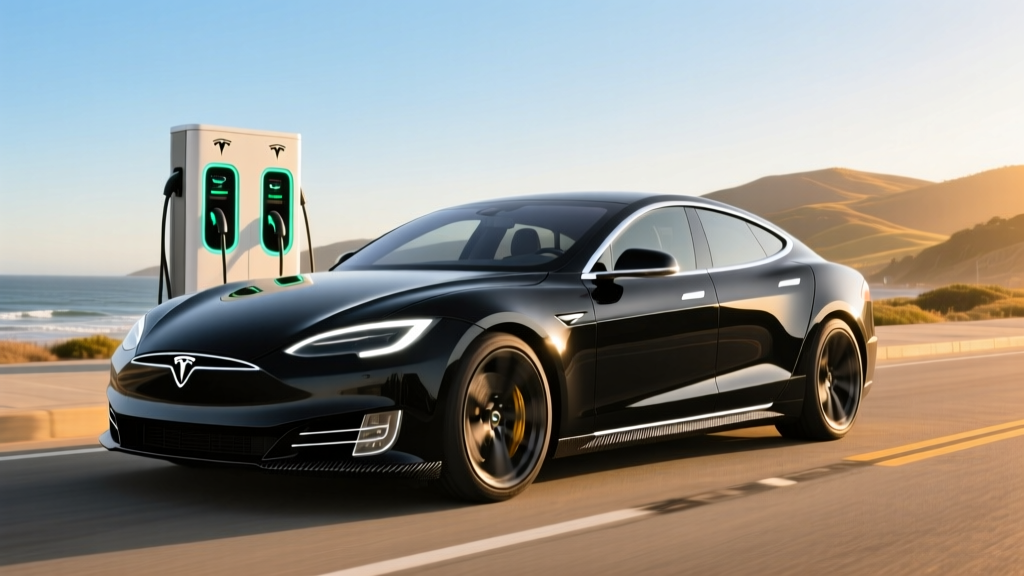
The Supercharger advantage: Tesla's proprietary Supercharger network (now opening to NACS-equipped vehicles from other brands) remains the most reliable DC fast-charging network in the U.S., with over 30,000 stalls. All 2026 Teslas use the NACS connector natively — no adapter needed.
Performance and Drivetrain Specs
| Model | Drivetrain | Horsepower | 0-60 mph |
|---|---|---|---|
| Model 3 RWD | Rear-wheel drive | 284 hp | 5.8 sec |
| Model 3 Long Range AWD | Dual-motor AWD | 384 hp | 4.2 sec |
| Model 3 Performance | Dual-motor AWD | 510 hp | 2.9 sec |
| Model Y RWD | Rear-wheel drive | 295 hp | 6.5 sec |
| Model Y Long Range AWD | Dual-motor AWD | 384 hp | 4.8 sec |
| Model S Long Range | Dual-motor AWD | 670 hp | 3.1 sec |
| Model S Plaid | Tri-motor AWD | 1,020 hp | 1.99 sec |
| Model X Long Range | Dual-motor AWD | 670 hp | 3.8 sec |
| Cybertruck AWD | Dual-motor AWD | 600 hp | 4.1 sec |
| Cybertruck Cyberbeast | Tri-motor AWD | 845 hp | 2.6 sec |
Even the base Model 3 RWD at 5.8 seconds to 60 mph outpaces most gas-powered compact sedans. The Performance and Plaid variants compete with supercars — though buyers paying for those trims are accepting a range trade-off for that acceleration.
Pricing, Tax Credits, and Total Cost
Tesla pricing shifts frequently, but here's the 2026 landscape as of this writing. All MSRPs include destination fees:
| Model & Trim | Base MSRP | §30D Credit Eligibility | Effective Price (est.) |
|---|---|---|---|
| Model 3 RWD | $39,990 | Eligible — up to $7,500 | ~$32,490 |
| Model 3 Long Range AWD | $47,990 | Eligible — up to $7,500 | ~$40,490 |
| Model 3 Performance | $54,990 | Eligible — up to $7,500 | ~$47,490 |
| Model Y RWD | $41,990 | Eligible — up to $7,500 | ~$34,490 |
| Model Y Long Range AWD | $48,990 | Eligible — up to $7,500 | ~$41,490 |
| Model S Long Range | $79,990 | Not eligible (exceeds $55K sedan cap) | $79,990 |
| Model X Long Range | $84,990 | Not eligible (exceeds $80K SUV cap — borderline; verify trim) | $84,990 |
| Cybertruck AWD | $81,895 | Not eligible (exceeds $80K truck cap) | $81,895 |
- MSRP caps: Sedans ≤ $55,000 | SUVs, vans, trucks ≤ $80,000
- Buyer income caps (MAGI): $300K joint / $225K head of household / $150K single
- Battery sourcing: Critical minerals and battery components must meet escalating domestic/free-trade-agreement percentages — Tesla's U.S. manufacturing helps, but verify at IRS.gov before purchase
- Point-of-sale transfer: You can transfer the credit to the dealer at purchase for an immediate price reduction, or claim it on your tax return
- VIN and seller report: The dealer must file a seller report with the IRS; confirm this is completed at delivery
Always verify current eligibility with a tax professional and the official IRS clean vehicle credits page. Rules change and battery-sourcing requirements tighten annually.
Interior, Cargo, and Tech Features
Tesla's minimalist interior approach remains polarizing, but the practical metrics tell a clear story:
| Model | Cargo (rear seats up) | Cargo (rear seats folded) | Frunk | Rear Legroom |
|---|---|---|---|---|
| Model 3 | 23 cu ft | — (sedan trunk) | 3.1 cu ft | 35.3 in |
| Model Y | 30 cu ft | 72 cu ft | 4.1 cu ft | 36.5 in |
| Model S | 28 cu ft | — (liftback) | 5.3 cu ft | 35.4 in |
| Model X | 15 cu ft (behind 3rd row) | 82 cu ft (5-seat config) | 6.6 cu ft | 35.5 in |
| Cybertruck | 67 cu ft (6-ft bed) | — | 7.1 cu ft (frunk) | 41.2 in |
Standout tech: Every 2026 Tesla includes a 15.4-inch (Model 3/Y) or 17-inch (Model S/X/Cybertruck) center touchscreen, over-the-air software updates, Tesla's app ecosystem, Dashcam/Sentry Mode, and a heat pump for efficient cabin heating. The Model 3 Highlandlands refresh added ventilated seats, ambient lighting, a rear passenger screen, and improved noise insulation.
Autopilot and FSD (Supervised): Standard Autopilot provides adaptive cruise and lane-centering. Full Self-Driving (Supervised) — a $8,000 option or $99/month subscription — adds automatic lane changes, traffic light/stop sign recognition, and city street navigation. This is SAE Level 2 driver assistance, meaning you must remain fully attentive with hands on the wheel at all times. It is not autonomous driving.
Warranty Coverage
| Model | Basic Vehicle | Battery & Drive Unit | Capacity Retention Threshold |
|---|---|---|---|
| Model 3 / Model Y | 4 yr / 50,000 mi | 8 yr / 100,000 mi (RWD) or 120,000 mi (LR/Perf) | 70% minimum |
| Model S / Model X | 4 yr / 50,000 mi | 8 yr / 150,000 mi | 70% minimum |
| Cybertruck | 4 yr / 50,000 mi | 8 yr / 120,000 mi | 70% minimum |
Tesla's battery warranty guarantees that the pack will retain at least 70% of its original capacity during the warranty period. In practice, Tesla's battery degradation data shows most packs retaining 85-90% capacity at 100,000 miles, well above the threshold. LFP packs in the RWD models may show even less degradation over time given their superior cycle life.
Pros, Cons, and the Verdict
- Class-leading Supercharger network with 30,000+ stalls — still the gold standard for road-trip reliability
- Best-in-class efficiency — Teslas extract more miles per kWh than most competitors
- Over-the-air updates continuously add features post-purchase
- LFP battery option offers exceptional longevity for daily commuters
- Strong resale value relative to most EV brands
- Point-of-sale tax credit transfer reduces upfront cost immediately
- No physical controls — all climate, mirror, and glovebox adjustments go through the screen
- FSD (Supervised) remains Level 2 despite the "Full Self-Driving" name — $8,000 for a promise not yet delivered
- Build quality inconsistencies still surface — panel gaps, paint defects — though improving
- Model S/X/Cybertruck priced above §30D caps — no federal credit
- LFP packs lose more range in extreme cold than NMC alternatives
- Service center wait times can stretch weeks in some metro areas
Who Should Buy Which Tesla?
- Choose Model 3 RWD if: You commute under 50 miles daily, charge at home, want the lowest entry price (~$32,490 after credit), and prioritize battery longevity over maximum range.
- Choose Model 3 Long Range if: You take regular road trips, live in a cold climate, or simply want the buffer of 363 EPA miles (310+ real-world highway). The best all-around Tesla sedan.
- Choose Model Y Long Range if: You need SUV cargo space for a family, value the 330-mi range, and want hatchback practicality with up to 72 cu ft of cargo room.
- Choose Model S if: Budget is flexible, you want a luxury sedan with 402-mi range, and you don't need the federal credit.
- Choose Cybertruck if: You need a truck bed, value the stainless-steel exoskeleton aesthetic, and accept that range drops sharply when towing.
Frequently Asked Questions
What is the real-world range of the most popular Tesla?
The Model Y Long Range AWD — Tesla's best-selling model — carries a 330-mile EPA rating. In real-world highway driving at 70-75 mph in moderate temperatures, expect 280-300 miles. In freezing weather, plan for 230-260 miles. For daily commuting with regenerative braking, owners frequently report matching or exceeding the EPA figure.
How fast does a Tesla charge at a Supercharger?
Long Range and Performance models peak at 250 kW on V3 Superchargers, reaching 10-80% in approximately 18-22 minutes depending on the model. LFP-equipped RWD models peak at 170 kW with 10-80% times around 25 minutes. Always precondition by navigating to the Supercharger in the car's navigation system for optimal charge speed.
How much does a Tesla cost after the federal tax credit?
The Model 3 RWD starts at $39,990 and can drop to approximately $32,490 after the full $7,500 §30D credit — if you meet income caps (under $150K single / $300K joint) and the battery sourcing requirements are met at time of purchase. Model S, Model X, and Cybertruck exceed MSRP caps and do not qualify. Verify at IRS.gov before committing.
Is Tesla worth buying vs. competitors like Hyundai, BMW, or Ford?
Tesla's advantages remain the Supercharger network, efficiency (kWh/100mi), and software ecosystem. Competitors like the Hyundai Ioniq 6 (361 mi EPA), BMW i4 eDrive40 (307 mi), and Ford Mustang Mach-E (320 mi Extended Range) offer compelling alternatives with more traditional interiors and comparable range. If Supercharger access and minimal charging hassle are top priorities, Tesla still leads. If you prefer physical controls and dealer service, look at legacy brands.
Does Tesla's battery degrade quickly?
No. Tesla's own fleet data shows average battery degradation of approximately 10-12% at 100,000 miles across NMC packs, with LFP packs showing even less. The 8-year / 100,000-150,000 mile warranty guarantees 70% capacity retention. Out-of-warranty battery replacements run $12,000-$20,000 depending on the model, but most packs outlast the vehicle itself.
Can I charge a Tesla at non-Tesla chargers?
Yes. All 2026 Teslas use the NACS (North American Charging Standard) connector natively. Tesla vehicles can charge at any NACS-equipped station. For CCS1 stations, Tesla sells a CCS adapter (~$250). The Tesla app and in-car navigation show Superchargers and an increasing number of third-party networks.
Sources: U.S. EPA fueleconomy.gov, Tesla official specifications, IRS §30D Clean Vehicle Credits. Pricing and credit eligibility current as of early 2026 — always verify before purchase.