Why Tesla Rated Tires Matter More Than You Think
When Tesla engineers validate a tire for their vehicles, they aren't just checking that it fits the wheel. Tesla rated tires — marked with specific OE (Original Equipment) designations like T0, T1, or T2 on the sidewall — undergo custom tuning for rolling resistance, noise absorption, load rating, and contact patch behavior under the unique demands of a heavy, high-torque electric vehicle. For Tesla owners and shoppers, understanding these tire specifications is critical because swapping to a non-rated tire can reduce your real-world range by 5-15%, alter regenerative braking behavior, and increase cabin noise significantly.
This guide breaks down exactly what Tesla rated tires are, how they influence the efficiency and range numbers you see on the window sticker, and what happens when you replace them with aftermarket alternatives. We'll also cover the tire specifications for the current 2025-2026 Tesla lineup, including the Model 3 Highland, Model Y Juniper refresh, Model S, and Model X.
What Makes a Tire "Tesla Rated"?
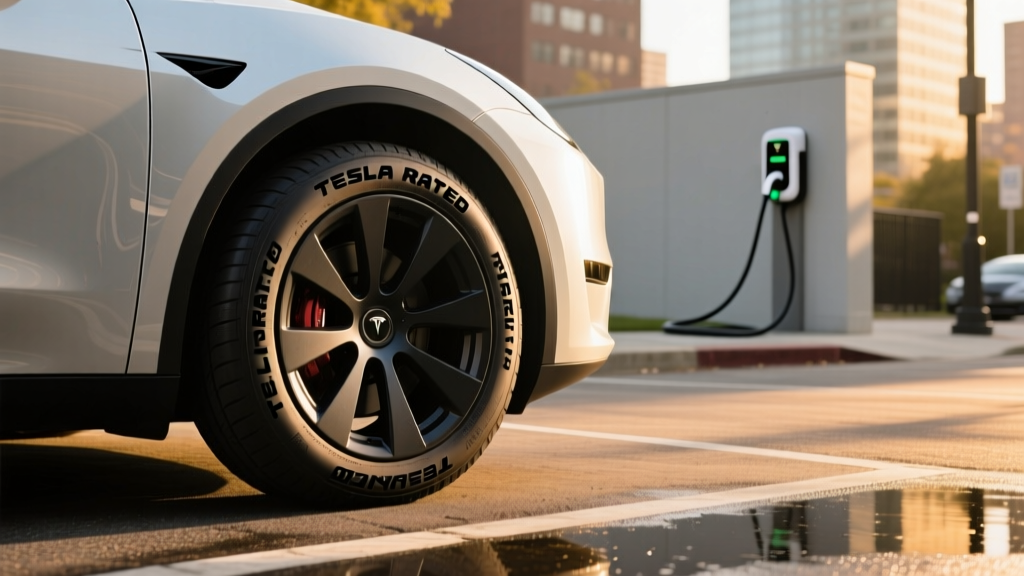
Tesla rated tires carry an OE marking on the sidewall that identifies them as specifically validated for Tesla vehicles. The most common markings include:
- T0 / T1 / T2 — Tesla-specific homologation codes indicating successive generations of tire validation
- HL (High Load) — Required for heavier EVs; Tesla vehicles typically carry 4,000-5,000+ lbs, demanding higher load-index tires than equivalent ICE vehicles
- PNCS (Pirelli Noise Cancelling System) / AMS (Acoustic Management System) — Foam-lined tires that reduce cavity resonance noise, critical in EVs without engine sound masking
- Low Rolling Resistance (LRR) — Custom compound and tread tuning to minimize energy loss, directly impacting miles per kWh
Major tire manufacturers producing Tesla rated tires include Michelin (Pilot Sport EV, Primacy All-Season), Pirelli (P Zero EV, Scorpion), Hankook (iON evo, iON AS), and Continental (EcoContact 6 Q, SportContact). Each tire is co-engineered with Tesla's chassis team to balance range, grip, noise, and tread life for specific Tesla models and wheel sizes.
| Model | Wheel Size | OEM Tire | OE Mark | Load Index | Foam-Lined |
|---|---|---|---|---|---|
| Model 3 RWD | 18" Photon | Hankook Kinergy GT | T1 | 97W XL | No |
| Model 3 Long Range AWD | 18" Photon | Michelin Primacy All-Season | T0 | 99W XL | Yes (AMS) |
| Model 3 Long Range AWD | 19" Nova | Michelin Pilot Sport 4S | T1 | 97Y XL | Yes |
| Model 3 Performance | 19" Pegasus / 20" Curvalinear | Pirelli P Zero (PZ5) | T1 | 97Y XL | Yes (PNCS) |
| Model Y Long Range AWD | 19" Gemini | Hankook Kinergy GT | T1 | 103W XL | Yes |
| Model Y Long Range AWD | 20" Induction | Michelin Pilot Sport EV | T0 | 105W XL | Yes (AMS) |
| Model Y Performance | 21" Überturbine | Pirelli P Zero (PZ4) | T1 | 105Y XL | Yes (PNCS) |
| Model S Long Range | 19" Tempest | Michelin Primacy All-Season | T0 | 104W XL | Yes |
| Model S Plaid | 21" Arachnid | Michelin Pilot Sport 4S | T1 | 105Y XL | Yes |
| Model X Long Range | 20" Cyberstream | Pirelli Scorpion Zero All Season | T0 | 108W XL | Yes (PNCS) |
How Tesla Rated Tires Affect EPA Range and Real-World Miles
The EPA range figure on your Tesla's window sticker is calculated with the OEM Tesla rated tires installed. These tires are optimized for low rolling resistance, and the EPA's test cycle captures that efficiency advantage. When you replace them with non-rated tires — even the same brand and model line without the Tesla OE code — you may see measurable range loss.
Real-World Range Impact: Tesla Rated vs Non-Rated Tires
Model 3 Long Range AWD (19" wheels):
- EPA estimated range: 363 miles (with Michelin Primacy All-Season T0 rated)
- Real-world highway (70 mph, 72°F): ~310-330 miles with Tesla rated tires
- Real-world highway with non-rated equivalent tire: ~280-305 miles (est. 8-12% reduction)
- Cold-weather highway (30°F, with heat pump): ~260-285 miles with rated tires
- City/mixed driving efficiency: ~130-136 MPGe / 24-25 kWh/100mi with rated tires
Model Y Long Range AWD (19" wheels):
- EPA estimated range: 320 miles
- Real-world highway (70 mph, 72°F): ~275-295 miles with Tesla rated tires
- Real-world highway with non-rated equivalent: ~250-270 miles
- Cold-weather highway (30°F): ~230-255 miles
- Efficiency: ~122-125 MPGe / 27-28 kWh/100mi with rated tires
Sources: fueleconomy.gov, Tesla owner community testing, Tire Rack independent rolling-resistance data.
The physics are straightforward: rolling resistance accounts for roughly 20-30% of the energy consumed by a vehicle at highway speeds. Tesla rated tires typically achieve rolling-resistance coefficients (RRC) in the 6.5-7.5 kg/ton range, while high-performance non-rated alternatives can push 8.5-10.0 kg/ton. That 1-3 kg/ton difference translates directly to 5-15% range variance depending on speed, temperature, and driving style.
Efficiency, Noise, and Handling: The Trade-Off Triangle
Tesla rated tires are engineered to balance three competing priorities that matter more in EVs than in gas cars:
1. Energy Efficiency (Range)
The low-rolling-resistance compound and optimized tread pattern minimize hysteresis — the energy lost as the tire deforms and recovers with each rotation. On a 4,400-lb Model Y, even small RRC improvements yield measurable kWh/100mi gains. Tesla's tire engineers work with manufacturers to tune the silica content and tread block geometry specifically for Tesla's weight distribution (roughly 50/50 front-rear with the battery pack low in the chassis).
2. Noise, Vibration, and Harshness (NVH)
Without an internal combustion engine, tire noise becomes the dominant sound source in an EV cabin above 30 mph. Tesla rated tires with acoustic foam lining (PNCS, AMS, or Continental's ContiSilent) reduce cavity resonance by 3-9 dB — a perceptible difference that makes highway driving noticeably quieter. Non-foam-lined alternatives, even premium ones, will let more road drone into the cabin.
3. Wet/Dry Grip and Handling
EVs produce instant torque and carry 500-1,000 lbs more than equivalent ICE vehicles. Tesla rated tires are validated for the specific torque curves and weight of each model. The Model 3 Performance's Pirelli P Zero PZ5 (T1), for example, is tuned for the car's 510 hp launch and ~4,000-lb curb weight. A generic P Zero without the T1 marking may have a different compound and construction, affecting traction under hard acceleration and regenerative-braking grip.
Tire Impact on Charging Efficiency and Cost Per Mile
Higher rolling resistance doesn't just reduce range — it also means you charge more often and spend more on electricity. Here's how the numbers stack up:
| Metric | Tesla Rated Tires (19") | Non-Rated Equivalent | Difference |
|---|---|---|---|
| Efficiency (kWh/100mi) | 27 kWh | 30 kWh (est.) | +11% energy use |
| MPGe (combined) | 123 MPGe | ~110 MPGe (est.) | -13 MPGe |
| Cost per mile (home, $0.14/kWh) | $0.038 | $0.042 | +$0.004/mi |
| Cost per mile (DC fast, $0.35/kWh) | $0.095 | $0.105 | +$0.01/mi |
| Annual energy cost (12,000 mi/yr, home) | $454 | $504 | +$50/yr |
| DC fast-charge sessions per year (est.) | ~22 | ~25 | +3 sessions |
Over a 50,000-mile ownership period, the extra energy consumption from non-rated tires could cost $150-$300 in additional charging — not enormous, but meaningful when combined with the range and comfort trade-offs. For road-trip-heavy owners who rely on DC fast charging, the added sessions add time and cost that compounds.
Tesla Tire Pricing, Lifespan, and Replacement Strategy
Tesla rated tires carry a price premium over generic equivalents, typically $30-$80 per tire. Here's what to expect for replacement costs:
- Model 3 (18" wheels): $200-$280 per tire (Hankook Kinergy GT T1, Michelin Primacy AS T0)
- Model 3 (19" wheels): $280-$360 per tire (Michelin Pilot Sport 4S T1)
- Model Y (19" wheels): $230-$310 per tire (Hankook Kinergy GT T1)
- Model Y (20" wheels): $310-$400 per tire (Michelin Pilot Sport EV T0)
- Model Y (21" wheels): $380-$480 per tire (Pirelli P Zero PZ4 T1)
- Model S/X (19"-22"): $280-$550 per tire depending on size and model
Tread life expectations: Tesla rated tires typically deliver 25,000-40,000 miles of usable tread life, depending on driving style, alignment, and rotation schedule. The instant torque of EVs accelerates tire wear compared to ICE vehicles — particularly on the driven axle. Tesla recommends tire rotation every 6,250 miles (or when tread depth difference between axles reaches 2/32").
Warranty note: Your Tesla vehicle warranty (8-year/100,000-120,000-mile battery and drive unit coverage) is not voided by using non-rated tires. However, if a tire-related issue causes damage to a suspension or drivetrain component, Tesla may scrutinize whether non-OE tires contributed. The Tesla New Vehicle Limited Warranty covers 4 years/50,000 miles on the vehicle, with tires covered by the tire manufacturer's own warranty.
Top Tesla Rated Tire Picks for 2025-2026
Based on current availability, rolling-resistance data, and owner feedback, here are the standout Tesla rated tire options by use case:
Best for Maximum Range: Michelin Primacy All-Season (T0)
Pros:
- Lowest rolling resistance in Tesla's OEM lineup
- Acoustic foam (AMS) for quiet highway driving
- 45,000-mile treadwear warranty
- Excellent wet traction for an LRR tire
Cons:
- Less aggressive dry grip than Pilot Sport line
- Not ideal for spirited driving or track use
- Premium pricing ($260-$340/tire)
Best All-Around: Hankook iON evo / Kinergy GT (T1)
Pros:
- Strong balance of range, grip, and comfort
- EV-specific compound designed for high torque
- Competitive pricing ($200-$280/tire)
- Good cold-weather performance
Cons:
- Shorter tread life than Michelin Primacy (~30,000 mi)
- Slightly higher road noise on coarse pavement
- Limited availability in some 21" sizes
Best for Performance: Pirelli P Zero PZ5 (T1)
Pros:
- Exceptional dry and wet grip for Performance models
- PNCS foam lining reduces cabin noise
- Validated for Model 3/Y Performance launch torque
- Precise steering feel and cornering stability
Cons:
- Higher rolling resistance reduces range 5-8% vs LRR tires
- Shorter tread life (~20,000-25,000 mi)
- Poor cold/snow traction (summer compound)
- Expensive ($380-$480/tire in larger sizes)
Best for Winter: Michelin X-Ice Snow (Tesla Validated)
Pros:
- Excellent snow and ice traction
- Relatively low rolling resistance for a winter tire
- Good tread life for winter category (~35,000 mi)
- Reduces cold-weather range loss vs all-season in snow
Cons:
- Not for year-round use (soft compound degrades above 45°F)
- Requires separate wheel set for best experience
- Increased road noise on dry pavement
- $220-$300/tire plus wheel cost
Federal Tax Credit and Ownership Cost Context
While tires themselves don't affect federal EV tax credit eligibility, they're part of the total ownership cost equation. For context, here's where the current Tesla lineup stands on the IRS §30D Clean Vehicle Credit:
| Model / Trim | Base MSRP | MSRP Cap | §30D Credit | Effective Price |
|---|---|---|---|---|
| Model 3 RWD | $38,990 | $55,000 (sedan) | Up to $7,500* | From ~$31,490 |
| Model 3 Long Range AWD | $45,740 | $55,000 (sedan) | Up to $7,500* | From ~$38,240 |
| Model 3 Performance | $54,990 | $55,000 (sedan) | Up to $7,500* | From ~$47,490 |
| Model Y Long Range AWD | $46,630 | $80,000 (SUV) | Up to $7,500* | From ~$39,130 |
| Model Y Performance | $51,490 | $80,000 (SUV) | Up to $7,500* | From ~$43,990 |
| Model S Long Range | $79,990 | $55,000 (sedan) | $0 (exceeds cap) | $79,990 |
| Model X Long Range | $84,990 | $80,000 (SUV) | $0 (exceeds cap) | $84,990 |
*§30D credit eligibility depends on buyer income limits ($150K single / $300K joint AGI), battery critical-mineral and component sourcing requirements, and point-of-sale transfer option. Verify current eligibility at IRS.gov and fueleconomy.gov before purchasing. Rules are subject to change.
When budgeting for Tesla ownership, factor in tire replacement every 25,000-40,000 miles ($800-$1,900 per set depending on model and wheel size). Over a 5-year/60,000-mile ownership period, plan for at least one full tire replacement, potentially two if you drive aggressively or skip rotations.
Tesla Rated Tires vs Aftermarket: The Decision Framework
Should you stick with Tesla rated tires or go aftermarket? Here's how to decide based on your priorities:
- Choose Tesla rated tires if: You prioritize maximum EPA-aligned range, quiet cabin acoustics, and validated handling for your specific model. Ideal for lease returns (OEM tire requirements), road-trip-heavy drivers, and anyone who values the factory-tuned driving experience.
- Consider non-rated alternatives if: You want a specific tire not available with Tesla OE marking (e.g., dedicated winter tires, ultra-high-performance track tires), you're on a tighter budget and accept a 5-10% range trade-off, or you've found independent test data confirming comparable rolling resistance and load ratings.
- Always match: Load index (XL rating), speed rating, tire diameter, and overall dimensions. Never downsize load rating on an EV — the weight demands it.
Frequently Asked Questions About Tesla Rated Tires
Can I use non-Tesla-rated tires on my Tesla without voiding the warranty?
Yes. Using non-OE tires does not void your Tesla vehicle warranty under the Magnuson-Moss Warranty Act. However, if a non-rated tire directly causes damage (e.g., incorrect load rating leading to suspension failure), Tesla may deny that specific claim. Always match the OEM tire's load index, speed rating, and size specifications.
Do Tesla rated tires really improve range?
Yes. Tesla rated tires are optimized for low rolling resistance, and the EPA range figure is calibrated with them installed. Independent testing by organizations like Tire Rack has shown that switching from an LRR-rated tire to a standard all-season tire can reduce EV range by 5-15%, depending on the tire and driving conditions. At highway speeds, the difference is most pronounced.
What does the T0, T1, or T2 marking on a Tesla tire mean?
These are Tesla's OE homologation codes printed on the tire sidewall. T0 is the first generation of Tesla validation, T1 is the second, and T2 is the third. Each successive generation reflects updated tuning for newer Tesla models and software. A tire with the T1 marking has been co-engineered with Tesla for specific characteristics like rolling resistance, NVH, and torque handling.
How often should I rotate Tesla tires?
Tesla recommends rotating tires every 6,250 miles or when the tread depth difference between front and rear axles reaches 2/32 of an inch. EV tire wear tends to be faster than ICE vehicles due to instant torque and higher vehicle weight. Regular rotation is critical to maximizing tire life, especially on dual-motor models where both axles are driven.
Are foam-lined tires worth the extra cost for a Tesla?
For most Tesla owners, yes. Acoustic foam lining (PNCS, AMS, ContiSilent) reduces tire cavity resonance noise by 3-9 dB, which is clearly perceptible in a quiet EV cabin. The premium is typically $20-$50 per tire over a non-foam equivalent. If you do significant highway driving or value cabin quietness, the investment pays off in daily comfort.
Do Tesla rated tires wear out faster than regular tires?
Not necessarily because of the Tesla rating — EV tire wear is driven by vehicle weight (4,000-5,000+ lbs), instant torque, and regenerative braking forces. Most Tesla rated tires last 25,000-40,000 miles with proper rotation and alignment. Performance-oriented Tesla rated tires (like the P Zero PZ5) wear faster (~20,000-25,000 mi) due to their softer compound, but this is a characteristic of the tire category, not the Tesla validation.
Where can I buy Tesla rated tires?
Tesla rated tires are available through Tesla Service Centers, Tire Rack, Discount Tire, Costco (select sizes), and most major tire retailers. Look for the T0/T1/T2 marking in the product description or on the sidewall. Tire Rack's website allows filtering by OE fitment, making it easy to confirm Tesla validation before ordering.