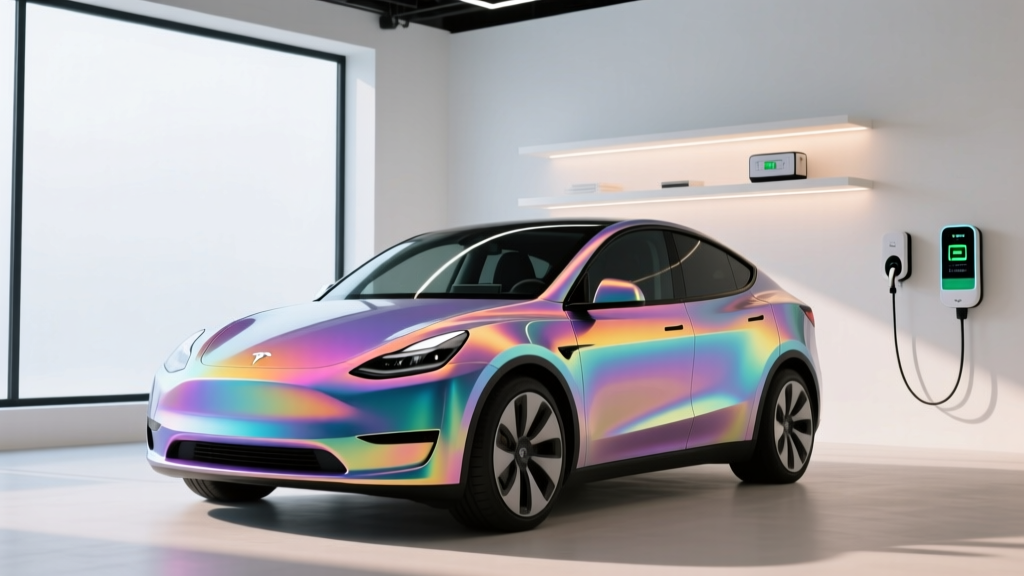
If you've scrolled through EV forums or Tesla owner groups recently, you've likely encountered the term Tesla Rainbow. It isn't a new factory paint code, a secret trim level, or an unreleased model — it's a grassroots customization trend where owners apply iridescent, color-shifting vinyl wraps to their vehicles, creating a prismatic effect that shifts hues depending on the viewing angle and lighting conditions.
As the trend gains traction heading into 2026, we're seeing a surge of searches around the phrase. This guide clarifies exactly what "Tesla Rainbow" refers to, what your actual color and customization options are for current Tesla models, and — because a wrap doesn't change the engineering — we break down the real specs, range, charging, and ownership costs of the vehicles underneath.
What Is the Tesla Rainbow Trend?
The "Tesla Rainbow" phenomenon is entirely aftermarket. Professional wrap shops across the U.S. report a sharp uptick in requests for chromatic and iridescent PPF (paint protection film) and vinyl wraps applied to Model 3, Model Y, Model S, and Model X bodies. These films use micro-prismatic layers that refract light, producing a rainbow-like color shift across the car's panels.
Popular wrap material brands offering these finishes include:
- 3M Dichroic Film series — premium color-shift vinyl with UV protection
- XPEL Colorflair PPF — combines paint protection with iridescent tint
- Avery Dennison Supreme Wrapping Film (Chromatic line) — widely used by professional installers
A full-body iridescent wrap typically costs between $3,500 and $7,000 depending on vehicle size, film brand, and shop labor rates. For a Model Y (the most common canvas), expect around $4,500–$5,500 at a reputable installer. The wrap generally lasts 5–7 years before the adhesive degrades or the film shows significant UV fading.
2026 Tesla Factory Paint Options & Pricing
Tesla streamlined its paint palette in recent years. Here's what's available directly from the factory for the 2026 Model 3 and Model Y lineup:
| Color | Type | Price (Model 3) | Price (Model Y) |
|---|---|---|---|
| Pearl White Multi-Coat | Standard (included) | $0 | $0 |
| Solid Black | Standard | $0 | $0 |
| Deep Blue Metallic | Premium | $1,000 | $1,000 |
| Ultra Red | Premium Multi-Coat | $2,000 | $2,000 |
| Quicksilver | Premium Multi-Coat | $2,000 | $2,000 |
For buyers planning a rainbow wrap anyway, choosing the included Pearl White or Solid Black saves $1,000–$2,000 on the purchase price — money that can go directly toward the wrap. White is actually the preferred base color for iridescent wraps because it maximizes the color-shift effect; dark bases mute the chromatic range.
Range, Battery & Efficiency: The Specs Under the Wrap
A vinyl wrap adds negligible weight (roughly 15–25 lbs for a full-body application) and has zero measurable impact on range or efficiency. The numbers that matter are the powertrain specs beneath the film. Here's the 2026 lineup:
| Spec | Model 3 RWD | Model 3 Long Range AWD | Model Y Long Range AWD | Model Y Performance |
|---|---|---|---|---|
| EPA Range | 272 mi | 341 mi | 320 mi | 285 mi |
| Battery (usable) | ~60 kWh (LFP) | ~75 kWh (NMC) | ~75 kWh (NMC) | ~75 kWh (NMC) |
| MPGe (combined) | 132 MPGe | 134 MPGe | 123 MPGe | 111 MPGe |
| Efficiency | 25 kWh/100mi | 25 kWh/100mi | 27 kWh/100mi | 30 kWh/100mi |
| 0–60 mph | 5.8 sec | 4.2 sec | 4.8 sec | 3.5 sec |
| Horsepower | 271 hp | 384 hp | 384 hp | 510 hp |
| Drivetrain | RWD | Dual-Motor AWD | Dual-Motor AWD | Dual-Motor AWD |
Source: fueleconomy.gov and Tesla specifications.
LFP vs NMC: Which Battery Is in Your Tesla?
The base Model 3 RWD uses a lithium iron phosphate (LFP) battery, while Long Range and Performance trims use nickel manganese cobalt (NMC) chemistry. The practical differences matter:
| Factor | LFP (Base Model 3) | NMC (Long Range / Performance) |
|---|---|---|
| Charge to 100% daily? | Yes — Tesla recommends it | No — 80% daily, 100% for trips |
| Cold-weather range loss | More pronounced (~30%) | Moderate (~20–25%) |
| Cycle life | Higher (3,000+ cycles) | Lower (~1,500–2,000 cycles) |
| Energy density | Lower (heavier pack) | Higher (more range per kg) |
| DC fast-charge speed | Slightly slower peak | Faster peak kW |
Charging Speed: DC Fast Charge & Home Level 2
Whether your Tesla wears a rainbow wrap or factory Pearl White, the charging hardware is identical. All 2026 Tesla vehicles sold in North America use the NACS (North American Charging Standard) connector natively — no adapter needed for Tesla Superchargers, and with the NACS industry adoption, an increasing number of third-party DC fast chargers from Electrify America, EVgo, and others.
| Charging Level | Power | Rate | Time / Notes |
|---|---|---|---|
| Level 1 (120V outlet) | ~1.4 kW | 3–5 mi/hr | 50+ hrs for full charge; emergency only |
| Level 2 (240V home) | 7.6–11.5 kW | 25–44 mi/hr | 8–10 hrs for full charge (overnight) |
| DC Fast Charge (V3 Supercharger) | Up to 250 kW peak | ~170 mi in 15 min | 10–80% in ~25–30 min |
| DC Fast Charge (V4 Supercharger) | Up to 350 kW peak | Faster initial ramp | 10–80% in ~18–22 min (model dependent) |
Charging curve reality: The "250 kW peak" figure applies only in the 10–30% state-of-charge window. Above 50% SoC, charge rate tapers significantly. Above 80%, it drops to under 50 kW. This is why the industry standard metric is 10–80% time, not peak kW. For road-trip planning, budget roughly 25–30 minutes at a V3 Supercharger stop — not the 15 minutes that marketing sometimes implies.
For home charging, Tesla's Wall Connector delivers up to 11.5 kW (48A) on a 60A circuit, adding roughly 44 miles of range per hour. A typical overnight session from 30% to 80% takes 4–5 hours. Installation costs range from $500 to $2,000 depending on your electrical panel's capacity and the run distance from panel to garage. Homes with older 100A service panels may need a $1,500–$3,000 panel upgrade — a factor often overlooked in budgeting.
Pricing, Trims & Federal Tax Credit Eligibility
| Model / Trim | Base MSRP | Under §30D MSRP Cap? | Potential Credit |
|---|---|---|---|
| Model 3 RWD | $38,990 | Yes ($55K sedan cap) | Up to $7,500* |
| Model 3 Long Range AWD | $45,990 | Yes | Up to $7,500* |
| Model Y Long Range AWD | $44,990 | Yes ($80K SUV cap) | Up to $7,500* |
| Model Y Performance | $48,990 | Yes | Up to $7,500* |
*Credit amount and eligibility depend on multiple factors. See IRS §30D guidelines for current rules.
§30D Tax Credit Eligibility Checklist
The federal clean vehicle credit is not automatic. For 2026, you must satisfy all of the following:
- Income caps: Modified AGI must not exceed $300,000 (married filing jointly), $225,000 (head of household), or $150,000 (single filers)
- MSRP caps: Sedans (Model 3) must be under $55,000; SUVs/trucks (Model Y, Model X) under $80,000
- Battery sourcing: A percentage of critical minerals and battery components must meet North American sourcing thresholds — these thresholds increase annually and can affect whether you receive the full $7,500 or only $3,750 (half-credit)
- Point-of-sale transfer: As of 2024, you can transfer the credit to the dealer at purchase, reducing your out-of-pocket cost immediately rather than waiting for tax filing
- One credit per vehicle, one per taxpayer per year: You cannot claim the credit on more than one new EV purchase per calendar year
Tesla's battery supply chain has been reshoring aggressively, and most 2026 Model 3 and Model Y vehicles built at Giga Austin and Giga Shanghai for the U.S. market are expected to qualify for at least a partial credit. However, the critical minerals requirement is the variable most likely to reduce the credit from $7,500 to $3,750. Always verify the specific VIN's eligibility on the fueleconomy.gov tax credit lookup tool before purchasing.
Interior, Cargo & Tech Features
The 2026 Model 3 "Highland" refresh and Model Y "Juniper" update brought meaningful interior improvements over earlier builds. Key dimensions:
| Dimension | Model 3 | Model Y |
|---|---|---|
| Front legroom | 42.7 in | 41.8 in |
| Rear legroom | 35.2 in | 41.6 in |
| Cargo (rear seats up) | 23 cu ft | 34 cu ft |
| Cargo (rear seats folded) | — (sedan trunk) | 76 cu ft |
| Frunk | 3.1 cu ft | 4.1 cu ft |
Tech highlights for 2026:
- 15.4-inch center touchscreen (Model 3) / 15.4-inch center + 8-inch rear screen (Model Y)
- Ambient lighting strips across the dashboard and doors (Highland/Juniper)
- Ventilated front seats (previously Tesla-only in Model S/X)
- Acoustic glass all around — significantly improved cabin quietness over pre-2024 models
- Hardware 4 (HW4) Autopilot computer with improved camera resolution and processing
- Over-the-air updates continue to add features post-purchase
Notable drawbacks:
- No traditional instrument cluster — all speed/navigation info is on the center screen
- Turn signals on the steering wheel (not a stalk) remain polarizing among owners
- Rear-seat comfort in the Model 3 is tighter than competitors like the Hyundai Ioniq 6
- No Apple CarPlay or Android Auto — Tesla's proprietary infotainment only
Driver Assistance: Autopilot & FSD (Supervised)
Tesla Autopilot and Full Self-Driving (Supervised) are Level 2 driver-assistance systems, not autonomous driving. The driver must remain fully engaged, hands on or near the wheel, eyes on the road, and ready to take over at any moment. Tesla's FSD (Supervised) can navigate intersections, change lanes, and handle highway on/off-ramps, but it makes errors and requires constant human supervision. No Tesla vehicle sold today is capable of unsupervised self-driving.
Pricing for 2026:
- Basic Autopilot: Included (lane centering, adaptive cruise control, emergency braking)
- Enhanced Autopilot: $6,000 (adds auto lane change, autosteer on city streets, auto park, summon)
- FSD (Supervised): $8,000 one-time or $99/month subscription
Whether FSD is worth $8,000 remains one of the most debated topics in the EV community. Our take: the $99/month subscription is the more rational choice for most buyers. It lets you evaluate the system on your commute without an $8,000 upfront commitment, and you can cancel if it doesn't meet your expectations. Safety data from NHTSA continues to show that Level 2 systems reduce certain crash types but introduce new risks around driver inattention.
Warranty & Long-Term Battery Durability
Tesla's warranty structure for 2026:
| Coverage | Model 3 | Model Y |
|---|---|---|
| Basic Vehicle | 4 yr / 50,000 mi | 4 yr / 50,000 mi |
| Battery & Drive Unit | 8 yr / 100,000 mi (RWD) 8 yr / 120,000 mi (LR/Perf) | 8 yr / 120,000 mi |
| Capacity retention threshold | 70% minimum | 70% minimum |
Real-world degradation data from fleet studies shows that Tesla NMC batteries typically lose about 5–8% capacity in the first 50,000 miles, then the degradation curve flattens significantly. LFP batteries in the base Model 3 show even slower degradation, with many fleet vehicles retaining 95%+ capacity after 100,000 miles. Out-of-warranty battery replacement costs range from $12,000 to $16,000 depending on the pack — a figure that has been declining as Tesla's cell costs drop, but it's still a significant potential expense for second owners.
Pros, Cons & Who the Tesla Rainbow Trend Suits
Pros
- Access to Tesla's Supercharger network — still the most reliable DC fast-charging ecosystem in North America
- Industry-leading software and OTA update cadence
- Strong efficiency (kWh/mile) relative to competitors
- High resale value compared to most EVs
- Wrap customization allows unlimited personalization without permanent paint changes
- Qualifies for §30D tax credit (subject to eligibility rules)
Cons
- No Apple CarPlay / Android Auto
- Turn signal buttons on steering wheel are unintuitive for many drivers
- Service center wait times remain long in many metro areas
- FSD costs $8,000 extra and is still Level 2 — not self-driving
- Wrap adds $3,500–$7,000 on top of vehicle cost
- Insurance premiums tend to be higher than non-Tesla EVs
Who Is This For?
The Tesla Rainbow wrap trend appeals to owners who want personalization and visual distinctiveness in a market where most Teslas look identical on the road. If you're drawn to the trend, here's how the underlying vehicle maps to use cases:
- Daily commuter (under 60 miles round-trip): Model 3 RWD is the sweet spot — lowest cost, LFP battery loves daily 100% charges, and home charging covers all needs
- Frequent road-tripper: Model 3 Long Range or Model Y Long Range — the Supercharger network and 300+ mile range make multi-state drives practical
- Family with kids/gear: Model Y — 76 cu ft of cargo space with seats folded, higher ride height, and the rear entertainment screen keep passengers content
- Performance enthusiast: Model Y Performance — 3.5-second 0–60 is sports-car territory in a practical crossover
Tesla Rainbow FAQ
Does the Tesla Rainbow wrap affect range or efficiency?
No. A full-body vinyl wrap adds approximately 15–25 pounds — less than a passenger's backpack. There is no measurable impact on range, efficiency, or charging speed. The aerodynamic profile of the vehicle is unchanged.
Will wrapping my Tesla void the warranty?
A professionally installed vinyl wrap does not void Tesla's battery or powertrain warranty. However, if the wrap adhesive damages paint or trim during removal, that cosmetic damage would not be covered. Choose an experienced installer and keep documentation of the installation.
How much does a rainbow/iridescent Tesla wrap cost?
Expect $3,500–$7,000 for a full-body chromatic or iridescent wrap, depending on film brand, vehicle size (Model 3 costs less than Model X), and regional labor rates. Premium films like XPEL Colorflair or 3M Dichroic tend to be at the higher end but offer better UV resistance and longevity.
Can I remove the wrap and return to factory paint?
Yes — that's one of the main advantages of wrapping over a respray. Factory paint in good condition will emerge intact underneath. In fact, the wrap protects the original paint from UV damage and minor chips during its lifespan, potentially preserving resale value.
Does a wrapped Tesla still qualify for the federal tax credit?
Yes. The §30D credit is based on the vehicle's MSRP, battery sourcing, and buyer income — not on aftermarket modifications. A wrap applied after purchase has no effect on credit eligibility. If the wrap is dealer-installed before delivery and included in the purchase agreement, ensure the total MSRP still falls under the $55K/$80K cap.
Is a Tesla Rainbow wrap legal for registration and insurance?
Yes, in all 50 states. Vinyl wraps are treated the same as factory paint for registration purposes. However, you should notify your insurance company of the wrap, as it represents an aftermarket modification. Some insurers may require a rider or adjusted coverage for the wrap's value.