Why Tesla Owners Are Searching for Radiator Cleaning Costs
Teslas don't have traditional radiators in the internal-combustion sense, but they do rely on a sophisticated thermal management system with condensers, heat exchangers, and coolant loops that serve the same fundamental purpose: moving heat away from critical components. When debris, bug buildup, and road grime clog the front-end heat exchanger, owners start noticing reduced efficiency, slower DC fast charging, and in extreme cases, thermal throttling during sustained highway driving or Supercharging sessions.
The search for "Tesla radiator cleaning cost" has grown as the fleet ages and more Model 3 and Model Y vehicles cross the 80,000-mile mark. This guide breaks down what you'll actually pay to have your Tesla's thermal system cleaned or serviced in 2026, what the warning signs are, and how thermal maintenance ties directly into your vehicle's real-world range and charging performance.
What the Tesla "Radiator" Actually Is
Tesla's thermal management architecture is fundamentally different from a gas car's cooling system. Rather than a single radiator cooling engine coolant, Teslas use a multi-loop system:
- Drive unit coolant loop: Cools the electric motor(s) and inverter
- Battery thermal loop: Maintains the battery pack within its optimal temperature window (roughly 70–95°F / 21–35°F for peak efficiency)
- Cabin HVAC loop: Heat pump and A/C condenser for climate control and battery preconditioning
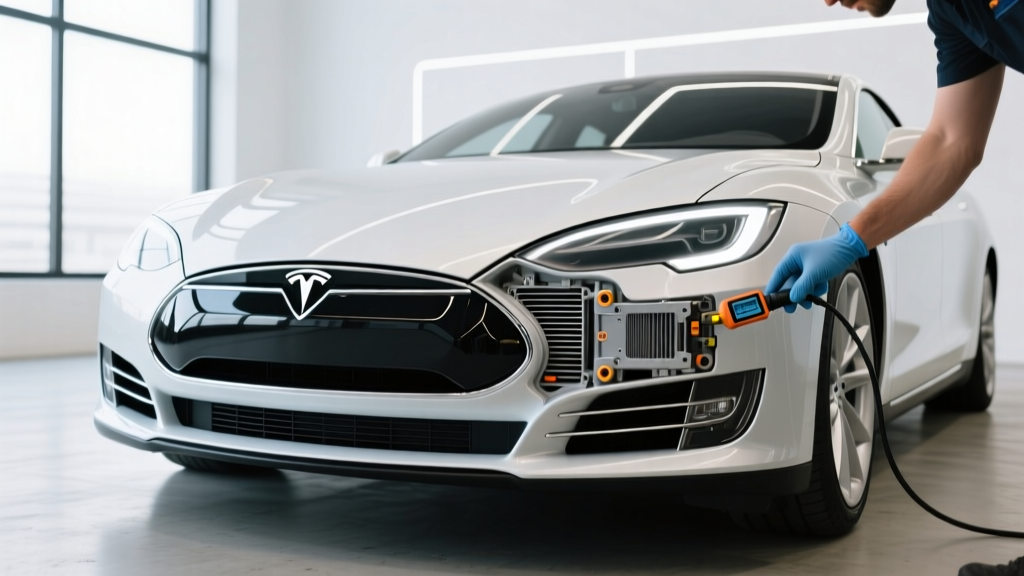
- Front-end heat exchanger stack: The closest analog to a "radiator" — a set of aluminum fin-and-tube heat exchangers mounted behind the front bumper and fascia
It's this front-end heat exchanger stack that accumulates debris. Located low and forward for maximum airflow, it acts as a filter for everything your Tesla drives through: insects, cottonwood, road salt residue, tar chips, and fine dust. Over 40,000–60,000 miles, the fin density becomes packed enough to restrict airflow, reducing the system's ability to shed heat.
Tesla Radiator Cleaning Cost Breakdown (2026)
Unlike an oil change, Tesla doesn't publish a standard "radiator cleaning" service menu item. Thermal system cleaning is typically performed by independent EV specialists or detail shops with EV experience. Here's what owners are paying in 2026:
| Service Type | Provider | Cost Range | Notes |
|---|---|---|---|
| Basic exterior condenser rinse | DIY / Mobile detailer | $0–$80 | Garden hose + soft spray nozzle from front wheel well access; low risk, moderate effectiveness |
| Professional front-end heat exchanger cleaning | Independent EV shop | $150–$350 | Bumper cover or undertray removal, low-pressure wash with coil cleaner, fin comb if needed |
| Full thermal system flush (coolant loops) | Tesla Service Center | $400–$650 | Coolant drain, flush, and refill of battery and drive unit loops; typically done at 100K+ miles |
| Heat exchanger replacement (damaged fins) | Tesla Service Center | $800–$1,800 | Required if fins are corroded through or physically crushed; part + labor |
| Heat pump assembly replacement | Tesla Service Center | $2,500–$4,200 | Out of warranty; covers the octovalve and heat pump unit, not routine cleaning |
The sweet spot for most owners: A professional front-end heat exchanger cleaning at $150–$350 every 40,000–50,000 miles (or every 2–3 years in dusty or high-bug regions). This is a fraction of what you'd spend on annual oil changes and air filter replacements for an ICE vehicle.
Signs Your Tesla's Heat Exchanger Needs Cleaning
Tesla doesn't provide a dashboard alert specifically for condenser or heat exchanger blockage, but the symptoms show up in performance data you can monitor:
- Reduced Supercharging speed: If your usual 150–250 kW peak has dropped to 100–120 kW and the battery is preconditioned, thermal restriction is a prime suspect
- Higher kWh/100mi consumption: Check your trip energy graph; a 5–10% increase in consumption at the same speeds and temperatures points to thermal inefficiency
- Cabin A/C struggles in heat: The heat pump and A/C share the front-end exchanger; reduced airflow means warmer cabin temps on 95°F+ days
- Fan noise at low speeds: The cooling fans work harder to compensate for restricted airflow — you'll hear them more at stoplights or while parked and charging
- Track-mode or sustained-hill thermal warnings: Performance models may hit thermal limits sooner on repeated hard acceleration or long mountain descents
How Thermal Maintenance Affects Your Tesla's Range and Charging
The connection between a clean heat exchanger and real-world performance is not trivial. Tesla's Octovalve-equipped vehicles (Model Y, refreshed Model 3, and all vehicles built from 2021 forward with the heat pump system) rely heavily on thermal efficiency to manage battery preconditioning for DC fast charging.
When the front-end heat exchanger is clogged:
- Preconditioning takes longer: The system can't heat or cool the battery as quickly before a Supercharger stop, meaning you arrive at the charger with a suboptimal battery temperature
- Charge curve tapers earlier: Even with a preconditioned battery, a restricted heat exchanger means the thermal system can't shed the heat generated during high-C-rate charging, so the BMS pulls back charge power sooner — instead of holding 200+ kW to 50% SoC, it may taper at 30%
- Cold-weather range loss compounds: In winter, the heat pump already works harder. A clogged exchanger forces the system to use resistive heating (the PTC heater) more frequently, which draws significantly more energy from the pack
2026 Tesla Model Y Long Range: Key Specs at a Glance
Since thermal maintenance questions skew heavily toward Model Y owners (the highest-volume Tesla on the road), here are the current specs for context:
| Specification | 2026 Model Y Long Range AWD |
|---|---|
| EPA Range | 330 miles |
| Battery Capacity | ~75 kWh usable (NMC chemistry) |
| Efficiency | 122 MPGe combined / 27 kWh/100mi |
| DC Fast Charge Peak | 250 kW (CCS/NACS) |
| 10–80% DC Charge Time | ~27 minutes (at V3/V4 Supercharger) |
| Level 2 Home Charge Rate | 11.5 kW (~44 miles/hr) |
| 0–60 mph | 4.8 seconds |
| Horsepower | 384 hp (dual motor) |
| Drivetrain | Dual Motor AWD |
| Cargo Volume | 76.2 cu ft (rear seats folded) |
| Rear Legroom | 41.6 inches |
| Battery Warranty | 8 years / 120,000 miles |
| Base MSRP | $48,990 (before destination) |
DIY vs. Professional Tesla Condenser Cleaning: What's Safe
Some owners tackle basic condenser cleaning themselves. If you're considering the DIY route, here's what you need to know:
What you CAN do safely
- Remove the front undertray (typically 8–10 clips/bolts on Model Y) and spray the heat exchanger face with a low-pressure garden hose from the bottom up
- Use a foaming coil cleaner (HVAC-rated, non-acidic) applied with a pump sprayer, let it dwell for 5–10 minutes, then rinse gently
- Inspect the fins with a flashlight for physical damage or heavy buildup
What you should NOT do
- Never use a pressure washer — Tesla's aluminum fins are thin and will bend or puncture at pressures above ~500 PSI, turning a $200 cleaning into a $1,200 part replacement
- Don't spray directly into the electrical connectors or the Octovalve assembly (visible behind the exchanger on heat-pump-equipped vehicles)
- Don't attempt to remove the bumper cover yourself unless you have experience with Tesla's clip and fastener system — the fascia clips break easily and replacement trim costs add up
For most owners, the $150–$350 professional cleaning is the right call. A shop that specializes in EVs will have the proper fin combs, coil cleaners, and the experience to remove and reinstall the undertray without damage. According to Tesla's official maintenance guidance, there is no scheduled radiator or coolant flush interval for normal driving, but the company does recommend cabin air filter replacement and brake fluid checks — the thermal system is largely "inspect as needed."
Federal Tax Credit & Ownership Cost Context
If you're evaluating whether to invest in thermal maintenance or put that money toward a new EV purchase, here's where the 2026 Tesla lineup stands on federal incentives:
| Model | Base MSRP | §30D Credit Eligibility | Effective Price (est.) |
|---|---|---|---|
| Model 3 RWD | $39,990 | Up to $7,500 (subject to income, sourcing) | ~$32,490 |
| Model 3 Long Range AWD | $47,990 | Up to $7,500 (subject to income, sourcing) | ~$40,490 |
| Model Y Long Range AWD | $48,990 | Up to $7,500 (subject to income, sourcing) | ~$41,490 |
| Model Y Performance | $53,990 | Up to $7,500 (subject to income, sourcing) | ~$46,490 |
IRS §30D eligibility requirements (2026):
- Income caps: Modified AGI must not exceed $150,000 (single), $225,000 (head of household), or $300,000 (joint filers)
- MSRP caps: Vans, SUVs, and pickup trucks must have an MSRP at or below $80,000; sedans at or below $55,000
- Battery sourcing: Critical minerals and battery components must meet phased-in domestic/content requirements that tighten annually through 2030 — check the latest IRS guidance on qualifying vehicles before purchasing
- Point-of-sale transfer: You can transfer the credit to the dealer at purchase to reduce your out-of-pocket cost, or claim it on your tax return
A $250 heat exchanger cleaning is a tiny fraction of your Tesla's total cost of ownership. Over five years and 75,000 miles, you'll likely spend $300–$500 total on thermal system maintenance — compared to $2,000–$4,000 in oil changes, coolant flushes, and transmission fluid services for a comparable ICE crossover.
Is Thermal Maintenance Covered Under Tesla's Warranty?
Tesla's New Vehicle Limited Warranty (4 years / 50,000 miles) and Battery & Drive Unit Warranty (8 years / 120,000 miles for Model Y Long Range) cover defects in materials and workmanship — but not routine maintenance or damage from environmental debris.
If your heat exchanger fails due to a manufacturing defect (e.g., a leak at a brazed joint), it's covered. If it's clogged with cottonwood and your Supercharging speeds drop, that's a maintenance item — you'll pay out of pocket regardless of warranty status. This is consistent with how every automaker treats air filtration and cooling system maintenance.
The battery warranty specifically guarantees that the pack will retain at least 70% of its original capacity over the warranty period. Poor thermal management from a clogged exchanger won't void the battery warranty, but it can accelerate degradation by forcing the battery to operate outside its ideal temperature range more frequently. Keeping the thermal system clean is one of the most impactful things you can do for long-term battery health and efficiency.
Pros of Proactive Thermal Maintenance
- Restores 5–12% efficiency in warm climates
- Improves DC fast-charge speeds by allowing sustained peak kW
- Reduces cooling fan noise and HVAC strain
- Extends battery lifespan by maintaining optimal thermal windows
- Low cost relative to ICE maintenance ($150–$350 every 2–3 years)
Cons & Limitations
- Not a scheduled service — requires owner vigilance or monitoring
- No Tesla dashboard alert for heat exchanger blockage
- DIY cleaning risks fin damage if done improperly
- Independent EV shops may not be available in all regions
- Does not address internal coolant loop degradation (separate service)
Frequently Asked Questions
How often should I clean my Tesla's condenser or heat exchanger?
Most owners benefit from a professional cleaning every 40,000–50,000 miles or every 2–3 years. If you drive in agricultural areas, heavy-bug regions, or dusty construction zones, consider annual inspections. There is no official Tesla-recommended interval — monitor your efficiency data and charging speeds for early warning signs.
Can a clogged heat exchanger damage my Tesla's battery?
Not immediately, but chronic thermal restriction forces the battery to operate at higher temperatures during charging and driving, which accelerates long-term degradation. Tesla's battery management system (BMS) will throttle performance to protect the pack, so you'll notice reduced power and charging speed before any damage occurs.
Does Tesla Service offer heat exchanger cleaning?
Tesla Service Centers will perform coolant flushes and replace damaged components, but they do not typically offer a standalone "condenser cleaning" service. Most owners use independent EV shops or mobile detailers with Tesla experience for this specific maintenance item.
Will cleaning the heat exchanger void my Tesla warranty?
No. Routine cleaning of accessible components does not void any Tesla warranty. However, if you or a shop damages the fins, connectors, or Octovalve during cleaning, that damage will not be covered. Choose a provider with documented EV experience.
How much does a Tesla coolant flush cost?
A full coolant loop flush and refill at a Tesla Service Center typically runs $400–$650 in 2026. Most owners won't need this until 100,000+ miles unless there's a contamination event or component replacement that requires draining the system.
Does the Tesla Model 3 have the same heat exchanger design as the Model Y?
The refreshed Model 3 (2024+) shares the heat-pump-based thermal architecture with the Model Y, including the Octovalve and front-end heat exchanger stack. Older Model 3 vehicles (pre-2021) use a simpler resistive-heater-based system with a different front-end cooling layout, but the condenser cleaning principles and costs are similar.