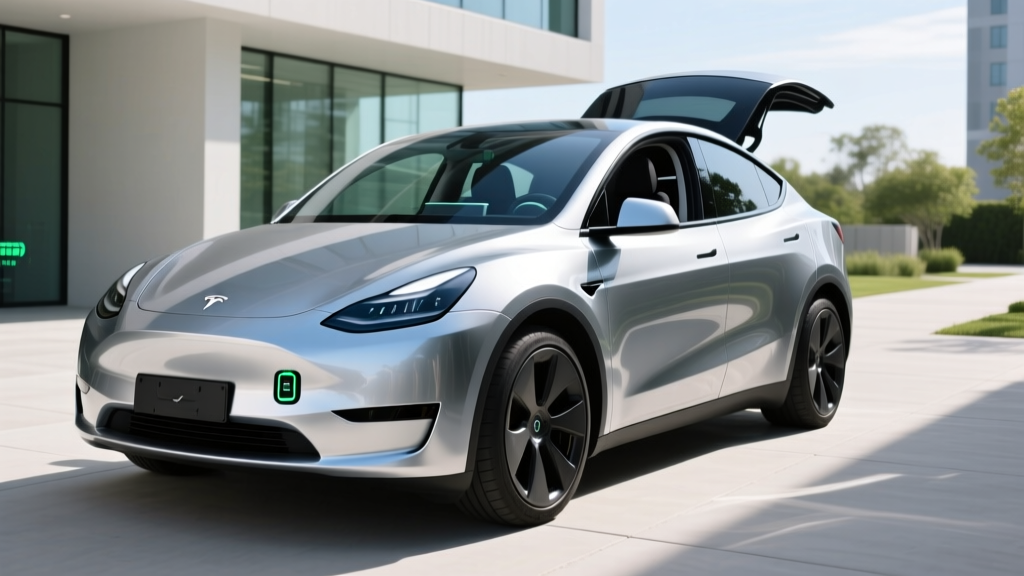
The Tesla Quicksilver color has become one of the most debated exterior options in the EV world. Originally introduced as a premium multi-coat finish, Quicksilver shifts between cool steel-gray and warm champagne depending on the light — a chameleon effect that has made it a top choice for Model Y buyers who want something beyond the ubiquitous Pearl White and Solid Black. But does the aesthetic upgrade justify its premium price, and more importantly, how does the 2026 Tesla Model Y underneath that paint perform as a daily-driver EV?
In this review, we evaluate the Quicksilver paint option in context — paired with a thorough breakdown of the 2026 Model Y Long Range AWD's range, charging, performance, interior, and total cost. Whether you're cross-shopping the Model Y against the Hyundai Ioniq 5, Ford Mustang Mach-E, or BMW iX3, this guide gives you the exact numbers you need.
2026 Tesla Model Y Quicksilver: Spec Snapshot
| Spec | Value |
|---|---|
| EPA Range | 320 miles |
| Battery (usable) | ~75 kWh, NMC (nickel manganese cobalt) |
| Drivetrain | Dual-Motor AWD |
| Horsepower | 384 hp (combined) |
| 0–60 mph | 4.8 seconds |
| Peak DC Fast Charge | 250 kW (Supercharger V3/V4) |
| 10–80% DC Charge Time | ~27 minutes |
| Level 2 Home Charging | 11.5 kW (~44 mi/hr) |
| Efficiency | 122 MPGe / 28 kWh/100 mi |
| Cargo Volume | 30.2 cu ft (rear up) / 72.1 cu ft (rear folded) |
| Battery Warranty | 8 years / 120,000 miles |
| Base MSRP (Long Range AWD) | $48,990 |
| Quicksilver Paint Add-On | $2,500 |
What Is the Tesla Quicksilver Color, Exactly?
Quicksilver is a multi-coat metallic finish that Tesla added to the premium paint palette. Unlike single-stage solid colors, it uses multiple layers of metallic flake and clear coat to produce a liquid-metal appearance. In direct sunlight, it reads as a bright, polished silver with subtle warm undertones. In overcast conditions or shade, it shifts toward a darker gunmetal gray. At dusk, some owners report a faint champagne-bronze cast.
The paint is applied at Tesla's Fremont or Austin paint shops using a process similar to the Ultra Red and Deep Blue Metallic multi-coat options. It requires more labor and material than Pearl White Multi-Coat, which is why Tesla charges a $2,500 premium. For comparison, Solid Black costs $1,500, while Pearl White is included at no extra cost on most trims.
Quicksilver vs. Other Tesla Silver and Gray Options
Tesla previously offered Midnight Silver Metallic (a darker, more uniform gray) and, in earlier years, a standard Silver that was discontinued. Quicksilver replaces Midnight Silver Metallic in the current lineup and is noticeably brighter and more reflective. If you're comparing the two: Quicksilver has more depth and color-shift; Midnight Silver was flatter and more subdued. Quicksilver also hides swirl marks and light scratches better than Solid Black, though not as well as Pearl White.
Real-World Range: Beyond the 320-Mile EPA Sticker
Real-World Highway (70–75 mph, 65°F): ~265–285 miles
Real-World City/Mixed: ~290–310 miles
Cold-Weather Highway (30°F or below): ~210–240 miles (30–35% reduction)
Hot-Weather Highway (95°F+, A/C running): ~260–280 miles
The 2026 Model Y Long Range AWD carries an EPA-estimated 320 miles of range. That figure assumes a mix of city and highway driving at moderate temperatures. In practice, highway driving at sustained speeds of 70–75 mph consumes energy faster than the EPA cycle predicts. Expect roughly 265–285 miles on a flat interstate run in mild weather.
Cold weather is the bigger variable. Lithium-ion batteries lose efficiency in freezing temperatures, and cabin heating draws significant power even with Tesla's standard heat pump. In sub-30°F conditions, plan for 210–240 miles of usable range on highway trips. Preconditioning the battery while plugged in (using the Tesla app's scheduled departure feature) mitigates some of this loss by warming the pack before you drive.
For most commuters driving 30–50 miles round-trip, the Model Y Long Range needs charging only twice a week at home. Road trippers will find Tesla's Supercharger network — now exceeding 6,000 stations in North America — makes 320 miles of EPA range practical for long hauls with 20–25-minute stops every 200–230 miles.
Charging Speed: DC Fast, Level 2, and the Charge Curve Reality
| Charging Level | Power | Speed | Notes |
|---|---|---|---|
| Level 1 (120V household) | ~1.4 kW | ~4 mi/hr | Emergency/trickle only |
| Level 2 (240V home, 48A) | 11.5 kW | ~44 mi/hr | Full charge in ~7.5 hours |
| DC Fast (Tesla Supercharger V3/V4) | Peak 250 kW | 10–80% in ~27 min | Tapers significantly above 80% |
| DC Fast (CCS adapter, Electrify America) | Peak ~150–200 kW | 10–80% in ~32–38 min | Depends on station output |
The Model Y Long Range peaks at 250 kW on Tesla's V3 and V4 Superchargers using its native NACS connector. However, peak rate is not sustained rate. The charge curve is aggressive in the 10–50% state-of-charge window, then tapers progressively. You'll add roughly 175 miles of range in the first 15 minutes, but the final 20% (80–100%) can take as long as the first 70% due to cell-balancing and thermal management.
For home charging, a Level 2 wall connector on a 60-amp circuit (48 amps continuous) delivers 11.5 kW, adding about 44 miles of range per hour. A full 10–100% charge takes roughly 7.5 hours — ideal for overnight replenishment. Installation costs for a home Level 2 setup typically range from $800 to $2,500 depending on panel proximity and whether your electrical panel needs a 200-amp upgrade. Always consult a licensed electrician for final specifications.
With Tesla's CCS adapter (sold separately for ~$175), Model Y owners can also access Electrify America, EVgo, and other CCS-equipped networks. Expect slower peak speeds (150–200 kW) due to adapter overhead and network variability.
Performance and Driving Dynamics
The 2026 Model Y Long Range AWD uses a dual-motor setup with a permanent-magnet motor on the rear axle and an induction motor up front. Combined output is 384 horsepower, delivering a 4.8-second 0–60 mph time. That's quick enough to merge confidently onto any freeway and overtake without hesitation, though it trails the Performance variant's 3.5-second sprint.
Regenerative braking is strong and adjustable. In "Hold" mode, the Model Y delivers near one-pedal driving — lifting off the accelerator slows the car substantially, often eliminating the need for the brake pedal in stop-and-go traffic. The low center of gravity from the under-floor battery pack keeps body roll controlled in corners, though the 4,398-lb curb weight is noticeable during aggressive direction changes.
Ride quality on the 2026 refresh has improved over earlier Model Y generations. Tesla revised the suspension tuning and added acoustic glass to reduce cabin noise. It's still firm by luxury-SUV standards — you'll feel sharp pavement imperfections — but it's no longer the harsh experience some early reviewers described.
Interior, Cargo, and Technology
The 2026 Model Y interior follows Tesla's minimalist philosophy: a single 15.4-inch center touchscreen controls nearly all vehicle functions, including climate, mirrors, and glovebox. There is no traditional instrument cluster — speed and navigation appear on the upper-left corner of the main display. A rear 8-inch screen serves second-row passengers for climate and entertainment.
Cargo and Passenger Space
- Cargo (behind 2nd row): 30.2 cu ft
- Cargo (2nd row folded): 72.1 cu ft
- Front trunk (frunk): 4.1 cu ft
- Rear legroom: 40.5 inches
- Front headroom: 41.0 inches
- Seating: 5 passengers standard (7-seat option discontinued for 2026)
The Model Y's cargo volume is competitive with the Ford Mustang Mach-E (29.7 cu ft) and exceeds the Hyundai Ioniq 5 (27.2 cu ft). The frunk adds useful space for charging cables or a small bag. The flat floor and wide hatch opening make loading bulky items straightforward.
Driver Assistance: Autopilot and FSD (Supervised)
Every Model Y ships with Tesla's Basic Autopilot, which includes adaptive cruise control and lane-centering on marked highways. The $8,000 Full Self-Driving (Supervised) package adds automated lane changes, traffic-light and stop-sign recognition, and the ability to navigate on-ramp to off-ramp on highways. FSD has improved substantially through 2025–2026 neural-network updates, but it still requires alert driver oversight and occasionally makes unexpected decisions in construction zones or unmapped areas.
Pricing, Trims, and Federal Tax Credit Eligibility
| Trim | Base MSRP | With Quicksilver | Est. After §30D Credit |
|---|---|---|---|
| Long Range RWD | $44,990 | $47,490 | From ~$37,490* |
| Long Range AWD | $48,990 | $51,490 | From ~$41,490* |
| Performance AWD | $53,490 | $55,990 | From ~$45,990* |
*After-tax-credit prices assume full $7,500 §30D credit eligibility. Actual credit depends on buyer income, battery sourcing, and MSRP caps. See eligibility checklist below.
Adding the Quicksilver paint ($2,500) to a Long Range AWD pushes the MSRP to $51,490 before destination. With common options — FSD ($8,000), 20-inch Induction wheels ($2,000), and white interior ($1,000) — an as-tested Model Y Quicksilver can reach $62,490.
Federal EV Tax Credit (§30D) Eligibility Checklist
- MSRP Cap: SUVs/vans/pickups must be under $80,000 — all Model Y trims qualify.
- Buyer Income Cap: Modified AGI must not exceed $150,000 (single), $225,000 (head of household), or $300,000 (joint filers).
- Battery Sourcing: Critical minerals and battery components must meet phased-in percentage thresholds from US or free-trade-agreement partners. Tesla's Austin-built Model Y has progressively increased domestic sourcing, but eligibility can shift by production batch.
- Point-of-Sale Transfer: Buyers can transfer the credit to the dealer (Tesla) at purchase, reducing the upfront price by up to $7,500 rather than waiting for a tax refund.
- Verification: Always check the current fueleconomy.gov tax credit listing and consult a tax professional for your specific situation. Rules under IRS §30D are subject to change.
Who Should Buy the Model Y in Quicksilver?
- Commuters who can charge at home and want 300+ miles of daily buffer
- Small families needing car-seat-friendly rear space and 72 cu ft of cargo room
- Road trippers who value Supercharger network access over brand prestige
- Tech-forward buyers who want OTA updates and app-based vehicle control
- You need a plush, quiet luxury ride (BMW iX, Genesis GV60 ride smoother)
- You want physical buttons and a traditional instrument cluster
- You regularly tow heavy loads (Model Y is rated for 3,500 lbs, but range drops sharply)
- You lack home charging access and your area has limited public DC infrastructure
Pros and Cons: 2026 Model Y Quicksilver
Pros
- Class-leading Supercharger network reliability
- Strong real-world efficiency (28 kWh/100 mi)
- Quicksilver paint hides minor imperfections well and stands out from white/black fleet
- Spacious cargo area with practical hatch and frunk
- Continuous OTA updates add features post-purchase
- Heat pump standard — better cold-weather range retention
Cons
- $2,500 premium for Quicksilver is steep for a paint option
- Minimalist interior frustrates buyers who prefer physical controls
- Ride quality firm on rough pavement, even after 2026 suspension revisions
- FSD ($8,000) remains a Level 2 system despite the name
- Insurance premiums run 15–25% higher than comparable gas SUVs
- DC charging tapers hard above 80% — plan stops accordingly
Model Y Quicksilver vs. Key Competitors
At the $50,000–$55,000 price point with Quicksilver, the Model Y Long Range AWD competes directly with:
- Hyundai Ioniq 5 Limited AWD: $54,600, 290 mi EPA, 800V architecture enables 10–80% in ~18 min on 350 kW chargers. More distinctive design, physical buttons, but less cargo space and no frunk.
- Ford Mustang Mach-E Premium AWD (Extended Range): $53,995, 290 mi EPA. More engaging steering feel and BlueCruise hands-free driving on mapped highways. Smaller Supercharger-adjacent charging network.
- BMW iX xDrive50: Starts at $87,250 — significantly more expensive but offers genuine luxury ride, sound insulation, and build quality the Model Y can't match.
The Model Y's primary advantages remain Supercharger access, efficiency, and cargo versatility. The Ioniq 5 charges faster on compatible hardware and offers a more conventional interior. The Mach-E drives more engagingly. If the Quicksilver paint is a priority, only Tesla offers it — no competitor has an equivalent color option.
Frequently Asked Questions
Is the Tesla Quicksilver color worth the $2,500 premium?
If you plan to keep the vehicle 4+ years and care about exterior aesthetics, Quicksilver offers a distinctive look that holds up well in daily use. It hides light scratches better than black and stands out from the dominant white and gray EVs in most parking lots. For resale, unique premium colors tend to perform modestly better than base white on Tesla vehicles, though the $2,500 investment won't fully recoup at trade-in.
Does the 2026 Model Y qualify for the full $7,500 federal tax credit?
The Model Y's MSRP falls well under the $80,000 SUV cap, so the vehicle itself is eligible. However, your personal eligibility depends on income limits ($150K single / $300K joint) and whether the specific production batch meets current critical-mineral and battery-component sourcing thresholds. Tesla's point-of-sale transfer lets you apply the credit at purchase. Verify on irs.gov before ordering.
How does Quicksilver look after a year of daily driving?
Multi-coat metallic paints like Quicksilver are durable, but all Tesla paint is relatively soft compared to German OEM finishes. Expect minor stone chips on the hood and front bumper after 12–18 months of highway driving. Many owners apply paint-protection film (PPF) to the front clip — budget $1,200–$2,000 for professional installation. Regular hand-washing and ceramic coating help maintain the color-shift effect.
Can I get Quicksilver on the Model Y Performance trim?
Yes. Quicksilver is available across all 2026 Model Y trims — Long Range RWD, Long Range AWD, and Performance — at the same $2,500 add-on price. It is not available on the base Standard Range RWD (if offered in your market), which limits exterior options to fewer colors.
What's the real cost to charge a Model Y at home vs. Superchargers?
At the US average residential electricity rate of ~$0.16/kWh, a full 75 kWh charge costs about $12 and delivers ~265 real-world highway miles — roughly $0.045 per mile. Supercharger pricing varies by location and time but averages $0.30–$0.35/kWh, making a full charge $22–$26 and per-mile cost ~$0.09. Compare that to a 25-MPG gas SUV at $3.50/gallon: $0.14 per mile. Home charging delivers the best economics; exclusive Supercharger use narrows the savings gap but still undercuts gasoline.