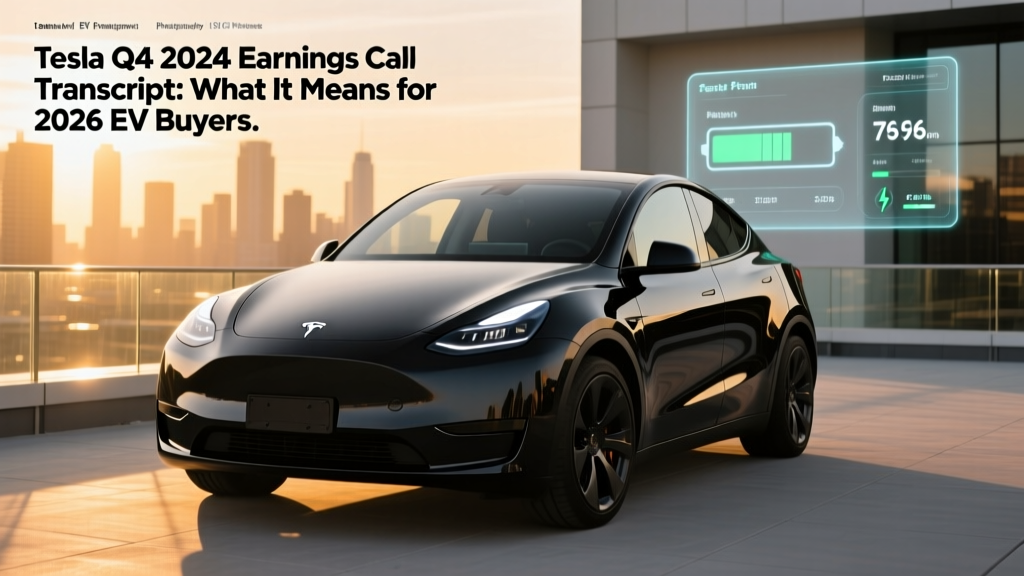
The Investor Angle: Decoding the Tesla Q4 2024 Earnings Call Transcript
While most auto industry watchers focus on quarterly delivery numbers, the Tesla Q4 2024 earnings call transcript offered a rare glimpse into the engineering and manufacturing shifts that define the 2026 model year. For prospective buyers of the Model 3 and Model Y, these financial discussions are actually roadmaps for upcoming hardware changes, battery chemistry transitions, and pricing strategies. As we move through 2026, the promises made during that call—specifically regarding the "Juniper" refresh and the next-generation platform—are now hitting the driveways.
2026 Model 3 & Model Y: The "Juniper" Reality
The most significant takeaway from the Q4 2024 earnings call was the confirmation of the comprehensive Model Y refresh, following the Model 3 "Highland" update. In 2026, both vehicles benefit from improved acoustic glass, a new suspension tuning, and the removal of ultrasonic sensors (USS) in favor of Tesla Vision. Below are the finalized specs for the 2026 Long Range AWD versions of both platforms.
| Feature | 2026 Model 3 Long Range AWD | 2026 Model Y Long Range AWD |
|---|---|---|
| EPA Est. Range | 363 miles | 320 miles |
| Battery Capacity | 79 kWh (NMC) | 81 kWh (NMC) |
| Peak DC Charge Rate | 250 kW | 250 kW |
| 10-80% Charge Time | ~28 minutes | ~27 minutes |
| 0-60 mph | 4.2 seconds | 4.8 seconds |
| Drivetrain | Dual-Motor AWD | Dual-Motor AWD |
| Base MSRP | $47,740 | $50,240 |
Range and Efficiency: Real-World Expectations
While the EPA estimates are impressive, the earnings call transcript highlighted Tesla's focus on "energy efficiency per mile" as a core margin driver. The 2026 Model 3 achieves an industry-leading 132 MPGe combined. However, buyers should be aware of the real-world variables.
Charging Infrastructure and the NACS Standard
One of the most discussed points in the Q4 2024 earnings call transcript was the opening of the Supercharger network to other manufacturers. In 2026, Tesla vehicles no longer have a monopoly on their own network, though they remain the most optimized for it. Both the Model 3 and Model Y feature the NACS connector natively, eliminating the need for adapters at home or on the road.
| Level | Power Output | Replenishment Rate |
|---|---|---|
| Level 1 (120V) | 1.4 kW | 3-4 miles per hour |
| Level 2 (240V/48A) | 11.5 kW | ~35 miles per hour |
| DC Fast (V3/V4) | 250 kW (Peak) | ~175 miles in 15 min |
The Economics: Pricing and Tax Credits
During the call, CFO Vaibhav Taneja emphasized "cost of goods sold" (COGS) reductions through manufacturing efficiencies like the unboxed process. For 2026, this has allowed Tesla to maintain aggressive pricing despite inflation. However, federal tax credit eligibility under IRS §30D remains a complex puzzle for many buyers.
- MSRP Cap: Must be under $55,000 for sedans (Model 3) and $80,000 for SUVs (Model Y).
- Income Cap: AGI must not exceed $150k (Single) or $300k (Joint).
- Battery Sourcing: Must meet critical mineral and battery component requirements (Tesla's Austin-built packs currently qualify).
- Transferability: The $7,500 credit can be applied as a point-of-sale discount.
Source: IRS.gov
Interior, Tech, and the "Vision" Controversy
The 2026 interior is minimalist, dominated by a 15.4-inch central touchscreen. The "Juniper" update added ambient lighting and ventilated seats to the Model 3, addressing previous complaints about cabin austerity. The biggest drawback remains the reliance on Tesla Vision for parking assist; without ultrasonic sensors, the car's distance estimation in tight garages can be less precise than competitors using LiDAR or USS.
Pros and Cons of the 2026 Lineup
Pros
- Access to the most reliable DC fast-charging network in North America.
- Class-leading efficiency and real-world range.
- Over-the-air (OTA) updates that add features post-purchase.
Cons
- Lack of a traditional instrument cluster or HUD.
- Panel gaps and paint quality still lag behind German competitors.
- FSD (Supervised) remains a Level 2 system requiring constant attention.
FAQ: Common Buyer Questions
Does the 2026 Model Y have a third row?
Yes, but it is only suitable for small children. Cargo space behind the third row is minimal (10.6 cu ft).
What is the warranty coverage for the 2026 battery?
Tesla provides an 8-year or 120,000-mile warranty (whichever comes first) with a minimum 70% capacity retention guarantee.
Is it worth waiting for the "Redwood" (Next-Gen) model?
If you need a sub-$30k EV, you may have to wait until late 2026 or 2027 for the high-volume production of the next-generation platform mentioned in the Q4 2024 earnings call transcript.