Tesla's Q1 2026 earnings report landed on April 22, 2026, and the stock reaction was swift — shares moved sharply in after-hours trading as investors digested delivery numbers, margin compression from the refreshed Model Y, and updated production guidance. But for EV shoppers watching from the sidelines, the real story isn't the stock ticker. It's what Tesla's financials reveal about pricing trajectory, the Model Y Juniper refresh ramp, and whether now is the right time to buy.
This analysis bridges Wall Street and the driveway. We'll break down the earnings data that matter to buyers, then deliver a full spec-level review of the current 2026 Tesla Model Y — the vehicle at the center of Tesla's volume strategy and the earnings narrative.
Tesla Q1 2026 Earnings: The Numbers That Affect Buyers
Tesla reported Q1 2026 revenue of approximately $21.3 billion, with automotive revenue reflecting the ongoing Model Y Juniper refresh transition. Global deliveries in Q1 came in around 386,000 vehicles — a figure impacted by the Fremont and Shanghai production changeovers for the updated Model Y. Automotive gross margins (excluding regulatory credits) settled in the mid-to-high teens percentage range, reflecting the pricing resets Tesla executed throughout late 2025 and early 2026.
The stock reaction was mixed: shares initially dipped on delivery misses relative to consensus, then recovered as management emphasized improved per-unit manufacturing efficiency on the Juniper line and reiterated full-year delivery growth targets. For buyers, the takeaway is concrete — Tesla is protecting margins through cost reduction, not price increases, meaning the current pricing environment is likely to hold steady through mid-2026.
2026 Tesla Model Y: Full Spec Review
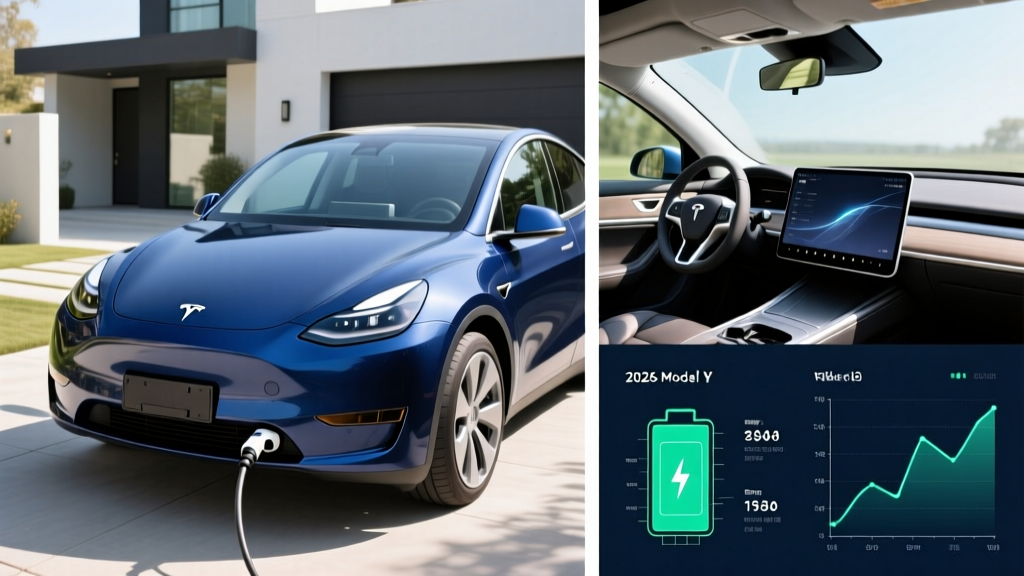
The 2026 Model Y carries the Juniper refresh introduced in early 2025 — updated exterior lighting, a ventilated-seat-equipped interior, ambient lighting, rear-seat entertainment screen, and improved suspension tuning. Powertrain options remain streamlined: a Long Range AWD and a Performance variant, both on the 4680-cell-based structural battery pack.
| Spec | Long Range AWD | Performance |
|---|---|---|
| EPA Range | 320 miles | 295 miles |
| Battery (usable) | ~78 kWh (NMC, 4680 cells) | ~78 kWh (NMC, 4680 cells) |
| Peak DC Fast Charge | 250 kW | 250 kW |
| 10–80% DCFC Time | ~25 min | ~25 min |
| Level 2 Home Charge | 11.5 kW (~44 mi/hr) | 11.5 kW (~44 mi/hr) |
| 0–60 mph | 4.8 sec | 3.5 sec |
| Horsepower | 384 hp | 456 hp |
| Drivetrain | Dual-motor AWD | Dual-motor AWD |
| Efficiency | 122 MPGe / 28 kWh/100mi | 111 MPGe / 30 kWh/100mi |
| Base MSRP | $46,630 | $51,630 |
Real-World Range: What the EPA Sticker Doesn't Tell You
EPA Estimate: 320 miles
Expected Highway (70 mph, 72°F): ~275–290 miles
Expected Cold Weather (32°F, mixed driving): ~230–260 miles
Worst-Case (highway + freezing + headwind): ~210–225 miles
The 2026 Model Y Long Range's 320-mile EPA figure is competitive within the segment, but real-world results depend heavily on driving conditions. Tesla's heat pump — standard across the lineup — mitigates cold-weather cabin heating draw better than most competitors, but battery chemistry still suffers reduced output and regen limitation below freezing. On a 75-mph interstate run in moderate temperatures, expect to consume roughly 30–32 kWh/100mi, yielding around 275 miles before you'd want to stop. In sub-freezing conditions, range loss of 20–30% is typical even with preconditioning.
One Juniper-specific improvement: the updated thermal management system preconditions the battery more aggressively when a Supercharger is set as the navigation destination, which helps sustain peak charge rates in cold weather. If you road-trip frequently in winter, this is a meaningful advantage over passive thermal systems.
Charging Speed: Supercharger Network and Home Setup
Tesla's 4680-cell pack in the Model Y supports a peak DC fast-charge rate of 250 kW on V3 Superchargers and the newer V4 posts. The charge curve is characteristic of NMC chemistry: peak rate holds from roughly 10% to 35% state of charge, then tapers progressively. A 10–80% session takes approximately 25 minutes under ideal thermal conditions. Above 80%, charging slows dramatically to protect cell longevity — expect 80–100% to add another 15–20 minutes.
| Level | Power (kW) | Miles Added per Hour | Typical Use Case |
|---|---|---|---|
| Level 1 (120V) | ~1.4 kW | ~4–5 mi/hr | Emergency / overnight trickle |
| Level 2 (240V, 48A) | 11.5 kW | ~44 mi/hr | Home daily charging |
| DC Fast (V3 Supercharger) | Up to 250 kW | ~1,000 mi/hr (peak) | Road trips, 10–80% in ~25 min |
For home charging, the Model Y's onboard charger accepts up to 11.5 kW on a 240V/48A circuit (Tesla's Wall Connector or any J1772 adapter setup). This adds roughly 44 miles of range per hour — enough to fully replenish the pack overnight from near-empty. Installation typically requires a 60A dedicated circuit; if your panel lacks capacity, a licensed electrician may recommend a panel upgrade ($1,500–$3,000 depending on your home's existing service).
With the NACS-to-CCS adapter landscape largely settled in 2026 — most non-Tesla networks now offer native NACS connectors — the Model Y accesses the broadest charging ecosystem in the US without adapters.
Pricing, Tax Credits, and Ownership Cost
The 2026 Model Y Long Range AWD starts at $46,630 (including destination). The Performance trim sits at $51,630. These figures place the Model Y under the IRS §30D MSRP cap of $80,000 for SUVs/trucks, but federal tax credit eligibility depends on several additional factors.
| Trim | MSRP | Max §30D Credit | Effective Price (if eligible) |
|---|---|---|---|
| Long Range AWD | $46,630 | Up to $7,500 | ~$39,130 |
| Performance | $51,630 | Up to $7,500 | ~$44,130 |
- MSRP Cap: Vehicle must be under $80,000 (SUV classification) — Model Y qualifies ✓
- Buyer Income Cap: AGI ≤ $150,000 (single) / $300,000 (joint) — verify against your tax situation
- Battery Sourcing: Critical minerals and battery components must meet phased percentage thresholds from US/FTA partners — check IRS.gov for current-year sourcing requirements
- Point-of-Sale Transfer: Eligible buyers can transfer the credit to the dealer at purchase, reducing out-of-pocket cost immediately
- Assembly: Must be final-assembled in North America — Fremont-built Model Y qualifies ✓
Note: Battery-sourcing rules tighten annually. Consult a tax professional and the IRS Clean Vehicle Credits page before committing to purchase.
Interior, Cargo, and Daily Livability
The Juniper refresh addressed the most common pre-2025 Model Y complaint: interior material quality. The 2026 cabin features ventilated front seats (previously heat-only), an 8-inch rear touchscreen for passenger climate and entertainment control, ambient lighting strips, and acoustic glass that noticeably reduces highway wind noise.
Cargo dimensions remain class-leading for the segment:
- Rear cargo (seats up): 30.2 cu ft
- Rear cargo (seats folded): 72.1 cu ft
- Front trunk (frunk): 4.1 cu ft
- Rear legroom: 41.6 inches
- Front headroom: 40.3 inches
The flat load floor and hatchback design make the Model Y practical for bulky cargo — a distinct advantage over sedan-form EVs like the Model 3 or Hyundai Ioniq 6. However, the absence of a traditional instrument cluster (all data routes through the 15.4-inch center touchscreen) remains polarizing. Drivers who prefer a dedicated speedometer or HUD will find the Tesla interface requires adaptation.
Driver Assistance: Autopilot and FSD (Supervised)
Tesla Autopilot and Full Self-Driving (Supervised) are driver-assistance systems, not autonomous driving. The driver must remain engaged, hands on or near the wheel, and eyes on the road at all times. Tesla's cabin camera monitors attentiveness. No consumer Tesla vehicle operates at SAE Level 3 or above.
The 2026 Model Y ships with basic Autopilot (adaptive cruise + lane centering) standard. FSD (Supervised) remains a $8,000 add-on or $99/month subscription. As of Q1 2026, FSD operates on a vision-only neural network architecture — no radar or ultrasonic sensors. Real-world performance is competent on highways but requires frequent driver intervention in construction zones, unmapped roundabouts, and heavy rain. Tesla's Q1 earnings call noted continued improvement in miles-per-intervention metrics, but the system is not a substitute for an attentive driver.
Warranty and Long-Term Battery Outlook
Tesla covers the 2026 Model Y with:
- Vehicle Limited Warranty: 4 years / 50,000 miles
- Battery & Drive Unit Warranty: 8 years / 120,000 miles (Long Range/Performance — retains ≥70% capacity)
The 4680 NMC cells in the current Model Y have demonstrated degradation curves consistent with Tesla's prior 2170-cell packs: approximately 5–8% capacity loss in the first 30,000 miles, followed by a slower linear decline. At 120,000 miles, most owners report 88–92% state of health (SoH). The 70% warranty threshold is conservative — Tesla has rarely needed to honor full pack replacements under warranty for vehicles that weren't abused via repeated 100% charges and DC fast-charging in extreme heat.
For longevity, Tesla recommends daily charging to 80–90% and reserving 100% charges for road trips. The battery preconditioning feature activates automatically when navigating to a Supercharger, reducing charge-session degradation.
How the Model Y Stacks Up Against Competitors
The Q1 2026 earnings data confirms Tesla is pricing the Model Y to defend volume against a deepening competitive field. Here's how it compares to key rivals:
| Metric | Tesla Model Y LR | Hyundai Ioniq 5 Long Range | Ford Mustang Mach-E ER AWD |
|---|---|---|---|
| EPA Range | 320 mi | 310 mi | 300 mi |
| Peak DCFC | 250 kW | 350 kW (800V) | 150 kW |
| 10–80% Time | ~25 min | ~18 min | ~38 min |
| 0–60 mph | 4.8 sec | 5.1 sec | 5.2 sec |
| Base MSRP | $46,630 | $47,500 | $48,995 |
| Charging Network | Supercharger (native) | NACS adapter / Supercharger access | NACS adapter / Supercharger access |
The Ioniq 5's 800V architecture delivers faster DC charging — an 18-minute 10–80% session versus the Model Y's 25 minutes. However, Tesla's Supercharger network reliability and plug-and-charge simplicity still outperform third-party networks in most US corridors, which matters if you road-trip frequently. The Mach-E trails on charging speed and efficiency but offers a more traditional interior layout with physical controls.
- You prioritize Supercharger network reliability for road trips
- You want the most cargo space in the segment
- You prefer minimal controls and a screen-centric interface
- Over-the-air updates and software refinement matter to you
- DC fast-charge speed is your top priority (18 min vs 25 min)
- You prefer physical buttons and a more conventional cockpit
- V2L (vehicle-to-load) capability matters for camping or backup power
Pros, Cons, and the Bottom Line
- Supercharger network — most reliable DC charging in the US
- Class-leading cargo volume (72.1 cu ft seats folded)
- Competitive efficiency at 122 MPGe combined
- Strong OTA update cadence keeps the vehicle current
- Heat pump standard — better cold-weather range retention
- Juniper suspension tuning is noticeably more compliant
- No instrument cluster or HUD — all info on center screen
- 250 kW peak DCFC trails 800V competitors (Ioniq 5/6, EV6)
- FSD (Supervised) remains Level 2 despite the name and price
- Build quality improved but still inconsistent vs. legacy OEMs
- Minimal physical controls — even glovebox opens via screen
- Rear visibility limited by thick C-pillars and small rear window
Frequently Asked Questions
What is the real-world range of the 2026 Tesla Model Y?
The EPA rates the Long Range AWD at 320 miles. In real-world highway driving at 70 mph in moderate temperatures, expect 275–290 miles. In freezing conditions, range drops to roughly 230–260 miles depending on driving style and terrain.
How fast does the Model Y charge at home and on the road?
On a Level 2 home charger (240V/48A), the Model Y adds about 44 miles of range per hour — a full charge takes roughly 8–9 hours from near-empty. On a V3 Supercharger, it peaks at 250 kW, achieving a 10–80% charge in approximately 25 minutes. Above 80%, the charge curve tapers significantly.
How much does the 2026 Model Y cost after federal tax credits?
The Long Range AWD starts at $46,630. If you meet all IRS §30D requirements (income caps, battery sourcing thresholds, North American assembly), the effective price drops to approximately $39,130. Eligibility is not guaranteed — verify on IRS.gov and with a tax professional before purchasing.
Is the Model Y worth buying vs. the Ioniq 5 or Mach-E?
It depends on your priorities. The Model Y wins on cargo space, Supercharger network access, and software. The Ioniq 5 charges faster (800V architecture) and offers V2L. The Mach-E provides a more conventional interior. All three are strong — test-drive each and compare your local charging options.
Does the 2026 Model Y qualify for the $7,500 federal EV tax credit?
The Model Y meets the MSRP cap and North American assembly requirements. However, the full $7,500 credit depends on battery-sourcing compliance (which changes annually) and your personal income falling under the §30D caps ($150K single / $300K joint). Always confirm current eligibility at the point of sale.
What did Tesla's Q1 2026 earnings reveal about future pricing?
Tesla's Q1 margins indicate the company is absorbing Juniper retooling costs rather than raising prices. Management signaled stable pricing through mid-2026, with potential for further reductions if battery cell costs continue declining. For buyers, there's no urgent price-increase pressure.