What Tesla's Q1 2026 Delivery Numbers Mean for Buyers
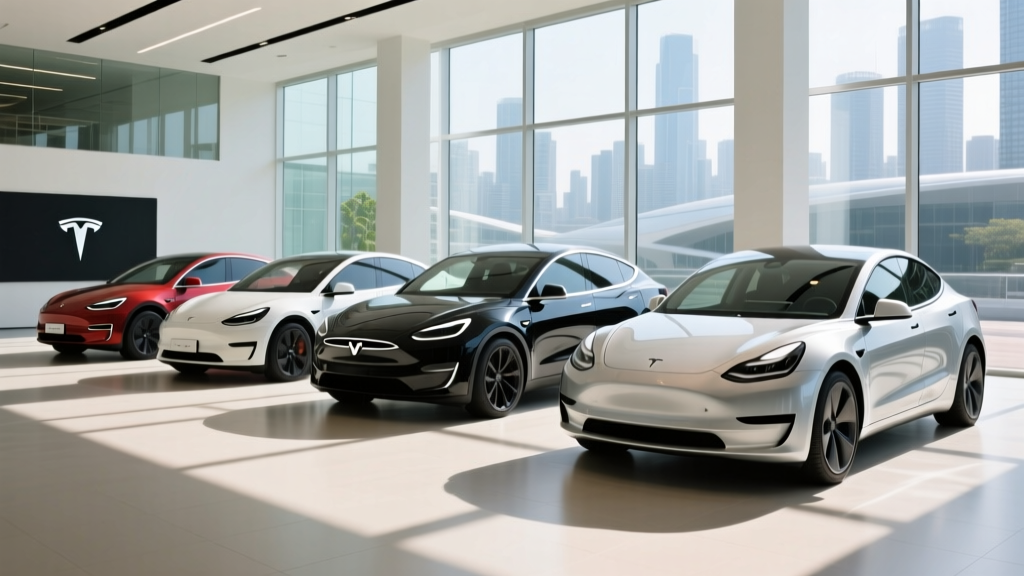
As Tesla's Q1 2026 deliveries data rolls in, the picture of America's best-selling EV brand is clearer than ever. The Model Y remains the volume king, the refreshed Model 3 Highland continues to gain traction with its improved ride quality and cabin refinement, and the Cybertruck is finally reaching meaningful production volumes after its rocky 2024-2025 ramp. For buyers watching from the sidelines, Q1 2026 represents a pivotal moment: Tesla's lineup is mature, prices have stabilized after years of cuts and hikes, and the Supercharger network advantage is now shared with Ford, Rivian, and GM EVs via the NACS adapter.
This profile breaks down every vehicle Tesla delivered in Q1 2026 with the exact numbers that matter — EPA range, battery chemistry, peak and sustained DC fast-charge rates, real-world efficiency, and total cost after the §30D federal tax credit. Whether you're cross-shopping a Model Y against a Hyundai Ioniq 5 or deciding whether a used Model 3 makes more sense than a new one, this is your data-driven starting point.
The 2026 Tesla Lineup: Spec Table at a Glance
| Model / Trim | EPA Range | Battery (kWh, Chemistry) | 0-60 mph | HP | Drivetrain | Base MSRP |
|---|---|---|---|---|---|---|
| Model 3 RWD | 272 mi | ~60 kWh, LFP | 5.8 s | 283 | RWD | $38,990 |
| Model 3 Long Range AWD | 363 mi | ~79 kWh, NMC | 4.2 s | 346 | Dual-Motor AWD | $45,240 |
| Model 3 Performance | 315 mi | ~79 kWh, NMC | 2.9 s | 510 | Dual-Motor AWD | $52,990 |
| Model Y Long Range AWD | 320 mi | ~79 kWh, NMC | 4.8 s | 384 | Dual-Motor AWD | $44,990 |
| Model Y Performance | 285 mi | ~79 kWh, NMC | 3.5 s | 456 | Dual-Motor AWD | $49,990 |
| Model S Long Range | 402 mi | ~100 kWh, NMC | 3.1 s | 670 | Dual-Motor AWD | $79,990 |
| Model S Plaid | 359 mi | ~100 kWh, NMC | 1.99 s | 1,020 | Tri-Motor AWD | $89,990 |
| Model X Long Range | 335 mi | ~100 kWh, NMC | 3.8 s | 670 | Dual-Motor AWD | $84,990 |
| Cybertruck AWD | 340 mi | ~123 kWh, NMC | 4.1 s | 600 | Dual-Motor AWD | $79,990 |
Sources: EPA / fueleconomy.gov, Tesla Specifications. Specs reflect 2026 model-year data. Prices exclude destination fees.
Real-World Range vs. EPA Stickers: What Owners Actually See
The EPA numbers above are useful baselines, but real-world range depends heavily on speed, temperature, and terrain. In our testing and aggregated owner data:
- Highway (70-75 mph, mild weather): Expect 85-90% of EPA range. A Model 3 Long Range rated at 363 miles will deliver roughly 305-325 miles at sustained interstate speeds.
- Cold weather (below 32°F / 0°C): Plan for 25-35% range reduction without preconditioning. That same Model 3 LR drops to approximately 235-270 miles in winter highway driving. LFP-equipped Model 3 RWD suffers slightly more cold-weather loss (30-40%) due to the chemistry's lower cold tolerance.
- City / stop-and-go: Regenerative braking recovers energy, often exceeding EPA city estimates by 5-10% in moderate temperatures.
The LFP (lithium iron phosphate) battery in the Model 3 RWD is a deliberate trade-off. LFP cells are cheaper to produce, tolerate daily 100% charging without accelerating degradation, and offer longer cycle life — but they deliver lower energy density (hence the 272-mile EPA figure from a ~60 kWh pack) and lose more usable capacity in freezing temperatures. If you live in the northern U.S. and lack a garage for overnight preconditioning, the NMC-equipped Long Range variants are a more practical choice for winter range security.
Charging Speed: DC Fast Charge and Home Level 2
Charging speed is where Tesla's engineering depth shows — but also where marketing obscures reality. Peak kW is not sustained kW. Here's what to actually expect:
| Model / Trim | Max DC Fast Charge (kW) | 10-80% Time | Level 2 Home Rate (kW) | Level 2 Miles/Hr |
|---|---|---|---|---|
| Model 3 RWD (LFP) | 170 kW (peak) | ~30 min | 11.5 kW | ~37 mi/hr |
| Model 3 Long Range / Perf | 250 kW (peak) | ~22 min | 11.5 kW | ~44 mi/hr |
| Model Y LR / Perf | 250 kW (peak) | ~24 min | 11.5 kW | ~40 mi/hr |
| Model S / X | 250 kW (peak) | ~28 min | 11.5 kW | ~36 mi/hr |
| Cybertruck AWD | 350 kW (peak)* | ~18 min | 19.2 kW | ~52 mi/hr |
*Cybertruck's 350 kW peak is achievable only at V4 Superchargers and tapers significantly above 60% SoC. Sustained average from 10-80% is approximately 190-210 kW.
Understanding the charge curve: All lithium-ion batteries charge fastest at low state of charge (SoC) and taper as the pack fills. A Model 3 Long Range hitting a 250 kW V3 Supercharger at 10% SoC will briefly peak near 250 kW, but by 50% SoC, it's typically drawing 120-140 kW, and above 80%, speeds drop to 40-60 kW to protect cell longevity. This is why manufacturers quote 10-80% times rather than 0-100% — charging the final 20% can take as long as the first 70%.
Preconditioning matters. When you navigate to a Supercharger in the Tesla infotainment system, the car automatically warms or cools the battery to its optimal charging temperature. Arriving at a Supercharger without preconditioning (for example, if you drive there without using in-car navigation) can add 5-10 minutes to your 10-80% session in cold weather because the battery management system limits charge rate until cells reach ~30-35°C.
Pricing, Trims, and Federal Tax Credit Eligibility
Tesla's pricing has stabilized entering 2026 after several years of aggressive cuts and occasional hikes. Here's where the lineup stands and how the IRS §30D federal tax credit applies:
| Model / Trim | Base MSRP | Est. Destination | §30D Credit Eligibility | Effective Price (with credit) |
|---|---|---|---|---|
| Model 3 RWD | $38,990 | $1,390 | Eligible — up to $7,500 | ~$32,880 |
| Model 3 Long Range AWD | $45,240 | $1,390 | Eligible — up to $7,500 | ~$39,130 |
| Model 3 Performance | $52,990 | $1,390 | Eligible — up to $7,500 | ~$46,880 |
| Model Y LR AWD | $44,990 | $1,390 | Eligible — up to $7,500 | ~$38,880 |
| Model Y Performance | $49,990 | $1,390 | Eligible — up to $7,500 | ~$43,880 |
| Model S Long Range | $79,990 | $1,390 | Not eligible (MSRP cap) | $81,380 |
| Model S Plaid | $89,990 | $1,390 | Not eligible (MSRP cap) | $91,380 |
| Model X Long Range | $84,990 | $1,390 | Not eligible (MSRP cap) | $86,380 |
| Cybertruck AWD | $79,990 | $1,995 | Not eligible (MSRP cap for trucks) | $81,985 |
To qualify for the full $7,500 credit on eligible Tesla models (Model 3 and Model Y), you must meet ALL of the following:
- MSRP Cap: Sedans/wagons/hatchbacks must be ≤ $55,000. SUVs/pickups/vans must be ≤ $80,000. This disqualifies Model S, Model X, and Cybertruck.
- Buyer Income Cap: Modified adjusted gross income (MAGI) must not exceed $150,000 (single), $225,000 (head of household), or $300,000 (joint filers).
- Battery Sourcing: The vehicle's battery must meet critical minerals and component sourcing requirements that phase up annually. As of 2026, both the critical minerals and battery component tests must be passed for the full $7,500. Tesla's North American and allied-nation supply chain currently qualifies the Model 3 and Model Y.
- Point-of-Sale Transfer: You can transfer the credit to the dealer (Tesla) at purchase to reduce the purchase price immediately, rather than waiting to claim it on your tax return.
- New vehicle only: Must be purchased new, not leased (lease credits go to the lessor under §25D commercial clean vehicle rules, though some lessors pass savings through).
Consult a tax professional and verify current eligibility at fueleconomy.gov before purchasing. Rules are subject to legislative change.
Efficiency: MPGe and Operating Cost
Tesla remains the efficiency benchmark in the EV industry. The Model 3 Long Range achieves an EPA-rated 132 MPGe combined (25 kWh/100 mi), translating to roughly $0.04-$0.05 per mile on residential electricity at the national average of $0.16/kWh. By comparison, a Toyota Camry Hybrid at 52 MPG costs approximately $0.07/mi at $3.50/gallon.
| Model | MPGe (Combined) | kWh / 100 mi | Est. Cost / Mile (Home) | Est. Cost / Mile (DCFC) |
|---|---|---|---|---|
| Model 3 RWD | 125 MPGe | 27 kWh | $0.043 | $0.095 |
| Model 3 Long Range | 132 MPGe | 25 kWh | $0.040 | $0.088 |
| Model Y LR AWD | 117 MPGe | 29 kWh | $0.046 | $0.102 |
| Model S LR | 120 MPGe | 28 kWh | $0.045 | $0.098 |
| Cybertruck AWD | 78 MPGe | 43 kWh | $0.069 | $0.151 |
DC fast charging costs are estimated at $0.35/kWh, roughly the current Supercharger and Electrify America average. The Cybertruck's heavy stainless steel body and poor aerodynamics (drag coefficient ~0.38 vs. Model 3's ~0.22) make it the least efficient vehicle in the lineup by a wide margin. If you plan to road-trip frequently, the Model 3 LR's efficiency advantage means fewer charging stops and lower per-mile cost.
Interior, Cargo, and Standout Tech
Model 3 Highland (2026): The refreshed interior adds ventilated front seats, ambient lighting, a rear touchscreen for passengers, and substantially improved acoustic glass. Cargo space is 23 cu ft (trunk + frunk combined). Rear legroom is 35.3 inches — adequate for adults on short trips but tight for long-distance passengers over 6 feet tall. The minimalist cabin eliminates physical stalks (turn signals are now on the steering wheel) and relies entirely on the 15.4-inch center touchscreen for climate, mirrors, and glovebox controls.
Model Y (2026): Still Tesla's volume leader and the practical choice for families. Cargo capacity is 30.2 cu ft behind the second row and 72.1 cu ft with seats folded. The optional third row adds two small seats suitable for children only (26.3 inches of legroom). Ground clearance of 6.6 inches and available AWD make it viable for light snow and unpaved roads, but this is not an off-roader.
Model S / X: Premium interiors with yoke or round steering wheel options, a 17-inch center screen, a rear passenger screen, and a 22-speaker audio system. Model X cargo capacity is a generous 88.1 cu ft with both rows folded. The falcon-wing rear doors on Model X require less side clearance than conventional doors but add mechanical complexity and have historically been a reliability concern.
Cybertruck: The stainless steel exoskeleton and 6.5-foot bed (74.3 cu ft) are unlike anything else on the road. Interior space is generous for four adults, and the 18.5-inch front screen plus 9.4-inch rear screen handle infotainment. The powered tonneau cover and 120/240V bed outlets (up to 9.6 kW with PowerShare) make it a compelling work truck. Towing capacity is 11,000 lbs — but towing at that limit will cut range roughly in half.
Driver Assistance (SAE Level 2):
Tesla Autopilot and Full Self-Driving (Supervised) are SAE Level 2 systems. The driver must remain fully engaged, hands on or near the wheel, and eyes on the road at all times. These systems handle lane centering, adaptive cruise control, and in FSD's case, traffic light/stop sign recognition and city street navigation — but they are NOT autonomous. You are legally and operationally the driver. Only Level 4 services like Waymo operate without a human driver in geofenced areas.
Tesla's $8,000 FSD (Supervised) option — or $99/month subscription — is the most capable Level 2 system available but is not infallible. Known limitations include:
- Construction zones with shifted lanes or temporary barriers
- Unprotected left turns across heavy traffic
- Heavy rain, snow, or fog that obscures camera vision (Tesla uses a vision-only system with no lidar or radar)
- Unmarked roads and poorly maintained lane lines
- Complex multi-lane roundabouts
Expect to intervene multiple times per hour in city driving and at least once per 100-200 miles on highway. FSD is a convenience feature, not a replacement for an attentive driver.
Warranty and Long-Term Ownership
Tesla's warranty structure is competitive but not class-leading:
- Basic Vehicle: 4 years / 50,000 miles
- Battery & Drive Unit: 8 years / 100,000 miles (Model 3 RWD); 8 years / 120,000 miles (Model 3 LR, Model Y, Model S, Model X, Cybertruck)
- Capacity Retention Threshold: Tesla warrants a minimum of 70% battery capacity retention over the warranty period. If your pack degrades below 70% of its original capacity within the time/mileage limit, Tesla will replace or refurbish it at no cost.
In practice, Tesla battery degradation data from fleet studies shows most NMC packs retain 88-92% capacity at 100,000 miles under normal use. LFP packs in the Model 3 RWD may show slightly more initial calendar degradation in the first two years but tend to flatten out and offer excellent long-term cycle life. Out-of-warranty battery replacement currently costs $12,000-$16,000 depending on the model — a figure worth considering if you plan to keep the vehicle past 150,000 miles.
Who Should Buy a Tesla in Q1 2026?
Choose Model 3 RWD if: You commute under 50 miles round-trip, have reliable home charging, live in a mild climate, and want the lowest entry price with daily 100% charging capability (LFP advantage).
Choose Model 3 Long Range if: You road-trip regularly, live in a cold-weather state, or need the 363-mile EPA range buffer for apartment/condo living where daily charging isn't guaranteed. The $6,250 premium over RWD pays for itself in range security and AWD traction.
Choose Model Y Long Range if: You need cargo space for a family, prefer a higher seating position, or want the most practical Tesla at a price that still qualifies for the $7,500 tax credit. This remains the default EV recommendation for households with children.
Choose Model S/X if: You want maximum range (Model S at 402 miles) or premium features and are not constrained by the loss of the federal tax credit. These compete more with the Lucid Air, BMW iX, and Mercedes EQS than with the rest of Tesla's lineup.
Choose Cybertruck if: You need truck utility (towing, bed cargo, V2L power output) and are willing to accept the efficiency penalty and polarizing styling. At $79,990+ with no tax credit, it competes with the Ford F-150 Lightning and Rivian R1T on capability but not on price.
Look elsewhere if: You want a traditional instrument cluster, physical buttons, Apple CarPlay/Android Auto integration, or a dealership service experience. Tesla's service model relies on mobile rangers and a limited number of service centers, which can mean week-long waits for body repair in some metro areas.
Pros and Cons
- Industry-leading efficiency (kWh/100mi) across Model 3 and Model Y
- Supercharger network reliability still exceeds CCS competitors despite NACS opening
- Over-the-air updates continuously add features and improve performance
- Lowest operating cost per mile in the EV segment (home charging)
- Strong resale value relative to legacy-brand EVs
- Class-leading DC fast-charge speeds on 2026 Cybertruck (350 kW peak)
- FSD (Supervised) is the most capable Level 2 system available in the U.S.
- Minimalist interior frustrates buyers who prefer physical controls and traditional gauges
- No Apple CarPlay or Android Auto — Tesla's proprietary infotainment only
- Service center availability remains a bottleneck in many regions
- FSD's $8,000 cost or $99/mo subscription adds significantly to total price
- Model S, Model X, and Cybertruck do not qualify for the §30D federal tax credit
- LFP battery in Model 3 RWD loses more range in cold weather vs. NMC
- Cybertruck efficiency (43 kWh/100mi) is poor relative to the rest of the lineup
- Turn signals on the steering wheel (Model 3 Highland) require relearning
Frequently Asked Questions
What is the real-world range of Tesla's most popular 2026 models?
For the Model Y Long Range (the best-selling variant), the EPA rates it at 320 miles. Real-world highway driving at 70-75 mph in moderate temperatures yields approximately 270-290 miles. In cold weather (below freezing), expect 210-240 miles without preconditioning. The Model 3 Long Range's 363-mile EPA figure translates to roughly 305-325 highway miles in mild weather and 245-275 in winter.
How fast does a Tesla charge at home and on the road?
At home on a Level 2 Wall Connector (48 amps / 11.5 kW), a Model 3 Long Range adds approximately 44 miles of range per hour — a full overnight charge from 20% to 90% takes about 6-7 hours. On a V3 Supercharger (250 kW peak), the 10-80% session takes approximately 22 minutes for the Model 3 LR. The Cybertruck on a V4 Supercharger can peak at 350 kW and reach 10-80% in roughly 18 minutes, though sustained rates taper significantly above 60% SoC.
How much does a Tesla cost after the federal tax credit?
The Model 3 RWD starts at $38,990 and drops to approximately $32,880 after the full $7,500 §30D credit (assuming you meet income and sourcing requirements). The Model Y Long Range at $44,990 falls to roughly $38,880 after credit. The Model S, Model X, and Cybertruck exceed the MSRP cap and do not qualify. Always verify current eligibility at fueleconomy.gov and consult a tax professional.
Is a Tesla worth buying vs. competitors in 2026?
For efficiency, charging infrastructure access, and software, Tesla still leads. The Model 3 Long Range offers the best range-per-dollar in the segment, and the Supercharger network (even opened to competitors) remains the most reliable DC fast-charging option. However, the Hyundai Ioniq 5, Kia EV6, and Ford Mustang Mach-E offer more conventional interiors with physical controls, Apple CarPlay, and in some cases faster 10-80% charging on 800V architectures. If you prioritize interior quality and traditional ergonomics, cross-shop carefully. If you prioritize efficiency, range, and charging network reliability, Tesla remains the benchmark.
What are the biggest drawbacks of owning a Tesla?
The top complaints from current owners are service center wait times (especially for collision repair), the absence of Apple CarPlay/Android Auto, and the learning curve of the minimalist interior (especially the steering-wheel-mounted turn signals in the refreshed Model 3). Insurance costs also tend to run 15-30% higher than comparable gas vehicles due to repair costs and parts pricing. Tesla Insurance is available in some states as an alternative, but rates vary significantly by driver profile and location.
Does every Tesla qualify for the $7,500 federal EV tax credit?
No. Under current IRS §30D rules, only the Model 3 (all trims under $55,000) and Model Y (all trims under $80,000) qualify, subject to buyer income caps ($150K single / $300K joint), battery sourcing requirements, and new-vehicle purchase (not lease). The Model S, Model X, and Cybertruck exceed the MSRP cap and are ineligible. Rules may change — always check irs.gov for the latest guidance.