Quick Verdict: Tesla Premium Connectivity and the 2026 Model Y
If you own or are considering a Tesla, you've likely encountered the Tesla Premium Connectivity cost — currently $9.99/month or $99/year — and wondered whether it justifies the expense. Premium Connectivity unlocks live traffic visualization, satellite-view maps, video and music streaming over cellular, a web browser, and the Car Wash Mode camera views while parked. But the real question isn't just about the subscription; it's whether the entire Tesla Model Y package — its range, charging speed, software ecosystem, and price — delivers enough value in 2026 to make that monthly fee a rounding error or a dealbreaker.
This review covers the 2026 Tesla Model Y Long Range AWD in full: EPA range, real-world efficiency, DC fast-charging performance, pricing after federal tax credits, and exactly what Premium Connectivity adds to the ownership experience. We'll also compare it against the Hyundai Ioniq 5, Ford Mustang Mach-E, and Chevrolet Equinox EV so you can decide where your money goes furthest.
2026 Tesla Model Y: Full Spec Breakdown
| Specification | 2026 Model Y Long Range AWD | 2026 Model Y Performance |
|---|---|---|
| EPA Range | 320 miles | 295 miles |
| Battery (usable) | ~78 kWh (NMC) | ~78 kWh (NMC) |
| Drivetrain | Dual-motor AWD | Dual-motor AWD |
| Horsepower | 384 hp | 456 hp |
| 0–60 mph | 4.8 sec | 3.5 sec |
| Peak DC Charge Rate | 250 kW | 250 kW |
| 10–80% DC Charge Time | ~27 min | ~27 min |
| Level 2 Home Charge Rate | 11.5 kW (~44 mi/hr) | 11.5 kW (~44 mi/hr) |
| MPGe (combined) | 111 MPGe | 102 MPGe |
| Efficiency | 28 kWh/100 mi | 31 kWh/100 mi |
| Cargo (rear seats up) | 30.2 cu ft | 30.2 cu ft |
| Cargo (rear seats folded) | 72.1 cu ft | 72.1 cu ft |
| Frunk | 4.1 cu ft | 4.1 cu ft |
| Rear Legroom | 37.6 in | 37.6 in |
| Battery/Drive Unit Warranty | 8 yr / 120,000 mi | 8 yr / 120,000 mi |
| Base MSRP | $44,990 | $48,990 |
Source: fueleconomy.gov and Tesla spec sheets. Figures reflect 2026 model year.
Real-World Range: What the EPA Sticker Doesn't Tell You
EPA estimate: 320 miles (Long Range AWD)
Real-world highway (70–75 mph, moderate temps): ~265–285 miles
Real-world mixed city/highway: ~280–305 miles
Cold weather (below 30°F, highway): ~220–250 miles
Expect 15–20% range loss at sustained highway speeds and up to 30% in deep cold without preconditioning.
The Model Y Long Range's 320-mile EPA figure is competitive, but real-world results depend heavily on how and where you drive. Tesla's heat pump — standard across the lineup — helps mitigate cold-weather losses compared to older EVs without thermal management, but physics still wins in sub-freezing temperatures. On a 300-mile road trip at 75 mph in 45°F weather, expect to arrive at your destination with roughly 10–15% state of charge remaining if you started at 100%. That's workable, but it leaves little margin for detours or headwinds.
City driving with frequent regenerative braking opportunities pushes efficiency closer to — or sometimes above — the EPA estimate. Commuters with stop-and-go routes will see the best real-world numbers. The key takeaway: plan road trips around 250–270 miles between charge stops, and you'll rarely feel range pressure.
Charging Speed: DC Fast, Level 2, and the Curve Reality
| Charging Level | Power (kW) | Speed (miles/hr added) | Notes |
|---|---|---|---|
| Level 1 (120V household) | ~1.4 kW | ~4–5 mi/hr | Emergency/trickle only |
| Level 2 (240V, 48A Wall Connector) | 11.5 kW | ~44 mi/hr | Full charge in ~7.5 hours |
| Level 2 (240V, 32A Mobile Connector) | 7.7 kW | ~30 mi/hr | Full charge in ~11 hours |
| DC Fast Charge (peak) | 250 kW | ~1,000+ mi/hr (peak) | 10–80% in ~27 min |
| DC Fast Charge (sustained avg) | ~120–140 kW avg | ~480–560 mi/hr avg | Above 80% SoC, rate tapers sharply |
The Model Y's peak 250 kW charge rate on V3 Superchargers is impressive on paper, but the charge curve tells the full story. Like all lithium-ion packs, the Model Y accepts peak power only at low states of charge (roughly 10–35% SoC). From 35% to 60%, the rate holds around 150–175 kW. Above 80%, it drops below 50 kW as the battery management system protects cell longevity. This means a 10–80% session takes roughly 27 minutes, but pushing from 80–100% adds another 25–30 minutes.
For road trips, the practical strategy is to charge from 10% to 80% and move on — which is exactly what Tesla's navigation system recommends. On the Supercharger network, this means roughly 15–20 minutes of charging adds 170–200 miles of real-world range, which is among the best in the segment.
At home, a Tesla Wall Connector on a 60-amp circuit delivers the full 11.5 kW (48 amps), recovering a full battery overnight in about 7.5 hours. Most owners charging from 20–80% daily will wake up fully replenished every morning. If your electrical panel can't support a 60-amp circuit, a 40-amp circuit (32A / 7.7 kW) still adds ~30 miles per hour — enough for most daily needs.
Pricing, Trims, and Federal Tax Credit Eligibility
| Trim | Base MSRP | Est. §30D Credit | Effective Price (before state incentives) |
|---|---|---|---|
| Long Range AWD | $44,990 | Up to $7,500* | ~$37,490* |
| Performance AWD | $48,990 | Up to $7,500* | ~$41,490* |
*Federal §30D credit eligibility depends on buyer income, battery critical-mineral sourcing, MSRP caps, and point-of-sale transfer rules. See IRS.gov §30D guidelines. Tesla's US-built vehicles have historically qualified for the full $7,500, but critical-mineral and battery-component sourcing requirements change annually. Always verify current-year eligibility with a tax professional.
The 2026 Model Y Long Range starts at $44,990 — comfortably below the $55,000 MSRP cap for SUVs under the §30D credit. Buyer income caps apply: modified adjusted gross income must not exceed $150,000 (single), $225,000 (head of household), or $300,000 (joint). The credit can now be transferred to the dealer at point of sale, reducing your out-of-pocket cost at purchase rather than waiting for a tax refund.
Add the $99/year Premium Connectivity subscription, and your ongoing digital cost is roughly $8.25/month — less than most streaming services. Over five years of ownership, that's $495 total for a feature set that includes real-time traffic, satellite maps, and in-car entertainment.
What Tesla Premium Connectivity Actually Gets You
Every new Tesla ships with Standard Connectivity, which includes basic navigation, Bluetooth, and Wi-Fi-dependent features. Premium Connectivity ($9.99/month or $99/year) adds:
- Live traffic visualization: Color-coded congestion overlays on the navigation map, enabling real-time rerouting.
- Satellite-view maps: Aerial imagery for the map display, useful for spotting parking lots, terrain, and landmarks.
- Video streaming: Netflix, YouTube, Disney+, and Twitch while parked (not while driving).
- Music streaming: Spotify, Tidal, and other services directly over cellular — no phone pairing required.
- Web browser: Full Chromium-based browser accessible while parked.
- Car Wash Mode camera views: External camera feeds visible while parked for alignment in car washes or tight spaces.
For daily commuters who rely on phone-based navigation (Google Maps, Waze) via Bluetooth, Standard Connectivity may suffice. But if you use Tesla's built-in navigation as your primary routing tool — especially for road trips where real-time traffic rerouting and Supercharger availability matter — Premium Connectivity becomes a practical necessity, not a luxury. The satellite maps and streaming features are nice-to-haves; the live traffic data is the real value driver.
Tech, Driver Assistance, and Interior
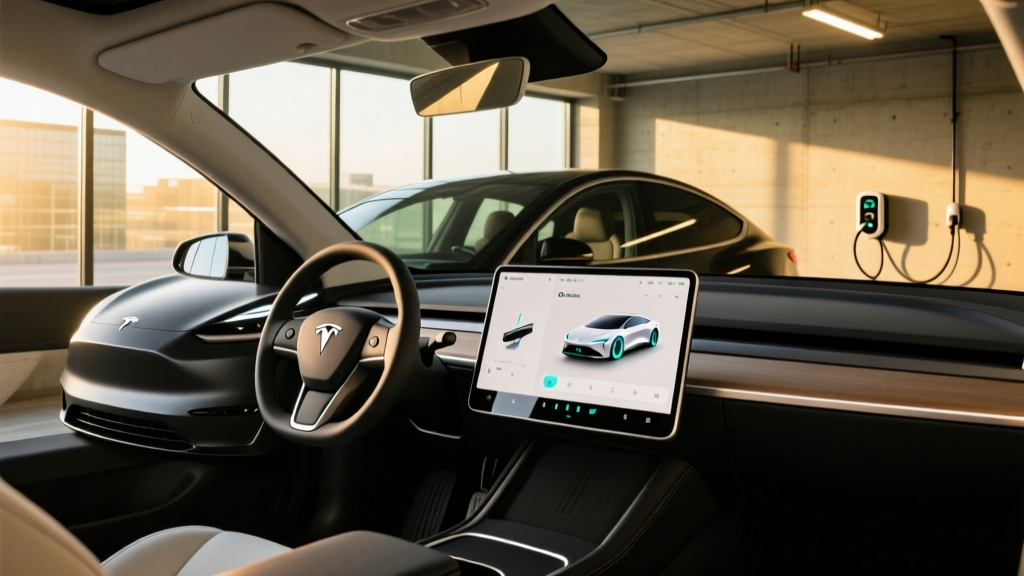
The Model Y's minimalist interior centers on a 15.4-inch touchscreen that controls nearly every vehicle function — climate, mirrors, glovebox, and driving settings. There is no instrument cluster; speed and navigation info appear in the upper-left corner of the main display. Rear passengers get an 8-inch screen for climate controls and entertainment.
Autopilot (standard) includes Traffic-Aware Cruise Control and Autosteer — a SAE Level 2 driver-assistance system that requires continuous driver supervision. The optional Full Self-Driving (Supervised) package ($8,000 or $99/month) adds automated lane changes, Navigate on Autopilot, Smart Summon, and traffic-light/stop-sign recognition. Despite the name, FSD remains Level 2 — the driver must remain alert and ready to intervene at all times. Tesla's naming has drawn scrutiny from NHTSA, and buyers should understand that no consumer Tesla vehicle is self-driving.
The over-the-air (OTA) update pipeline is Tesla's most significant software advantage. Feature additions, efficiency improvements, and UI refinements arrive wirelessly, sometimes materially improving the vehicle post-purchase. No other automaker matches Tesla's OTA cadence or scope.
How the Model Y Compares: Key Competitors
| Spec | 2026 Tesla Model Y LR AWD | 2026 Hyundai Ioniq 5 LR AWD | 2026 Ford Mustang Mach-E ER AWD | 2026 Chevy Equinox EV 3RS AWD |
|---|---|---|---|---|
| EPA Range | 320 mi | 305 mi | 312 mi | 307 mi |
| Battery | ~78 kWh (NMC) | 84 kWh (NMC) | 91 kWh (NMC) | 85 kWh (NMC) |
| Peak DC Charge | 250 kW | 240 kW (350 kW capable) | 150 kW | 190 kW |
| 10–80% Time | ~27 min | ~18 min | ~38 min | ~32 min |
| 0–60 mph | 4.8 sec | 5.1 sec | 5.1 sec | 6.2 sec |
| MPGe (combined) | 111 | 110 | 101 | 97 |
| Cargo (seats up) | 30.2 cu ft | 27.2 cu ft | 29.7 cu ft | 26.4 cu ft |
| Base MSRP | $44,990 | $49,500 | $47,995 | $43,900 |
| Charging Network | Supercharger (native NACS) | NACS adapter / Supercharger access | NACS adapter / Supercharger access | NACS adapter / Supercharger access |
The Model Y's advantages are clear: best-in-class efficiency (111 MPGe), native Supercharger access without adapters, the largest frunk+cargo combination, and Tesla's unmatched software/OTA ecosystem. The Ioniq 5 charges faster (18 minutes 10–80% on a 350 kW charger), and the Equinox EV undercuts on price. But for buyers who prioritize the Supercharger network's reliability and coverage — still the strongest DC fast-charging network in the US — the Model Y retains a meaningful edge.
Pros, Cons, and Who Should Buy
Pros
- Class-leading efficiency (111 MPGe)
- Native NACS/Supercharger access — no adapter needed
- Strong OTA update pipeline improves vehicle over time
- Spacious cargo area (72.1 cu ft with seats folded)
- Best-in-class infotainment and route planning
- Competitive pricing after §30D credit
Cons
- Minimalist interior isn't for everyone (no physical buttons, no instrument cluster)
- 250 kW peak charge rate trails Ioniq 5's 350 kW capability
- Panel gaps and build consistency still draw complaints
- FSD (Supervised) is expensive and remains Level 2 only
- Premium Connectivity is essentially required for navigation to function fully
- Ride quality is firm on rough pavement
Who the Model Y Suits Best
Buy the Model Y if: You road-trip regularly and value Supercharger reliability, you want the most efficient midsize electric SUV, and you prefer a software-forward ownership experience with frequent OTA improvements.
Look elsewhere if: You want the fastest possible DC charging (Ioniq 5), you need physical buttons and a traditional instrument cluster, or you want a lower entry price without sacrificing range (Equinox EV).
Frequently Asked Questions
What is the real-world range of the 2026 Tesla Model Y?
The EPA rates the Long Range AWD at 320 miles. In real-world highway driving at 70–75 mph, expect 265–285 miles. Cold weather (below 30°F) can reduce range to 220–250 miles. City driving with regenerative braking typically yields 280–305 miles.
How fast does the Model Y charge at home and on the road?
On a Tesla V3 Supercharger (250 kW peak), the Model Y charges from 10–80% in approximately 27 minutes. At home on a 240V/48A Wall Connector (11.5 kW), it adds roughly 44 miles of range per hour, fully charging in about 7.5 hours.
How much does the Model Y cost after the federal tax credit?
The Long Range AWD starts at $44,990 MSRP. If you qualify for the full $7,500 §30D credit (subject to income caps, battery sourcing rules, and MSRP limits), the effective price drops to approximately $37,490. Eligibility varies — verify with IRS guidelines and a tax professional.
Does the Tesla Model Y qualify for the federal EV tax credit?
As of 2026, the US-built Model Y qualifies for up to $7,500 under §30D, provided the buyer meets income thresholds ($150K single / $300K joint), the MSRP is under $55,000 (SUV cap), and battery sourcing requirements are met. The credit can be applied at point of sale. Rules evolve annually — confirm current-year eligibility before purchasing.
Is the Tesla Premium Connectivity cost worth it?
At $99/year, Premium Connectivity is worthwhile if you rely on Tesla's built-in navigation for daily driving or road trips. The live traffic visualization and real-time Supercharger rerouting are the primary functional benefits. If you exclusively use phone-based navigation via Bluetooth, Standard Connectivity may be sufficient.
Is the Model Y worth buying over the Ioniq 5 or Mach-E?
The Model Y wins on efficiency (111 MPGe), cargo space, and Supercharger network access. The Ioniq 5 charges faster (18 min 10–80%) and has a more conventional interior. The Mach-E offers a sportier driving feel but slower charging. For road-trippers prioritizing charging infrastructure reliability, the Model Y remains the default choice in this segment.
What is the Model Y's battery warranty?
Tesla covers the battery and drive unit for 8 years or 120,000 miles (whichever comes first), with a minimum 70% capacity retention guarantee over that period. The limited vehicle warranty is 4 years or 50,000 miles.