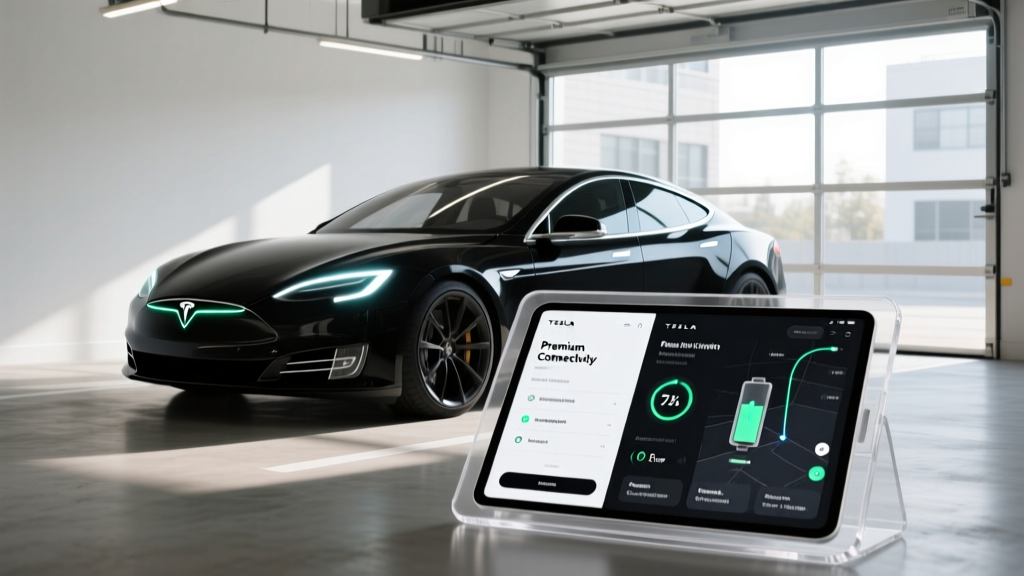
If you own a Tesla or are about to buy one, you'll eventually face a subscription prompt for Premium Connectivity. As of 2026, Tesla charges $9.99 per month or $99 per year (effectively two months free on the annual plan) for this add-on, purchased directly through your Tesla account or the in-car infotainment system. But what exactly does that money buy, which features are locked behind it, and is it genuinely worth the cost compared to relying on your phone's hotspot?
This guide breaks down every Premium Connectivity feature, the current pricing structure, how it interacts with Tesla's existing vehicle lineup specs, and whether you should subscribe based on your driving habits.
What Tesla Premium Connectivity Actually Includes
Every new Tesla comes with Standard Connectivity at no extra cost. This baseline tier covers core navigation, Bluetooth, Wi-Fi software updates (when parked near a network), and basic map rendering. Premium Connectivity layers on data-dependent features that require Tesla's embedded cellular connection while driving.
Here is exactly what you gain with the $9.99/month subscription:
- Live Traffic Visualization: Color-coded congestion overlays on the navigation map, enabling real-time rerouting around accidents and slowdowns.
- Satellite-View Maps: Aerial imagery layered onto the map display, useful for identifying parking lot layouts, driveway entrances, and off-road trails.
- Video Streaming: Netflix, YouTube, Twitch, Disney+, and Tesla Arcade streaming — but only while parked. The vehicle will not play video content while in drive.
- Music Streaming via In-Car Data: Stream Spotify, Tidal, or other linked services using Tesla's cellular connection rather than your phone's Bluetooth or hotspot.
- Caraoke: Lyrics display with streaming backing tracks over the cellular connection.
- Internet Browser: Full Chromium-based web browser accessible while parked (and limited use while driving for passengers, depending on firmware version).
- Sentry Mode Live Camera Access: View your vehicle's exterior cameras remotely through the Tesla app — a feature that streams video over cellular and requires significant data bandwidth.
- Dashcam Live View: Remote access to dashcam footage stored on the vehicle's USB drive, viewable through the app.
Notably absent from Premium Connectivity: Full Self-Driving (Supervised) and Autopilot are separate purchases entirely. Premium Connectivity has no bearing on ADAS capabilities — it is purely an infotainment and remote-access data package.
Tesla Premium Connectivity Pricing: Monthly vs. Annual
| Plan | Cost | Effective Monthly Rate | Commitment |
|---|---|---|---|
| Monthly | $9.99/month | $9.99 | Cancel anytime |
| Annual | $99/year | $8.25 | 12 months, auto-renews |
The annual plan saves roughly $20 per year and is the obvious choice if you know you'll keep the vehicle for at least a year. Tesla occasionally includes a 30-day free trial of Premium Connectivity with new vehicle deliveries, though this promotion varies by model year and region. Check your Tesla app under Upgrades → Subscriptions to see your current status.
Used Tesla buyers: Premium Connectivity does not transfer with the vehicle. If you purchase a used Tesla, you will need to start your own subscription regardless of whether the previous owner had one active.
Which Tesla Models Support Premium Connectivity?
Premium Connectivity is available across the entire current Tesla lineup. However, the value proposition shifts depending on the vehicle's hardware generation and your use case:
| Model | Hardware | 2026 Base MSRP | Premium Connectivity Value |
|---|---|---|---|
| Model 3 (Highland refresh) | HW4 / AMD Ryzen | $38,990 | High — streaming while parked at chargers is a top use case |
| Model Y (Juniper refresh) | HW4 / AMD Ryzen | $44,990 | High — families use streaming and Sentry Mode heavily |
| Model S | HW4 / AMD Ryzen | $74,990 | Medium — premium buyers expect it bundled |
| Model X | HW4 / AMD Ryzen | $79,990 | Medium — same as Model S |
| Cybertruck | HW4 / AMD Ryzen | $60,990 | High — off-road satellite maps are genuinely useful |
All current models use the AMD Ryzen infotainment processor, which handles satellite map rendering, video decoding, and browser rendering without lag. Older models with Intel Atom processors (pre-2021) can still run Premium Connectivity, but the browser and map rendering are noticeably slower.
Real-World Use: When Premium Connectivity Pays Off
The subscription's value depends entirely on your driving patterns. Here's a practical framework:
Subscribe if:
- You frequently DC fast-charge on road trips and want Netflix/YouTube during 20-30 minute charging stops.
- You park in areas where Sentry Mode is essential and want live camera access from your phone.
- You navigate unfamiliar cities regularly and rely on live traffic rerouting and satellite-view maps.
- You don't want to drain your phone's battery running a hotspot for in-car music streaming.
Skip it if:
- You charge primarily at home and rarely stream video in the car.
- Your phone plan includes unlimited hotspot data and you prefer tethering.
- You mostly drive familiar routes where live traffic adds minimal value.
- You use Apple CarPlay or Android Auto in a non-Tesla EV and find Tesla's native apps lacking.
How Premium Connectivity Interacts with Tesla's Current EV Specs
While Premium Connectivity is an infotainment feature, buyers evaluating a Tesla purchase need the full picture. Here's how the current lineup stacks up on the metrics that actually drive purchase decisions:
| Spec | Model 3 Long Range AWD | Model Y Long Range AWD | Model S Long Range |
|---|---|---|---|
| EPA Range | 346 mi | 320 mi | 402 mi |
| Battery (usable) | ~75 kWh (NMC) | ~75 kWh (NMC) | ~95 kWh (NMC) |
| Peak DC Charge Rate | 250 kW | 250 kW | 250 kW |
| 10-80% DC Charge Time | ~25 min | ~27 min | ~30 min |
| Level 2 Home Charge Rate | 11.5 kW (~44 mi/hr) | 11.5 kW (~44 mi/hr) | 11.5 kW (~44 mi/hr) |
| 0-60 mph | 4.2 sec | 4.8 sec | 3.1 sec |
| Horsepower | 346 hp | 384 hp | 670 hp |
| Efficiency | 132 MPGe / 25 kWh/100mi | 122 MPGe / 28 kWh/100mi | 124 MPGe / 27 kWh/100mi |
| Battery Warranty | 8 yr / 120,000 mi | 8 yr / 120,000 mi | 8 yr / 150,000 mi |
Real-World Range Note: The EPA figures above assume mixed driving. On a sustained 75 mph highway run in moderate temperatures (65-75°F), expect roughly 85-90% of EPA range — so a Model 3 Long Range delivers approximately 295-310 highway miles. In cold weather (below 32°F), range loss of 20-30% is common due to cabin heating and battery resistance, dropping the Model 3 to roughly 240-275 miles. Preconditioning the battery while plugged in mitigates some of this loss.
Source: fueleconomy.gov — Tesla Model 3 2025
Federal Tax Credit Eligibility for Tesla Vehicles (2026)
The §30D Clean Vehicle Credit remains available for qualifying Tesla purchases in 2026, but eligibility is governed by three intersecting rules: MSRP caps, buyer income limits, and battery component/critical mineral sourcing requirements. Here's the current framework:
- MSRP Cap: Sedans (Model 3) must have an MSRP at or below $55,000. SUVs, pickups, and vans (Model Y, Cybertruck, Model X) have a $80,000 cap.
- Income Cap: Modified adjusted gross income (MAGI) must not exceed $150,000 (single), $225,000 (head of household), or $300,000 (joint filing).
- Battery Sourcing: The $7,500 credit splits into two halves — $3,750 for battery components manufactured in North America and $3,750 for critical minerals sourced from the U.S. or free-trade-agreement partners. Tesla's sourcing has shifted over time; as of early 2026, many Model 3 and Model Y trims qualify for the full $7,500, but this must be verified at point of sale via the dealer report.
- Point-of-Sale Transfer: Buyers can transfer the credit to the dealer at purchase, reducing the out-of-pocket price immediately rather than waiting to claim it on their tax return.
Source: IRS — Clean Vehicle Credit
| Model / Trim | MSRP | Est. Credit | Effective Price |
|---|---|---|---|
| Model 3 RWD | $38,990 | Up to $7,500 | ~$31,490 |
| Model 3 Long Range AWD | $45,240 | Up to $7,500 | ~$37,740 |
| Model Y Long Range AWD | $44,990 | Up to $7,500 | ~$37,490 |
| Cybertruck AWD | $60,990 | Up to $7,500 | ~$53,490 |
Critical caveat: Battery sourcing requirements tighten annually. Always confirm the exact credit amount with Tesla at delivery and consult a tax professional to verify your personal eligibility. The credit is non-refundable — you must have sufficient tax liability to claim it unless you use the point-of-sale transfer.
Tesla vs. Competitors: Does Premium Connectivity Compare?
No other automaker offers an identical subscription package, but several have comparable connected-service tiers:
| Brand / Service | Monthly Cost | Key Features |
|---|---|---|
| Tesla Premium Connectivity | $9.99 | Live traffic, satellite maps, video streaming, Sentry Mode live view |
| BMW ConnectedDrive | $0-$15 (varies) | Remote services, real-time traffic, concierge — often included first year |
| Hyundai Bluelink+ | $0 (included 3 yr) | Remote start, navigation, stolen vehicle recovery — no video streaming |
| Ford BlueCruise + Connected Services | $0-$75 (varies) | Hands-free driving, navigation, Wi-Fi hotspot — BlueCruise is separate subscription |
Tesla's package is unique in offering in-car video streaming and live Sentry Mode camera access — features no competitor matches at any price point. However, Tesla still lacks Apple CarPlay and Android Auto, meaning phone-based navigation and music users must rely on Tesla's native apps or Bluetooth audio. For buyers who consider CarPlay essential, this remains a significant drawback regardless of connectivity tier.
Pros and Cons of Tesla Premium Connectivity
Pros
- $9.99/month is inexpensive compared to competitor connected-service packages
- Live traffic rerouting is genuinely useful in metro areas with unpredictable congestion
- Video streaming during DC fast-charging stops reduces perceived wait time
- Sentry Mode live camera access provides real peace of mind for street parkers
- Satellite maps help with off-road navigation and unfamiliar parking areas
- No contract — cancel monthly anytime through the app
Cons
- Does not include Apple CarPlay or Android Auto — a dealbreaker for some buyers
- Video streaming only works while parked, limiting passenger use during trips
- Cellular data quality varies by region — rural areas may see buffering or dropped connections
- Does not transfer to used-vehicle buyers, adding to total ownership cost on resale
- Browser is functional but limited — no Chrome extensions, some sites render poorly
- Subscription fatigue — another monthly charge on top of insurance, electricity, and potential FSD costs
Frequently Asked Questions
Can I use my phone's hotspot instead of paying for Premium Connectivity?
Yes, partially. Tethering your phone's hotspot to the Tesla enables the browser and some streaming features while parked. However, live traffic visualization, satellite-view maps, and Sentry Mode live camera access require Tesla's embedded cellular connection and will not function over a phone hotspot. If your phone plan includes generous hotspot data and you don't need Sentry Mode remote viewing, tethering covers most use cases.
Does Premium Connectivity improve Autopilot or FSD performance?
No. Premium Connectivity is entirely separate from Tesla's driver-assistance systems. Autopilot (standard) and FSD (Supervised) operate using the vehicle's onboard cameras and neural network processing. They do not require a cellular data connection to function. Premium Connectivity adds zero ADAS capability.
How much data does Tesla Premium Connectivity use per month?
Tesla does not publish official data caps, but owner reports suggest typical usage of 2-8 GB per month for navigation, music streaming, and moderate Sentry Mode use. Heavy video streaming (multiple hours per week) can push this to 15-25 GB. Tesla's embedded SIM uses an AT&T or similar carrier connection, and the company manages data prioritization — you will not see overage charges, but heavy users may experience throttled speeds during peak network congestion.
Is Premium Connectivity worth it for a Model 3 or Model Y owner who mostly commutes?
For a daily commuter who charges at home, drives familiar routes, and rarely streams video in the car, the answer is often no. Standard Connectivity covers navigation, Bluetooth music, and Wi-Fi updates adequately. The $9.99/month is better spent elsewhere unless you specifically need live traffic rerouting in a congested metro area or Sentry Mode live access for street parking.
Can I cancel Premium Connectivity at any time?
Yes. The monthly plan can be cancelled instantly through your Tesla account or the in-car menu. The annual plan runs for 12 months and auto-renews; you can disable auto-renewal at any time, but Tesla does not prorate refunds for early cancellation of the annual tier.
Does Tesla ever include Premium Connectivity for free?
New Tesla vehicles occasionally ship with a 30-day trial. Tesla has also offered complimentary Premium Connectivity as a delivery incentive during slower sales periods, though these promotions are unpredictable and region-specific. The Model S and Model X historically included longer complimentary periods, but as of 2026, all models follow the same subscription structure after any trial expires.