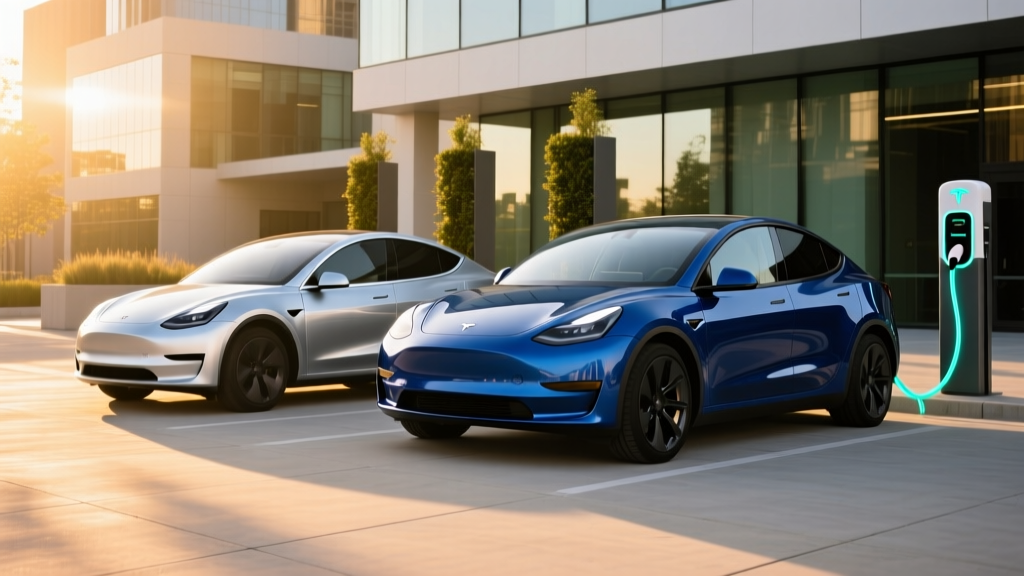
If you've been searching tesla precio to figure out what a Tesla actually costs in 2026 — not just the sticker, but the out-the-door number after credits, charging, and ownership — you're in the right place. Tesla's lineup has consolidated around the refreshed Model 3 (Highland) and the Juniper-updated Model Y, with pricing that shifts more often than any legacy automaker. This guide pins down the current MSRP by trim, real-world range expectations, charging speeds, and exactly which models qualify for the §30D federal tax credit.
Current Tesla Lineup: Base MSRP and Trim Pricing
Tesla adjusts prices frequently — sometimes multiple times per quarter — so treat these as the current 2026 model-year baseline. All prices below are base MSRP before destination fees, taxes, or incentives.
| Model / Trim | Drivetrain | Base MSRP | EPA Range | Est. After §30D Credit |
|---|---|---|---|---|
| Model 3 RWD | Rear-Wheel Drive | $38,990 | 272 mi | $31,490* |
| Model 3 Long Range AWD | Dual-Motor AWD | $45,740 | 341 mi | $38,240* |
| Model 3 Performance | Dual-Motor AWD | $52,990 | 315 mi | $45,490* |
| Model Y Long Range AWD | Dual-Motor AWD | $44,990 | 320 mi | $37,490* |
| Model Y Performance | Dual-Motor AWD | $51,490 | 292 mi | $43,990* |
*After-$7,500 figures assume full §30D eligibility. See the tax credit section below for income, MSRP, and sourcing requirements.
The Model 3 RWD is the entry point to the Tesla ecosystem and remains one of the most affordable premium electric sedans available. The Model Y Long Range is the volume seller — a compact crossover that fits a family of four comfortably and qualifies for the full credit under current rules. Both the Model 3 and Model Y fall under the §30D MSRP cap of $55,000 for sedans and $80,000 for SUVs/vans/pickups, so all trims listed above are potentially eligible.
Real-World Range: What the EPA Sticker Doesn't Tell You
Model 3 Long Range AWD: EPA 341 mi → Expect ~280–300 mi on mixed highway driving at 70–75 mph. In sub-30°F winter conditions, plan for 220–250 mi usable range.
Model Y Long Range AWD: EPA 320 mi → Expect ~260–285 mi highway; ~210–240 mi in cold weather.
Model 3 RWD: EPA 272 mi → Expect ~225–245 mi highway; ~180–210 mi in cold weather.
EPA range estimates are generated under controlled laboratory conditions that don't fully replicate sustained highway speeds, elevation changes, or temperature extremes. Tesla's efficiency is among the best in the industry — the Model 3 Long Range achieves roughly 25 kWh/100 mi (about 132 MPGe combined per fueleconomy.gov) — but physics still applies. At 75 mph, aerodynamic drag increases significantly compared to the EPA's 55/45 mph city/highway test cycle.
The Model 3 RWD uses an LFP (lithium iron phosphate) battery pack, approximately 60 kWh usable. LFP chemistry trades some energy density for exceptional cycle life and thermal stability — Tesla recommends charging LFP packs to 100% regularly, which effectively gives you the full usable capacity daily. The Long Range and Performance trims use NMC (nickel manganese cobalt) chemistry with roughly 75–82 kWh usable, and Tesla recommends an 80–90% daily charge limit to preserve long-term health.
| Attribute | LFP (RWD) | NMC (Long Range / Performance) |
|---|---|---|
| Usable Capacity | ~60 kWh | ~75–82 kWh |
| Daily Charge Limit | 100% recommended | 80–90% recommended |
| Cold-Weather Range Loss | ~25–35% | ~20–30% |
| Cycle Life (est.) | 3,000+ cycles | 1,500–2,000 cycles |
| Energy Density | Lower | Higher |
Charging Speeds: DC Fast Charging and Home Level 2
Tesla's Supercharger network remains the most reliable DC fast-charging ecosystem in North America, and the NACS (North American Charging Standard) connector is now the industry standard, with Ford, GM, Rivian, and others adopting it. Here's what charging actually looks like across all three levels:
| Charging Level | Power (kW) | Model 3 LR Speed | Time / Rate |
|---|---|---|---|
| Level 1 (120V outlet) | ~1.4 kW | 3–5 mi/hr | ~60+ hrs for full charge |
| Level 2 (240V, 48A) | ~11.5 kW | ~44 mi/hr | ~8 hrs for 10–80% |
| DC Fast (V3 Supercharger) | Peak 250 kW | ~1,000 mi/hr (peak) | 10–80% in ~25 min |
| DC Fast (V4 Supercharger) | Peak 250–350 kW | Model-dependent | 10–80% in ~18–22 min |
Important nuance on the charge curve: The "250 kW peak" number applies only at low state-of-charge (roughly 10–30% SoC) with a preconditioned battery. As the pack fills past 50%, charge rate tapers significantly — you might see 150 kW at 60% and under 50 kW above 85%. The 10–80% time of ~25 minutes on V3 Superchargers is realistic; the last 20% (80–100%) can take nearly as long as the first 70%. Tesla's onboard heat pump and battery preconditioning (activated when you navigate to a Supercharger) are critical for achieving peak rates, especially in cold weather.
For home charging, Tesla's Wall Connector at 48 amps on a 240V/60A circuit delivers up to 11.5 kW — enough to add roughly 44 miles of range per hour. Most owners who plug in overnight never need public charging for daily driving. A Level 2 home installation typically costs $500–$2,000 depending on panel proximity and whether your electrical panel needs an upgrade (older homes with 100A service may need a $1,500–$3,000 panel upgrade to support a 60A circuit).
Performance and Efficiency by Trim
| Trim | 0–60 mph | Horsepower | Drivetrain | Efficiency (kWh/100mi) | MPGe Combined |
|---|---|---|---|---|---|
| Model 3 RWD | 5.8 sec | 271 hp | RWD | ~25 | ~132 |
| Model 3 Long Range | 4.2 sec | 346 hp | Dual-Motor AWD | ~25 | ~132 |
| Model 3 Performance | 2.9 sec | 510 hp | Dual-Motor AWD | ~28 | ~118 |
| Model Y Long Range | 4.8 sec | 384 hp | Dual-Motor AWD | ~28 | ~119 |
| Model Y Performance | 3.5 sec | 456 hp | Dual-Motor AWD | ~30 | ~111 |
The Model 3 Performance is genuinely quick — a 2.9-second 0–60 time puts it in supercar territory at a fraction of the cost. But for most buyers, the Long Range AWD at 4.2 seconds is more than adequate and gives you the best combination of range, power, and all-weather traction. The RWD Model 3 is the efficiency champion and, with its lighter curb weight, offers surprisingly engaging handling.
Federal Tax Credit Eligibility (§30D Rules for 2026)
- Income caps: Modified AGI ≤ $150,000 (single), $225,000 (head of household), $300,000 (joint). Check IRS.gov §30D rules for current-year thresholds.
- MSRP caps: Sedans (Model 3) must be ≤ $55,000; SUVs (Model Y) must be ≤ $80,000. All current trims qualify.
- Battery sourcing: Increasing percentages of critical minerals and battery components must be sourced from the U.S. or FTA partners. Tesla's U.S. manufacturing gives it an advantage, but verify current-year compliance on the IRS eligible vehicle list.
- Point-of-sale transfer: As of 2024+, you can transfer the credit to the dealer at purchase for an immediate price reduction — you don't have to wait until tax filing.
- VIN verification: Confirm the specific vehicle's battery sourcing compliance at fueleconomy.gov before purchasing.
Tesla manufactures both the Model 3 and Model Y at its Fremont, California and Austin, Texas factories, which gives it strong positioning for domestic battery-component sourcing requirements. However, the critical-minerals threshold increases each year under the Inflation Reduction Act, and eligibility can change between model years. Always confirm the specific VIN's credit eligibility with Tesla at the time of order and consult a tax professional — this is not tax advice.
If you don't qualify for the full $7,500 federal credit (due to income limits or tax liability), some states offer additional rebates — California's CVRP, Colorado's state credit, and various utility-company incentives can stack. Check your state and local utility for current programs.
Interior, Cargo, and Technology
The refreshed Model 3 (Highland) and Model Y (Juniper) both feature significantly improved cabin insulation, ventilated front seats, ambient lighting, and a rear touchscreen for passengers (Model 3). The minimalist interior remains polarizing — no physical stalks (turn signals are steering-wheel-mounted buttons), no instrument cluster, and all climate/vehicle controls route through the 15.4-inch center display.
| Model | Cargo (rear seats up) | Cargo (seats folded) | Frunk | Rear Legroom |
|---|---|---|---|---|
| Model 3 | 23 cu ft | — | ~3.1 cu ft | 35.3 in |
| Model Y | 30 cu ft | 72 cu ft | ~4.1 cu ft | 41.6 in |
Standout tech: Tesla's infotainment remains the industry benchmark for responsiveness and over-the-air (OTA) update frequency. The 15.4-inch touchscreen handles navigation, media, vehicle settings, and even gaming (Steam integration). The Tesla app provides remote climate control, charging status, location tracking, and Summon (low-speed remote parking). Autopilot comes standard with adaptive cruise control and lane-centering; FSD (Supervised) is a $8,000 add-on or $99/month subscription that adds automated lane changes, intersection handling, and parking assistance — but it remains a SAE Level 2 system requiring full driver attention at all times.
Notable drawbacks: The turn-signal buttons on the steering wheel (replacing the traditional stalk) are a genuine ergonomic regression that frustrates many drivers, particularly in roundabouts. The Model 3's rear seat is tighter than competitors like the Hyundai Ioniq 6. Neither model offers Apple CarPlay or Android Auto — you're locked into Tesla's ecosystem. Build quality, while improved post-Highland/Juniper, still shows occasional panel-gap inconsistency compared to legacy luxury brands.
Warranty Coverage and Battery Longevity
| Coverage | Model 3 RWD | Model 3 LR / Performance | Model Y LR / Performance |
|---|---|---|---|
| Basic Vehicle | 4 yr / 50,000 mi | 4 yr / 50,000 mi | 4 yr / 50,000 mi |
| Battery & Drive Unit | 8 yr / 100,000 mi | 8 yr / 120,000 mi | 8 yr / 120,000 mi |
| Capacity Retention Threshold | 70% | 70% | 70% |
Tesla's battery warranty guarantees that the pack will retain at least 70% of its original capacity over the warranty period. In practice, Tesla's own fleet data shows average degradation of roughly 12–15% at 100,000 miles across all chemistries, with LFP packs showing even slower fade. A full battery replacement out of warranty runs approximately $12,000–$16,000 for the Model 3 and $14,000–$18,000 for the Model Y, based on current service-center pricing — though most packs outlast 200,000 miles with proper charging habits (avoiding prolonged 100% storage, using preconditioning for DC fast charging).
Pros, Cons, and Who Should Buy
✅ Pros
- Best-in-class Supercharger network (250+ kW, high reliability)
- Industry-leading efficiency (25–30 kWh/100 mi)
- Excellent OTA updates and software ecosystem
- Strong resale value relative to other EVs
- LFP option for buyers who want maximum cycle life
- Full §30D credit eligibility on all trims
- Heat pump standard for cold-weather efficiency
❌ Cons
- Steering-wheel turn-signal buttons are divisive
- No Apple CarPlay or Android Auto
- FSD ($8,000) remains Level 2 — not autonomous
- Rear-seat space in Model 3 trails competitors
- Repair costs and insurance premiums above segment average
- Build quality improving but still inconsistent
- Limited service center locations in rural areas
🎯 Who This EV Suits Best
Choose the Model 3 RWD if: You're a commuter with home Level 2 charging, drive under 60 miles/day, want the lowest entry price, and value LFP battery longevity.
Choose the Model 3 Long Range if: You regularly road-trip 250+ miles, need AWD for snow/rain, and want the best range-to-price ratio in a sedan.
Choose the Model Y Long Range if: You need cargo versatility (72 cu ft folded), have a family, or want crossover ride height with strong efficiency and Supercharger access.
Choose the Model 3 Performance if: You want supercar acceleration (2.9s 0–60) in a daily-drivable sedan and don't mind sacrificing ~25 miles of range for it.
Look elsewhere if: You need third-row seating (consider the Kia EV9), prefer physical controls, want CarPlay integration, or live in an area with no Tesla service center.
Tesla vs. Key Competitors: Quick Comparison
| Spec | Tesla Model 3 LR AWD | Hyundai Ioniq 6 SEL | BMW i4 eDrive40 |
|---|---|---|---|
| Base MSRP | $45,740 | $42,450 | $57,900 |
| EPA Range | 341 mi | 305 mi | 301 mi |
| Peak DC Charge | 250 kW | 233 kW | 200 kW |
| 10–80% Time | ~25 min | ~18 min | ~31 min |
| Charging Network | Supercharger (NACS) | CCS / NACS adapter | CCS / NACS adapter |
| Apple CarPlay | No | Yes (wireless) | Yes (wireless) |
The Model 3 Long Range still leads on EPA range and Supercharger-network convenience, but the Ioniq 6 charges faster (10–80% in ~18 minutes thanks to its 800V architecture) and costs less. The BMW i4 offers a more traditional luxury interior and CarPlay but at a significant price premium. If Supercharger access matters to you — and for road-trippers, it should — the Tesla advantage is tangible. But if you mostly charge at home and want CarPlay, the Ioniq 6 is a compelling alternative.
Frequently Asked Questions
What is the real-world range of the Tesla Model 3 and Model Y?
The Model 3 Long Range's EPA 341 miles translates to roughly 280–300 miles at highway speeds (70–75 mph) in moderate temperatures, and 220–250 miles in sub-30°F winter conditions. The Model Y Long Range (EPA 320 mi) yields about 260–285 miles highway and 210–240 miles in cold weather. The Model 3 RWD with its LFP pack (EPA 272 mi) gives roughly 225–245 miles highway. These are realistic figures based on sustained-speed driving — city driving with regenerative braking often exceeds highway efficiency.
How fast does a Tesla charge at home and on the road?
On a Tesla V3 Supercharger (250 kW peak), expect a 10–80% charge in roughly 25 minutes with a preconditioned battery. At home on a Level 2 Wall Connector (48A / 11.5 kW), you'll add about 44 miles of range per hour — a full overnight charge covers most daily needs. Level 1 (standard 120V outlet) adds only 3–5 miles per hour and is suitable only for emergency or very-low-mileage use.
Does the Tesla Model 3 and Model Y qualify for the $7,500 federal tax credit?
All current Model 3 and Model Y trims fall under the §30D MSRP caps ($55,000 for sedans, $80,000 for SUVs) and are assembled in the U.S. However, your personal eligibility depends on income limits ($150K single / $300K joint modified AGI) and the specific vehicle's battery-sourcing compliance for the current year. You can transfer the credit to the dealer at point of sale for an immediate price reduction. Verify eligibility on the IRS clean vehicle credit page and confirm with Tesla before ordering.
Is the Tesla Model Y worth it vs. the Ford Mustang Mach-E or Hyundai Ioniq 5?
The Model Y leads in EPA range, Supercharger network access, and cargo volume. The Mach-E offers a more conventional interior with CarPlay and competitive pricing, while the Ioniq 5 charges faster (800V architecture, ~18 min 10–80%) and has a more distinctive design. If you road-trip frequently and value charging-network reliability, the Model Y remains the strongest choice. If you prioritize fast public charging, CarPlay, or interior ergonomics, test-drive the Ioniq 5 and Mach-E before committing.
How long will a Tesla battery last before needing replacement?
Tesla's fleet data indicates average battery degradation of roughly 12–15% at 100,000 miles. LFP packs (Model 3 RWD) tend to degrade even more slowly due to their chemistry. The warranty guarantees ≥70% capacity retention for 8 years / 100,000–120,000 miles. Out-of-warranty replacement costs $12,000–$18,000 depending on the model. With proper habits — avoiding prolonged 100% storage, using preconditioning, and not exclusively DC fast-charging — most packs should outlast 200,000 miles.
Is Tesla's Full Self-Driving (FSD) actually autonomous?
No. FSD (Supervised) is an SAE Level 2 driver-assistance system, meaning the driver must remain fully engaged, hands on or near the wheel, and eyes on the road at all times. It handles lane changes, highway interchanges, and some city streets with varying reliability, but it can and does make errors. True autonomous driving (Level 4) is currently offered only by robotaxi services like Waymo in limited metro areas. Do not treat FSD as a substitute for attentive driving.