The Tesla Home Power Station Equation for EV Owners
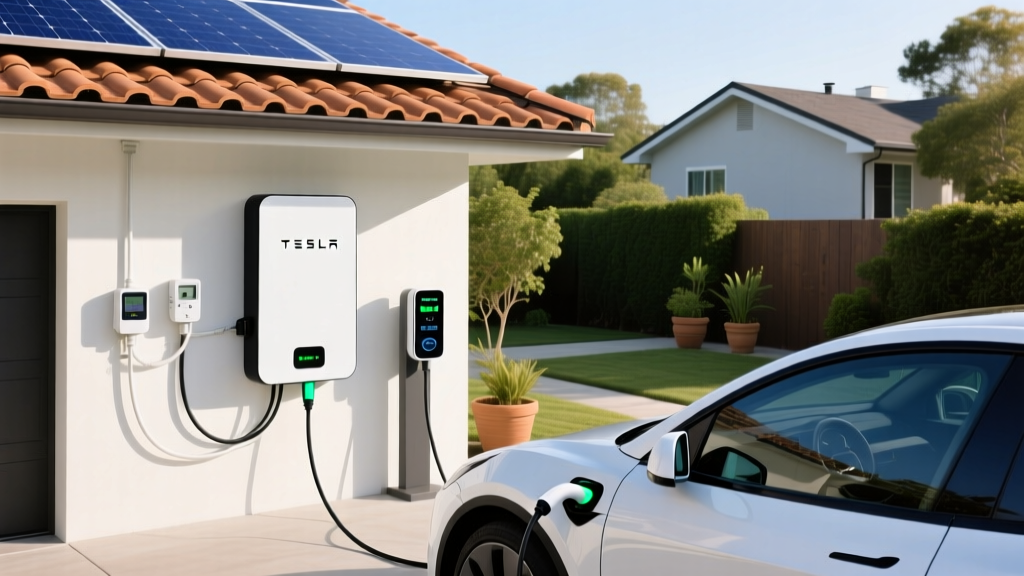
If you've searched for "power station Tesla," you're likely weighing whether Tesla's home energy ecosystem — specifically the Tesla Powerwall 3 paired with Solar Roof or solar panels — can function as a dependable home power station for EV charging. It's a fair question. With the Powerwall 3's integrated solar inverter and higher continuous power output, Tesla has positioned its battery hardware as a dual-purpose system: backup power during outages and daily energy management, including topping off your Tesla (or any EV) overnight.
This guide evaluates the Tesla Powerwall 3 as a home power station specifically through the lens of EV ownership. We'll cover usable kWh capacity, charge and discharge rates (kW), solar integration, real-world EV charging performance, costs, and whether this setup makes financial sense compared to a standard grid-tied Level 2 charger.
| Specification | Value |
|---|---|
| Usable Energy Capacity | 13.5 kWh per unit |
| Continuous Power Output | 11.5 kW (single Powerwall 3) |
| Peak Power Output | ~15 kW (short burst) |
| Integrated Inverter | Yes — built-in solar inverter (no separate unit needed) |
| Stackable | Yes — up to 4 units (54 kWh usable, ~46 kW continuous) |
| Battery Chemistry | Lithium-ion (NMC variant) |
| Round-Trip Efficiency | ~90% (AC-AC) |
| Warranty | 10 years, unlimited cycles (with solar or grid charge) |
| Backup Gateway | Gateway 3 included (automatic transfer) |
| Approximate Installed Cost (1 unit) | $12,000–$16,000 (before incentives) |
Source: Tesla Powerwall product page. Pricing varies by installer, region, and electrical complexity.
Can the Powerwall 3 Actually Charge Your EV?
The short answer: yes, but with important caveats about speed and capacity that every EV owner should understand before investing.
Understanding kW vs. kWh in This Context
This is the single most critical distinction for EV owners evaluating a home power station:
- kWh (kilowatt-hours) = energy capacity. Think of it as the size of the fuel tank. A Powerwall 3 holds 13.5 kWh of usable energy.
- kW (kilowatts) = power, or the rate at which energy flows. Think of it as the diameter of the hose. The Powerwall 3 can deliver up to 11.5 kW continuously.
For comparison, a typical Level 2 home charger (like a Tesla Wall Connector) runs at up to 11.5 kW (48 amps on a 60-amp circuit). The Powerwall 3's continuous output of 11.5 kW matches this — meaning it can theoretically power a Level 2 charger at full rate. But the 13.5 kWh capacity is the limiting factor.
Real-World EV Charging from a Single Powerwall 3
What 13.5 kWh gets you:
- Tesla Model 3 RWD (4.0 mi/kWh): ~54 miles of range (accounting for ~90% round-trip efficiency: ~48 miles net)
- Tesla Model Y Long Range AWD (3.5 mi/kWh): ~47 miles of range (~42 miles net)
- Tesla Cybertruck AWD (2.0 mi/kWh): ~27 miles of range (~24 miles net)
- Ford F-150 Lightning (2.0 mi/kWh): ~27 miles of range (~24 miles net)
Bottom line: A single Powerwall 3 cannot fully recharge any current EV from empty. It's best understood as a partial top-up station or an emergency buffer, not a primary daily charging source for high-mileage drivers.
Charging Speeds: Powerwall vs. Grid vs. Solar Direct
| Source | Max Power (kW) | Miles of Range per Hour (Model Y LR) | Full Charge Feasibility |
|---|---|---|---|
| Level 1 (120V outlet) | 1.4 kW | ~4–5 mi/hr | Yes — 24+ hours |
| Level 2 (Grid, 48A/240V) | 11.5 kW | ~35–40 mi/hr | Yes — 6–10 hours |
| Powerwall 3 (battery discharge) | 11.5 kW (continuous) | ~35–40 mi/hr | Partial — ~20–25 min before depleted |
| Solar panels direct (10 kW array, peak) | ~7–10 kW (varies) | ~25–35 mi/hr | Yes — daytime only, weather-dependent |
| Solar + Powerwall 3 (combined) | Up to 11.5 kW | ~35–40 mi/hr | Yes — solar extends session beyond battery |
The Solar Multiplier Effect
Here's where the "power station" concept earns its keep. If your solar array is producing 8 kW during midday and the Powerwall holds 13.5 kWh, your EV can draw from both simultaneously. On a sunny day with a 12 kW solar array, you might sustain Level 2 charging speeds for hours — effectively charging your EV on sunlight alone, with the Powerwall smoothing out cloud-passing dips and absorbing excess solar for evening use.
Realistic daily solar yield: A 10 kW solar array in a sun-rich region (Arizona, Southern California) produces roughly 40–50 kWh per day in summer, 25–30 kWh in winter. That's enough to fully recharge a Model 3 and still power household loads — but only if you charge during peak solar hours or store the excess in Powerwalls.
Cost Breakdown: Powerwall 3 as a Home Power Station
| Component | Cost Range |
|---|---|
| Powerwall 3 unit (hardware) | $7,500–$9,500 |
| Gateway 3 (backup transfer switch) | $800–$1,200 |
| Installation labor (certified installer) | $2,500–$4,500 |
| Electrical panel upgrade (if needed, 200A+) | $1,500–$3,500 |
| Permits and inspection | $300–$800 |
| Total (single Powerwall 3, no solar) | $12,600–$19,500 |
| Solar array add-on (10 kW, if not existing) | $18,000–$28,000 (before credits) |
Federal Tax Credits for Home Energy Storage
Under the Inflation Reduction Act, the Residential Clean Energy Credit (IRC §25D) provides a 30% federal tax credit for qualified home battery storage (capacity of 3 kWh or greater) installed through 2032. This applies to the Powerwall 3 whether or not it's paired with solar.
- Single Powerwall 3 installed at $15,000 → 30% credit = $4,500 back
- Powerwall 3 + 10 kW solar at $40,000 combined → 30% credit = $12,000 back
This is distinct from the §30D Clean Vehicle Credit that applies to EV purchases. Both credits can be claimed in the same tax year if you buy an EV and install a Powerwall. Consult a tax professional for eligibility specifics — income limits and credit phase-out schedules apply. Source: IRS Residential Clean Energy Credit.
Who Should Use the Tesla Powerwall as a Home Power Station?
Choose the Powerwall 3 + Solar Setup If:
- You live in a region with frequent outages (Texas, California wildfire zones, Gulf Coast hurricane areas) and need backup power that doubles as EV charging
- You have or plan to install a solar array and want to maximize self-consumption of solar energy
- Your daily EV commute is under 40 miles and you can charge during solar-peak hours
- You want to shift EV charging to off-peak hours using stored solar (time-of-use rate arbitrage)
- You own a Tesla and want deep integration with the Tesla app for energy and vehicle management
Stick with Grid-Tied Level 2 Charging If:
- You drive 60+ miles daily and need reliable full charges every night regardless of weather
- Your utility offers cheap overnight rates ($0.06–$0.10/kWh) — grid charging is cheaper than battery cycling
- You live in an apartment or home without roof solar potential
- Your primary goal is lowest cost per mile — a $500 Level 2 charger on grid power wins on pure economics
Stacking Powerwalls: When One Isn't Enough
For EV owners who want true whole-home backup and full EV recharging during multi-day outages, stacking Powerwalls is the answer:
- 2x Powerwall 3: 27 kWh usable, 23 kW continuous — enough to fully recharge a Model 3 RWD (57.5 kWh battery) to ~47% or give a Model Y roughly 80 miles of range during an outage.
- 4x Powerwall 3: 54 kWh usable, 46 kW continuous — approaches a full recharge for a Model 3 and sustains Level 2 charging speeds indefinitely while solar replenishes.
At 4 units, the system cost reaches $45,000–$70,000+ before the 30% credit. That's a significant investment — justifiable primarily for resilience, not as a cost-saving EV charging strategy.
Tesla Powerwall vs. Competing Home Batteries for EV Charging
| Feature | Tesla Powerwall 3 | Enphase IQ 5P | FranklinWH aPower 2 |
|---|---|---|---|
| Usable Capacity | 13.5 kWh | 5 kWh (stackable) | 13.6 kWh |
| Continuous Power | 11.5 kW | 3.84 kW per unit | 11.5 kW |
| Integrated Inverter | Yes | Microinverter-based | Yes |
| EV Charger Integration | Tesla Wall Connector native | Enphase EV charger | Universal (any L2 charger) |
| Warranty | 10 years, unlimited cycles | 15 years | 12 years |
| Best For | Tesla ecosystem owners | Modular, phased installs | Whole-home management |
Pros
- Integrated solar inverter eliminates a separate hardware purchase and reduces failure points
- 11.5 kW continuous output matches Level 2 home charging speeds
- Seamless Tesla app integration — monitor solar, battery, and vehicle from one interface
- 10-year warranty with unlimited cycles when paired with solar or grid charging
- Eligible for 30% federal tax credit (§25D) — no income cap on this credit
- Gateway 3 provides automatic, seamless backup transfer during outages
Cons
- 13.5 kWh capacity provides only partial EV charge — not a full refill for any current EV
- High upfront cost ($12,000–$19,500 installed for one unit) vs. $500 for a grid-tied Level 2 charger
- NMC chemistry degrades faster in high-heat environments vs. LFP alternatives
- Tesla's certified installer network has long lead times in some regions (3–6 months)
- Battery replacement after warranty: estimated $8,000–$12,000 per unit
- Solar production is weather- and season-dependent — winter charging yield drops 30–50%
The Economics: Cost per Mile Charging from Your Tesla Power Station
Let's run the numbers that actually matter for ownership decisions:
- Grid-only Level 2 (national avg. $0.16/kWh): ~$0.045 per mile (Model Y at 3.5 mi/kWh)
- Solar + Powerwall (amortized system cost over 10 years): ~$0.02–$0.03 per mile if maximizing solar self-consumption
- Gasoline equivalent ($3.40/gal, 28 MPG): ~$0.121 per mile
The solar + Powerwall route saves roughly $0.015–$0.025 per mile vs. grid charging. For a driver covering 12,000 miles/year, that's $180–$300 in annual savings. Over 10 years, the savings partially offset the system cost — but the Powerwall is primarily a resilience and energy-independence investment, not a pure cost-saving play for EV charging alone.
Frequently Asked Questions
What is the real-world EV range I can get from a Tesla Powerwall 3?
A single Powerwall 3 (13.5 kWh usable, ~90% round-trip efficiency) delivers approximately 48 miles of range in a Tesla Model 3 RWD, 42 miles in a Model Y Long Range, or 24 miles in a Cybertruck. Real-world range drops further in cold weather — expect 10–20% less in sub-freezing temperatures due to cabin heating and battery conditioning demands.
How fast does an EV charge from the Powerwall 3 vs. a standard Level 2 charger?
The Powerwall 3's 11.5 kW continuous output matches a Tesla Wall Connector on a 60-amp circuit. Charging speed is identical: roughly 35–40 miles of range per hour for a Model Y. The difference is duration — the Powerwall depletes in about 70 minutes at full output, while grid power is unlimited.
Does installing a Powerwall affect my EV's federal tax credit?
No. The Powerwall qualifies for the §25D Residential Clean Energy Credit (30% of installed cost, no income cap), which is entirely separate from the §30D Clean Vehicle Credit (up to $7,500 for qualifying EVs, with MSRP and income caps). You can claim both in the same tax year. Consult IRS guidelines at irs.gov and your tax professional.
Is the Powerwall 3 worth it just for EV charging, or should I stick with grid power?
For pure EV charging economics, a $500 Level 2 charger on grid power is far cheaper. The Powerwall 3 makes sense as an EV charging source when combined with solar panels and a need for backup power. The value proposition is resilience + solar self-consumption + energy independence, not lowest-cost-per-mile charging.
Can I charge a non-Tesla EV from the Powerwall 3?
Yes. The Powerwall 3 stores and delivers standard AC power to your home's electrical panel. Any Level 2 EV charger — ChargePoint, Emporia, Grizzl-E — draws from the same panel and works seamlessly during backup or solar-powered sessions. The Powerwall doesn't discriminate by vehicle brand.
How long will the Powerwall 3 battery last before needing replacement?
Tesla warranties the Powerwall 3 for 10 years with unlimited cycles when the system charges from solar or grid (not generator-only). Real-world degradation data from earlier Powerwall 2 units suggests 70–80% capacity retention at the 10-year mark under typical cycling. Replacement cost is estimated at $8,000–$12,000 per unit after warranty.
Final Verdict: The Tesla Power Station for EV Owners
The Tesla Powerwall 3 functions as a capable home power station for EV charging — but it's best understood as one component of a broader solar-plus-storage system rather than a standalone EV charger. Its 11.5 kW output delivers genuine Level 2 speeds, but the 13.5 kWh capacity means you're getting a partial charge, not a full tank. Stack multiple units and pair with a robust solar array, and you approach energy independence — at a premium price.
For EV owners in outage-prone areas with good solar potential, the Powerwall 3 + solar combo is the most integrated and app-friendly home power station available. For everyone else, a standard Level 2 charger on grid power remains the most cost-effective way to charge at home.