What Is Tesla PowerShare (And Why It Matters in 2026)
Tesla PowerShare is the company's branded bidirectional energy system that lets select Tesla vehicles push electricity out of their traction batteries to power tools, appliances, or even an entire home. It encompasses two distinct capabilities: V2L (Vehicle-to-Load), which powers devices via onboard outlets, and V2H (Vehicle-to-Home), which feeds energy back through a hardwired home energy gateway.
As of the 2026 model year, PowerShare is not a standalone product you buy off a shelf — it's a vehicle-integrated feature paired with specific Tesla hardware. Think of it as Tesla's answer to Ford's Pro Power Onboard, but with deeper integration into the Powerwall and Solar ecosystem. For EV buyers who split time between job sites, off-grid camping, and areas with unreliable utility power, PowerShare is one of the strongest arguments for putting a Cybertruck in the driveway.
How PowerShare Actually Works: V2L vs. V2H
Bidirectional charging sounds simple until you dig into the wiring. Tesla separates the feature into two tiers:
- V2L (Vehicle-to-Load): Uses built-in 120V and 240V outlets in the bed and cabin. You plug in a saw, a refrigerator, or a campsite string of lights. No extra hardware required beyond the vehicle itself. Output is capped to protect the battery and inverter.
- V2H (Vehicle-to-Home): Requires the Tesla Powerwall and a compatible gateway (typically the Tesla Wall Connector with bidirectional capability or a dedicated transfer switch). During an outage, the Cybertruck can back-feed the home's electrical panel, effectively acting as a rolling backup generator.
Critically, PowerShare is not V2G (Vehicle-to-Grid) in the utility-interactive sense. Tesla does not currently let you sell electricity back to your utility through PowerShare. It's a resilience and job-site feature, not a revenue stream.
PowerShare Output: What the Numbers Actually Mean
Rated V2L continuous output: up to 11.5 kW (240V / 48A) from the bed outlet on properly equipped Cybertruck trims.
Rated V2H output: up to ~11.5 kW sustained when paired with Powerwall and gateway.
Real-world caveat: Continuous high-draw loads (welders, multiple space heaters) will trip thermal protection. Expect ~9–10 kW sustained on hot days. A full 123 kWh Cybertruck battery can run a typical 2 kW home load for roughly 55–60 hours before hitting a 10% reserve buffer.
Vehicles That Support Tesla PowerShare (2026)
Not every Tesla on the road can do this. As of the 2026 model year, PowerShare is limited to:
| Vehicle | V2L (Outlets) | V2H (Home Backup) | Max Output |
|---|---|---|---|
| Cybertruck AWD (2024–2026) | Yes — bed + cabin | Yes (with Powerwall/Gateway) | 11.5 kW |
| Cybertruck Cyberbeast (2024–2026) | Yes — bed + cabin | Yes (with Powerwall/Gateway) | 11.5 kW |
| Model 3 / Model Y / Model S / Model X | No (12V only) | No | N/A |
| Next-gen Tesla (announced) | Expected | Unconfirmed | TBD |
If you own a Model 3 or Model Y, PowerShare is not available. The 12V outlet in the cabin is limited to roughly 150W — enough for a laptop, not a job site.
PowerShare vs. Ford Pro Power Onboard: A Spec-Level Comparison
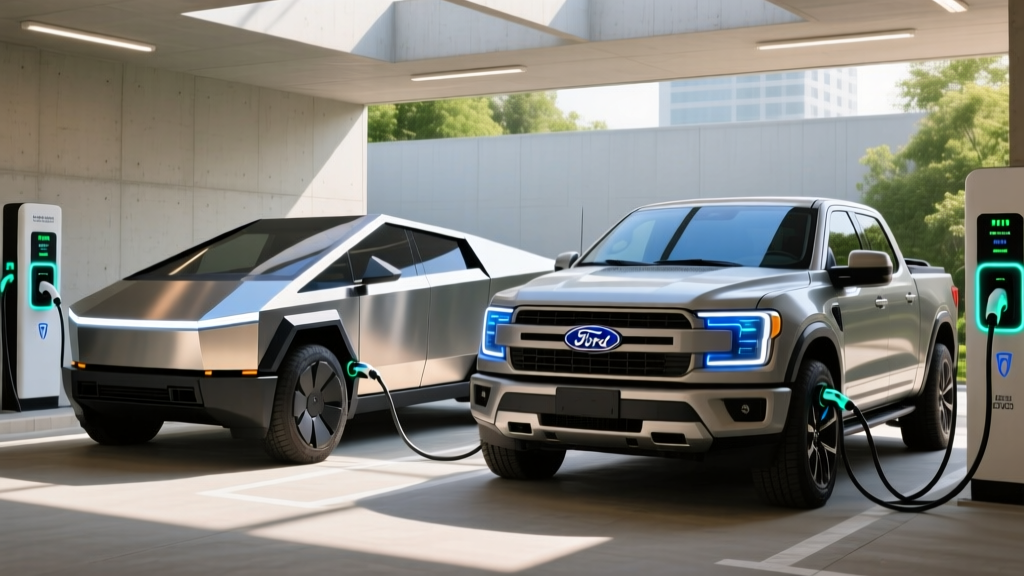
Ford beat Tesla to market with bidirectional output on the F-150 Lightning and F-150 PowerBoost hybrid. Here's how the two systems stack up on paper and in practice:
| Feature | Tesla PowerShare (Cybertruck) | Ford Pro Power Onboard (F-150 Lightning) |
|---|---|---|
| Max V2L output | 11.5 kW (240V) | 9.6 kW (240V, 30A) |
| 120V cabin/bed outlets | Yes (multiple) | Yes (up to 6) |
| V2H (whole-home backup) | Yes — requires Powerwall | Yes — requires Ford Charge Station Pro + Home Integration System |
| Battery capacity usable | ~123 kWh (Cybertruck) | ~98 kWh (Std) / ~131 kWh (Ext Range) |
| Home ecosystem lock-in | Tesla Powerwall required | Sunrun/Ford partnership, more flexible |
| V2G (utility export) | No | No (as of 2026) |
| Vehicle starting MSRP | ~$79,990 (AWD) | ~$54,995 (Flash, 2026 est.) |
The takeaway: Tesla's 11.5 kW peak edges out Ford's 9.6 kW, which matters if you're running a plasma cutter or multiple heavy loads. But Ford's extended-range battery is larger (~131 kWh usable), which translates to longer home-runtime during outages. If you're already in the Tesla/Powerwall ecosystem, PowerShare is a natural extension. If you want a lower entry price and more flexible home integration, Ford still has the edge for most homeowners.
Battery, Chemistry, and Degradation Concerns
Pushing energy out of a traction battery raises a legitimate question: does PowerShare use accelerate degradation?
The Cybertruck uses an NMC (nickel manganese cobalt) structural battery pack — not the LFP chemistry found in base Model 3 RWD. NMC has higher energy density but is more sensitive to high state-of-charge (SoC) storage and deep cycling. Tesla's battery management system (BMS) enforces a lower buffer during V2H operation, preventing the pack from draining below roughly 10% SoC.
Degradation math worth knowing: A typical NMC pack loses ~10–12% capacity over 150,000 miles of normal driving. Occasional PowerShare use (a few outages per year, job-site loads) adds minimal extra cycles — we estimate less than 1% additional degradation over five years for a homeowner who uses V2H 10–15 times annually. Daily heavy V2L use (contractors running 8 kW for 6 hours a day) will meaningfully accelerate wear and should be factored into total cost of ownership.
Tesla's battery and drive unit warranty covers 8 years / 120,000 miles with a minimum 70% capacity retention threshold — which aligns with industry norms for NMC packs of this size.
Who Should Actually Care About PowerShare?
PowerShare solves three real problems, and if none of them apply to you, the feature shouldn't drive your purchase decision:
PowerShare is worth paying for if:
- You live in an outage-prone area (Texas grid, California PSPS events, hurricane corridors) and want backup power without a standby generator.
- You work on job sites without shore power and currently haul a gasoline generator.
- You already own or plan to buy a Powerwall — the integration is seamless and the app control is best-in-class.
- You camp off-grid with high-draw appliances (induction cooktops, space heaters, Starlink).
PowerShare is not worth the premium if:
- You have reliable utility power and a conventional commuter use case.
- You'd be buying a Cybertruck solely for this feature — a Powerwall + a small inverter generator is cheaper insurance.
- You want to earn money exporting to the grid (not supported).
Pricing, Tax Credits, and the 2026 Reality
The Cybertruck's pricing has shifted several times since launch. As of early 2026:
| Trim | Base MSRP | Federal §30D Credit | Effective Price (if eligible) |
|---|---|---|---|
| Cybertruck AWD | $79,990 | $0 (over MSRP cap) | $79,990 |
| Cybertruck Cyberbeast | $99,990 | $0 (over MSRP cap) | $99,990 |
Critical tax-credit caveat: Under IRS §30D rules, the federal EV tax credit caps eligible trucks at an MSRP of $80,000. The base Cybertruck AWD at $79,990 technically squeezes under, but destination fees and any option push it over — and the Cyberbeast is far above the cap. Buyer income limits ($150k single / $300k joint AGI) and battery critical-mineral sourcing requirements further narrow eligibility. In practice, most Cybertruck buyers in 2026 will not receive the $7,500 federal credit. Consult a tax professional before relying on it.
For buyers specifically after bidirectional capability at a lower price with potential credit eligibility, the F-150 Lightning (qualifying trims under $80k) remains a more credit-friendly path.
Biggest Pros and Cons of Tesla PowerShare
Pros
- Highest peak V2L output in its class (11.5 kW)
- Seamless app integration with Powerwall and solar
- Whole-home backup without a gas generator
- No extra hardware cost for V2L — outlets are built in
- Cybertruck's stainless body and bed durability on job sites
Cons
- V2H requires Powerwall purchase (~$9,000+ installed)
- Cybertruck MSRP mostly disqualifies it from §30D credit
- NMC chemistry more cycle-sensitive than LFP for daily heavy V2L
- No V2G utility export (yet)
- Only available on Cybertruck — no Model 3/Y support
Frequently Asked Questions
Can I use Tesla PowerShare without a Powerwall?
Yes, for V2L. You can plug appliances and tools directly into the Cybertruck's bed and cabin outlets without any additional hardware. V2H (whole-home backup), however, requires a Powerwall and compatible gateway to safely back-feed your electrical panel.
How long can a Cybertruck power my home during an outage?
With a ~123 kWh usable battery and a typical home drawing 1.5–2 kW average (refrigerator, lights, router, some outlets), expect roughly 55–75 hours of runtime before the BMS reserves kick in. Heavy HVAC loads cut this dramatically — central AC can draw 3–5 kW alone.
Does PowerShare work while the Cybertruck is charging?
No. PowerShare and charging are mutually exclusive states. The vehicle cannot simultaneously accept charge from a wall connector and discharge to your home.
Will PowerShare void my battery warranty?
No. PowerShare is a factory-supported feature. Using it as designed does not void the 8-year/120,000-mile battery warranty. However, extreme daily cycling will still count against the 70% capacity retention threshold.
Is Tesla PowerShare available on the Model Y or refreshed Model 3?
Not as of the 2026 model year. Tesla has not announced plans to retrofit bidirectional hardware onto existing Model 3/Y fleets, and current production vehicles do not include the necessary inverters or outlets.