Quick Verdict: PowerShare Turns Your Powerwall Into a Home Microgrid
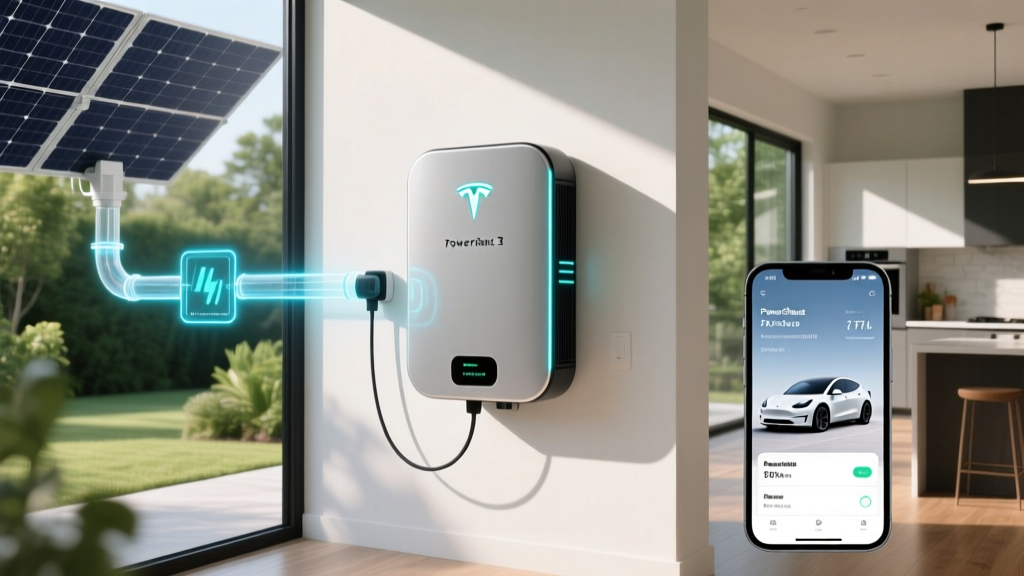
Tesla's Powerwall 3 with PowerShare isn't a vehicle — it's the missing link between your EV, your solar panels, and your home's electrical panel during an outage. The PowerShare system enables your Powerwall 3 to back up your entire home (not just critical circuits) and intelligently manages energy flow between solar, battery, home loads, and even your EV. For Tesla owners, it adds bidirectional potential; for all EV owners, it provides blackout-proof home charging. At a starting installed price of roughly $9,200–$12,500 for a single Powerwall 3, it's a serious investment — but one that pays measurable dividends in outage resilience and energy arbitrage.
Specs at a Glance: Powerwall 3 with PowerShare
| Specification | Value |
|---|---|
| Usable Battery Capacity | 13.5 kWh (per unit) |
| Battery Chemistry | NMC (Nickel Manganese Cobalt) |
| Continuous Power Output | 11.5 kW |
| Peak Power (surge) | ~15 kW |
| Integrated Inverter | Yes — built-in, no separate unit required |
| Round-Trip Efficiency | ~90% |
| PowerShare Whole-Home Backup | Up to 3 Powerwalls in parallel (34.5 kW continuous) |
| Dimensions (H × W × D) | 43.5 × 24 × 7.6 in |
| Weight | ~280 lbs |
| Warranty | 10 years, unlimited cycles (retained capacity ≥70%) |
| Base Equipment Price | ~$7,300 (before install) |
| Installed Cost (typical) | $9,200–$12,500 per unit |
What Is Tesla PowerShare and How Does It Work?
PowerShare is Tesla's branding for the whole-home backup and intelligent energy-routing capability built into the Powerwall 3. Unlike the Powerwall 2, which typically backed up only a sub-panel of critical circuits (refrigerator, lights, Wi-Fi), PowerShare enables the Powerwall 3 to back up your entire main electrical panel — including high-draw 240V circuits like your EV charger, electric oven, dryer, and HVAC.
The system works through an integrated Gateway controller that monitors grid status in real time. When the grid drops, PowerShare isolates your home from the grid (anti-islanding safety) and seamlessly transitions to battery power in under a second. Your lights don't flicker; your EV charger doesn't lose its session.
Critically for EV owners, PowerShare can prioritize and manage EV charging during outages. The Tesla app lets you set rules: for example, "charge the Model Y to 60% only during an outage" or "pause EV charging when battery drops below 40%." This prevents a common outage mistake — draining your home battery by charging your car, leaving nothing for the house.
EV Integration: Which Cars Work with PowerShare?
PowerShare's smartest EV features activate when paired with a Tesla vehicle and the Tesla Wall Connector. The system recognizes the car, reads its state of charge (SoC), and coordinates charging schedules with battery reserves. However, PowerShare backs up any Level 2 EV charger on your panel — it just won't have the deep software integration.
EV Compatibility with PowerShare
| EV Brand | Charger Compatibility | Smart Scheduling | SoC Integration |
|---|---|---|---|
| Tesla (Model 3/Y/S/X, Cybertruck) | Wall Connector (native) | Yes — full | Yes — bidirectional via app |
| Ford (F-150 Lightning, Mach-E) | Any Level 2 on backed-up panel | Limited (Ford app) | No direct integration |
| Hyundai/Kia (Ioniq 5/6, EV6/EV9) | Any Level 2 on backed-up panel | No | No |
| GM (Equinox EV, Blazer EV, Silverado EV) | Any Level 2 on backed-up panel | No | No |
| Rivian (R1T, R1S) | Rivian Wall Connector or any L2 | Limited | No |
For non-Tesla EVs, the practical takeaway: your charger still works during an outage because PowerShare backs up the whole panel. You just manage charge limits manually through your car's app rather than through a unified Tesla ecosystem.
Real-World Backup Duration: How Long Will It Last?
Estimated Backup Duration by Home Load Profile
EPA/test data doesn't apply here — these are calculated estimates based on average US home consumption (~30 kWh/day).
| Scenario | Load Profile | 1× Powerwall 3 (13.5 kWh) | 2× Powerwall 3 (27 kWh) |
|---|---|---|---|
| Essential loads only | Fridge, lights, Wi-Fi, phone charging (~1 kW avg) | ~13 hours | ~27 hours |
| Moderate use | Above + TV, microwave, EV top-off (~3 kW avg) | ~4.5 hours | ~9 hours |
| Full-home with EV charging | All circuits including 7.7 kW L2 EV charge (~8 kW avg) | ~1.7 hours | ~3.4 hours |
| Full-home + solar replenishment | Moderate use + 8 kW solar array (daytime) | Indefinite (day-recharge cycle) | Indefinite |
The solar pairing is where PowerShare shines. If you have a typical 8–10 kW rooftop solar array, daytime generation can replenish the Powerwall while also running household loads. This creates a self-sustaining microgrid that can ride out multi-day outages — as demonstrated by thousands of Tesla solar+storage customers during California PSPS (Public Safety Power Shutoff) events and Texas winter storms.
Installation, Electrical Requirements, and Costs
PowerShare requires a licensed electrician and typically a permit. The Powerwall 3's integrated inverter simplifies installation compared to Powerwall 2 (which required a separate inverter), but the Gateway controller and whole-panel backup wiring add complexity.
| Component | Cost Range |
|---|---|
| Powerwall 3 unit | $7,300 |
| Gateway controller | $800–$1,200 |
| Electrical labor (8–16 hrs) | $1,500–$3,000 |
| Main panel upgrade (if needed, 200A+) | $1,500–$3,500 |
| Permit & inspection | $200–$600 |
| Total installed (1 unit) | $9,200–$12,500 |
| Each additional Powerwall 3 | +$7,800–$9,500 |
Panel upgrade gotcha: PowerShare backs up your entire panel, which means your main breaker panel must handle the combined load. Homes with 100A service almost always need an upgrade to 200A before PowerShare can be installed. Budget $2,000–$3,500 for this if your panel is older or undersized.
Tax Credits and Incentives
The Powerwall 3 with PowerShare qualifies for the 30% federal Investment Tax Credit (ITC) under IRC §25D — not the §30D vehicle credit, but the residential clean energy credit. This applies to both the equipment and installation labor.
- Credit amount: 30% of total installed cost (no dollar cap)
- Example: $11,000 installed → $3,300 federal tax credit → net cost ~$7,700
- Eligibility: Must be installed at your primary or secondary US residence; you must have sufficient tax liability to claim it (it's non-refundable)
- Solar pairing bonus: If installed with solar, the entire system (panels + Powerwall + labor) qualifies for the 30% ITC
- State incentives: Vary widely — California's SGIP rebate can add $1,000–$3,000; check your state energy office or DSIRE database
Note: Tax rules are subject to change. Consult a tax professional and review current IRS guidance on the Residential Clean Energy Credit before purchasing.
Pros and Cons: PowerShare for EV Owners
Pros
- Whole-home backup including 240V EV charger — no sub-panel limitations
- Seamless grid-to-battery transition (<1 second)
- Deep Tesla vehicle integration for smart outage charging rules
- Integrated inverter reduces install complexity vs. competitors
- Solar self-consumption and time-of-use arbitrage reduce electricity bills
- 10-year warranty with unlimited cycle guarantee (≥70% capacity)
- Up to 3 units stackable for 40.5 kWh / 34.5 kW continuous
Cons
- High upfront cost ($9,200–$12,500 per unit installed)
- Non-Tesla EVs lack deep SoC integration and automated scheduling
- Single unit provides limited backup for high-load homes (1.7 hrs at 8 kW)
- Requires 200A+ main panel — upgrade cost adds $1,500–$3,500
- Installation wait times can stretch 4–12 weeks in high-demand markets
- Not a vehicle-to-home (V2H) system — cannot send EV battery energy back to home (yet)
- NMC chemistry has higher thermal sensitivity than LFP alternatives
Competitor Comparison: PowerShare vs. Alternatives
| Feature | Tesla Powerwall 3 (PowerShare) | Enphase IQ 5P | FranklinWH aPower 2 | Generac PWRcell |
|---|---|---|---|---|
| Capacity per unit | 13.5 kWh | 5 kWh (modular) | 13.6 kWh | 9–18 kWh (modular) |
| Continuous output | 11.5 kW | 1.92 kW (per battery) | 10.8 kW | 7.5–12 kW |
| Whole-home backup | Yes (PowerShare) | Yes (with IQ System Controller) | Yes (aGate) | Yes (with smart management) |
| Integrated inverter | Yes | Microinverter-based | Yes | Separate inverter required |
| EV smart scheduling | Yes (Tesla ecosystem) | No | Limited | No |
| Warranty | 10 yr / unlimited cycles | 15 yr | 12 yr / 36,000 cycles | 10 yr |
| Installed cost (base) | $9,200–$12,500 | $8,000–$14,000 | $10,000–$14,000 | $10,000–$16,000 |
Who Should Buy Powerwall 3 with PowerShare?
Choose PowerShare If:
- You own a Tesla vehicle and want unified app control of car + home energy
- You experience frequent outages (3+ per year) and need whole-home backup
- You have or plan to install rooftop solar for self-consumption
- You want EV charging capability during multi-hour or multi-day outages
- You're on a time-of-use rate plan and want battery arbitrage (charge cheap, discharge expensive)
Look Elsewhere If:
- You drive a non-Tesla EV and want deep vehicle-to-home integration (consider Ford's V2H with the F-150 Lightning + Charge Station Pro)
- Your outages are brief (<2 hours) — a small UPS or portable power station may suffice
- Your home has 100A service and you're unwilling to pay for a panel upgrade
- You need more than ~27 kWh of storage — modular systems like Enphase may scale more affordably
Frequently Asked Questions
Can Tesla PowerShare send my EV battery energy back to my home?
Not currently. PowerShare manages energy from your solar panels and Powerwall to your home and EV — it's a one-way flow from battery to car. True vehicle-to-home (V2H) bidirectional charging is available through Ford (F-150 Lightning with Charge Station Pro) and is expected from GM and Hyundai in upcoming model years. Tesla has discussed V2H capabilities but has not announced a production timeline as of early 2026.
How many Powerwall 3 units do I need to back up my whole home?
For most 2,000–3,000 sq ft homes with central AC and an EV charger, two Powerwall 3 units (27 kWh total, 23 kW continuous) provide comfortable whole-home coverage for 6–12 hours without solar. Three units (40.5 kWh) can sustain a home through a full overnight outage. Tesla's online estimator and your installer can model your specific load profile.
Does PowerShare work with non-Tesla solar inverters?
Yes. The Powerwall 3 integrates with most major string and microinverter brands (Enphase, SolarEdge, SMA) through the Gateway controller. You don't need Tesla Solar Panels or Tesla Solar Inverter to use PowerShare — though the Tesla app experience is most seamless with an all-Tesla ecosystem.
What happens if the Powerwall runs out of charge during an outage?
The system will automatically disconnect non-essential loads first (configurable in the app), then shed additional circuits as the battery depletes. Once the battery reaches its configured reserve (default 20%), it stops discharging to preserve enough energy for a safe grid-reconnection sequence. If you have solar, the system prioritizes recharging the battery from solar before powering home loads.
Is the 30% tax credit guaranteed?
The Residential Clean Energy Credit (IRC §25D) is currently set at 30% through 2032. However, it's a non-refundable credit — you can only claim it up to the amount of federal tax you owe in the installation year. Excess credit cannot be refunded, though it may carry forward depending on your tax situation. Always confirm with a qualified tax professional before relying on the credit in your purchase decision.